


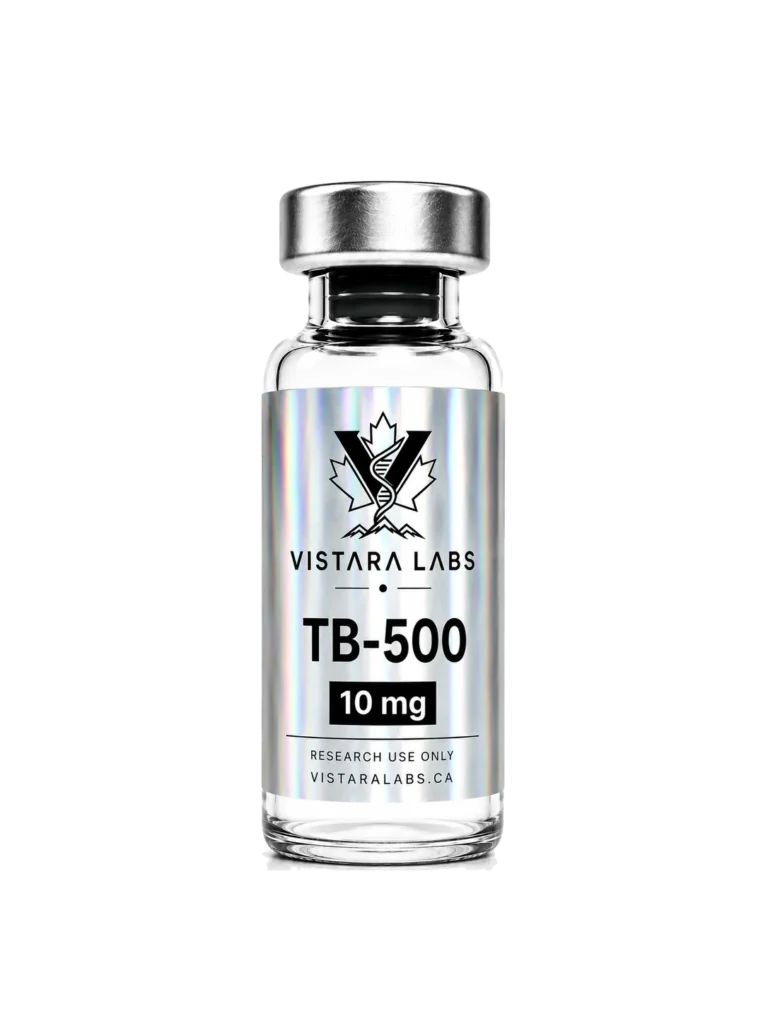
TB-500 and Thymosin Beta-4: The Repair Research
Recherche sur la récupération après blessure
TB-500 is the research name for thymosin beta-4, a 43-amino-acid repair peptide present in nearly every cell and concentrated wherever healing is happening: wound fluid, platelets, injured tissue. Its clinical research program is one of the broadest of any compound in the catalogue, spanning wounds, the eye and the heart.
 View product →
Findings
- Thymosin beta-4 regulates actin, the protein cells use to move and rebuild — the machinery of tissue repair itself.
- A double-blind, placebo-controlled European trial tested topical thymosin beta-4 in venous leg ulcers, building on its wound-healing and anti-inflammatory profile.
- In a randomized, double-masked, placebo-controlled eye trial, thymosin beta-4 drops cut ocular discomfort by 35% and corneal damage staining by 59%, with the improvements still present a month after treatment ended.
- Phase 3 programs in dry eye and neurotrophic keratopathy followed.
- Cardiac research shows thymosin beta-4 can limit heart-muscle cell death, stimulate vessel growth and activate the heart’s own progenitor cells in laboratory models.
The repair mechanism
Thymosin beta-4 is the body’s main actin-sequestering peptide. Actin is the scaffolding protein cells rebuild with, and controlling it is how cells migrate into damaged tissue, close wounds and lay down new structure. That single mechanism — mobilising the machinery of repair — is why the same molecule appears in wound, eye, heart and soft-tissue research.
Wound healing: the ulcer research
Venous leg ulcers are among the hardest wounds in medicine to close. A double-blind, placebo-controlled, dose-escalation trial across eight European sites tested topical thymosin beta-4 in exactly that setting, on the strength of its documented wound-healing properties: keratinocyte and endothelial cell migration, increased collagen deposition and stimulation of new blood-vessel growth (Ann N Y Acad Sci, 2010).
The eye program
In a randomized, double-masked, placebo-controlled trial in severe dry eye, thymosin beta-4 drops (RGN-259) reduced ocular discomfort 35.1% and corneal fluorescein staining 59.1% versus vehicle control, with better tear film and tear production — and the improvements persisted 28 days after the last drop, consistent with actual tissue repair rather than lubrication (Cornea, 2015). Phase 3 programs in dry eye and neurotrophic keratopathy followed (Expert Opin Biol Ther, 2018).
The heart research
After cardiac injury, adult heart muscle barely regenerates. Thymosin beta-4 research showed the peptide can inhibit heart-muscle cell death, stimulate vessel growth and reactivate the heart’s embryonic repair program — awakening progenitor cells in the adult heart (Ann N Y Acad Sci, 2010). It remains one of the most cited findings in cardiac-repair peptide research.
Recovery research and the knee data
TB-500’s research audience is largely interested in soft-tissue recovery, and there is a clinical data point here too: in a 2021 retrospective review, 87.5% of knee-pain patients reported relief after intra-articular BPC-157, given alone or with TB-500. We break down the numbers in our BPC-157 and TB-500 knee-pain analysis.
Frequently asked questions
What is the difference between TB-500 and thymosin beta-4?
TB-500 is the research name for the synthetic form of thymosin beta-4. The clinical programs study the same core molecule, which is why the thymosin beta-4 research record is directly relevant to TB-500.
What has thymosin beta-4 research covered?
Wound healing (including a placebo-controlled venous ulcer trial), a randomized eye program that advanced to Phase 3, cardiac-repair research, and soft-tissue recovery work.
Sources: Guarnera G et al., Ann N Y Acad Sci 2010 (PMID 20536470); Sosne G et al., Cornea 2015 (PMID 25826322); Sosne G, Expert Opin Biol Ther 2018 (PMID 30063853); Shrivastava S et al., Ann N Y Acad Sci 2010 (PMID 20536454); Goldstein AL et al., Expert Opin Biol Ther 2012 (PMID 22074294).
References
TB-500 and thymosin β4 are not the same molecule. TB-500 is a thymosin β4-derived fragment (Ac-LKKTETQ); the human trials below studied full-length thymosin β4 and are related research rather than trials of TB-500 itself.
- Synthesis and characterization of the N-terminal acetylated 17-23 fragment of thymosin beta 4 identified in TB-500, a product suspected to possess doping potentialAnalytical chemistry: characterises TB-500 as the N-terminally acetylated 17-23 fragment of thymosin β4 (Ac-LKKTETQ), not the intact 43-amino-acid protein.
- A first-in-human, randomized, double-blind, single- and multiple-dose, phase I study of recombinant human thymosin β4 in healthy Chinese volunteersFirst-in-human randomised, double-blind phase 1; 54 single-dose and 30 multiple-dose subjects; recombinant human thymosin β4.
- The effect of thymosin treatment of venous ulcersRandomised, double-blind, placebo-controlled phase 2 trial; 73 patients, eight European centres; topical full-length thymosin β4.
- Thymosin beta 4 ophthalmic solution for dry eye: a randomized, placebo-controlled, Phase II clinical trial conducted using the controlled adverse environment (CAE™) modelRandomised, double-masked, placebo-controlled phase 2 trial; 72 subjects; thymosin β4 ophthalmic solution.
- Thymosin β4 significantly improves signs and symptoms of severe dry eye in a phase 2 randomized trialRandomised phase 2 trial in severe dry eye; 9 patients.
Links open the study record on PubMed so the source can be checked directly. Listing a study is not a claim that its findings apply to any other use, product or route of administration. Research use only.