


Qu'est-ce que le MOTS-c? Le peptide encodé dans l'ADN mitochondrial
Recherche sur l'énergie cellulaire et les mitochondries
Almost every peptide in a research catalogue is encoded in nuclear DNA. MOTS-c is not. It is written into the mitochondrial genome — a separate, circular strand of DNA that mitochondria carry from their origin as free-living bacteria. That address is the whole reason the molecule is interesting.
A peptide with a different return address
Human mitochondria carry their own genome: roughly 16,500 base pairs, entirely separate from the ~3 billion in the cell nucleus. For decades it was assumed to encode only a handful of components for the machinery that generates cellular energy.
MOTS-c — mitochondrial open reading frame of the twelve S rRNA type-c — was identified within that small genome. Its existence supports a broader idea: that mitochondria are not simply power plants taking instructions, but participants that send signals of their own into the rest of the cell.
That is the shift worth understanding. A peptide encoded in the mitochondrion implies communication running outward from the mitochondrion, not only inward to it.
What the research actually examines
Laboratory work on MOTS-c concentrates on metabolic signalling: glucose handling, insulin signalling pathways, and the metabolic adaptations that follow physical exertion in research models.
These are open questions. Mitochondrial-derived peptides are a young field, and the literature is characterising the molecule rather than concluding about it — which is precisely why it is bought as a research material.
Form, storage and what arrives
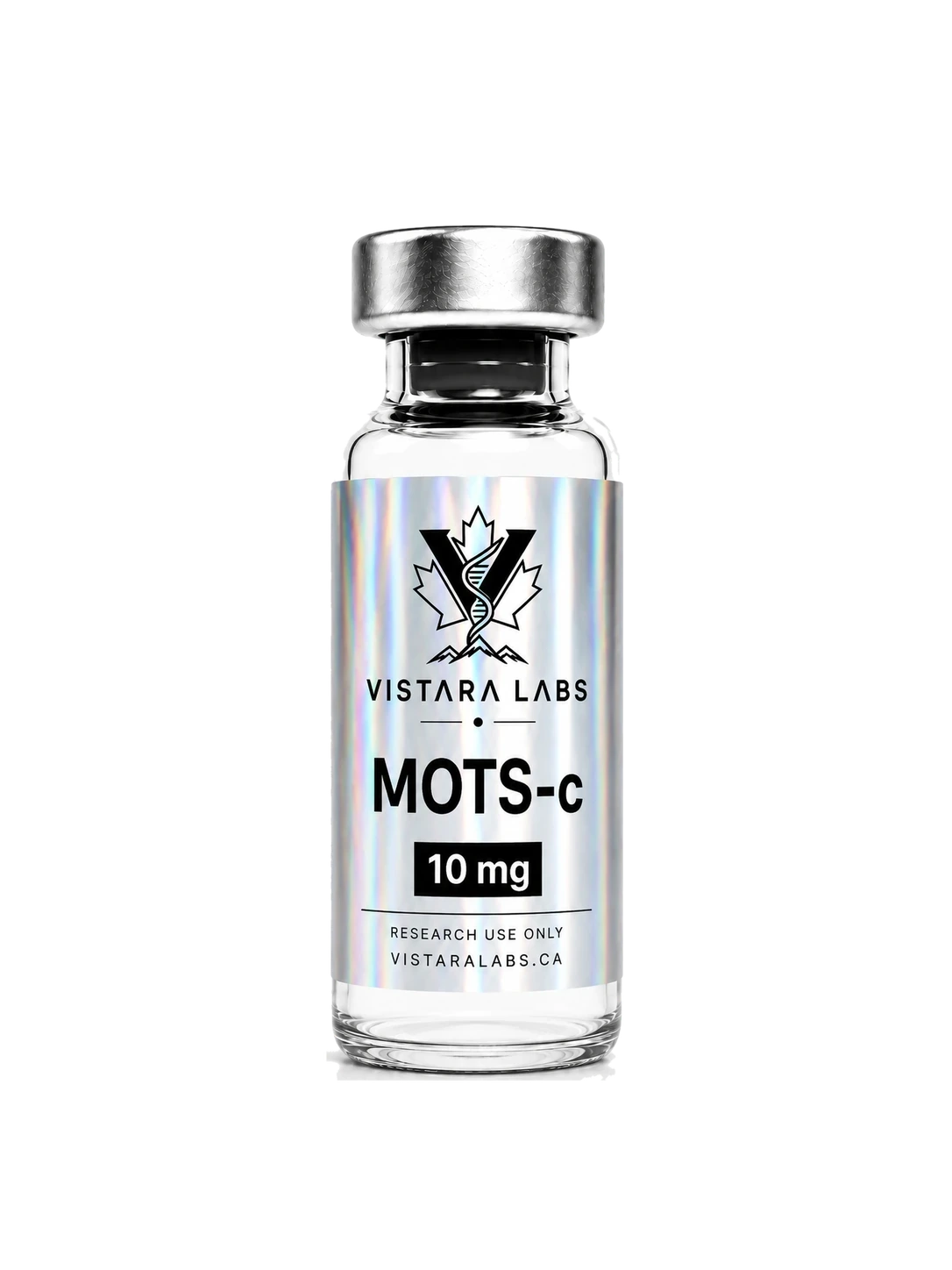
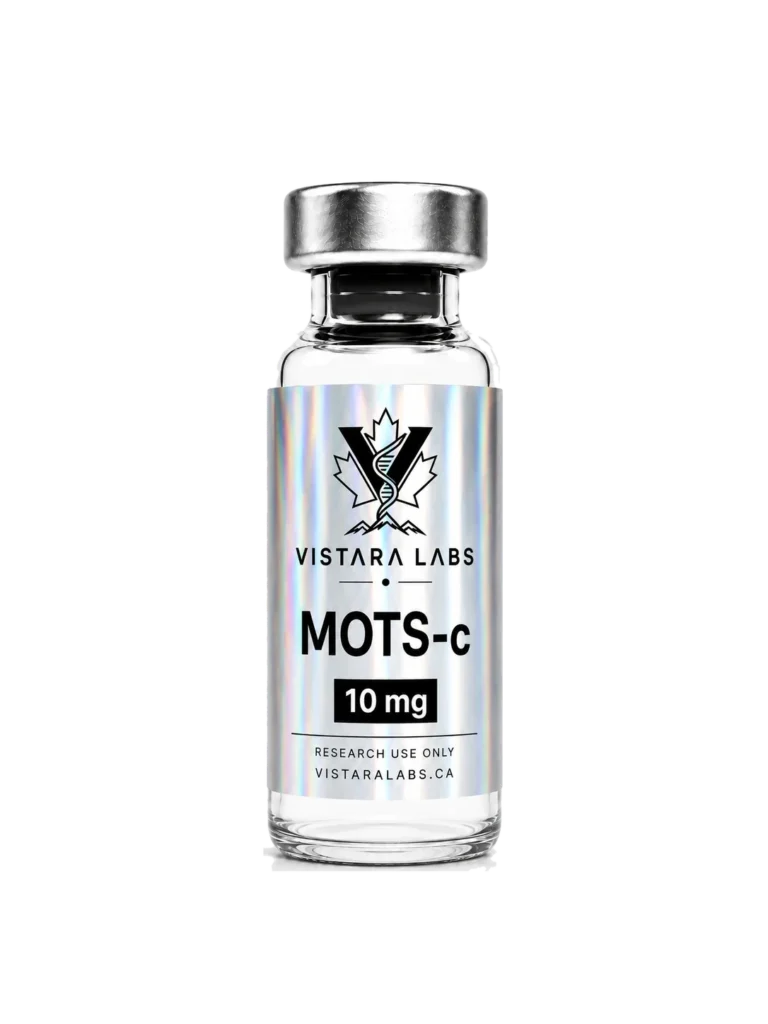
MOTS-c is supplied lyophilised: freeze-dried powder in a sealed vial, often a barely-visible quantity at the bottom. The dry state is chosen because it is far more stable than a solution, which matters across shipping and storage.
Reconstitution in a laboratory setting is typically performed with eau bactériostatique, with vials kept cold and out of light afterwards. Specific handling protocols are set by the researcher.
Verifying the vial
Sequence length makes MOTS-c a reasonable synthesis target, but “reasonable” is not “guaranteed” — identity and purity still have to be established analytically rather than asserted on a label. The certificate of analysis is that record.
Vistara Labs material is third-party tested, with COAs available on request.
Buying MOTS-c in Canada
Domestic shipping removes the international border crossing, which in practice means shorter transit and fewer temperature-exposure variables for a product whose stability depends on staying dry and cool.
Vistara Labs supplies MOTS-c in 10 mg and 40 mg vials, shipping across Canada with free shipping over $150.
Studied alongside
Researchers working on cellular energy commonly reference NAD+, the coenzyme central to electron transfer, and SS-31, studied in connection with mitochondrial membranes.
All products supplied by Vistara Labs are intended for laboratory research use only. They are not drugs, are not approved for human or veterinary use, and are not intended to diagnose, treat, cure or prevent any condition. Nothing on this page constitutes medical advice or guidance for use in humans.
References
Human MOTS-c studies measure the peptide the body already makes; no controlled trial administering native synthetic MOTS-c was identified. (CB4211, which has completed phase 1, is an optimised analogue, not native MOTS-c.)
- The mitochondrial-derived peptide MOTS-c promotes metabolic homeostasis and reduces obesity and insulin resistanceFoundational preclinical paper identifying MOTS-c; mouse studies of insulin sensitivity and diet-induced obesity.
- Acute endurance exercise stimulates circulating levels of mitochondrial-derived peptides in humansHuman study measuring naturally occurring (endogenous) mitochondrial-derived peptides after acute endurance exercise — not administration of synthetic MOTS-c.
Links open the study record on PubMed so the source can be checked directly. Listing a study is not a claim that its findings apply to any other use, product or route of administration. Research use only.