GLP-1, GLP-2 and “GLP-3”: What Retatrutide (Reta) Actually Is
Weight Loss & Metabolism Research
GLP-1 is a real hormone. GLP-2 is a real hormone. “GLP-3” is not. It is a label that circulates in the research-peptide market, and it usually refers to retatrutide — a compound that is not a GLP-3 anything, because no such hormone exists. If you are searching these terms, here is what each one actually denotes.
View product →Findings
- GLP-1 and GLP-2 are real human hormones. “GLP-3” is not; no such hormone exists.
- The name “GLP-3” in the peptide market almost always refers to retatrutide.
- Retatrutide is a triple receptor agonist: GLP-1 + GIP + glucagon.
- If a listing says “GLP-3”, ask what molecule is actually in the vial.
The glucagon-like peptides that do exist
GLP-1 and GLP-2 are both produced by cleaving a larger precursor molecule, proglucagon. They are genuinely related, and genuinely distinct:
- GLP-1 — the widely studied one. It acts at the GLP-1 receptor and is the basis for an entire class of compounds investigated in metabolic research.
- GLP-2 — a separate peptide from the same precursor, studied largely in the context of intestinal tissue rather than metabolic signalling.
The numbering stops there. There is no endogenous “GLP-3.”
If a supplier lists “GLP-3” without saying what molecule is in the vial, that is worth a direct question. The name describes nothing. The compound underneath it is what matters.
What retatrutide actually is
Retatrutide — shortened to reta almost everywhere it is discussed — is a synthetic peptide investigated as a triple receptor agonist. It is studied for activity at three receptors at once:
- the GLP-1 receptor,
- the GIP receptor (glucose-dependent insulinotropic polypeptide),
- and the glucagon receptor.
That third one is what separates it from earlier compounds in the literature. Engaging the glucagon receptor alongside the other two produces a combined signalling profile that single- and dual-agonist molecules do not, and that combination is the reason it appears in metabolic research.
Why the naming drifted
Vendors in this market often avoid printing recognisable compound names, and substitute codes or invented family labels. “GLP-3” reads as though it belongs to the GLP series, which makes it feel familiar — but it conveys no information about receptor activity, sequence or purity.
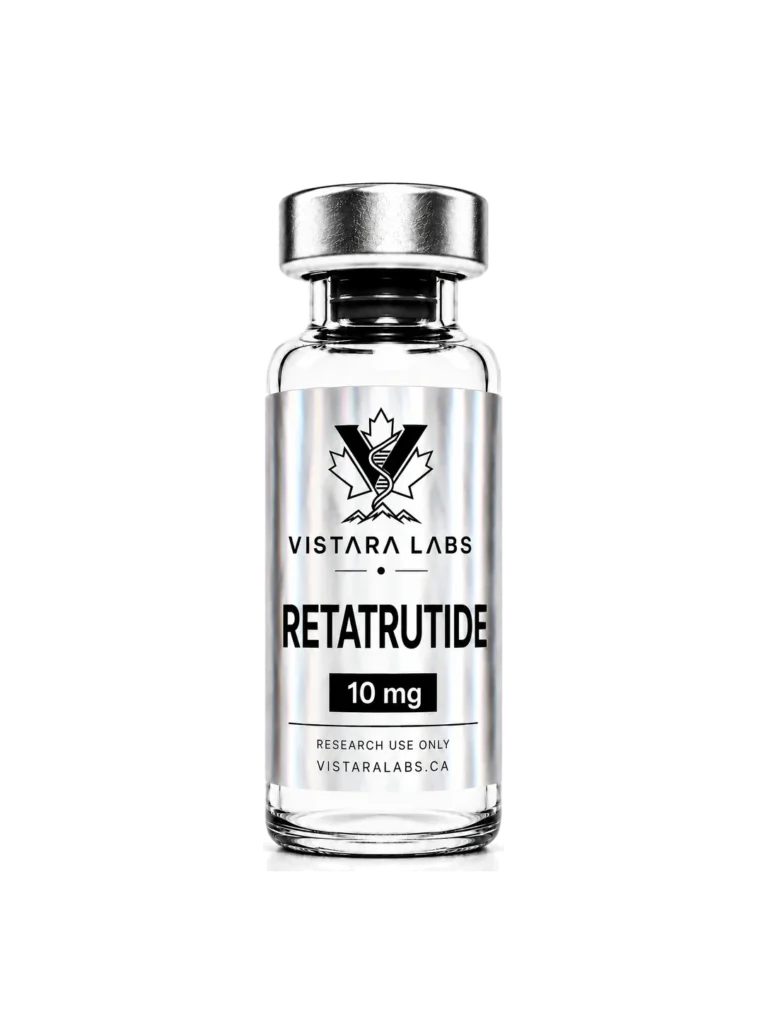
Vistara Labs lists the compound under its actual name: retatrutide.
What to confirm before ordering
Because this compound circulates under several labels, the certificate of analysis matters more than the product title. A COA records the identity and purity of the material, established analytically. Vistara Labs material is third-party tested with.
Retatrutide is supplied as a lyophilised powder in a sealed vial, in 10 mg and 20 mg sizes, and ships across Canada with free shipping over $150.
Related compounds in the catalogue
Researchers comparing incretin-receptor compounds also reference tirzepatide, a dual GIP/GLP-1 receptor agonist, which makes a useful point of comparison against a triple agonist.
All products supplied by Vistara Labs are intended for laboratory research use only. They are not drugs, are not approved for human or veterinary use, and are not intended to diagnose, treat, cure or prevent any condition. Nothing on this page constitutes medical advice or guidance for use in humans.
References
Retatrutide has been evaluated in randomised, placebo-controlled human trials through phase 3.
- Triple-Hormone-Receptor Agonist Retatrutide for Obesity - A Phase 2 TrialRandomised, double-blind, placebo-controlled phase 2 obesity trial, 48 weeks.
- Retatrutide, a GIP, GLP-1 and glucagon receptor agonist, for people with type 2 diabetes: a randomised, double-blind, placebo and active-controlled, parallel-group, phase 2 trial conducted in the USARandomised, double-blind, placebo- and active-controlled phase 2 trial; 281 participants with type 2 diabetes.
- Triple hormone receptor agonist retatrutide for metabolic dysfunction-associated steatotic liver disease: a randomized phase 2a trialRandomised phase 2a substudy; 98 participants with metabolic dysfunction-associated steatotic liver disease.
- Efficacy and safety of retatrutide, a GIP, GLP-1, and glucagon receptor agonist, in people with type 2 diabetes and inadequate glycaemic control with diet and exercise (TRANSCEND-T2D-1): a double-blind, randomised, phase 3 trialDouble-blind randomised phase 3 trial in type 2 diabetes (TRANSCEND-T2D-1).
Links open the study record on PubMed so the source can be checked directly. Listing a study is not a claim that its findings apply to any other use, product or route of administration. Research use only.