SS-31 (Elamipretide): From Research to FDA Approval
Cellular Energy & Mitochondrial Research
SS-31 — known in the clinic as elamipretide — is a mitochondria-targeted peptide that has reached large randomized trials. Its record is mixed, and reading it honestly means noting both the wins and the misses.
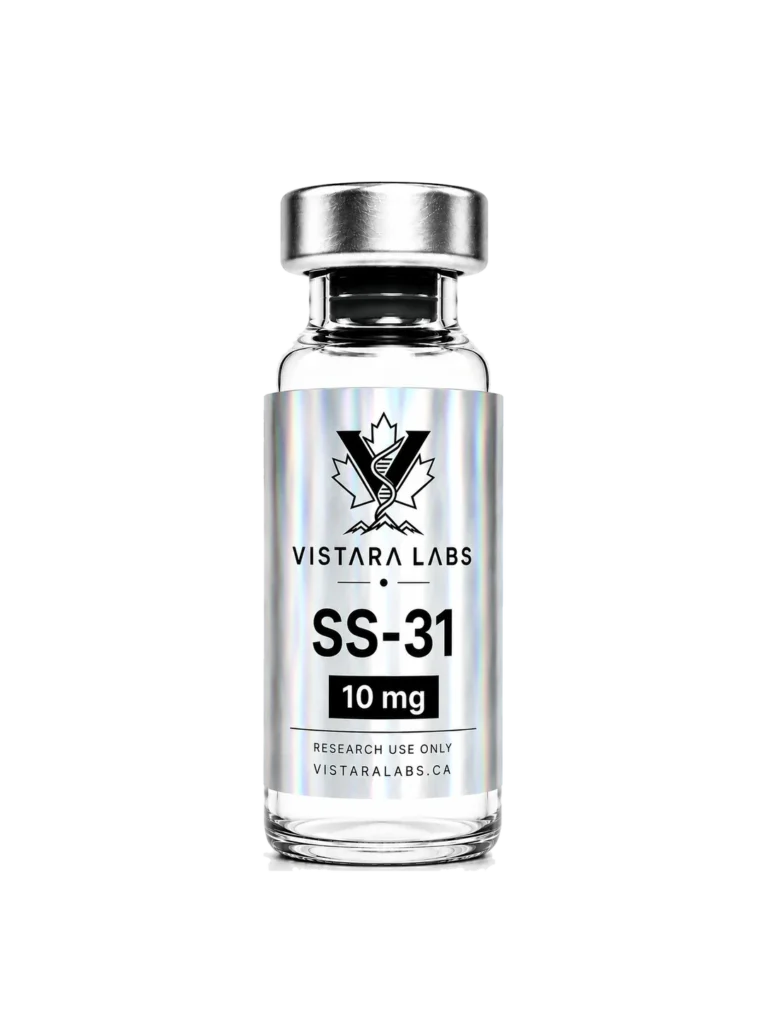 View product →
Findings
- In late 2025, elamipretide received its first FDA approval — SS-31’s clinical form is now an approved medicine.
- SS-31 (called elamipretide in the clinic) targets the mitochondria, the cell’s power plants, and has been tested in large randomized trials.
- In Barth syndrome, patients on long-term elamipretide walked about 96 metres farther in the standard six-minute walking test.
- In a trial for dry age-related macular degeneration, it reduced a key measure of retinal-cell loss by 43%.
- The Barth syndrome approval is the first ever for a mitochondria-targeted therapeutic of this class.
From trial compound to approved medicine (2025)
In late 2025, elamipretide received its first FDA approval, for Barth syndrome — making it the first cardiolipin-targeted mitochondrial therapeutic ever approved (“Elamipretide: First Approval,” Drugs, 2026). For a compound that began as a research peptide, that is the full distance: laboratory, randomized trials, approval.
The approval rests on the trial record covered below, with the Barth syndrome walking-distance gains carrying the weight. It also changes how the rest of the program reads: elamipretide is no longer a candidate molecule. It is a medicine with an expanding evidence base.
Barth syndrome: the clearest positive (Genet Med, 2024)
The TAZPOWER trial’s 168-week open-label extension followed patients with Barth syndrome on daily elamipretide 40 mg. Eight of ten patients reached the week-168 visit. There were significant improvements on the six-minute walk test at every time point, totalling a cumulative 96.1 metres of improvement (P=0.003 at week 168), along with improved fatigue scores and measurable gains in left-ventricular function. It was well tolerated, with injection-site reactions the most common adverse event.
Macular degeneration: positive on secondary measures (Ophthalmol Sci, 2024)
In the Phase II ReCLAIM-2 trial in dry age-related macular degeneration, elamipretide produced a 43% reduction in progression of ellipsoid-zone loss (a marker of photoreceptor damage, P=0.0034), and significantly more patients gained at least 10 letters of low-luminance visual acuity (14.6% vs 2.1%, P=0.04). Both results came on the trial’s secondary measures.
Primary mitochondrial myopathy (Neurology, 2023)
A Phase 3 trial in 218 patients with primary mitochondrial myopathy found elamipretide well tolerated, and research in that condition continues. The strongest human results so far are in Barth syndrome, where elamipretide received its first FDA approval in late 2025.
What SS-31 is
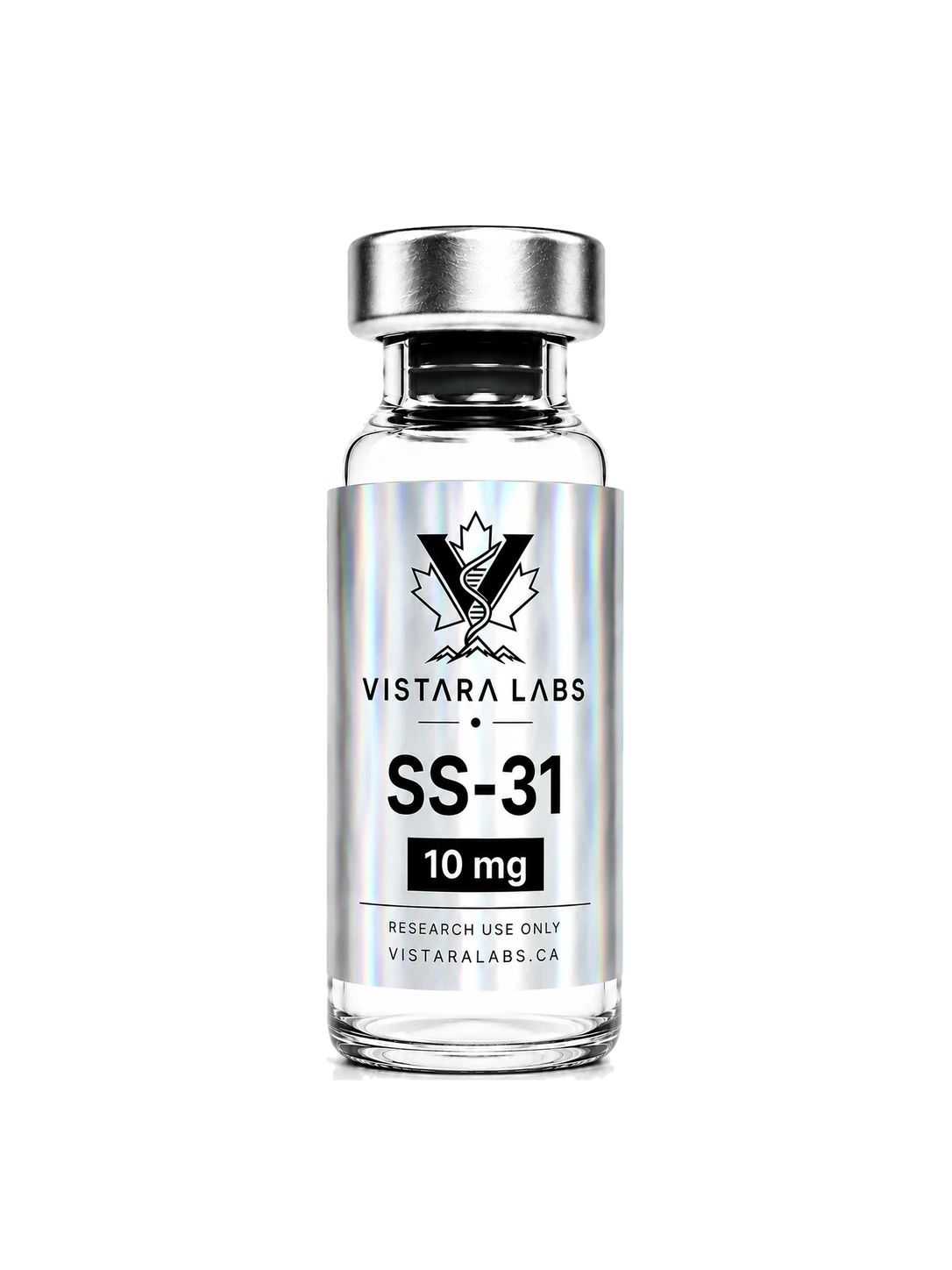
SS-31 (elamipretide) is a mitochondria-targeted tetrapeptide that accumulates in the inner mitochondrial membrane, binding cardiolipin and studied for its effect on cellular energy. Our SS-31 buying guide covers the compound and its handling.
Vistara Labs stocks SS-31 research vials, shipped from within Canada to every province.
Frequently asked questions
Has SS-31 shown positive results in humans?
Yes, in specific settings. In a 168-week open-label extension in Barth syndrome patients, elamipretide (SS-31) produced a cumulative 96.1-metre improvement on the six-minute walk test and improvements in cardiac function. A macular-degeneration trial slowed a marker of photoreceptor loss.
Which conditions has SS-31 been studied in?
Barth syndrome, where the strongest results were reported and elamipretide received its first FDA approval in late 2025; dry age-related macular degeneration, where it slowed a marker of photoreceptor loss; and primary mitochondrial myopathy, where a large trial found it well tolerated and research continues.
What is SS-31?
SS-31 (elamipretide) is a mitochondria-targeted tetrapeptide that concentrates in the inner mitochondrial membrane, where it is studied for its effect on cellular energy production.
Sources: Thompson WR, et al. Long-term efficacy and safety of elamipretide in Barth syndrome (TAZPOWER 168-week OLE). Genet Med. 2024;26:101138. PMID 38602181. Ehlers JP, et al. ReCLAIM-2: Elamipretide in age-related macular degeneration. Ophthalmol Sci. 2024;5:100628. PMID 39605874. Karaa A, et al. Elamipretide in primary mitochondrial myopathy (MMPOWER-3). Neurology. 2023;101:e238-e252. PMID 37268435.