Semax Peptide: What the Research Actually Covers
Cognitive & Nootropic Research
Semax is not an obscure compound everywhere in the world. In Russia it is a registered pharmaceutical with a nasal formulation, listed among the country’s essential medicines and in clinical use since the 1990s. Almost nowhere else has assessed it at all. Both halves of that sentence matter, and most writing about Semax keeps only the half that suits it.
 View product →
Findings
- Semax is a registered pharmaceutical in Russia, on the essential-medicines list, in clinical use since the 1990s.
- It is an engineered fragment of ACTH, redesigned to act in the brain without the hormone’s effects on the body.
- The most consistent research finding: raised BDNF, a growth factor central to brain repair.
- Given as nasal drops, the route used in the clinical literature.
What Semax is
Semax is a short synthetic peptide — seven amino acids. It was built from a fragment of ACTH, the adrenocorticotropic hormone, specifically the 4–10 region, with a short Pro-Gly-Pro tail attached to the end.
That tail is the interesting part of the design. ACTH is a hormone with powerful effects on the adrenal system, and the researchers who developed Semax wanted the fragment’s activity in the brain without the hormonal activity in the body. Adding the Pro-Gly-Pro sequence did two things at once: it made the peptide far more stable against the enzymes that would otherwise chop it up in minutes, and it removed the corticotropic hormone action of the parent molecule.
So Semax is a deliberately engineered fragment. It is not a naturally occurring peptide and it is not ACTH.
Where the research points
The literature clusters around a few themes. In plain terms:
- BDNF and neurotrophic signalling. The most consistent finding across the published work is that Semax is associated with increased expression of brain-derived neurotrophic factor and its TrkB receptor. BDNF is the protein most often studied in connection with synaptic plasticity — the brain’s capacity to form and reshape connections.
- Neuroprotection models. The original Russian programme was aimed at ischaemic stroke and brain injury, and a substantial share of the clinical work sits there rather than in healthy cognition.
- Attention and memory models. The cognitive strand — the one that gave Semax its nootropic reputation — is real but smaller than the neuroprotection work behind it.
- Melanocortin activity. As an ACTH-derived sequence, Semax retains activity at melanocortin receptors, which is one proposed route for its effects on attention and arousal.
Where the research stands
The clinical record behind Semax has a clear shape, and it is set out below.
The clinical literature is almost entirely Russian. Semax went through the Russian regulatory system in the early 1990s and has been in use there since. That is a genuinely long clinical history.
But a Russian registration is not an FDA or Health Canada assessment. Much of the supporting work is published in Russian, in journals with limited international reach, and the trials are generally small by Western standards. Independent replication outside Russia is thin.
The fair summary: Semax has a real clinical history in Russia, and the international literature is still building on it. Read as a whole, the published work gives researchers a clear starting point, with BDNF signalling and neuroprotection as the best documented threads.
Why it is usually studied intranasally
The registered Russian product is a nasal solution, and the published work follows that route. There is a mechanistic reason: peptides are large, charged molecules that cross the blood–brain barrier poorly, and the nasal route is studied as a way of reaching the central nervous system more directly along the olfactory pathway. For a compound whose entire point of interest is in the brain, that route choice drives a lot of the literature.
This is covered in more depth in our comparison of intranasal versus subcutaneous research routes.
Semax and Selank
The two come from the same Russian research lineage and are frequently studied as a pair, which is why they are so often discussed together. They are not variants of each other — Semax is derived from ACTH and is the stimulating, plasticity-oriented half, while Selank derives from tuftsin and sits on the calming, GABAergic side. Our Semax vs Selank comparison covers what actually separates them.
What Semax is not
- Not a stimulant. It has no amphetamine-class mechanism and does not act on the dopamine transporter the way that category does.
- Not a growth or metabolic peptide. It has nothing to do with the GH axis or the incretin receptors that define the weight-loss peptide category.
- Not approved in Canada. Health Canada has not assessed Semax for safety or efficacy, and it holds no Canadian marketing authorisation.
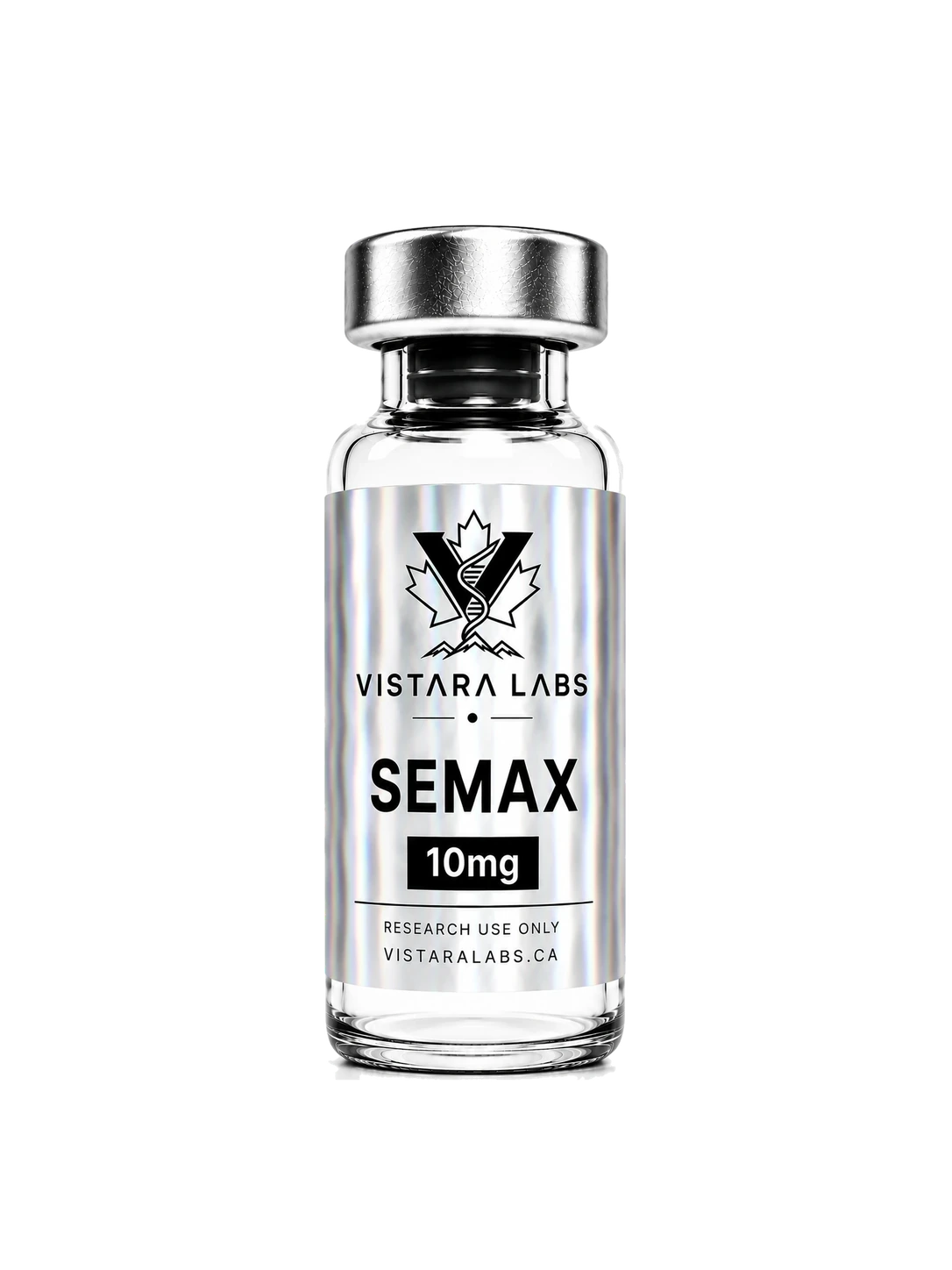
Vistara Labs stocks Semax as a lyophilised powder, shipped from within Canada to every province. It is also available paired with Selank and Cerebrolysin in our research stacks.
Frequently asked questions
What is Semax?
A seven amino acid synthetic peptide derived from the ACTH(4–10) fragment with a Pro-Gly-Pro tail added for stability. The modification also removes the hormonal activity of the parent molecule.
Is Semax approved anywhere?
It is a registered pharmaceutical in Russia and appears on that country’s essential medicines list, primarily for ischaemic stroke and cognitive disorders. It is not approved in Canada, the United States or the European Union.
What does the Semax research actually cover?
Mainly BDNF and neurotrophic signalling, neuroprotection in stroke and brain-injury models, and a smaller body of work on attention and memory. Most of the clinical literature is Russian and small in scale.
Why is Semax studied as a nasal formulation?
Because peptides cross the blood–brain barrier poorly, and the intranasal route is studied as a more direct path to the central nervous system. The registered Russian product is a nasal solution, so the published literature largely follows that route.
What is the difference between Semax and Selank?
Semax comes from ACTH and is associated with plasticity and attention; Selank comes from tuftsin and is associated with GABAergic and anxiolytic activity. They share a research lineage but act on different systems.
All products supplied by Vistara Labs are intended for laboratory research use only. They are not drugs, are not approved for human or veterinary use, and are not intended to diagnose, treat, cure or prevent any condition. Nothing on this page constitutes medical advice or guidance for use in humans.
References
Semax has human research, mostly small studies concentrated in Russian-language literature rather than large modern placebo-controlled trials.
- [The efficacy of semax in the tretament of patients at different stages of ischemic stroke]Clinical study of 110 people after ischaemic stroke, with and without Semax; not a large modern placebo-controlled randomised trial.
- Effects of Semax on the Default Mode Network of the BrainSmall human study; 24 healthy volunteers, intranasal Semax versus placebo, resting-state fMRI. Mechanistic — does not establish improved cognition.
- [Effectiveness of semax in acute period of hemispheric ischemic stroke (a clinical and electrophysiological study)]Clinical study; 30 acute ischaemic stroke patients against an 80-patient conventional-treatment control cohort.
Links open the study record on PubMed so the source can be checked directly. Listing a study is not a claim that its findings apply to any other use, product or route of administration. Research use only.