Peptides for Women’s Libido: What PT-141 and Oxytocin Research Shows
Sexual Health & Intimacy Research
PT-141 (bremelanotide) is the most studied peptide for women’s libido, and in 2019 it became the first peptide approved in the United States for low sexual desire in premenopausal women. It acts in the brain, on the melanocortin receptors that govern sexual motivation, rather than on hormones or blood flow. Oxytocin, the hormone released at orgasm, has a smaller body of research on how sex feels and on closeness between partners. This article covers what the women’s trials found for desire, arousal and satisfaction, and how the two peptides fit together.
 View product →
Findings
- In a 2016 dose-finding trial of 327 premenopausal women, PT-141 raised satisfying sexual events and sexual function scores and lowered distress, all significantly more than placebo.
- Two 2019 phase 3 trials of 1,267 women found significant increases in desire and reductions in distress about low desire over 24 weeks.
- Of the women who finished those trials, 684 continued for a further 52 weeks; the improvements held and no new safety signals appeared.
- After a single nasal dose, more women reported moderate or high sexual desire than after placebo (2006).
- In couples, intranasal oxytocin left women more relaxed, and some reported being better able to share sexual wishes with their partner (2014).
Why PT-141 is studied for female libido
Low sexual desire that causes distress is called hypoactive sexual desire disorder, and it is the condition the PT-141 trials enrolled. Most of the women were in their late thirties, in relationships, and had no medical cause for the change.
PT-141 is a synthetic analogue of alpha-melanocyte-stimulating hormone. It activates the MC3 and MC4 melanocortin receptors (Diamond et al., 2006), which sit in the hypothalamic circuits involved in sexual motivation. That is a different route from estrogen or testosterone therapy, which act on hormone levels, and from blood-flow drugs, which act on the body’s arousal response. The question the trials asked was whether acting on the brain’s desire circuits could bring desire back.
What has PT-141 research shown in women?
| Study | Women | Result |
|---|---|---|
| Nasal, J Sex Med 2006 | 18 | More moderate or high desire |
| Phase 2b, 2016 | 327 | More satisfying events, less distress |
| RECONNECT, 2019 | 1,267 | Desire up, distress down |
| Extension, 2019 | 684 | Gains held over 52 weeks |
2006, a single nasal dose. Eighteen premenopausal women with sexual arousal disorder each received one nasal dose of PT-141 and one of placebo, in random order, in a double-blind design. More women reported moderate or high sexual desire after PT-141 (P=0.0114). Among women who had intercourse within the next 24 hours, significantly more were satisfied with their level of arousal after PT-141 (P=0.0256), and there was a trend towards more positive feelings of genital arousal (Diamond et al.).
2016, the dose-finding trial. 327 premenopausal women with sexual dysfunction used PT-141 or placebo under the skin, as desired, for 12 weeks. On the two higher amounts combined, satisfying sexual events rose by 0.7 a month against 0.2 on placebo (p=0.0180). Female Sexual Function Index scores rose by 3.6 against 1.9 (p=0.0017), and distress about desire, arousal and orgasm fell by 11.1 against 6.8 points (p=0.0014). A later responder analysis found every one of seven endpoints significant against placebo at the strength chosen for phase 3 (Clayton et al.; Althof et al., 2019).
2019, the phase 3 trials. Two identical randomised, double-blind trials, together called RECONNECT, enrolled 1,267 premenopausal women with low sexual desire, mean age 39, who used PT-141 or placebo as needed for 24 weeks. Against placebo, desire scores rose by 0.30 and 0.42 points in the two trials (0.35 combined, P<.001), and distress about low desire fell by 0.37 and 0.29 points (0.33 combined, P<.001). Nausea, flushing and headache were the most common side effects, and most were mild or moderate (Kingsberg et al.).
2019, the year-long extension. Of 856 eligible women who completed the trials, 684 continued into a 52-week open-label extension. Women on PT-141 from the start improved on the desire score by 1.25 to 1.30 points from baseline, and women who switched from placebo improved by 0.70 to 0.77. No new safety signals appeared (Simon et al.). The US approval followed in June 2019 (Dhillon, 2019).
What has oxytocin research shown for women?
Oxytocin is the body’s own nine-amino-acid hormone. In 13 women and 9 men, blood oxytocin rose during arousal and was significantly higher at orgasm than at baseline (Carmichael et al., 1987).
In 2014, 29 healthy couples used an oxytocin nasal spray at home before sex. Oxytocin increased orgasm intensity and contentment afterwards across the couples. Women on oxytocin felt more relaxed, and some reported being better able to share their sexual wishes and to empathise with their partner (Behnia et al.).
A 2015 Vienna trial gave 30 pre- and postmenopausal women an oxytocin nasal spray before intercourse for eight weeks. Sexual function scores rose by 26%, sexual quality of life by 144% and desire scores by 29%, and distress fell by 36%; the placebo phase improved by a similar amount, so the trial did not separate the two (Muin et al.). Oxytocin’s research points less at desire itself and more at how sex feels and the closeness around it.
PT-141 and oxytocin together
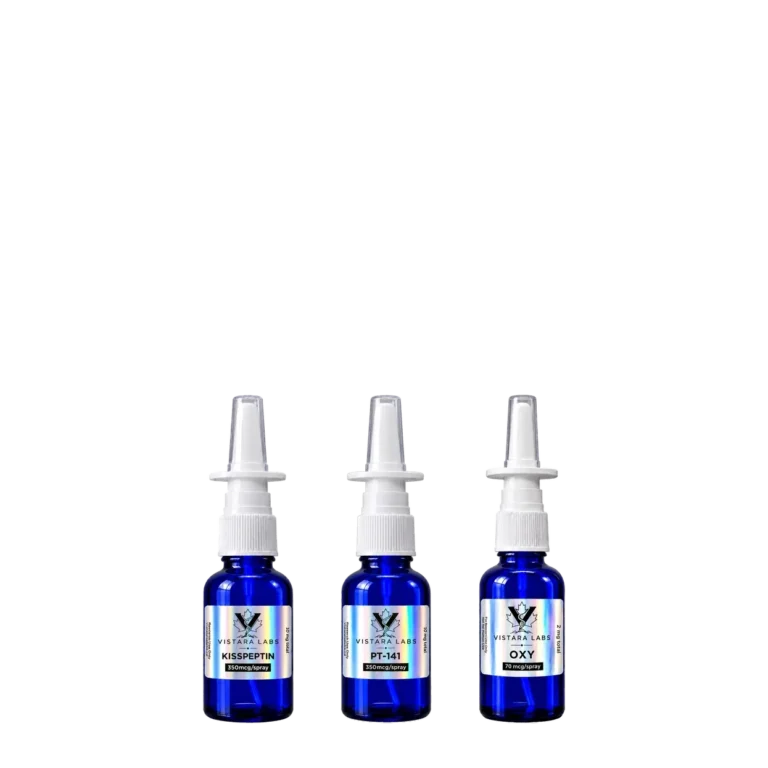
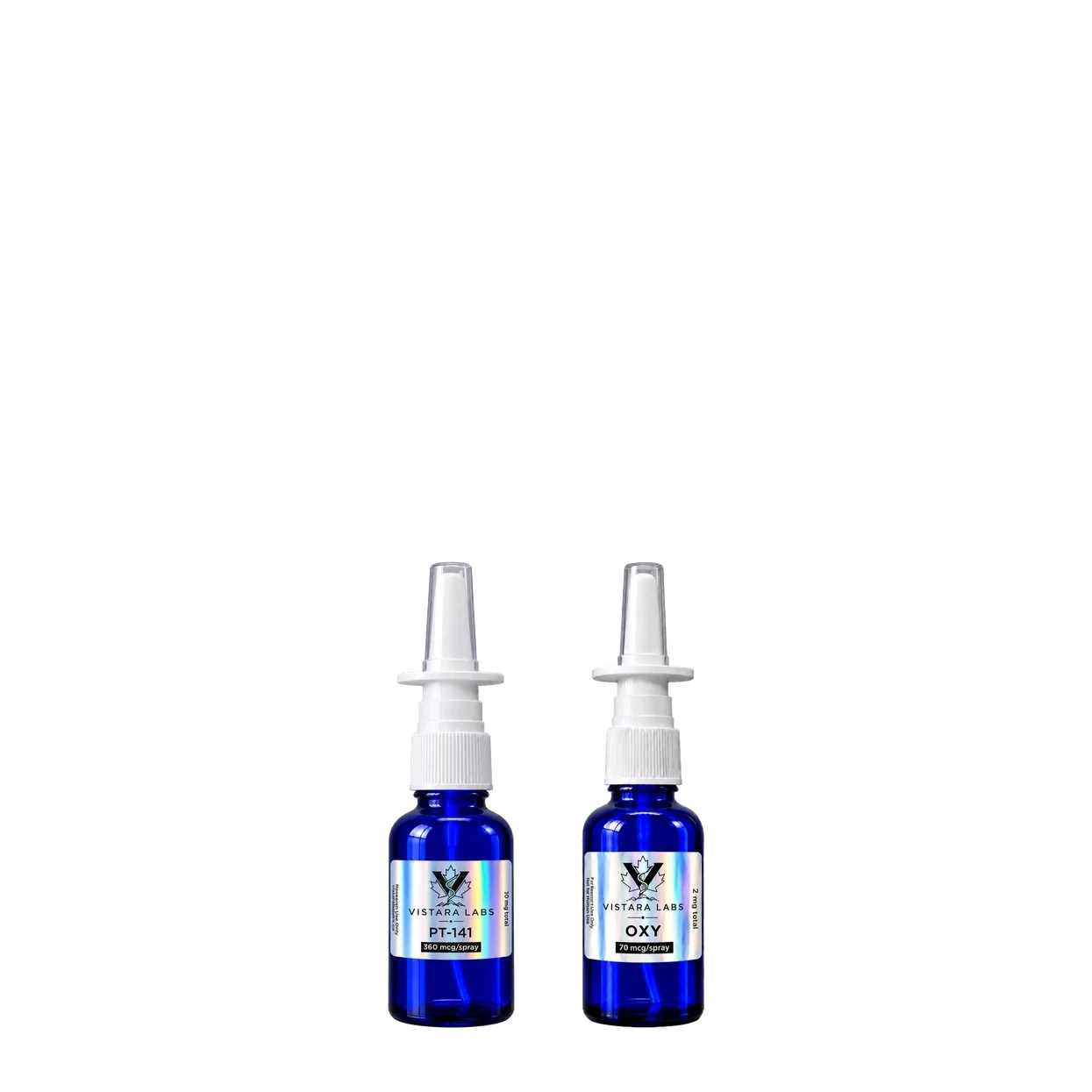
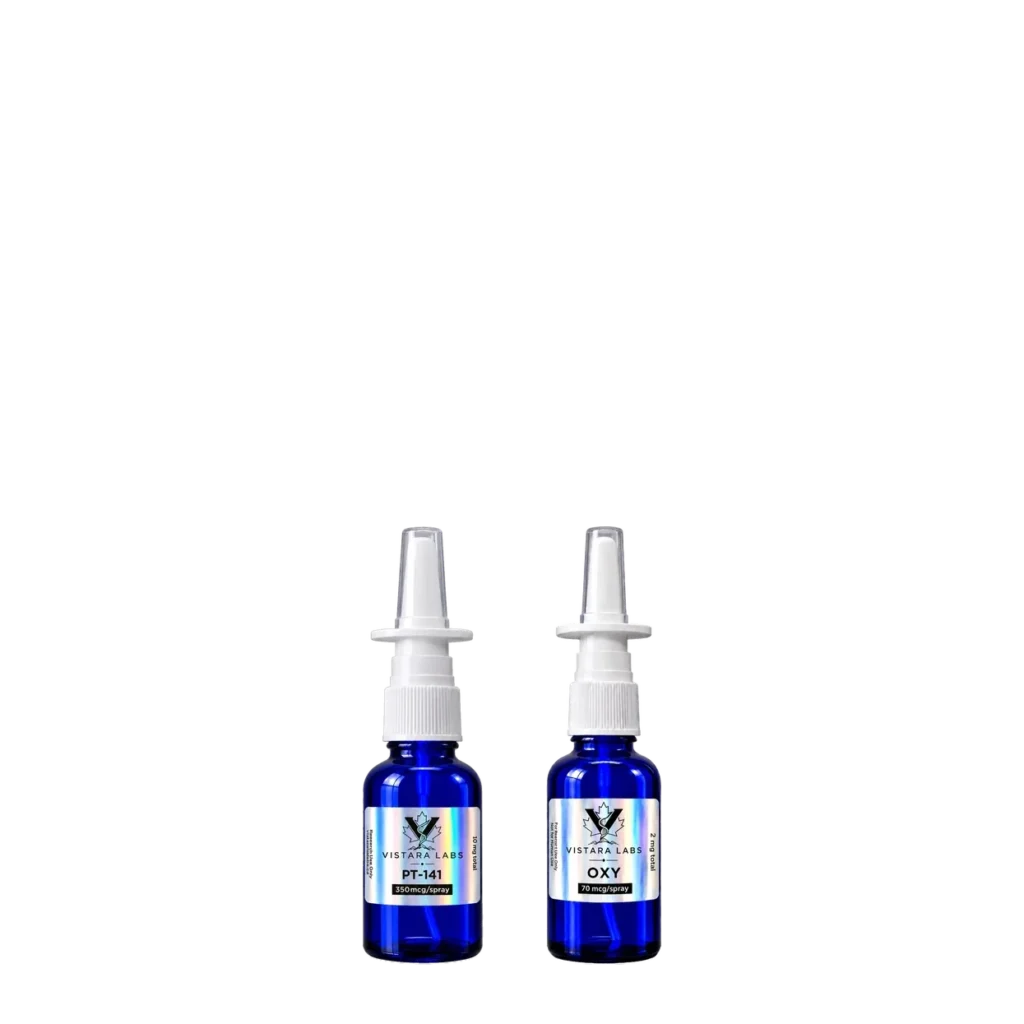
The two peptides cover different parts of intimacy: PT-141 the desire that starts it, oxytocin the orgasm and bond that follow. Our Libido Spray Stack puts both in ready-mixed nasal sprays. A side-by-side comparison is in PT-141 vs oxytocin, and the full PT-141 trial record is in PT-141 studies.
- PT-141 Nasal Spray, 10 mg or 20 mg, about 350 mcg per spray; or the PT-141 10 mg vial.
- Oxytocin Nasal Spray, about 70 mcg per spray; or the oxytocin vial.
For everything in this area, see Sexual Health & Intimacy Research. For the men’s research on erections and desire, see peptides for sex.
Frequently asked questions
What is the best peptide for female libido?
PT-141 (bremelanotide) has the strongest research. Two phase 3 trials of 1,267 premenopausal women found significant gains in desire and drops in distress over 24 weeks, and it was approved in the United States in 2019 for low sexual desire in premenopausal women.
What has PT-141 research shown for women?
In a 2016 trial of 327 women, PT-141 increased satisfying sexual events and sexual function scores and lowered distress more than placebo. In the 2019 phase 3 trials, desire rose and distress fell significantly, and the improvements held through a 52-week extension.
How does PT-141 work for women’s sex drive?
It activates the MC3 and MC4 melanocortin receptors in the brain, which are part of the circuits behind sexual motivation. It does not work through estrogen, testosterone or blood flow.
What has oxytocin research shown for women?
Oxytocin rises at orgasm in women. In 29 couples, an oxytocin spray increased orgasm intensity and contentment after sex, and women felt more relaxed and better able to share sexual wishes with their partner.
Where can I buy PT-141 and oxytocin in Canada?
Vistara Labs supplies PT-141 and oxytocin as lyophilised vials and ready-mixed nasal sprays, and together as the Libido Spray Stack, shipped from within Canada by tracked Xpresspost.
References: Diamond LE et al. An effect on the subjective sexual response in premenopausal women with sexual arousal disorder by bremelanotide (PT-141). J Sex Med. 2006. PMID 16839319. Clayton AH et al. Bremelanotide for female sexual dysfunctions in premenopausal women: a randomized, placebo-controlled dose-finding trial. Womens Health (Lond). 2016. PMID 27181790. Althof S et al. Responder analyses from a phase 2b dose-ranging study of bremelanotide. J Sex Med. 2019. PMID 31277966. Kingsberg SA et al. Bremelanotide for the treatment of hypoactive sexual desire disorder: two randomized phase 3 trials. Obstet Gynecol. 2019. PMID 31599840. Simon JA et al. Long-term safety and efficacy of bremelanotide for hypoactive sexual desire disorder. Obstet Gynecol. 2019. PMID 31599847. Dhillon S. Bremelanotide: first approval. Drugs. 2019. PMID 31429064. Carmichael MS et al. Plasma oxytocin increases in the human sexual response. J Clin Endocrinol Metab. 1987. PMID 3782434. Behnia B et al. Differential effects of intranasal oxytocin on sexual experiences and partner interactions in couples. Horm Behav. 2014. PMID 24503174. Muin DA et al. Effect of long-term intranasal oxytocin on sexual dysfunction in premenopausal and postmenopausal women. Fertil Steril. 2015. PMID 26151620.
More on this: Peptides for Libido: What the Research Shows.
All products supplied by Vistara Labs are intended for laboratory research use only. They are not drugs, are not approved for human or veterinary use, and are not intended to diagnose, treat, cure or prevent any condition. Nothing on this page constitutes medical advice or guidance for use in humans.