PT-141 vs Oxytocin: How They Differ
Hormonal, Growth Hormone & Body Composition Research
PT-141 is a synthetic peptide that activates melanocortin receptors in the brain, while oxytocin is the body’s own nine-amino-acid hormone, made in the hypothalamus and acting through a receptor of its own. PT-141’s large trials measured desire, while oxytocin’s human studies have looked at orgasm, bonding and how couples interact. Here is how they compare, what the human research found, and why the Libido Spray Stack pairs them.
 View product →
Findings
- Different origins, different receptors. PT-141 is a designed analogue of alpha-MSH that acts on the melanocortin 3 and 4 receptors; oxytocin is a natural hormone that acts on the oxytocin receptor.
- PT-141 has two 2019 phase 3 trials in 1,267 women: over 24 weeks it raised desire scores and lowered distress about low desire compared with placebo (pooled P<.001 for both).
- Oxytocin is part of the sexual response itself: in 9 men and 13 women, plasma levels rose during arousal and were significantly higher at orgasm than at baseline (1987).
- In 29 couples, nasal oxytocin raised reported orgasm intensity and contentment after intercourse compared with placebo (2014).
What is PT-141?
PT-141, also called bremelanotide, is a synthetic analogue of alpha-melanocyte-stimulating hormone (alpha-MSH). It is an agonist at the melanocortin 3 and 4 receptors (MC3R and MC4R), expressed mainly in the central nervous system (Molinoff et al., Ann N Y Acad Sci, 2003), and its high affinity for MC4R, the receptor thought to matter most for sexual function, gives it a route into the brain pathways of sexual response (Dhillon and Keam, Drugs, 2019). Its origins are covered in Melanotan II: the clinical history and the PT-141 connection.
Its largest human dataset comes from two identical phase 3 trials (Obstetrics & Gynecology, 2019) that randomised 1,267 premenopausal women with hypoactive sexual desire disorder (low desire that causes distress) to PT-141 or placebo, given under the skin as needed for 24 weeks. In the pooled analysis, desire scores rose 0.35 points and distress about low desire fell 0.33 points more than on placebo (both P<.001); nausea, flushing and headache were the most common side effects, mostly mild or moderate (Kingsberg et al.). Of the women who finished, 684 continued into a 52-week open-label extension, which recorded sustained improvement and no new safety signals (Simon et al., Obstet Gynecol, 2019).
The earlier work used a nasal spray: in 2006, 18 premenopausal women with sexual arousal disorder more often reported moderate or high desire after a single nasal administration than after placebo (P = 0.0114) (Diamond et al., J Sex Med). The full record is in PT-141 human studies.
What is oxytocin?
Oxytocin is a nonapeptide, a chain of nine amino acids, made by neurons in the hypothalamus that project into higher brain centres and to the posterior pituitary gland, which releases it into the circulation. In the brain it is involved in maternal, sexual, social and stress-related behaviour; in the body it contracts smooth muscle, particularly in the reproductive tracts (Tom and Assinder, Int J Biochem Cell Biol, 2010). It acts through a single G protein-coupled receptor, and its best-known roles are uterine contraction in labour and milk let-down (Jurek and Neumann, Physiol Rev, 2018).
Its place in sexual response shows up in the body’s own chemistry. In a 1987 study of 9 men and 13 women, plasma oxytocin rose during sexual arousal and was significantly higher during orgasm than at baseline (Carmichael et al., J Clin Endocrinol Metab).
Nasal-spray studies have picked up effects on the later phases of sex and on partner interaction. In a 2014 naturalistic study of 29 couples (58 people), nasal oxytocin raised orgasm intensity and contentment after intercourse compared with placebo, more markedly in men, and women reported feeling more relaxed. Drive and arousal measures held steady, so the effects sat in the orgasmic and post-orgasmic phase (Behnia et al., Horm Behav). In 2009, 47 couples given nasal oxytocin before a structured conflict discussion showed more positive relative to negative communication (p = .047) and lower salivary cortisol afterwards (p = .011), compared with placebo (Ditzen et al., Biol Psychiatry). Trust and appetite studies are covered in Oxytocin nasal spray: what the human research shows.
How do PT-141 and oxytocin compare side by side?
| Question | PT-141 | Oxytocin |
|---|---|---|
| What is it? | Synthetic analogue of alpha-MSH | Natural nine-amino-acid hormone |
| Made in the body? | No | Yes, in the hypothalamus |
| Receptor | Melanocortin MC3R and MC4R | Oxytocin receptor |
| Largest human dataset | Two phase 3 trials, 1,267 women | Blood-level and nasal studies since 1987 |
| Sexual-response focus | Desire, and distress about low desire | Orgasm, contentment, partner interaction |
| Formats we stock | Vial and nasal spray | Vial and nasal spray |
Which one fits which research question?
- Desire and the melanocortin system: PT-141. It has a defined receptor target and phase 3 data on desire and the distress tied to low desire.
- Orgasm, bonding and partner interaction: oxytocin. Its human studies measured orgasm intensity, contentment, communication and the stress hormone cortisol.
- Natural signalling against a designed probe: oxytocin is released by the body during sex; PT-141 is a synthetic analogue aimed at one receptor family.
Can PT-141 and oxytocin be studied together?
Yes, and the pairing has a clear design logic. The two act on separate receptor systems, and their human literatures cover different phases of sexual response: desire for PT-141; orgasm, the period afterwards and partner interaction for oxytocin. Compounds that pull on separate levers give a study two distinguishable variables. That rationale is built from each compound’s own literature.
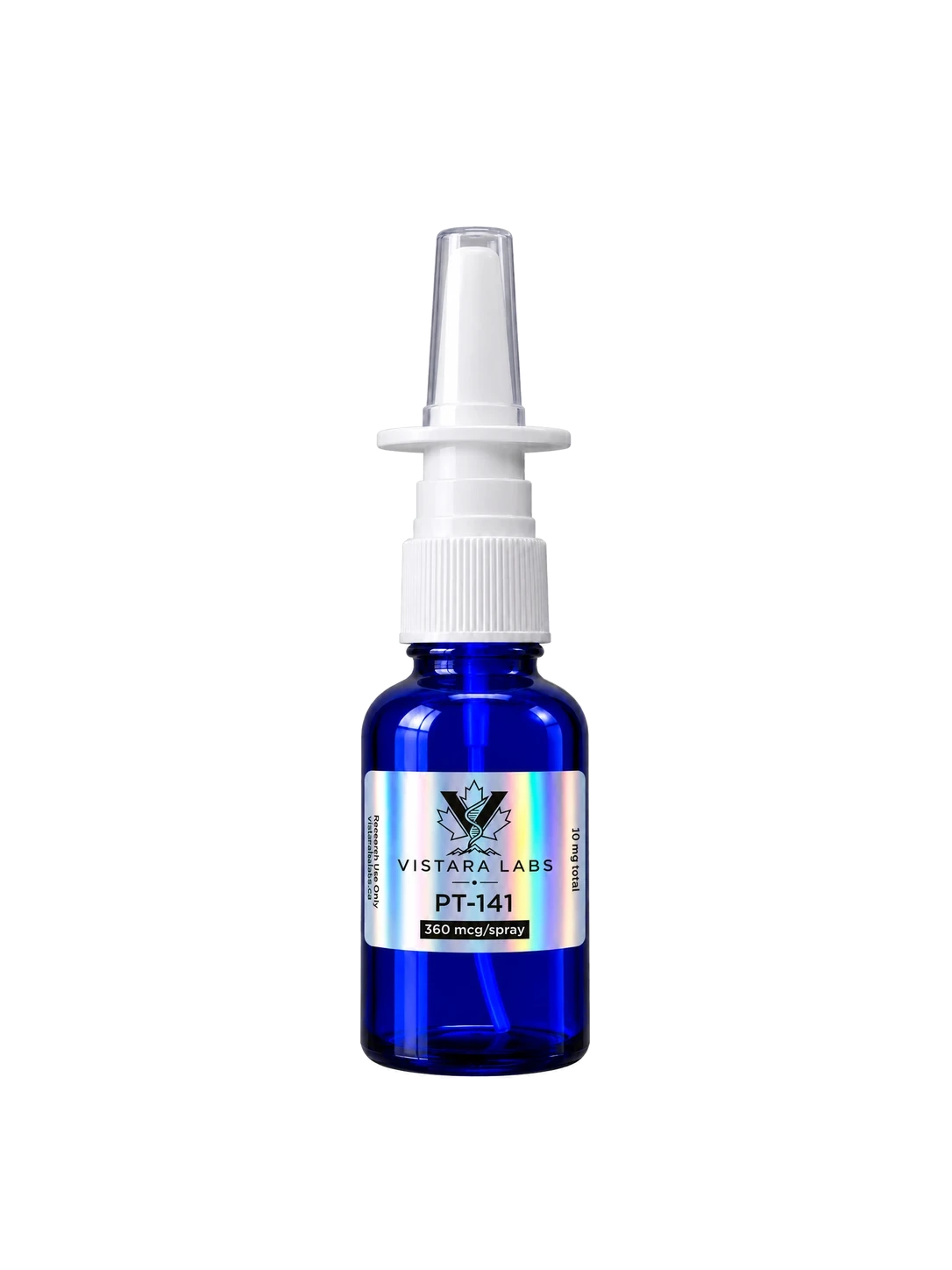
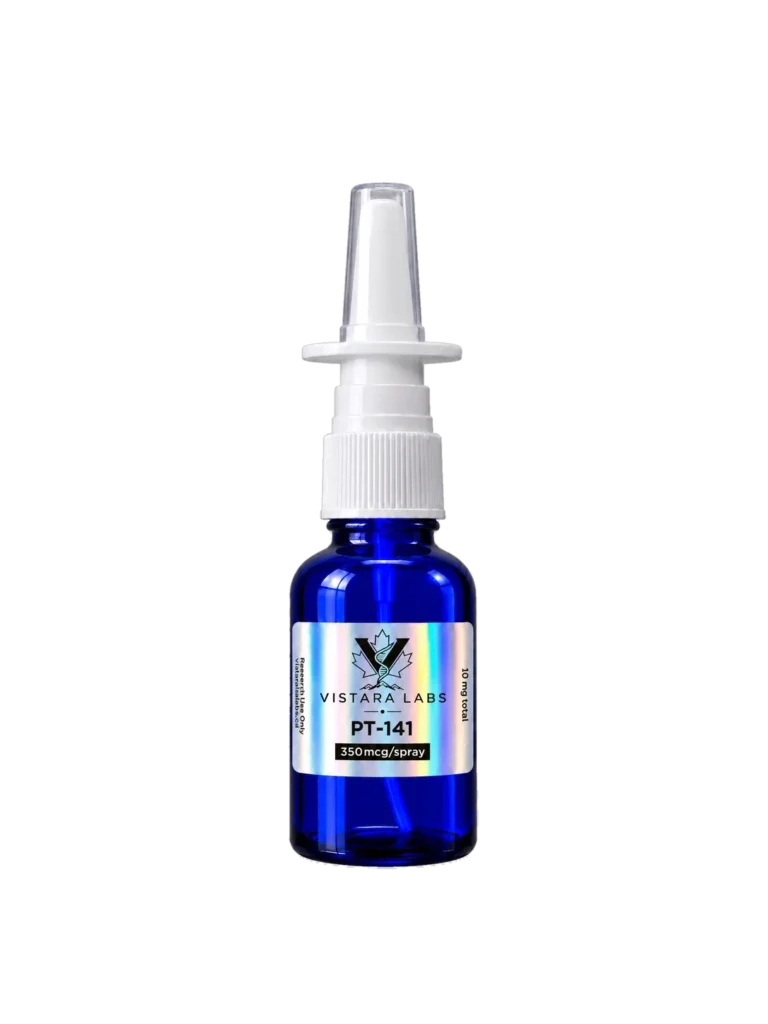
The Libido Spray Stack puts the two side by side: one PT-141 Nasal Spray and one Oxytocin Nasal Spray, both ready-mixed. Other combinations are on the stacks page.
How are PT-141 and oxytocin supplied?
Each comes as a lyophilised vial, reconstituted with bacteriostatic water, and as a nasal spray pre-mixed in sterile saline in a sealed metered pump, in two bottle sizes. Both literatures used the nasal route: the 2006 PT-141 study in women and the oxytocin couple studies above. The full range is in peptide nasal sprays in Canada, certificates of analysis are on the lab reports page, and every order ships from within Canada.
PT-141 and oxytocin are supplied for laboratory research use only. The studies above were clinical research using pharmaceutical preparations.
Frequently asked questions
What is the difference between PT-141 and oxytocin?
PT-141 is a synthetic analogue of alpha-MSH that acts on the melanocortin receptors MC3R and MC4R. Oxytocin is the body’s own nine-amino-acid hormone, made in the hypothalamus and acting on the oxytocin receptor. PT-141’s trials measured desire; oxytocin’s studies looked at orgasm, bonding and partner interaction.
What has PT-141 research shown?
In two 2019 phase 3 trials with 1,267 premenopausal women with low sexual desire, PT-141 raised desire scores and lowered distress about low desire compared with placebo over 24 weeks, with sustained improvement through a 52-week extension.
What has oxytocin research shown about sexual response?
In a 1987 study of 22 adults, plasma oxytocin rose during arousal and was significantly higher at orgasm than at baseline. In a 2014 study of 29 couples, nasal oxytocin raised orgasm intensity and contentment after intercourse compared with placebo, and in a 2009 study of 47 couples it increased positive communication and lowered cortisol during conflict.
Can PT-141 and oxytocin be studied together?
Yes. They act on separate receptor systems and their human research covers different phases of sexual response, which gives a study two distinguishable variables. The Libido Spray Stack combines the PT-141 and Oxytocin nasal sprays.
Where can I buy PT-141 and oxytocin in Canada?
Vistara Labs supplies both as lyophilised vials and as ready-mixed nasal sprays, plus the Libido Spray Stack, shipped from within Canada by Canada Post Xpresspost.
Product details from vistaralabs.ca, October 2026. Sources: Molinoff PB et al. PT-141: a melanocortin agonist for the treatment of sexual dysfunction. Ann N Y Acad Sci. 2003. PMID 12851303. Dhillon S, Keam SJ. Bremelanotide: first approval. Drugs. 2019. PMID 31429064. Kingsberg SA et al. Bremelanotide for the treatment of hypoactive sexual desire disorder: two randomized phase 3 trials. Obstet Gynecol. 2019. PMID 31599840. Simon JA et al. Long-term safety and efficacy of bremelanotide for hypoactive sexual desire disorder. Obstet Gynecol. 2019. PMID 31599847. Diamond LE et al. An effect on the subjective sexual response in premenopausal women with sexual arousal disorder by bremelanotide (PT-141), a melanocortin receptor agonist. J Sex Med. 2006. PMID 16839319. Tom N, Assinder SJ. Oxytocin in health and disease. Int J Biochem Cell Biol. 2010. PMID 19840865. Jurek B, Neumann ID. The oxytocin receptor: from intracellular signaling to behavior. Physiol Rev. 2018. PMID 29897293. Carmichael MS et al. Plasma oxytocin increases in the human sexual response. J Clin Endocrinol Metab. 1987. PMID 3782434. Behnia B et al. Differential effects of intranasal oxytocin on sexual experiences and partner interactions in couples. Horm Behav. 2014. PMID 24503174. Ditzen B et al. Intranasal oxytocin increases positive communication and reduces cortisol levels during couple conflict. Biol Psychiatry. 2009. PMID 19027101.
More on this: Peptides for Libido: What the Research Shows.
All products supplied by Vistara Labs are intended for laboratory research use only. They are not drugs, are not approved for human or veterinary use, and are not intended to diagnose, treat, cure or prevent any condition. Nothing on this page constitutes medical advice or guidance for use in humans.