What Is KLOW? The Four-Peptide Blend Explained
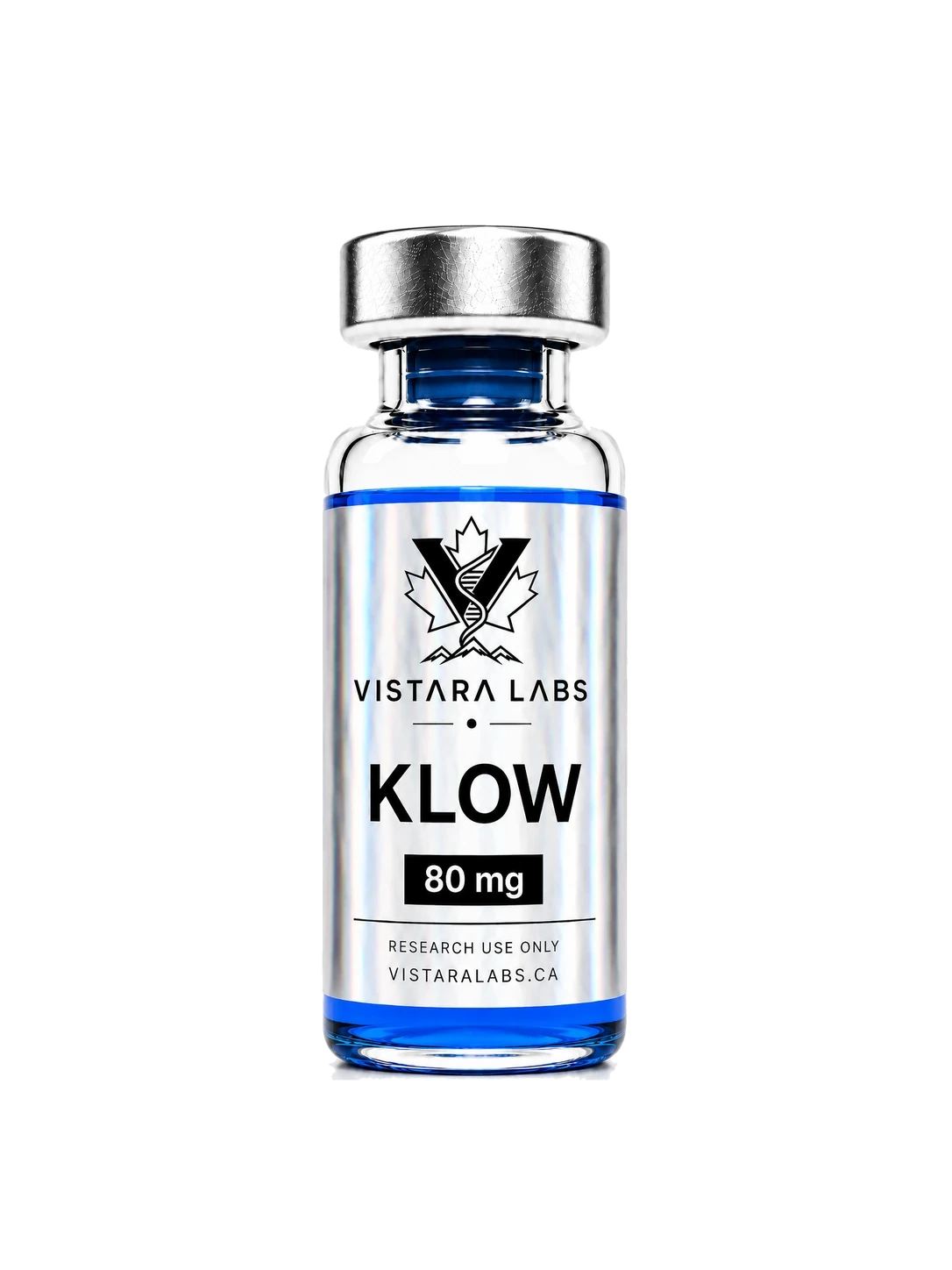
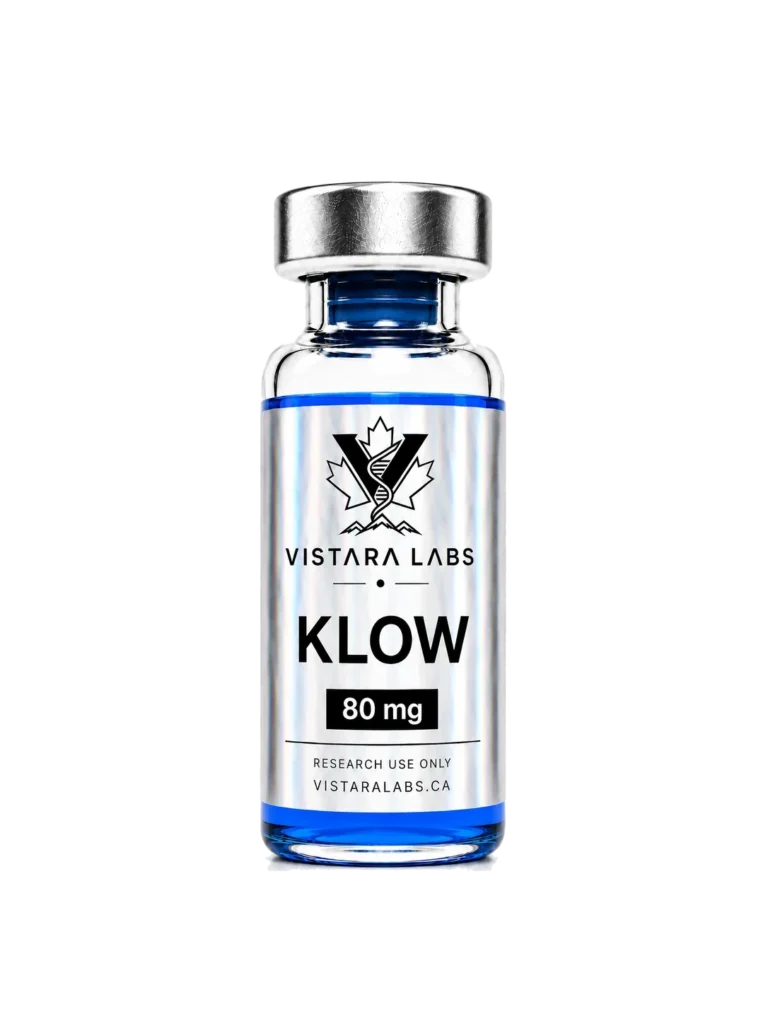
KLOW is a four-peptide blend: GHK-Cu, BPC-157, TB-500 and KPV in one vial, 80 mg in total. Each of the four has its own line of research: GHK-Cu on collagen and skin, BPC-157 and TB-500 on tissue repair, and KPV on inflammation and the gut lining. KLOW puts them together for research that spans skin, soft tissue and inflammatory signalling. This article covers what is in a KLOW vial, what each peptide’s research found, the vial and spray formats, and what people mean by a “KLOW pen”.
 View product →
Findings
- A KLOW vial holds 50 mg GHK-Cu, 10 mg BPC-157, 10 mg TB-500 and 10 mg KPV, 80 mg in total. The copper in GHK-Cu gives it a blue tint.
- GHK-Cu stimulated collagen synthesis in human fibroblast cultures at very low concentrations (FEBS Letters, 1988).
- In a 2021 retrospective study, 14 of 16 patients given BPC-157, alone or with thymosin beta-4, reported relief of knee pain.
- TB-500 is built on thymosin beta-4, which binds actin and promotes the cell migration that wound repair depends on (Goldstein et al., 2012).
- KPV entered human gut-lining and immune cells through the PepT1 transporter and damped the NF-kB inflammatory pathway at nanomolar concentrations (Gastroenterology, 2008).
What is in a KLOW vial?
| Peptide | Amount | Research focus |
|---|---|---|
| GHK-Cu | 50 mg | Collagen, skin |
| BPC-157 | 10 mg | Tendon, gut, soft tissue |
| TB-500 | 10 mg | Cell migration, wounds |
| KPV | 10 mg | Inflammation, gut lining |
| Total | 80 mg |
GHK-Cu makes up most of the blend by weight. The other three are present at 10 mg each. Take KPV away and what remains is GLOW, the three-peptide blend; the choice between the two is set out in KLOW vs GLOW.
What does each peptide in KLOW do?
GHK-Cu. GHK (glycyl-histidyl-lysine) is a tripeptide found in human plasma that binds copper. In fibroblast cultures, the GHK-copper complex stimulated collagen synthesis at very low concentrations (Maquart et al., 1988). A 2015 review describes it as a natural modulator of multiple cellular pathways in skin regeneration (Pickart et al.).
BPC-157. A 15-amino-acid fragment of a protein found in human gastric juice. Its research centres on gut protection and blood-vessel recruitment in healing tissue (Sikiric et al., 2018), with a wider body of animal work on tendon, ligament and muscle. In the human work that exists, a 2021 retrospective study of knee pain followed 16 patients: 11 of the 12 given BPC-157 alone and 3 of the 4 given it with thymosin beta-4 reported significant improvement, 14 of 16 overall (Lee and Padgett).
TB-500. Built on thymosin beta-4, a naturally occurring peptide released by platelets, macrophages and many other cells after injury. It binds actin, promotes cell migration, and in wounds it lowers the number of myofibroblasts, the cells behind scar tissue (Goldstein et al., 2012).
KPV. Lys-Pro-Val, the last three amino acids of alpha-melanocyte-stimulating hormone. A 2008 review describes it as keeping the parent hormone’s anti-inflammatory activity without its effect on skin pigment (Brzoska et al.). In human intestinal and immune cells, KPV was carried inside by PepT1 and damped NF-kB and MAP kinase signalling; given orally, it reduced inflammation in two colitis models (Dalmasso et al., 2008). More is in KPV peptide research.
Why combine them in one vial?
The four cover connected parts of the same repair process. GHK-Cu and TB-500 act on the cells that rebuild skin and connective tissue, BPC-157 on blood supply and the gut, and KPV on the inflammatory signals that run alongside. In a blend, one vial and one reconstitution cover all four, and the amounts stay in a fixed ratio. A blend also costs less than buying the four as separate vials.
Separate vials still make sense when the research calls for a different ratio, or for one peptide on its own. All four are stocked singly: GHK-Cu, BPC-157, BPC-157 + TB-500 and KPV.
KLOW vial or KLOW nasal spray
The KLOW Blend vial is lyophilised powder. It is reconstituted with bacteriostatic water before use; the steps are in how to reconstitute the KLOW blend.
The KLOW Nasal Spray holds the same 80 mg ready-mixed in 10 mL, 8 mg per mL. Each spray from the metered pump delivers about 1.4 mg (875 mcg GHK-Cu and 175 mcg each of BPC-157, TB-500 and KPV), and the bottle gives about 57 sprays. No mixing is needed.
What is a KLOW pen?
“KLOW pen” usually means a pre-filled pen injector holding the blend already in solution, a format some sellers offer. The point of a pen is that the mixing is done. We do not sell pens; the ready-mixed KLOW format we stock is the nasal spray, which arrives mixed and metered with nothing to reconstitute. For research that needs the vial, the KLOW Blend comes as powder.
Frequently asked questions
What is KLOW peptide?
KLOW is a blend of four peptides in one vial: 50 mg GHK-Cu, 10 mg BPC-157, 10 mg TB-500 and 10 mg KPV, 80 mg in total. It is GLOW with KPV added.
Is KLOW the same as GLOW?
No. GLOW has three peptides (GHK-Cu, BPC-157 and TB-500, 70 mg). KLOW has the same three at the same amounts plus 10 mg of KPV, 80 mg in total.
What has KLOW research shown?
The research is on the four peptides individually: GHK-Cu stimulated collagen synthesis in fibroblasts, BPC-157 was linked to knee pain relief in 14 of 16 patients in a 2021 study, thymosin beta-4 promotes cell migration in wound repair, and KPV damped inflammatory signalling in gut cells.
Is there a KLOW pen?
Some sellers offer KLOW in pre-filled pen injectors. Vistara Labs supplies KLOW as a lyophilised 80 mg vial and as a ready-mixed 80 mg nasal spray, which needs no mixing.
Where can I buy KLOW in Canada?
Vistara Labs supplies the KLOW Blend vial and the KLOW Nasal Spray, shipped from within Canada by tracked Xpresspost. The buying guide is at buy KLOW blend in Canada.
Buying guides: buy KLOW blend in Canada and buy KLOW nasal spray in Canada.
References: Maquart FX et al. Stimulation of collagen synthesis in fibroblast cultures by the tripeptide-copper complex glycyl-L-histidyl-L-lysine-Cu2+. FEBS Lett. 1988. PMID 3169264. Pickart L et al. GHK peptide as a natural modulator of multiple cellular pathways in skin regeneration. Biomed Res Int. 2015. PMID 26236730. Sikiric P et al. Novel cytoprotective mediator, stable gastric pentadecapeptide BPC 157. Curr Pharm Des. 2018. PMID 29879879. Lee E, Padgett B. Intra-articular injection of BPC 157 for multiple types of knee pain. Altern Ther Health Med. 2021. PMID 34324435. Goldstein AL et al. Thymosin beta4: a multi-functional regenerative peptide. Expert Opin Biol Ther. 2012. PMID 22074294. Brzoska T et al. Alpha-melanocyte-stimulating hormone and related tripeptides. Endocr Rev. 2008. PMID 18612139. Dalmasso G et al. PepT1-mediated tripeptide KPV uptake reduces intestinal inflammation. Gastroenterology. 2008. PMID 18061177.
All products supplied by Vistara Labs are intended for laboratory research use only. They are not drugs, are not approved for human or veterinary use, and are not intended to diagnose, treat, cure or prevent any condition. Nothing on this page constitutes medical advice or guidance for use in humans.
References
No study of the KLOW blend as a complete formulation was identified. The references below cover its individual components.
- Enhanced healing of ulcers in patients with diabetes by topical treatment with glycyl-l-histidyl-l-lysine copperMulticentre randomised, evaluator-blinded, placebo-controlled trial; topical GHK-Cu in diabetic neuropathic ulcers.
- Intra-Articular Injection of BPC 157 for Multiple Types of Knee PainRetrospective chart review, 17 patients (16 followed up by telephone); no control group, no blinding, no validated outcome instrument.
- Synthesis and characterization of the N-terminal acetylated 17-23 fragment of thymosin beta 4 identified in TB-500, a product suspected to possess doping potentialAnalytical chemistry: characterises TB-500 as the N-terminally acetylated 17-23 fragment of thymosin β4 (Ac-LKKTETQ), not the intact 43-amino-acid protein.
- PepT1-mediated tripeptide KPV uptake reduces intestinal inflammationLaboratory study in human intestinal epithelial cells and human T cells; no human exposure.
Links open the study record on PubMed so the source can be checked directly. Listing a study is not a claim that its findings apply to any other use, product or route of administration. Research use only.