Dihexa vs Semax: How They Differ
Dihexa and Semax are both small engineered molecules built from fragments of the body’s own hormones and studied for memory and brain recovery, but they work through two different growth-factor systems. Semax is a seven-amino-acid analogue of an ACTH fragment, studied around brain-derived neurotrophic factor (BDNF), with human stroke research and decades of clinical use in Russia. Dihexa is a capped two-amino-acid analogue of angiotensin IV, studied around hepatocyte growth factor (HGF) and its receptor c-Met, with laboratory research on new synapses and learning. Here is how they compare and what each one suits as a research tool.
Findings
- Semax in stroke recovery: in 110 patients after ischaemic stroke, Semax raised plasma BDNF, which stayed high for the whole study, and sped recovery on the Barthel index (2018).
- Semax and brain networks: in 24 healthy volunteers, intranasal Semax changed the default mode network on resting-state functional MRI against placebo (2018).
- Dihexa and synapses: at picomolar concentrations Dihexa nearly tripled dendritic spine counts in cultured hippocampal neurons and was active when given by mouth in preclinical studies (2013).
- Dihexa and working memory: after repeated mild traumatic brain injury, Dihexa restored working memory to 81.5% correct against 67.1% with vehicle (2025).
What is Semax?
Semax is a synthetic heptapeptide with the sequence Met-Glu-His-Phe-Pro-Gly-Pro. Its first four residues match positions 4 to 7 of adrenocorticotropic hormone (ACTH), and the Pro-Gly-Pro tail slows its breakdown. It keeps none of the adrenal-stimulating activity of ACTH. Semax was developed at the Institute of Molecular Genetics of the Russian Academy of Sciences and has been used clinically in Russia for decades as nasal drops.
The human research
The human work centres on stroke. In 1997, 30 patients in the acute period of hemispheric ischaemic stroke received Semax alongside standard care and were compared with 80 patients of similar severity on standard care alone; the Semax group showed faster recovery of general and focal deficits, especially motor ones (Gusev et al., Zh Nevrol Psikhiatr Im S S Korsakova, 1997). In 2018 the same Moscow group followed 110 patients through early or late rehabilitation after ischaemic stroke. Semax raised plasma BDNF whenever rehabilitation began, the level stayed high throughout, and Semax with high BDNF sped and improved final recovery on the Barthel index (Gusev et al., 2018).
In healthy volunteers, resting-state functional MRI before and after intranasal 1% Semax showed a greater volume of the frontal subcomponent of the default mode network than with placebo, confirming a measurable effect on the brain’s networks (Lebedeva et al., Bull Exp Biol Med, 2018).
The BDNF research
In preclinical studies, a single intranasal application of Semax produced a maximal 1.4-fold rise in hippocampal BDNF protein, a 1.6-fold rise in phosphorylation of its receptor trkB and a 3-fold rise in BDNF exon III messenger RNA, alongside faster learning of an avoidance task (Dolotov et al., Brain Res, 2006). A second study found intranasal Semax raised both BDNF and NGF gene expression in the hippocampus within an hour (Agapova et al., Neurosci Lett, 2007).
What is Dihexa?
Dihexa is N-hexanoic-Tyr-Ile-(6) aminohexanoic amide, developed at Washington State University from angiotensin IV. Angiotensin IV peptides had long been linked to learning but broke down within minutes. Dihexa was engineered to resist that: it lasted about 335 minutes in serum against under 2 minutes for its parent compound, was active when given by mouth, and concentrated in brain tissue relative to blood (McCoy et al., J Pharmacol Exp Ther, 2013).
Its developers describe it as a positive modulator of HGF and c-Met, a system that drives dendrite growth and synapse formation in the brain (Wright and Harding, J Alzheimers Dis, 2015). Stem-cell groups have used Dihexa in place of recombinant HGF to mature liver-like cells (Siller et al., Stem Cell Reports, 2015).
The laboratory research
The published work on Dihexa itself to date is laboratory research. At 10-12 M, Dihexa raised spine density in cultured hippocampal neurons from about 15 to about 41 per 50 micrometres of dendrite, and the frequency of AMPA-type synaptic currents rose 1.6-fold. Given by mouth, it fully reversed a scopolamine-induced learning deficit and improved learning in an ageing model (McCoy et al., 2013). In an Alzheimer’s disease model it restored spatial learning, raised synaptophysin and lowered IL-1β and TNF-α through the PI3K/AKT pathway (Sun et al., Brain Sci, 2021). After repeated mild traumatic brain injury it rescued working memory, an effect a MET antagonist blocked (Martino et al., Neurotrauma Rep, 2025).
How do Dihexa and Semax compare side by side?
| Question | Dihexa | Semax |
|---|---|---|
| Built from | Angiotensin IV | ACTH(4-10) |
| Size | Capped Tyr-Ile core | 7 amino acids |
| Growth factor | HGF and c-Met | BDNF and trkB |
| Main research area | Synapses, learning, brain injury | Stroke recovery, cognition |
| Usual research route | Oral in preclinical work | Intranasal |
| Human evidence | Laboratory research | Stroke studies (1997, 2018); fMRI (2018) |
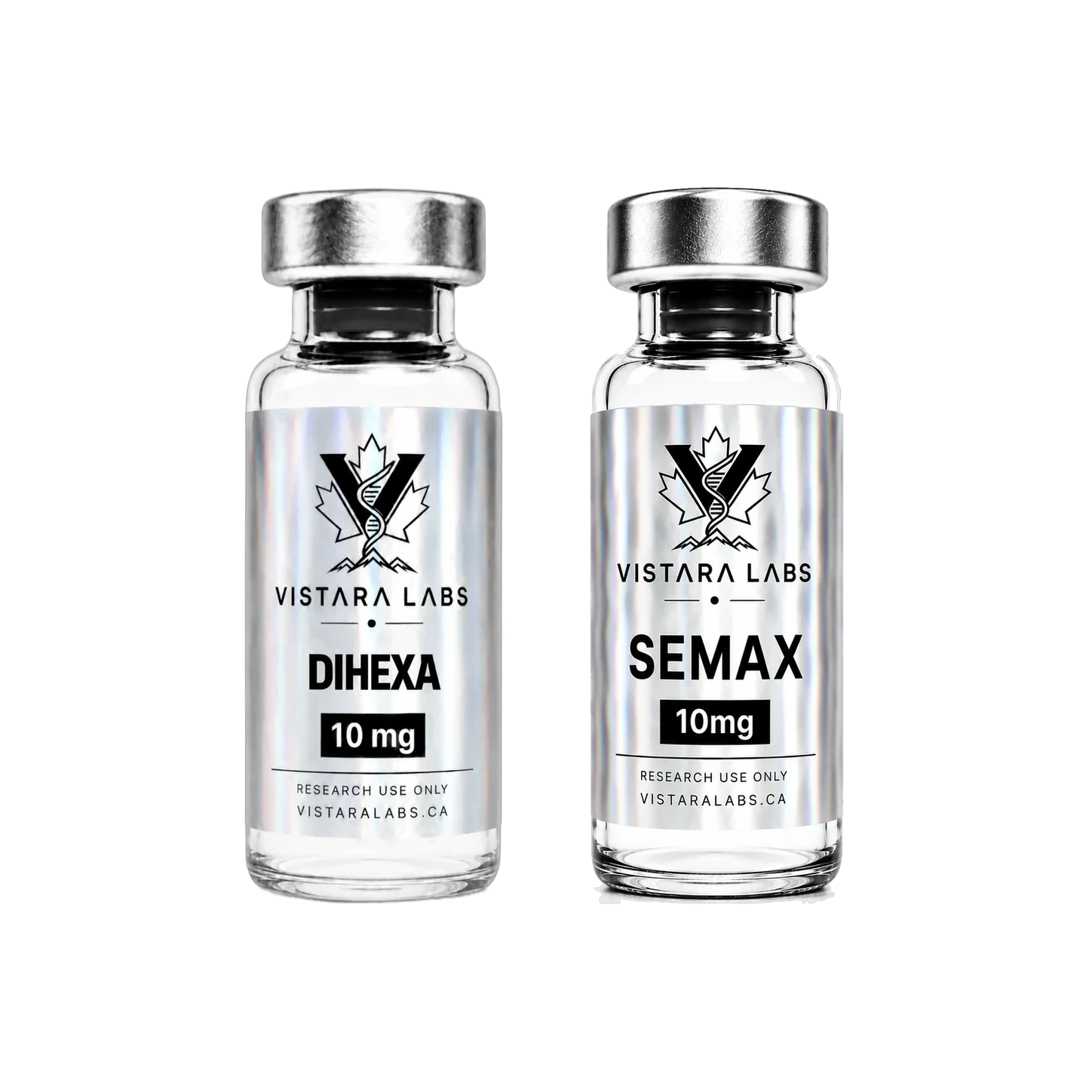
| Forms we supply | 10 mg vial | 10 mg vial; nasal spray |
Which one fits which research question?
- Synapse formation and dendritic spines: Dihexa, whose founding study measured spine counts and synaptic currents directly.
- The HGF/c-Met pathway: Dihexa, which stem-cell groups have used as a stand-in for HGF itself.
- BDNF and trkB signalling: Semax, with BDNF protein, receptor and gene-expression data.
- Human stroke recovery and intranasal designs: Semax, whose human studies are built around that route.
Can Dihexa and Semax be studied together?
They act on two separate growth-factor systems, so in study design they are complementary probes: one for HGF and c-Met, one for BDNF and trkB. Each one’s role here is drawn from its own literature; we found no published study that gave the two together, so a combined design would use separate arms to tell their contributions apart. Semax is also often compared with its sister peptide in Semax vs Selank.
How are Dihexa and Semax supplied?
Dihexa comes as a 10 mg lyophilised vial; it has limited solubility in plain water, and the concentration arithmetic is in the Dihexa reconstitution guide. Semax comes as a 10 mg lyophilised vial and as the ready-mixed Semax Nasal Spray; its vial arithmetic is in the Semax reconstitution guide. Certificates of analysis are on the lab reports page, and every order ships from within Canada by Canada Post Xpresspost. Buying guides: Dihexa and Semax.
Dihexa and Semax are supplied for laboratory research use only. The Semax human studies above were clinical research using pharmaceutical preparations; the Dihexa studies were laboratory research.
Frequently asked questions
What is the difference between Dihexa and Semax?
Dihexa is a capped two-amino-acid analogue of angiotensin IV studied around hepatocyte growth factor and its receptor c-Met. Semax is a seven-amino-acid analogue of ACTH(4-10) studied around BDNF. Both are researched for memory and brain recovery.
What has Semax research shown in people?
In 110 patients after ischaemic stroke, Semax raised plasma BDNF and sped recovery on the Barthel index (2018). In healthy volunteers, intranasal Semax changed the default mode network on resting-state functional MRI against placebo (2018).
What has Dihexa research shown?
In laboratory studies, Dihexa nearly tripled dendritic spine counts in cultured neurons, reversed a drug-induced learning deficit (2013), restored spatial learning in an Alzheimer’s disease model (2021) and rescued working memory after repeated mild brain injury (2025).
Do Dihexa and Semax act on the same pathway?
No. Dihexa works through hepatocyte growth factor and c-Met, while Semax raises BDNF and activates its receptor trkB. Both pathways support the growth and connections of nerve cells.
How does Vistara Labs supply Dihexa and Semax?
Dihexa comes as a 10 mg lyophilised vial. Semax comes as a 10 mg lyophilised vial and a ready-mixed nasal spray. Both ship by Canada Post Xpresspost.
Product details from vistaralabs.ca, October 2026. Sources: Gusev EI et al. Effectiveness of semax in acute period of hemispheric ischemic stroke. Zh Nevrol Psikhiatr Im S S Korsakova. 1997. PMID 11517472. Dolotov OV et al. Brain Res. 2006. PMID 16996037. Agapova TY et al. Neurosci Lett. 2007. PMID 17353092. Gusev EI et al. The efficacy of semax in the treatment of patients at different stages of ischemic stroke. Zh Nevrol Psikhiatr Im S S Korsakova. 2018. PMID 29798983. Lebedeva IS et al. Effects of Semax on the default mode network of the brain. Bull Exp Biol Med. 2018. PMID 30225715. McCoy AT et al. Evaluation of metabolically stabilized angiotensin IV analogs as procognitive/antidementia agents. J Pharmacol Exp Ther. 2013. PMID 23055539. Wright JW, Harding JW. The brain hepatocyte growth factor/c-Met receptor system: a new target for the treatment of Alzheimer’s disease. J Alzheimers Dis. 2015. PMID 25649658. Siller R et al. Small-molecule-driven hepatocyte differentiation of human pluripotent stem cells. Stem Cell Reports. 2015. PMID 25937370. Sun X et al. AngIV-analog Dihexa rescues cognitive impairment and recovers memory via the PI3K/AKT signaling pathway. Brain Sci. 2021. PMID 34827486. Martino KA et al. Hepatocyte growth factor/MET activator rescues working memory deficits after repeated mild traumatic brain injury. Neurotrauma Rep. 2025. PMID 42825082.
More on this: Dihexa vs Cerebrolysin: How They Differ.
All products supplied by Vistara Labs are intended for laboratory research use only. They are not drugs, are not approved for human or veterinary use, and are not intended to diagnose, treat, cure or prevent any condition. Nothing on this page constitutes medical advice or guidance for use in humans.