Buy Dihexa in Canada: 10 mg Research Vial
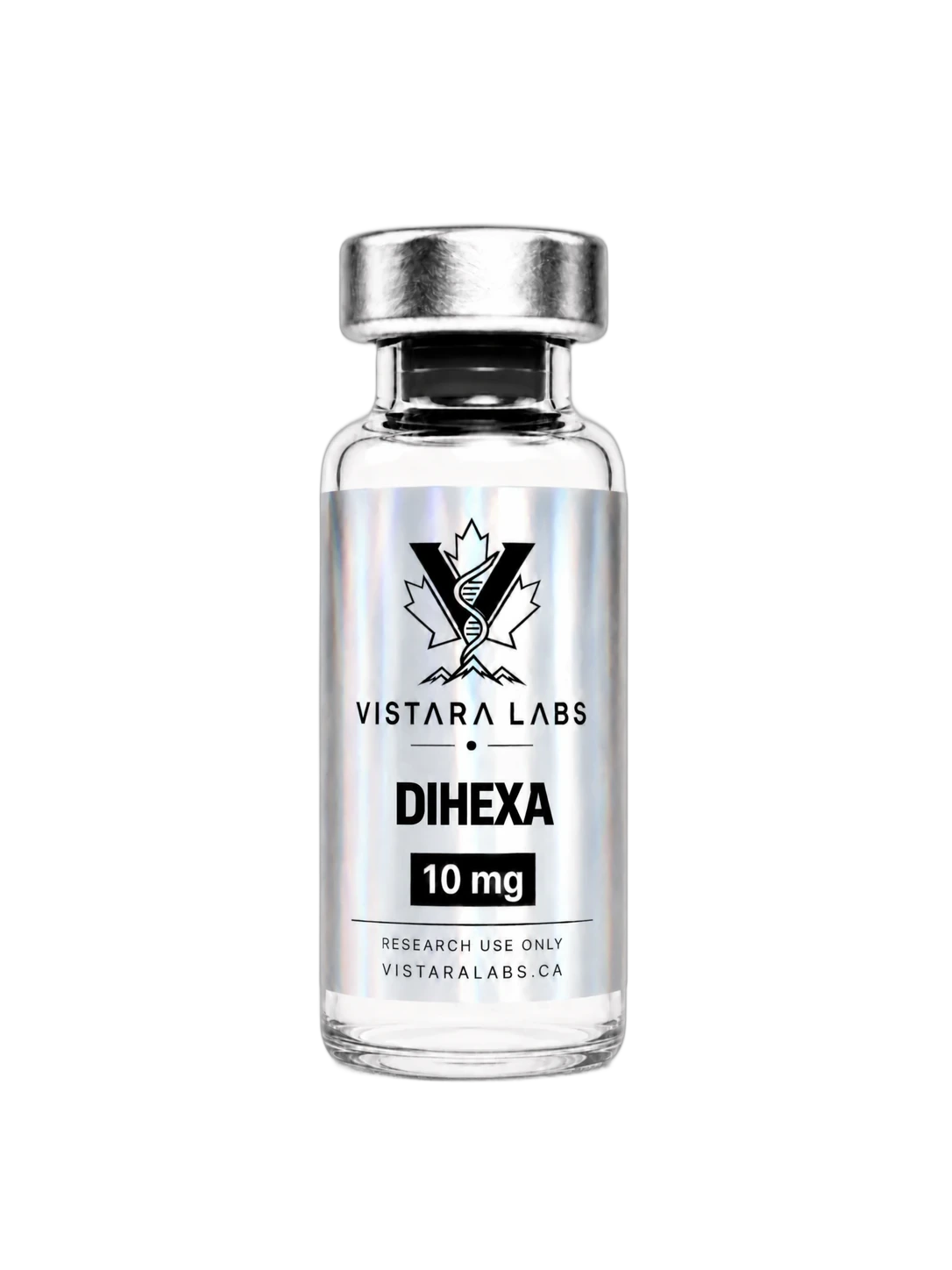
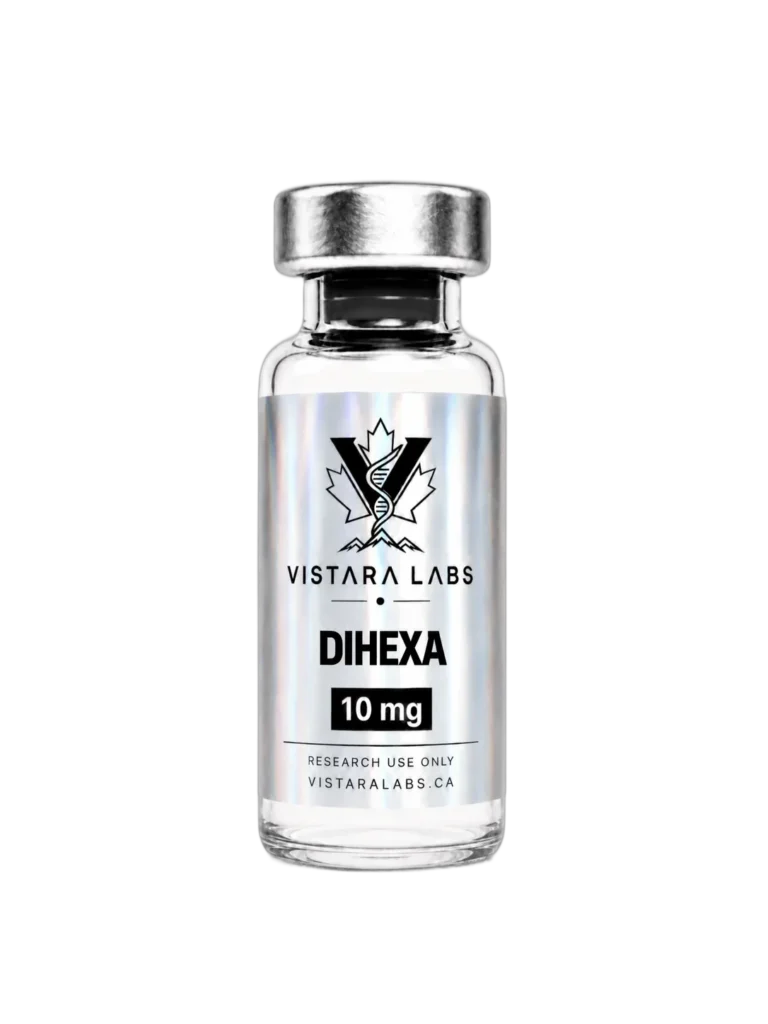
You can buy Dihexa in Canada from Vistara Labs as a 10 mg lyophilised vial, in stock and shipped from within Canada by Canada Post Xpresspost. Dihexa is a small, metabolically stabilised compound developed at Washington State University from angiotensin IV, a fragment of the body’s own angiotensin system. In the laboratory studies that introduced it, Dihexa was active when given by mouth, reached the brain, nearly tripled dendritic spine counts in cultured neurons and improved learning in cognitive-deficit models. This guide covers what Dihexa is, what the research found, how the vial is handled and how to order.
At a glance: Vistara Labs stocks Dihexa as a 10 mg lyophilised vial, with certificates of analysis on our Lab Reports page, shipped from within Canada by Canada Post Xpresspost, with same-business-day dispatch on orders placed before 3 pm Pacific, Monday to Friday. We deliver to every province, including Ontario, Quebec, British Columbia and Alberta.
 View product →
Findings
- Built for stability, 2013: Dihexa lasted about 335 minutes in serum, against under 2 minutes for its parent compound, and was active when given by mouth in preclinical studies (Journal of Pharmacology and Experimental Therapeutics).
- New connections between neurons, 2013: at picomolar concentrations Dihexa nearly tripled dendritic spine counts in cultured hippocampal neurons and raised the frequency of functional synaptic signals.
- Memory models, 2013 and 2021: Dihexa reversed a drug-induced learning deficit, improved spatial learning in an ageing model and restored spatial learning in an Alzheimer’s disease model (Brain Sciences).
- Brain injury model, 2025: after repeated mild traumatic brain injury, Dihexa restored working memory to 81.5% correct against 67.1% with vehicle, an effect blocked by a MET receptor antagonist (Neurotrauma Reports).
- A growth-factor stand-in, 2015: stem-cell researchers in Oslo used Dihexa in place of recombinant hepatocyte growth factor to mature liver-like cells (Stem Cell Reports).
What is Dihexa?
Dihexa is N-hexanoic-Tyr-Ile-(6) aminohexanoic amide, also catalogued as PNB-0408. It has the formula C27H44N4O5 and a molecular weight of about 504.7. Its starting point was angiotensin IV, a six-amino-acid fragment of the angiotensin system that had long been linked to learning and memory but broke down within minutes and could not cross into the brain.
Researchers at Washington State University found that the active core sat in the first three amino acids of an angiotensin IV analogue, Nle-Tyr-Ile. They capped both ends of that core to resist enzymes and made it more hydrophobic, which produced Dihexa: a molecule that was stable in serum, active by mouth and concentrated in brain tissue after it reached the circulation (McCoy et al., J Pharmacol Exp Ther, 2013).
How does Dihexa work?
Its developers describe Dihexa as a positive modulator of hepatocyte growth factor (HGF) and its receptor, c-Met. HGF is best known from the liver, but in the brain the HGF/c-Met system supports the growth of dendrites and the formation of new synapses (Wright and Harding, J Alzheimers Dis, 2015).
Independent groups have since put that link to work. Stem-cell laboratories used Dihexa as the HGF component in growth-factor-free protocols for making liver-like cells (Siller et al., Stem Cell Reports, 2015; Pan et al., Stem Cell Res Ther, 2022). In a 2025 brain-injury study at Rowan University, the working-memory benefit of Dihexa disappeared when the MET receptor was blocked first (Martino et al., Neurotrauma Rep, 2025).
What has Dihexa research shown?
- Synapses, 2013. At 10-12 M, Dihexa raised spine density in cultured hippocampal neurons to about 41 spines per 50 micrometres of dendrite, against about 15 with vehicle, and increased the frequency of excitatory synaptic currents 1.6-fold.
- Learning deficits, 2013. Given by mouth, Dihexa fully reversed a scopolamine-induced spatial learning deficit and improved performance on most test days in an ageing model.
- Alzheimer’s disease model, 2021. A China Pharmaceutical University group found Dihexa restored spatial learning, raised the synaptic protein synaptophysin and neuron counts, lowered the inflammatory signals IL-1β and TNF-α and raised IL-10, acting through the PI3K/AKT pathway.
- Brain injury model, 2025. After repeated mild traumatic brain injury, Dihexa rescued working memory in a dose-dependent way.
- Sensory hair cells, 2015. In a laboratory model of hair cell damage, Dihexa at 1 micromolar gave the strongest protection against the antibiotics neomycin and gentamicin.
- Nerve repair, 2021. In a peripheral nerve repair model, Dihexa combined with mesenchymal stem cells significantly improved motor function 8 to 16 weeks after surgery.
The published work on Dihexa itself to date is laboratory research. A 2018 systematic review of angiotensin IV and its analogues, Dihexa among them, found that eight of nine studies in cognitive-deficit models reported improved performance on spatial working memory and avoidance tasks (Ho and Nation, Neurosci Biobehav Rev, 2018). The fuller story is in What Is Dihexa?
Which Dihexa format is available?
| Format | What it holds | Preparation |
|---|---|---|
| Dihexa vial, 10 mg | 10 mg lyophilised powder | Reconstitute for research handling |
Dihexa is supplied as a vial only. Our Dihexa reconstitution guide sets out the concentrations for 1, 2, 3 and 5 mL of bacteriostatic water, and the peptide calculator works out any other volume.
How should Dihexa be handled and stored?
Dihexa was designed to be hydrophobic, so it has limited solubility in plain water; in the published laboratory work it was dissolved in a small amount of DMSO before dilution in saline or buffer. Keep the unopened vial cold and dark until it is needed. Once reconstituted, label the vial with the date and concentration and refrigerate it at 2 to 8 °C, away from light. The general method is in how to reconstitute peptides with bacteriostatic water.
What pairs with Dihexa in cognitive research?
Dihexa works through HGF and c-Met, a different pathway from the BDNF signalling studied with Semax and the GABA-linked work on Selank. Cerebrolysin brings a large clinical literature on neurotrophic support, and NAD+ covers cellular energy research. The comparisons are in Dihexa vs Semax and Dihexa vs Cerebrolysin, and the wider field is on our Cognitive & Nootropic Research page.
Where to buy Dihexa in Canada
- No customs step. Every order ships from within Canada.
- Same-day dispatch. Orders placed before 3 pm Pacific, Monday to Friday, leave the same business day by tracked Canada Post Xpresspost, with free Xpresspost on larger orders.
- Certificates. Certificates of analysis are on our Lab Reports page.
- Payment. We accept Interac e-Transfer, all major credit cards and crypto (Bitcoin).
- The product. Order the Dihexa 10 mg vial.
Frequently asked questions
What has Dihexa research shown?
In laboratory studies, Dihexa nearly tripled dendritic spine counts in cultured neurons (2013), reversed a drug-induced learning deficit and improved learning in an ageing model (2013), restored spatial learning in an Alzheimer’s disease model (2021) and rescued working memory after repeated mild brain injury (2025).
How does Dihexa work?
Its developers describe it as a positive modulator of hepatocyte growth factor and its receptor c-Met, a system that supports dendrite growth and new synapses. In a 2025 study its working-memory benefit disappeared when the MET receptor was blocked.
What did the research show about Dihexa’s stability?
Dihexa lasted about 335 minutes in serum, against under 2 minutes for its parent compound, and was active when given by mouth in preclinical studies.
What concentration does a 10 mg Dihexa vial give?
It depends on the volume added: 5 mg/mL with 2 mL, 10 mg/mL with 1 mL, 3.33 mg/mL with 3 mL and 2 mg/mL with 5 mL. The vial holds 10 mg whichever volume is chosen.
Where can I buy Dihexa in Canada?
Vistara Labs supplies Dihexa as a 10 mg lyophilised vial, shipped from within Canada by Canada Post Xpresspost.
Sources: McCoy AT, et al. Evaluation of metabolically stabilized angiotensin IV analogs as procognitive/antidementia agents. J Pharmacol Exp Ther. 2013. PMID 23055539. Wright JW, Harding JW. The brain hepatocyte growth factor/c-Met receptor system: a new target for the treatment of Alzheimer’s disease. J Alzheimers Dis. 2015. PMID 25649658. Siller R, et al. Small-molecule-driven hepatocyte differentiation of human pluripotent stem cells. Stem Cell Reports. 2015. PMID 25937370. Uribe PM, et al. Hepatocyte growth factor mimetic protects lateral line hair cells from aminoglycoside exposure. Front Cell Neurosci. 2015. PMID 25674052. Ho JK, Nation DA. Cognitive benefits of angiotensin IV and angiotensin-(1-7): a systematic review of experimental studies. Neurosci Biobehav Rev. 2018. PMID 29733881. Sun X, et al. AngIV-analog Dihexa rescues cognitive impairment and recovers memory via the PI3K/AKT signaling pathway. Brain Sci. 2021. PMID 34827486. Weiss JB, et al. Stem cell, granulocyte-colony stimulating factor and/or Dihexa to promote limb function recovery in a sciatic nerve damage-repair model. Ann Med Surg. 2021. PMID 34703584. Pan T, et al. Efficiently generate functional hepatic cells from human pluripotent stem cells by complete small-molecule strategy. Stem Cell Res Ther. 2022. PMID 35410439. Martino KA, et al. Hepatocyte growth factor/MET activator rescues working memory deficits after repeated mild traumatic brain injury. Neurotrauma Rep. 2025. PMID 42825082.
More on this: What Is Dihexa? The Angiotensin IV Analogue and What the Research Showed.
All products supplied by Vistara Labs are intended for laboratory research use only. They are not drugs, are not approved for human or veterinary use, and are not intended to diagnose, treat, cure or prevent any condition. Nothing on this page constitutes medical advice or guidance for use in humans.