CJC-1295 vs Ipamorelin: Which Growth Hormone Peptide to Choose
Hormonal, Growth Hormone & Body Composition Research
CJC-1295 and ipamorelin are not rivals. They reach the same growth hormone cells in the pituitary through two different receptors, which is why they are sold together. Here is the CJC-1295 vs ipamorelin comparison: how they differ, why they pair, where tesamorelin fits, and which option to buy.
 View product →
Findings
- CJC-1295 is a GHRH analogue, a modified copy of the first 29 amino acids of growth-hormone-releasing hormone. Ipamorelin is a ghrelin-receptor agonist, a five-amino-acid peptide.
- Growth hormone release answers to two signals, GHRH and ghrelin (Nature, 1999). In healthy men, triggering both at once released more growth hormone than the sum of each alone (J Clin Endocrinol Metab, 1990 and 2001).
- In the 1998 paper that introduced it, ipamorelin released growth hormone without raising ACTH or cortisol beyond what GHRH itself produced, even at more than 200 times the amount needed for a half-maximal response.
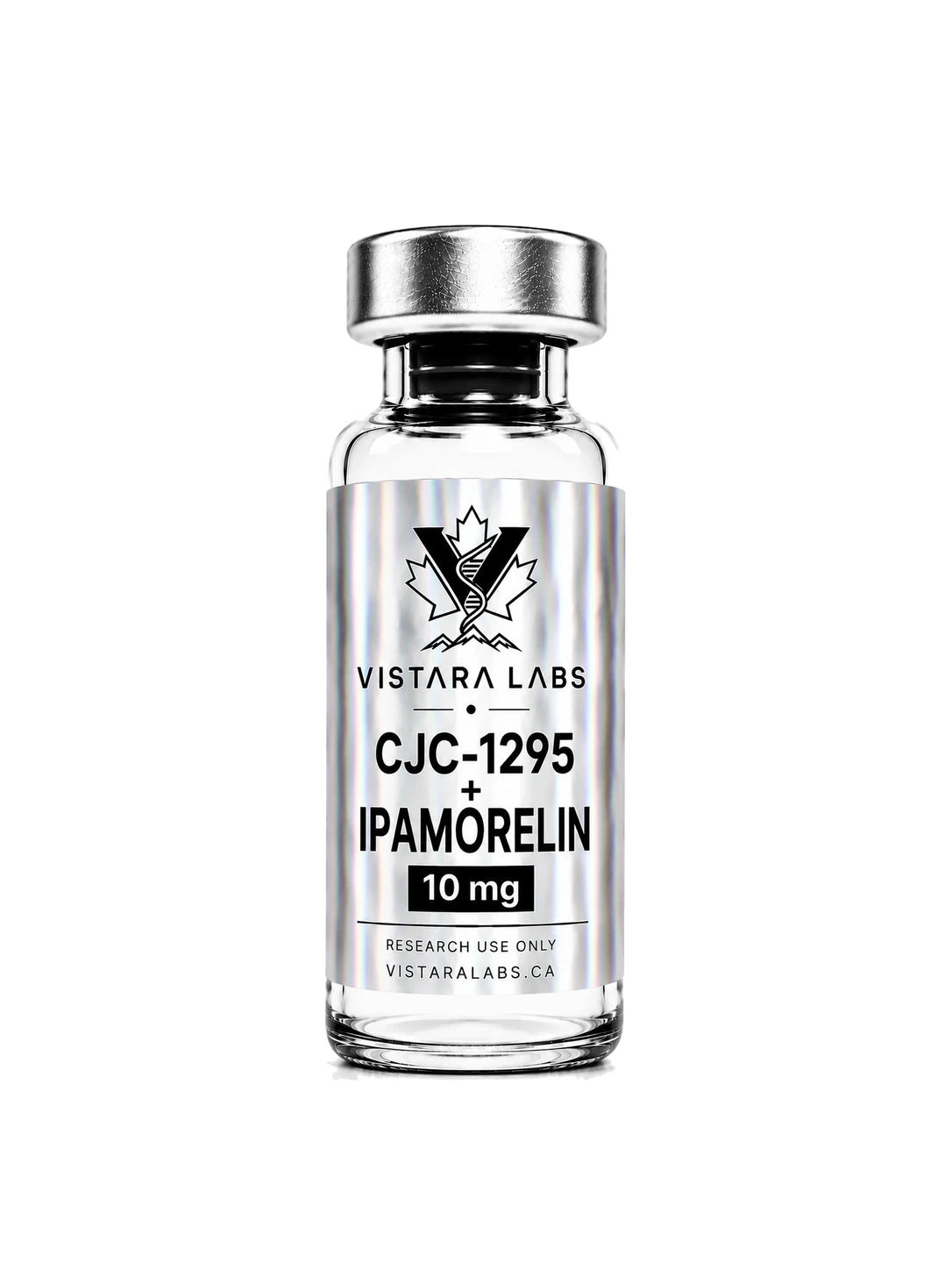
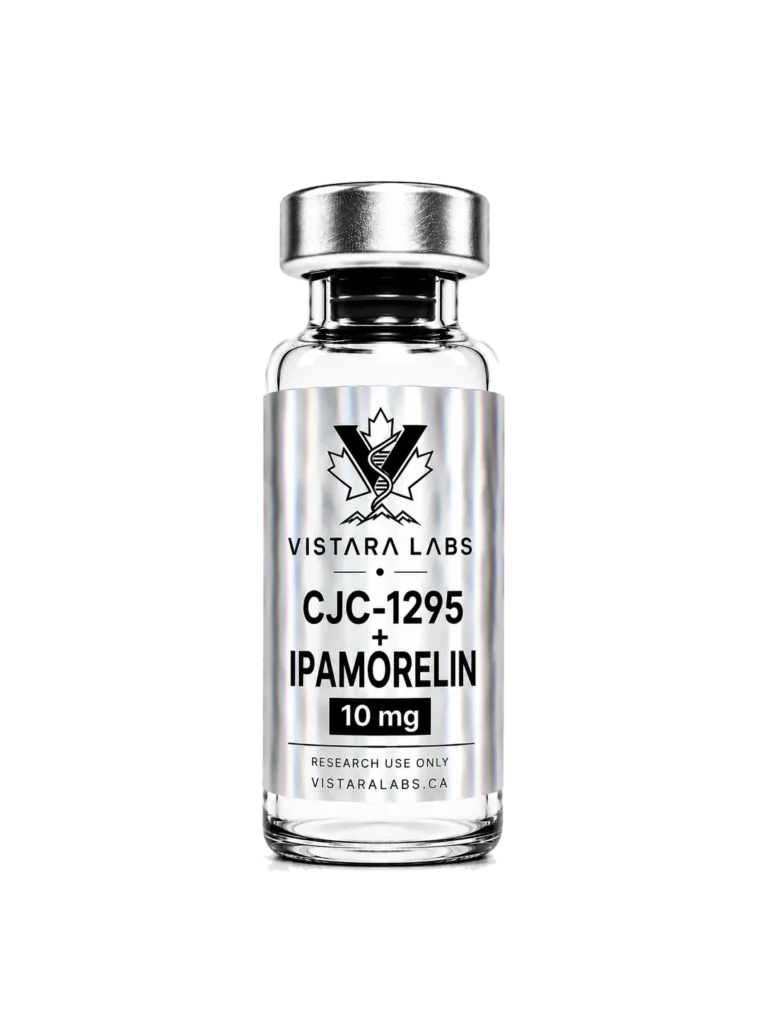
- Our CJC-1295 is the No DAC form, also sold as Mod GRF 1-29, paired with ipamorelin at 5 mg of each in one vial.
CJC-1295 vs ipamorelin: two receptors, one target
Two signals drive growth hormone release from the pituitary. The first is growth-hormone-releasing hormone (GHRH) from the hypothalamus. The second, identified in 1999, is ghrelin, a 28-amino-acid stomach peptide and the natural partner of the growth hormone secretagogue receptor (Kojima et al., Nature). CJC-1295 works the first signal; ipamorelin works the second.
| CJC-1295 (No DAC) | Ipamorelin | |
|---|---|---|
| Class | GHRH analogue | Ghrelin-receptor agonist |
| Receptor | GHRH receptor | Ghrelin receptor |
| Structure | Modified GHRH(1-29) | 5 amino acids |
| Mimics | GHRH (hypothalamus) | Ghrelin (stomach) |
CJC-1295. Natural GHRH does not last: in a 1986 study, intact GHRH had a half-life of 6.8 minutes in healthy volunteers before a plasma enzyme clipped it into an inactive fragment (Frohman et al., J Clin Invest). CJC-1295 is built on GHRH(1-29), the first 29 amino acids of the hormone, with four amino-acid substitutions (Jetté et al., Endocrinology, 2005).
Ipamorelin. A pentapeptide, Aib-His-D-2-Nal-D-Phe-Lys-NH2. The 1998 paper that introduced it found that it released growth hormone through the same receptor class as the older secretagogue GHRP-6, with similar potency. Where GHRP-6 and GHRP-2 also raised ACTH and cortisol, ipamorelin did not, which led the authors to call it the first selective growth hormone secretagogue (Raun et al., Eur J Endocrinol). In healthy men, an infusion produced a single growth hormone episode peaking at about 40 minutes, and ipamorelin’s half-life was 2 hours (Gobburu et al., Pharm Res, 1999).
Why CJC-1295 and ipamorelin are combined
Because the two signals add up to more than either alone. In 1990, a study of 18 healthy men found that GHRP-6 and GHRH given together released growth hormone synergistically, and the authors suggested the two act independently (Bowers et al., J Clin Endocrinol Metab). In 2001, low amounts of ghrelin plus GHRH produced a combined growth hormone response greater than the sum of each given alone (P<0.05), with no synergy in ACTH or prolactin (Hataya et al., J Clin Endocrinol Metab).
Those studies used GHRP-6 and ghrelin rather than CJC-1295 and ipamorelin, but they set out the logic of the blend: a GHRH analogue for one receptor, a selective ghrelin-receptor agonist for the other, in one vial.
What No DAC means for CJC-1295
As first described in 2005, CJC-1295 carried a linker that binds albumin in the blood, the drug affinity complex (DAC), and stayed in plasma beyond 72 hours in laboratory work (Jetté et al.). In healthy adults aged 21 to 61, the DAC form raised mean growth hormone 2- to 10-fold for 6 days or more, with an estimated half-life of 5.8 to 8.1 days (Teichman et al., J Clin Endocrinol Metab, 2006).
The No DAC form, also sold as Mod GRF 1-29, is the same modified GHRH(1-29) without the albumin anchor, so nothing holds it in circulation for days. That is the version in our blend and nasal spray. More in CJC-1295 with or without DAC.
Where tesamorelin fits
Tesamorelin is the other GHRH analogue we stock, built a different way: the full-length hormone, GHRH(1-44), with a trans-3-hexenoyl group added to its first amino acid. That change made it resistant to DPP-4, the enzyme that clips natural GHRH, and slowed its breakdown in human plasma (Ferdinandi et al., 2007).
It also carries a substantial human trial record. In a 2007 New England Journal of Medicine trial, 412 people with HIV and abdominal fat accumulation received tesamorelin or placebo for 26 weeks: visceral fat fell 15.2% on tesamorelin and rose 5.0% on placebo (Falutz et al.). More in Tesamorelin and visceral fat: the trial record. Paired with ipamorelin, it gives the same two-receptor design.
CJC-1295, ipamorelin or a stack: which to choose
CJC-1295 + Ipamorelin: the default
Both receptors in one lyophilised vial: 5 mg of CJC-1295 (No DAC) and 5 mg of ipamorelin. For the GHRH and ghrelin-receptor pairing, this is the one. Buy CJC-1295 + Ipamorelin
Tesamorelin + Ipamorelin stack
The two-receptor design built around tesamorelin, shipped as two separate vials, one of each, so the ratio stays in your hands. Buy the Tesamorelin + Ipamorelin Stack
GH Axis stack
Both GHRH analogues side by side: Tesamorelin plus the CJC-1295 + Ipamorelin blend. Buy the GH Axis Stack
CJC-1295 + Ipamorelin Nasal Spray
The same pair, 5 mg of each in 5 mL of sterile saline, about 28 sprays, pre-mixed in a sealed metered atomiser: no reconstitution and no bacteriostatic water. Buy the CJC-1295 + Ipamorelin Nasal Spray
Handling the vials
The vials are lyophilised and reconstituted with bacteriostatic water. The guides for CJC-1295 + Ipamorelin, Ipamorelin and Tesamorelin walk through it, and the peptide calculator does the arithmetic.
CJC-1295, ipamorelin and tesamorelin are supplied for laboratory research use only. For more, browse Hormonal, Growth Hormone and Body Composition Research.
Frequently asked questions
What is the difference between CJC-1295 and ipamorelin?
CJC-1295 is a GHRH analogue that acts on the GHRH receptor. Ipamorelin is a five-amino-acid ghrelin-receptor agonist. Both act on the pituitary, through different receptors.
Is CJC-1295 or ipamorelin better?
Neither replaces the other. Studies in healthy men found that activating the GHRH and ghrelin receptors together released more growth hormone than the sum of each alone, which is why the two are combined in one vial.
What does No DAC mean on CJC-1295?
CJC-1295 without the drug affinity complex, an albumin-binding linker that kept the DAC form circulating for days, with an estimated half-life of 5.8 to 8.1 days in healthy adults. The No DAC form is also sold as Mod GRF 1-29.
CJC-1295 + ipamorelin or tesamorelin + ipamorelin?
Both pair a GHRH analogue with ipamorelin. The CJC-1295 blend puts both peptides in one vial; the Tesamorelin + Ipamorelin stack ships two separate vials built around tesamorelin, which has large trials in people with HIV.
Where can I buy CJC-1295 and ipamorelin in Canada?
Vistara Labs supplies CJC-1295 + Ipamorelin (No DAC) as a lyophilised vial and a ready-mixed nasal spray, plus Ipamorelin, Tesamorelin and two growth hormone stacks, shipped from within Canada. Laboratory research use only.
Product specifications from vistaralabs.ca, October 2026. Sources: Kojima M et al. Ghrelin is a growth-hormone-releasing acylated peptide from stomach. Nature. 1999. PMID 10604470. Frohman LA et al. Rapid enzymatic degradation of growth hormone-releasing hormone by plasma in vitro and in vivo to a biologically inactive product cleaved at the NH2 terminus. J Clin Invest. 1986. PMID 3093533. Jetté L et al. Human growth hormone-releasing factor (hGRF)1-29-albumin bioconjugates activate the GRF receptor on the anterior pituitary in rats: identification of CJC-1295 as a long-lasting GRF analog. Endocrinology. 2005. PMID 15817669. Teichman SL et al. Prolonged stimulation of growth hormone (GH) and insulin-like growth factor I secretion by CJC-1295, a long-acting analog of GH-releasing hormone, in healthy adults. J Clin Endocrinol Metab. 2006. PMID 16352683. Raun K et al. Ipamorelin, the first selective growth hormone secretagogue. Eur J Endocrinol. 1998. PMID 9849822. Gobburu JV et al. Pharmacokinetic-pharmacodynamic modeling of ipamorelin, a growth hormone releasing peptide, in human volunteers. Pharm Res. 1999. PMID 10496658. Bowers CY et al. Growth hormone (GH)-releasing peptide stimulates GH release in normal men and acts synergistically with GH-releasing hormone. J Clin Endocrinol Metab. 1990. PMID 2108187. Hataya Y et al. A low dose of ghrelin stimulates growth hormone (GH) release synergistically with GH-releasing hormone in humans. J Clin Endocrinol Metab. 2001. PMID 11549707. Ferdinandi ES et al. Non-clinical pharmacology and safety evaluation of TH9507, a human growth hormone-releasing factor analogue. Basic Clin Pharmacol Toxicol. 2007. PMID 17214611. Falutz J et al. Metabolic effects of a growth hormone-releasing factor in patients with HIV. N Engl J Med. 2007. PMID 18057338.
References
The published human CJC-1295 trial used the long-acting DAC analogue, not the no-DAC form. Ipamorelin has its own human pharmacokinetic study. No trial of the two combined was identified.
- Prolonged stimulation of growth hormone (GH) and insulin-like growth factor I secretion by CJC-1295, a long-acting analog of GH-releasing hormone, in healthy adultsRandomised placebo-controlled trial in healthy adults — of the LONG-ACTING (DAC) CJC-1295 analogue, not the no-DAC form.
- Pharmacokinetic-pharmacodynamic modeling of ipamorelin, a growth hormone releasing peptide, in human volunteersHuman pharmacokinetic/pharmacodynamic study; five escalating infusion levels, eight healthy male subjects per level.
Links open the study record on PubMed so the source can be checked directly. Listing a study is not a claim that its findings apply to any other use, product or route of administration. Research use only.