GHK-Cu vs KLOW Blend: What the Other Three Add
GHK-Cu is one copper peptide studied for collagen and skin repair; the KLOW Blend is an 80 mg vial of 50 mg GHK-Cu with 10 mg each of BPC-157, TB-500 and KPV. GHK-Cu alone keeps the research on one molecule. KLOW adds three peptides with their own literatures: BPC-157 and TB-500 for soft-tissue repair, and KPV, the anti-inflammatory fragment of alpha-MSH. Here is what those three add, what the evidence for each looks like, and when the single vial is the cleaner choice.
Findings
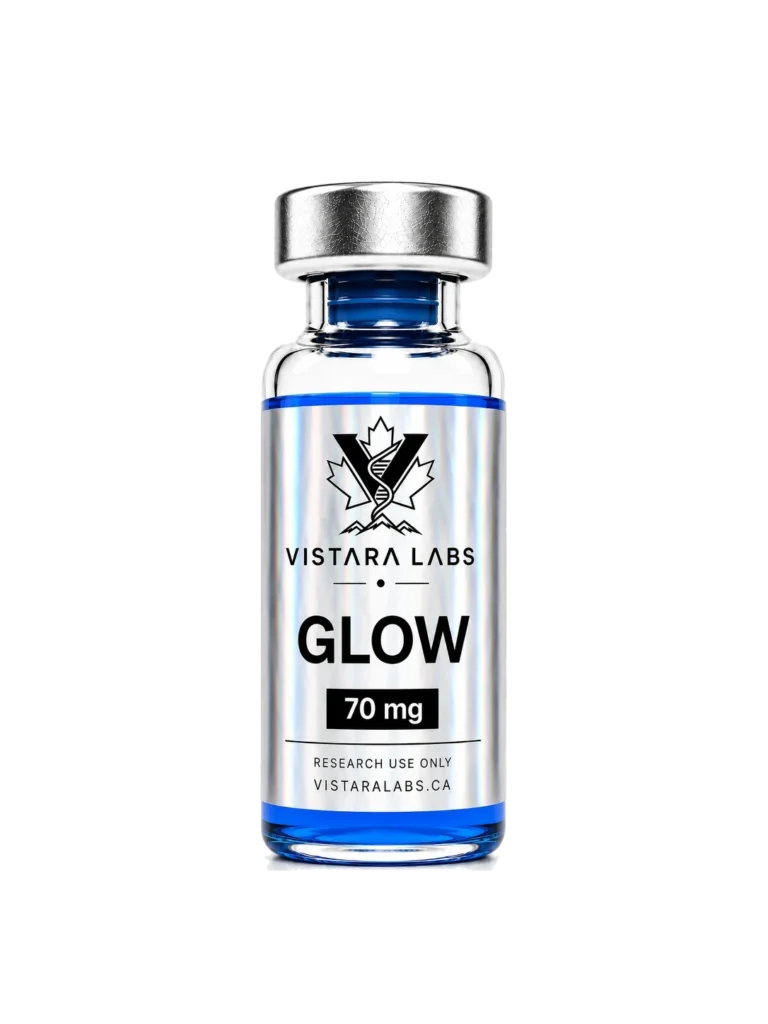
- KLOW carries 50 mg GHK-Cu, the same as the 50 mg GHK-Cu vial and the GLOW Blend; GHK-Cu makes up 62.5% of the KLOW vial by mass.
- GHK-Cu’s human record is topical: in a randomised, placebo-controlled diabetic ulcer trial, GHK-Cu gel tripled the rate of closure against vehicle (1994).
- KPV, the extra peptide over GLOW, reduced colitis in two mouse models and acts through the PepT1 transporter, inhibiting NF-kappaB signalling at nanomolar concentrations (2008).
- BPC-157 has two small uncontrolled clinic reports, including a 2024 pilot in which 10 of 12 women with interstitial cystitis reported complete symptom resolution after one procedure.
- Thymosin beta-4, the parent of TB-500, binds actin, promotes cell migration and reduces scar formation in wound research (2012 review). No study of KLOW as a formulation was identified.
What is in each vial?
| Component | GHK-Cu vial | KLOW Blend vial |
|---|---|---|
| GHK-Cu | 50 mg or 100 mg | 50 mg |
| BPC-157 | None | 10 mg |
| TB-500 | None | 10 mg |
| KPV | None | 10 mg |
| Total | 50 mg or 100 mg | 80 mg |
KLOW is the GLOW Blend plus 10 mg KPV. Its makeup and rationale are covered in What Is KLOW? The Four-Peptide Blend Explained.
What does GHK-Cu bring on its own?
GHK (glycyl-histidyl-lysine) is a tripeptide described in human serum in 1973 (Pickart and Thaler, Nat New Biol), whose plasma level falls from about 200 ng/mL at age 20 to 80 ng/mL by 60 (Pickart and Margolina, Int J Mol Sci, 2018). Bound to copper, it stimulated collagen synthesis in fibroblast cultures from 10-12 M, peaking at 10-9 M (Maquart et al., FEBS Lett, 1988), and it modulates both metalloproteinases and their inhibitors, so it influences the breakdown as well as the building of the matrix (Pickart et al., Biomed Res Int, 2015). In diabetic neuropathic ulcers, GHK-Cu gel produced 98.5% median closure against 60.8% for vehicle, with infections at 7% against 34% (Mulder et al., Wound Repair Regen, 1994). The copper is also why GHK-Cu, GLOW and KLOW are all blue in solution (why GHK-Cu is blue).
What do the other three peptides add?
KPV: the inflammation variable
KPV is lysine-proline-valine, residues 11 to 13 of alpha-MSH. Reviewers identified it as keeping the hormone’s anti-inflammatory effect without its pigmentary action (Brzoska et al., Endocr Rev, 2008). In DSS and T-cell transfer colitis in mice, KPV sped recovery and weight regain and reduced inflammatory infiltrates; in mice without a working melanocortin-1 receptor it rescued every treated animal from death during DSS colitis (Kannengiesser et al., Inflamm Bowel Dis, 2008). It enters intestinal and immune cells through the PepT1 transporter and, at nanomolar concentrations, inhibits NF-kappaB and MAP kinase signalling and cytokine release (Dalmasso et al., Gastroenterology, 2008). KPV is the only difference between KLOW and GLOW. Its comparison with GHK-Cu is in KPV vs GHK-Cu.
BPC-157: the gastric repair peptide
BPC-157 is a 15-amino-acid stable gastric pentadecapeptide, native to human gastric juice, whose research group describes healing of lesions in several organs, protection of blood vessel lining and recruitment of collateral vessels after obstruction in animal models (Sikiric et al., Curr Pharm Des, 2018). Two uncontrolled clinic reports exist. In a 2024 pilot, 12 women with interstitial cystitis who had not responded to pentosan polysulfate received BPC-157 injections around the inflamed bladder area in a single procedure; 10 of 12 reported complete resolution and no adverse events were reported (Lee et al., Altern Ther Health Med, 2024). A 2021 chart review reported knee-pain relief in 14 of 16 patients (Lee and Padgett, Altern Ther Health Med). See BPC-157 for bladder pain.
TB-500: the cell migration peptide
Thymosin beta-4 is a naturally occurring peptide released by platelets, macrophages and other cells after injury. It binds actin and promotes cell migration, including of stem and progenitor cells that form new vessels, and it reduces myofibroblast numbers in wounds, which lowers scar formation (Goldstein et al., Expert Opin Biol Ther, 2012). Analysis of a product sold as TB-500 identified the acetylated 17 to 23 fragment of thymosin beta-4, Ac-LKKTETQ (Esposito et al., Drug Test Anal, 2012), the region that carries the actin-binding motif. More is in TB-500 and Thymosin Beta-4: The Repair Research.
How do GHK-Cu and KLOW compare at a glance?
| Question | GHK-Cu | KLOW Blend |
|---|---|---|
| What is it? | Copper-bound tripeptide | GHK-Cu, BPC-157, TB-500 and KPV in one vial |
| Size | 3 amino acids plus copper | Four peptides, two of them tripeptides |
| Main research area | Collagen, skin, wound closure | Skin, soft-tissue repair and inflammation |
| Mechanism focus | Fibroblast matrix synthesis and remodelling | Adds cell migration, vessel recruitment and NF-kappaB inhibition |
| Human evidence | Topical diabetic ulcer trial | Per component only; none for the blend |
| Ratio control | Full | Fixed at 5 to 1 to 1 to 1 |
| Forms we supply | 50 mg and 100 mg vials, nasal spray | 80 mg vial, nasal spray |
When does each one fit?
- Collagen, matrix or gene-expression work on one molecule: GHK-Cu alone, so any effect can be attributed to the copper peptide.
- Repair designs where inflammation is also measured: KLOW, which pairs the matrix literature with KPV’s anti-inflammatory data and the soft-tissue models of BPC-157 and thymosin beta-4.
- Repair designs without an inflammation arm: the GLOW Blend, the same three peptides without KPV (GHK-Cu vs GLOW).
- Custom ratios or staggered timing: separate vials of GHK-Cu, KPV, BPC-157 and TB-500. The blend-or-singles trade-off is set out in KLOW vs GLOW.
How are GHK-Cu and KLOW supplied?
GHK-Cu comes as 50 mg and 100 mg lyophilised vials and a ready-mixed GHK-Cu Nasal Spray; KLOW as an 80 mg vial and a ready-mixed KLOW Nasal Spray, metered at 0.175 mL per press. Vials are reconstituted with bacteriostatic water (see the GHK-Cu and KLOW reconstitution guides) and kept cold and dark once mixed (how long GHK-Cu lasts). Certificates of analysis are on the lab reports page, and every order ships from within Canada.
GHK-Cu and the KLOW Blend are supplied for laboratory research use only. The studies above used their own preparations of each individual peptide, not this blend.
Frequently asked questions
What is the difference between GHK-Cu and KLOW?
GHK-Cu is a single copper-bound tripeptide. KLOW is an 80 mg blend of 50 mg GHK-Cu with 10 mg each of BPC-157, TB-500 and KPV, adding soft-tissue repair and anti-inflammatory peptides to the same amount of GHK-Cu found in a 50 mg vial.
How much GHK-Cu is in KLOW?
50 mg per 80 mg vial, 62.5% of the blend by mass. GLOW holds the same 50 mg in a 70 mg vial.
Is KLOW better than GHK-Cu?
They answer different questions. KLOW adds three peptides with their own research areas, while GHK-Cu alone isolates the copper peptide. No study has compared the blend with GHK-Cu alone.
What is the difference between KLOW and GLOW?
KLOW is GLOW plus 10 mg KPV, the anti-inflammatory tripeptide from alpha-MSH. The GHK-Cu, BPC-157 and TB-500 amounts are the same in both.
Where can I buy GHK-Cu and KLOW in Canada?
Vistara Labs supplies GHK-Cu as 50 mg and 100 mg vials and a nasal spray, and KLOW as an 80 mg vial and a nasal spray, shipped from within Canada by Canada Post Xpresspost.
Product details from vistaralabs.ca, October 2026. Sources: Pickart L, Thaler MM. Tripeptide in human serum which prolongs survival of normal liver cells and stimulates growth in neoplastic liver. Nat New Biol. 1973. PMID 4349963. Pickart L, Margolina A. Regenerative and protective actions of the GHK-Cu peptide in the light of the new gene data. Int J Mol Sci. 2018. PMID 29986520. Maquart FX et al. Stimulation of collagen synthesis in fibroblast cultures by the tripeptide-copper complex glycyl-L-histidyl-L-lysine-Cu2+. FEBS Lett. 1988. PMID 3169264. Pickart L et al. GHK peptide as a natural modulator of multiple cellular pathways in skin regeneration. Biomed Res Int. 2015. PMID 26236730. Mulder GD et al. Enhanced healing of ulcers in patients with diabetes by topical treatment with glycyl-l-histidyl-l-lysine copper. Wound Repair Regen. 1994. PMID 17147644. Brzoska T et al. Alpha-melanocyte-stimulating hormone and related tripeptides. Endocr Rev. 2008. PMID 18612139. Kannengiesser K et al. Melanocortin-derived tripeptide KPV has anti-inflammatory potential in murine models of inflammatory bowel disease. Inflamm Bowel Dis. 2008. PMID 18092346. Dalmasso G et al. PepT1-mediated tripeptide KPV uptake reduces intestinal inflammation. Gastroenterology. 2008. PMID 18061177. Sikiric P et al. Novel cytoprotective mediator, stable gastric pentadecapeptide BPC 157. Vascular recruitment and gastrointestinal tract healing. Curr Pharm Des. 2018. PMID 29879879. Lee E, Walker C, Ayadi B. Effect of BPC-157 on symptoms in patients with interstitial cystitis: a pilot study. Altern Ther Health Med. 2024. PMID 39325560. Lee E, Padgett B. Intra-articular injection of BPC 157 for multiple types of knee pain. Altern Ther Health Med. 2021. PMID 34324435. Goldstein AL et al. Thymosin beta4: a multi-functional regenerative peptide. Basic properties and clinical applications. Expert Opin Biol Ther. 2012. PMID 22074294. Esposito S et al. Synthesis and characterization of the N-terminal acetylated 17-23 fragment of thymosin beta 4 identified in TB-500, a product suspected to possess doping potential. Drug Test Anal. 2012. PMID 22962027.
More on this: KLOW vs GLOW: Which Blend to Buy, and When to Pick Separate Vials.
All products supplied by Vistara Labs are intended for laboratory research use only. They are not drugs, are not approved for human or veterinary use, and are not intended to diagnose, treat, cure or prevent any condition. Nothing on this page constitutes medical advice or guidance for use in humans.