
Oxytocin Nasal Spray: What the Human Research Shows
Cognitive & Nootropic Research
Oxytocin is one of the few peptides with both a long clinical history and a large human research literature, and almost all of that research delivers it as a nasal spray. This article covers what oxytocin is, what the landmark intranasal studies reported, what the larger trials found, and how our sprays are made up.
 View product →
Findings
- Oxytocin is a nine-amino-acid peptide closed into a ring by a disulfide bridge, molecular weight 1007.2. It was the first peptide hormone made in a laboratory (du Vigneaud, 1953), work recognised with the 1955 Nobel Prize in Chemistry.
- Most human studies give it intranasally, and a nasal dose reaches the cerebrospinal fluid as well as the blood (Striepens et al., 2013).
- Early, small studies reported effects on trust and emotion recognition. The larger trials that followed, in autism (290 and 106 participants) and obesity (61), did not meet their main endpoints.
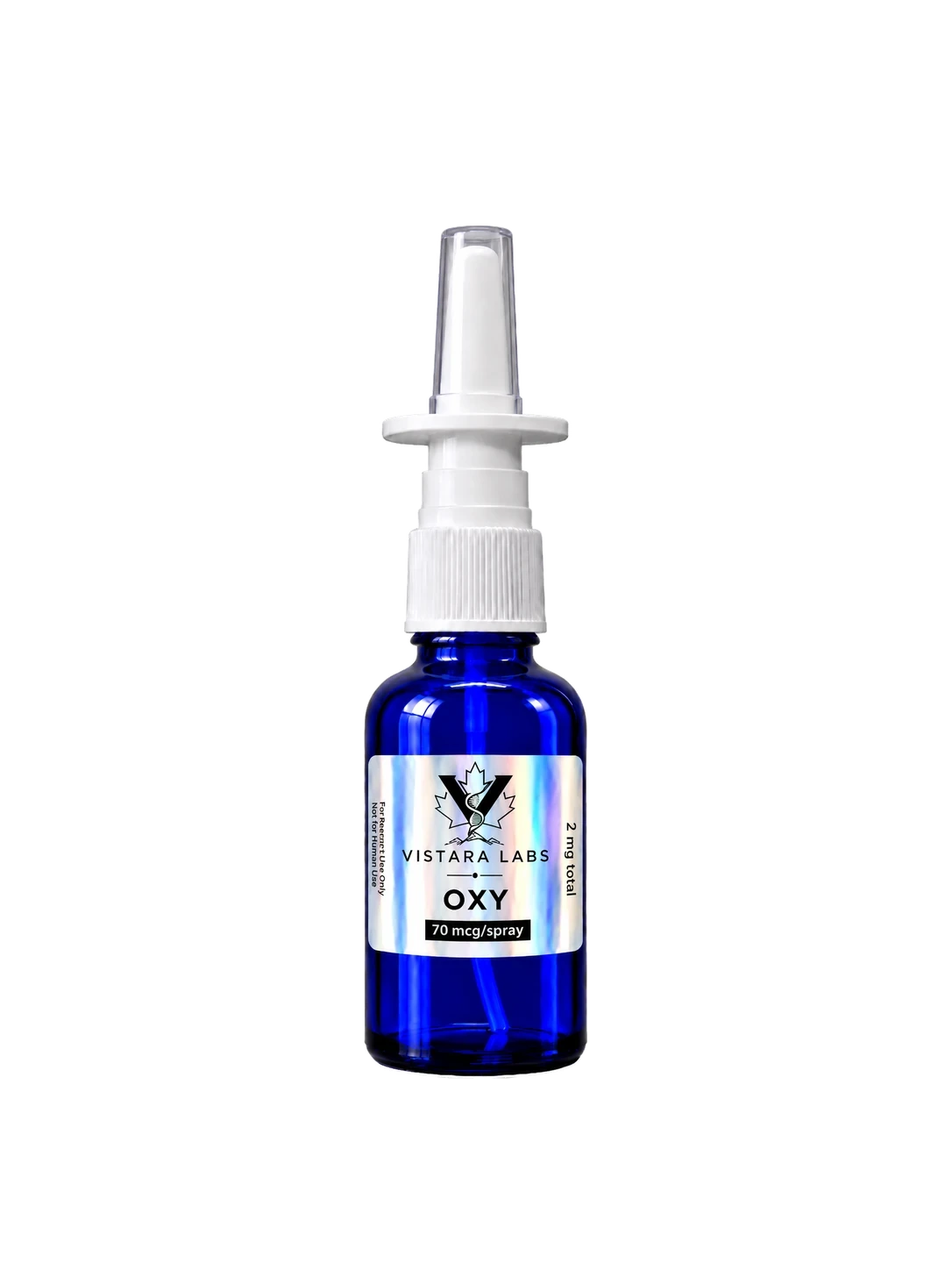
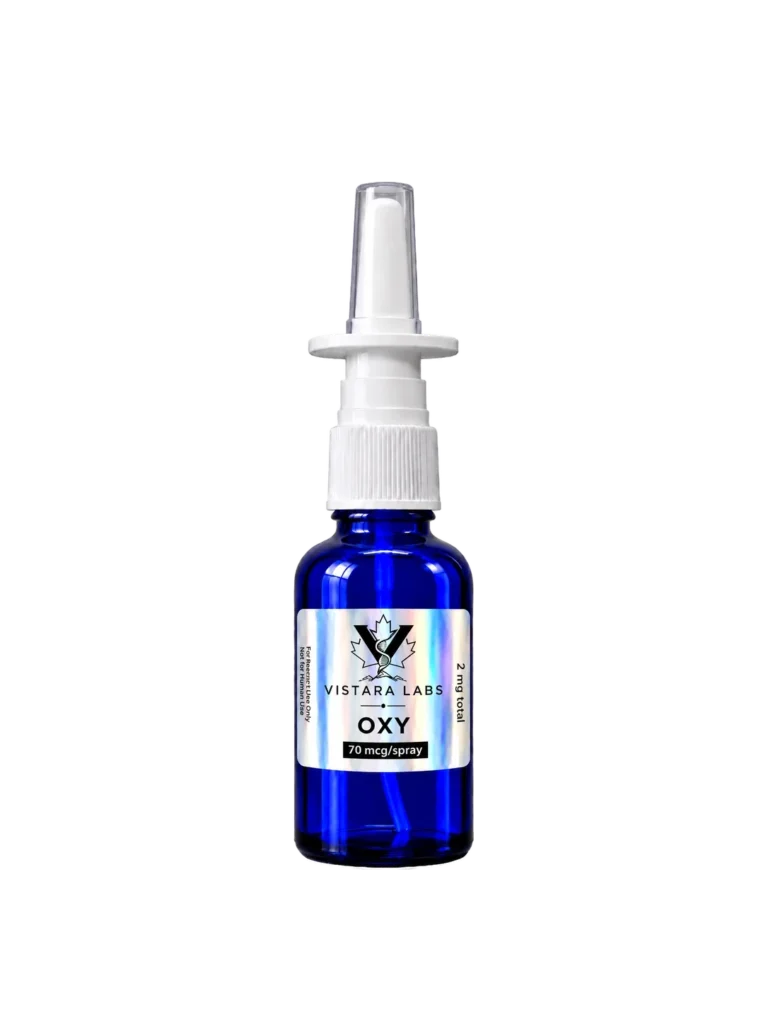
- Our sprays are 400 mcg per mL, about 70 mcg per spray, and arrive pre-mixed: no reconstitution needed.
What oxytocin is
Oxytocin is a cyclic peptide of nine amino acids, Cys-Tyr-Ile-Gln-Asn-Cys-Pro-Leu-Gly-NH2, closed into a ring by a disulfide bridge between its two cysteines. Its formula is C43H66N12O12S2, and it differs from vasopressin at just two positions.
It is made mainly in the paraventricular and supraoptic nuclei of the hypothalamus and released into the blood from the posterior pituitary, with smaller amounts made in the uterus, placenta, testis and heart. It acts on a single receptor, the oxytocin receptor, which belongs to the G protein-coupled family. Its classic roles are uterine contraction in labour and milk let-down in breastfeeding, and in hospitals it is given by infusion or injection around delivery. In the bloodstream it is short-lived, with a half-life of roughly 1 to 6 minutes.
The nasal route is not new. A commercial oxytocin nasal spray was in use for breastfeeding difficulties by 1960. A 1981 BMJ trial in mothers of premature babies reported milk volumes on days 2 to 5 that were 3.5 times higher in first-time mothers given oxytocin than in those given placebo, while a 2006 trial in 51 mothers found no difference in total milk output.
The landmark intranasal studies
| Study | Participants | Design | What was reported |
|---|---|---|---|
| Kosfeld et al., Nature 2005 | Healthy men | Single intranasal dose; a trust game, with a risk game as the control | A substantial increase in trust, not explained by a general willingness to take risks. |
| Guastella et al., Biol Psychiatry 2010 | 16 males aged 12 to 19 with autism | Placebo-controlled crossover | Better scores on the Reading the Mind in the Eyes test. |
| Striepens et al., Sci Rep 2013 | 15 adults (11 oxytocin, 4 placebo) | Single intranasal dose; blood and spinal fluid sampled | Oxytocin rose in both. Blood levels peaked at 15 minutes, spinal fluid levels took up to 75 minutes, and the two did not correlate. |
| Lawson et al., Obesity 2015 | 25 men | Placebo-controlled crossover, single intranasal dose | 122 kcal less eaten at a test meal, a shift toward using fat for fuel, and better insulin sensitivity. |
What the larger trials found
| Trial | Participants | Length | Main result |
|---|---|---|---|
| Sikich et al., NEJM 2021 (SOARS-B) | 290 children and adolescents with autism | 24 weeks, daily | No difference from placebo on the main social-withdrawal measure (change of -3.7 against -3.5, P=0.61). |
| Yamasue et al., Mol Psychiatry 2020 | 106 adult men with autism | 6 weeks, daily | No difference on the main social-reciprocity score (P=0.69); repetitive behaviour and eye-gaze measures improved as secondary outcomes. |
| Declerck et al., Nat Hum Behav 2020 | Healthy adults | Registered replication of the 2005 trust experiment, powered above 95% | No effect of oxytocin on trust in the condition matching the original design. |
| Plessow et al., NEJM Evidence 2024 | 61 adults with obesity | 8 weeks, four times daily | No difference in weight (0.20 kg against 0.26 kg, P=0.934); intake at a test meal was 152 kcal lower. |
Taken together the pattern is familiar from other fields: small early studies with positive results, and larger pre-registered trials that mostly did not reproduce them.
Does a nasal spray reach the brain?
This is the question the field has argued about most. The 2013 spinal-fluid study showed that a nasal dose raises oxytocin in cerebrospinal fluid, and a 2021 review by Quintana and colleagues concluded that the evidence points to functionally relevant nose-to-brain effects. A 2020 imaging study (Martins et al.) adds a nuance: one brain effect of a nasal dose, a drop in blood flow to the amygdala, tracked the oxytocin that reached the bloodstream, and it appeared after an intravenous dose as well.
Handling and storage
Oxytocin is heat-sensitive. How fast it breaks down depends on both temperature and pH, and it is most stable in mildly acidic solution, around pH 4.5 (Hawe et al., 2009). The World Health Organization’s guidance for clinical oxytocin is refrigerated transport and storage at 2 to 8 °C, and the same range suits research solutions: keep the spray, or a reconstituted vial, in the refrigerator.
Spray or vial
We supply oxytocin two ways. The Oxytocin Nasal Spray arrives pre-mixed in a sealed metered atomiser: the 2 mg bottle holds 2 mg in 5 mL of saline (about 29 sprays) and the 4 mg bottle holds 4 mg in 10 mL (about 57 sprays). Both are 400 mcg per mL, so each spray delivers approximately 70 mcg, and no reconstitution is needed. The Oxytocin 2 mg vial is lyophilised and is reconstituted with bacteriostatic water; the oxytocin reconstitution guide and the peptide calculator cover the arithmetic. Certificates of analysis are on the lab reports page.
Oxytocin is supplied for laboratory research use only. For more on nasal delivery, see Semax and Selank: nasal spray or injection and our guide to peptide nasal sprays in Canada.
Frequently asked questions
How much oxytocin is in each spray?
Both sizes are 400 mcg per mL, so each spray delivers approximately 70 mcg. The 2 mg bottle holds about 29 sprays and the 4 mg bottle about 57.
Why is oxytocin studied as a nasal spray?
Most human oxytocin research delivers it intranasally. A 2013 study measured oxytocin rising in cerebrospinal fluid as well as blood after a nasal dose, and the route avoids injection.
What did the largest oxytocin trial find?
SOARS-B, published in the New England Journal of Medicine in 2021, followed 290 children and adolescents with autism for 24 weeks and found no difference from placebo on its main social measure.
Does the oxytocin spray need mixing?
No. It arrives pre-mixed in a sealed metered atomiser. Only the 2 mg lyophilised vial is reconstituted, with bacteriostatic water.
Where can I buy oxytocin nasal spray in Canada?
Vistara Labs supplies oxytocin as a ready-mixed nasal spray in 2 mg and 4 mg sizes and as a 2 mg lyophilised vial, shipped from within Canada. Laboratory research use only.
Sources: Kosfeld M et al. Oxytocin increases trust in humans. Nature. 2005. PMID 15931222. Guastella AJ et al. Intranasal oxytocin improves emotion recognition for youth with autism spectrum disorders. Biol Psychiatry. 2010. PMID 19897177. Striepens N et al. Elevated cerebrospinal fluid and blood concentrations of oxytocin following its intranasal administration in humans. Sci Rep. 2013. PMID 24310737. Lawson EA et al. Oxytocin reduces caloric intake in men. Obesity. 2015. PMID 25865294. Sikich L et al. Intranasal oxytocin in children and adolescents with autism spectrum disorder. N Engl J Med. 2021. PMID 34644471. Yamasue H et al. Effect of intranasal oxytocin on the core social symptoms of autism spectrum disorder. Mol Psychiatry. 2020. PMID 29955161. Declerck CH et al. A registered replication study on oxytocin and trust. Nat Hum Behav. 2020. PMID 32514040. Plessow F et al. Intranasal oxytocin for obesity. NEJM Evid. 2024. PMID 38815173. Quintana DS et al. Advances in the field of intranasal oxytocin research. Mol Psychiatry. 2021. PMID 32807845. Martins DA et al. Effects of route of administration on oxytocin-induced changes in regional cerebral blood flow in humans. Nat Commun. 2020. PMID 32127545. Hawe A et al. Towards heat-stable oxytocin formulations: analysis of degradation kinetics and identification of degradation products. Pharm Res. 2009. PMID 19343484. Ruis H et al. Oxytocin enhances onset of lactation among mothers delivering prematurely. BMJ. 1981. PMID 6788318. Fewtrell MS et al. Randomised, double blind trial of oxytocin nasal spray in mothers expressing breast milk for preterm infants. Arch Dis Child Fetal Neonatal Ed. 2006. PMID 16223754. Gimpl G, Fahrenholz F. The oxytocin receptor system: structure, function, and regulation. Physiol Rev. 2001. PMID 11274341.