HCG Peptide: What It Is, Why It Is Measured in IU, and Its Clinical History
Hormonal, Growth Hormone & Body Composition Research
HCG is the rare item in a research catalogue that needs no introduction to medicine: it has been an approved, prescribed hormone therapy for decades, with a clinical record most compounds never approach. It is also the item that raises the most questions from people arriving from a search for “HCG peptide”, because it is not quite a peptide, it is not measured in milligrams, and its regulatory history is unlike anything else on the shelf. This article covers the clinical record and then answers those questions.
 View product →
Findings
- HCG is an approved medication with decades of clinical use in fertility medicine and hormone therapy.
- It signals the body the same way luteinising hormone does, stimulating natural testosterone production in men and ovulation in women.
- Unlike testosterone replacement, clinical reviews note HCG maintains the body’s own hormone production and fertility rather than shutting it down.
- Structurally it is a glycoprotein of two chains, 92 and 145 amino acids, far larger than a typical research peptide, which is why it is measured in international units rather than milligrams.
- In the United States it has been regulated as a biologic since March 2020, which changed who may make it and how.
What HCG is
Human chorionic gonadotropin is a natural glycoprotein hormone. Structurally it is a close mimic of luteinising hormone (LH), the pituitary signal that tells the testes to make testosterone and the ovaries to release an egg. That mimicry is the entire clinical story: give HCG, and the body’s own hormonal machinery responds.
The molecule is built from two chains. The alpha subunit, 92 amino acids long, is shared with LH, follicle-stimulating hormone and thyroid-stimulating hormone. The beta subunit, 145 amino acids, is what makes HCG HCG, and it is the part that pregnancy tests detect. Both chains carry sugar groups, which is what “glyco” means and why the intact hormone weighs in around 36 to 40 kilodaltons. A typical research peptide such as BPC-157 is 15 amino acids on a single chain. HCG is in a different size class altogether.
The clinical record
HCG has been used clinically since the mid-twentieth century: in fertility medicine to trigger ovulation, and in men to stimulate natural testosterone and sperm production. Its labelled indications in the United States have been stable for decades: prepubertal cryptorchidism not caused by anatomical obstruction, selected cases of hypogonadotropic hypogonadism in males, and induction of ovulation in anovulatory infertile women. A 2021 review in Expert Review of Endocrinology and Metabolism summarised the comparison with testosterone replacement therapy directly: testosterone replacement suppresses the body’s own production and impairs fertility, while HCG stimulates both. That is why the authors describe it as a prime candidate for secondary hypogonadism.
The molecule has one more historical claim: it was the basis of the first reliable pregnancy test. The Aschheim-Zondek test of 1927 detected HCG in urine by its effect on immature mice, and every pregnancy test since, down to the strip in a pharmacy, detects the same beta subunit.
The weight-loss episode, and what the label says
A 1954 letter to The Lancet by the physician Albert Simeons proposed HCG injections alongside a very-low-calorie diet, and the “HCG diet” has resurfaced periodically ever since. It is the reason every HCG product label in the United States carries a mandated statement that HCG has not been demonstrated to be effective adjunctive therapy in the treatment of obesity, and that there is no substantial evidence it increases weight loss beyond that resulting from caloric restriction. Controlled trials from the 1970s onward found the same. This is worth knowing because a large share of online HCG interest still traces back to that diet, and none of the clinical record supports it.
Why the vial says IU, not mg
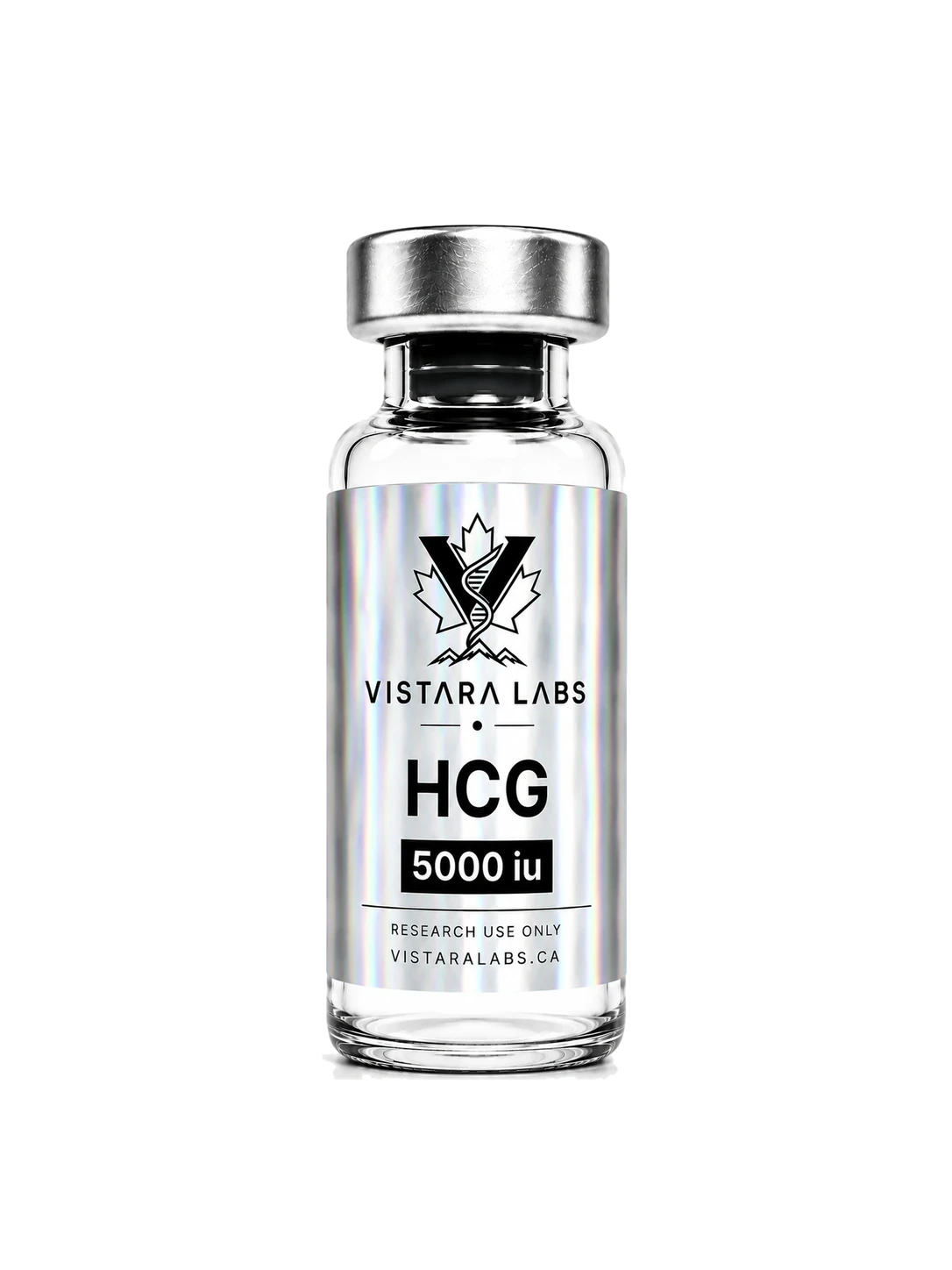
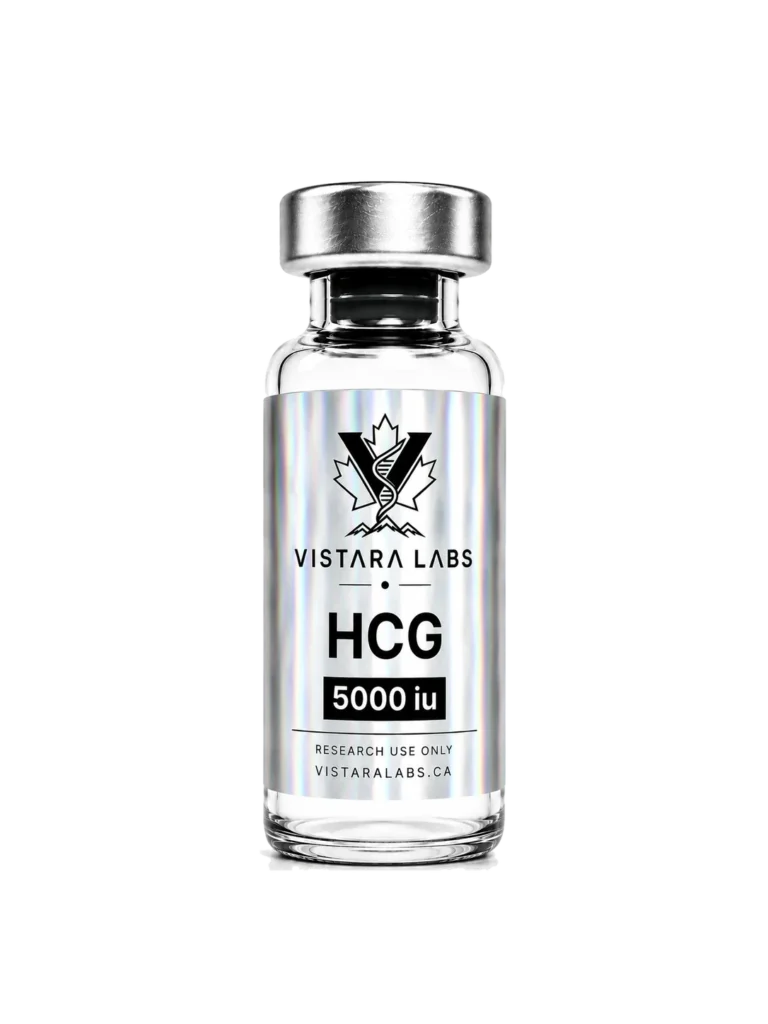
Every other vial in this catalogue is labelled in milligrams, because a synthetic peptide is a single defined molecule whose mass can be weighed and whose purity can be read off an HPLC trace. HCG is a natural glycoprotein with variable sugar chains, so two preparations of identical mass can differ in biological activity. It is therefore standardised the way insulin and other biologics are: by international units of activity, calibrated against a World Health Organization reference standard. A 5,000 IU vial is a statement about potency, not weight. It also means the documentation for HCG reads differently from a synthetic peptide’s certificate, with activity rather than an HPLC purity percentage as the headline figure.
A biologic, not a small molecule
On 23 March 2020 the United States FDA moved chorionic gonadotropin, along with insulin and a set of other protein products, from drug approvals to biologics licences under a transition written into law a decade earlier. The practical consequence was that HCG could no longer be compounded by pharmacies the way it had been, and supply narrowed to the licensed manufacturers. That single change explains most of the shortage stories and the interest in HCG as a research material that followed. In Canada, HCG is a prescription drug under the Food and Drugs Act.
Why it sits in a peptide catalogue
HCG is a peptide-class molecule, a glycoprotein built from amino-acid chains, and it is studied alongside the hormonal axis compounds in this catalogue: the same research territory as tesamorelin and the growth-hormone secretagogues, one axis over. In laboratory settings it is the standard tool for LH-receptor signalling, because it binds the same receptor as LH but with a longer half-life. That is why it appears in reproductive biology, steroidogenesis and receptor-signalling work, and why it is stocked here.
Form, storage and reconstitution
HCG arrives lyophilised, a freeze-dried powder in a sealed vial, because the dry state is far more stable than a solution across shipping and storage. It is reconstituted in the laboratory with bacteriostatic water. Because the vial is labelled in units, the arithmetic is units per millilitre rather than milligrams per millilitre: 5,000 IU into 1 mL gives 5,000 IU/mL, into 2 mL gives 2,500 IU/mL, and so on. As a glycoprotein it is more fragile in solution than a short synthetic peptide: reconstituted HCG is kept refrigerated, not frozen, protected from light, and used within the window the protocol sets. Specific handling is the researcher’s decision.
Frequently asked questions
Is HCG an approved drug?
Yes. HCG has been an approved medication for decades, used clinically in fertility treatment and hormone therapy.
Is HCG a peptide?
Strictly it is a glycoprotein hormone: two amino-acid chains of 92 and 145 residues carrying sugar groups. It is grouped with peptides in research catalogues because it is a protein signal studied on the same hormonal axes, but it is far larger than a typical peptide and is handled and measured differently.
Why is HCG measured in IU instead of mg?
Because it is a natural glycoprotein whose biological activity does not track its mass exactly. It is standardised by international units of activity against a WHO reference, the same way insulin is.
How does HCG differ from testosterone therapy?
Clinical reviews note that testosterone replacement suppresses natural production and fertility, while HCG stimulates the body’s own testosterone and sperm production.
Does HCG help with weight loss?
No. The product labelling in the United States is required to state that HCG has not been shown to be effective for obesity or to increase weight loss beyond caloric restriction, and controlled trials agree.
Sources: Fink J et al., Expert Rev Endocrinol Metab 2021 (PMID 33345656); Nat Rev Urol 2025 (PMID 40346275); US FDA, Novarel and Pregnyl (chorionic gonadotropin for injection, USP) prescribing information, indications and obesity statement; US FDA, “Transition of biological products approved under the FD&C Act to BLAs”, 23 March 2020; Simeons ATW, The action of chorionic gonadotrophin in the obese, Lancet 1954.
References
hCG has an extensive controlled human research literature; it is a glycoprotein hormone rather than a short research peptide.
- Low-dose human chorionic gonadotropin maintains intratesticular testosterone in normal men with testosterone-induced gonadotropin suppressionRandomised trial; 29 normal men on testosterone enanthate randomised to placebo or varying hCG doses.
- A double-blind, placebo-controlled, randomized clinical trial of recombinant human chorionic gonadotropin on muscle strength and physical function and activity in older men with partial age-related androgen deficiencyDouble-blind, placebo-controlled randomised trial in older men with partial age-related androgen deficiency.
Links open the study record on PubMed so the source can be checked directly. Listing a study is not a claim that its findings apply to any other use, product or route of administration. Research use only.