How Much Bacteriostatic Water for a GLOW Blend 70 mg Vial?
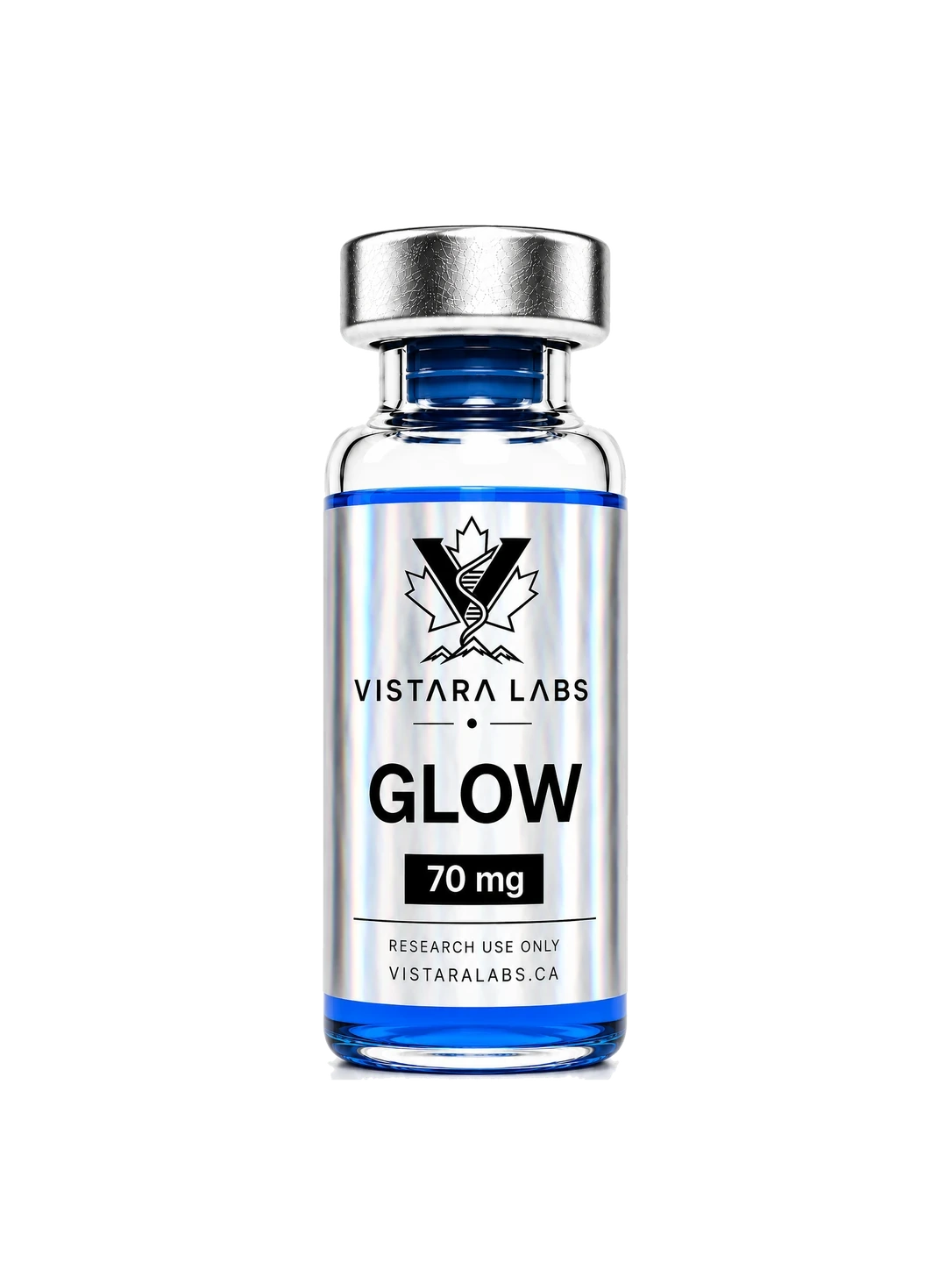
A 70 mg vial of GLOW Blend reconstituted with 2 mL of bacteriostatic water gives a concentration of 35 mg/mL; with 3 mL it gives 23.33 mg/mL. The calculation depends only on the quantity in the vial and the volume of water added, so the figures below apply to any 70 mg vial.
There is no single correct volume. Adding more water does not change how much is in the vial. It spreads the same quantity through a larger volume, which changes how many syringe units correspond to a given amount. The tables on this page use volumes that produce round numbers on a U-100 syringe; other volumes work identically as long as the resulting concentration is written on the vial.
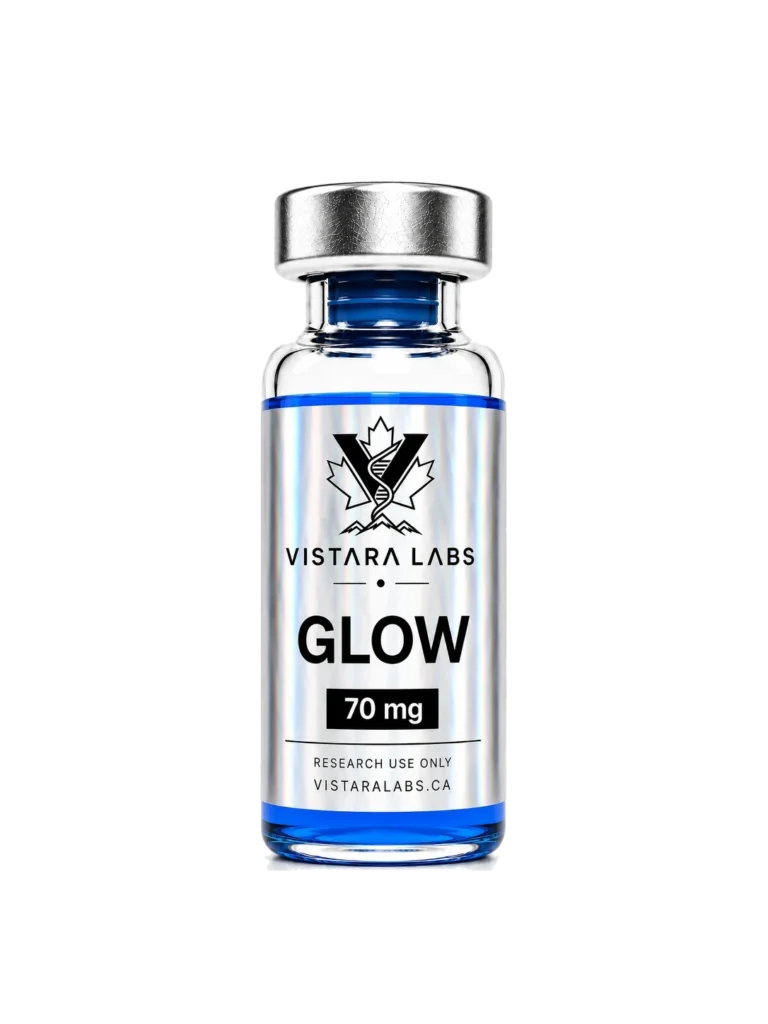 View product →
GLOW Blend reconstitution calculator
Set to this vial below. Change the vial size, water volume, amount or syringe and it recalculates the concentration and the syringe units. For laboratory research use only.
All products are sold strictly for laboratory research use only and are not for human or veterinary consumption. This calculator is provided as a general reference tool.
Concentration by water volume
Concentration is the quantity in the vial divided by the water volume. A 70 mg vial holds 70 mg whether it receives 2 mL or 5 mL; only the mg/mL figure moves. The right-hand column converts each concentration into the number of U-100 units that contain 10 mg.
| Vial | Bacteriostatic water added | Concentration | Units containing 10 mg |
|---|---|---|---|
| 70 mg GLOW | 2 mL | 35 mg/mL | 28.6 units |
| 70 mg | 3 mL | 23.33 mg/mL | 42.9 units |
| 70 mg | 4 mL | 17.5 mg/mL | 57.1 units |
| 70 mg | 5 mL | 14 mg/mL | 71.4 units |
Before choosing a larger volume, check that the vial has headspace for it. One multi-dose vial of bacteriostatic water covers several research vials.
What each draw carries
Because the components are fixed in ratio, the concentration of each one is its own mass divided by the same water volume. At 2 mL the whole vial sits at 35 mg/mL, and each component contributes as follows.
| Component | In the vial | Per 1 mL (100 units) | Per 0.1 mL (10 units) |
|---|---|---|---|
| GHK-Cu | 50 mg | 25 mg | 2.5 mg |
| BPC-157 | 10 mg | 5 mg | 0.5 mg |
| TB-500 | 10 mg | 5 mg | 0.5 mg |
Double the water and every figure in the last two columns halves; the ratio between the components never changes.
Reading the concentration on a U-100 syringe
A U-100 insulin syringe is graduated in units, and 100 units equal 1 mL. Units are therefore millilitres multiplied by 100: 0.1 mL is 10 units and 0.25 mL is 25 units. A 0.5 mL syringe carries 50 units and a 0.3 mL syringe carries 30 units on the same scale, with finer markings that make small volumes easier to read.
To find the volume that contains a given amount, divide the amount by the concentration. At 35 mg/mL (a 70 mg vial with 2 mL of water), the volume that contains 10 mg is 10 divided by 35, which is 0.286 mL, or 28.6 units. The table below runs the same calculation for four arbitrary amounts. They illustrate the arithmetic and nothing else.
| Amount (illustrative) | Volume at 35 mg/mL | U-100 units |
|---|---|---|
| 3.5 mg | 0.1 mL | 10 units |
| 7 mg | 0.2 mL | 20 units |
| 10.5 mg | 0.3 mL | 30 units |
| 17.5 mg | 0.5 mL | 50 units |
At 23.33 mg/mL, which the same vial gives with 3 mL of water, every volume in the table moves in proportion: a 10.5 mg draw measures 45 units instead of 30. Volumes below about 0.1 mL are hard to read accurately on a 1 mL syringe. Either move to a 0.3 mL or 0.5 mL syringe, or reconstitute with more water so that the same mass occupies a larger, more legible volume.
GLOW Blend is supplied by Vistara Labs as a lyophilised material for research use. The quantities on this page illustrate the arithmetic of dilution and measurement only.
The GLOW Blend vial
GLOW Blend is a three-peptide vial: 50 mg GHK-Cu, 10 mg BPC-157 and 10 mg TB-500, 70 mg in total. The three are fixed in that ratio, so one reconstitution sets the concentration of all of them and every draw carries the same proportions. The 70 mg on the label is the combined mass. Certificates of analysis for the catalogue are published on the Lab Results page. The GLOW nasal spray is supplied pre-mixed and needs no reconstitution; this page is for the lyophilised vial only.
The fixed ratio is the point of the blend and also its limit. Once the vial is reconstituted, the three peptides cannot be separated or rebalanced, so a protocol that needs BPC-157 and TB-500 without the copper peptide, or in a different proportion, calls for separate vials instead. The trade-off is set out in blend or separate vials?. GLOW is KLOW without KPV; the two are compared in KLOW vs GLOW.
Reconstitution technique
Let the vial reach room temperature, swab both stoppers, and run the measured water slowly down the inside wall of the vial rather than onto the powder. Swirl or tilt gently until the cake dissolves, never shake, and give any remaining powder a few minutes to settle into solution. Label the vial with the date and the concentration, then keep it refrigerated at 2 to 8 °C and protected from light. The full method, with the reason behind each step, is in how to reconstitute peptides with bacteriostatic water.
Why the solution is blue
Properly reconstituted GLOW Blend forms a clear blue solution. The colour is the copper ion in GHK-Cu and deepens with concentration; it is not a dye and not a fault. What should not appear is cloudiness, visible strands or a gel that will not disperse, which often point to water being added too fast or the vial being shaken. Turbidity that appears after a period of storage can mean the solution has been kept too warm or exposed to light. The causes are covered in more detail in why peptides gel or go cloudy.
Bacteriostatic water, not sterile water
Bacteriostatic water is sterile water with 0.9% benzyl alcohol, a preservative that allows a refrigerated vial to be accessed more than once; plain sterile water is intended for single access. The difference is explained in bacteriostatic water explained.
How much bacteriostatic water for 70 mg GLOW Blend?
A 70 mg GLOW Blend vial is commonly reconstituted with 2 mL of bacteriostatic water, which gives 35 mg/mL; 3 mL gives 23.33 mg/mL, 4 mL gives 17.5 mg/mL and 5 mL gives 14 mg/mL. The table shows how much blend each 0.1 mL of solution contains at each volume. Adding more water does not change the 70 mg in the vial; it only lowers the concentration.
| Water added | Concentration | Amount in 0.1 mL (10 units on a U-100 syringe) |
|---|---|---|
| 2 mL | 35 mg/mL | 3.5 mg |
| 3 mL | 23.33 mg/mL | 2.33 mg |
| 4 mL | 17.5 mg/mL | 1.75 mg |
| 5 mL | 14 mg/mL | 1.4 mg |
For any other water volume, enter it in the peptide calculator on this page and it works out the concentration.
Frequently asked questions
How much bacteriostatic water do I add to a 70 mg vial of GLOW Blend?
There is no single correct volume. With 2 mL of bacteriostatic water a 70 mg vial of GLOW Blend gives 35 mg/mL; with 3 mL it gives 23.33 mg/mL. Adding more water does not change the quantity in the vial, it spreads it through a larger volume, so write the concentration you chose on the vial.
How many 70 mg vials does one vial of bacteriostatic water cover?
One multi-dose vial of bacteriostatic water covers several research vials. Check that the peptide vial has headspace for the volume before choosing a larger one.
How many units on a U-100 syringe contain 10 mg at 35 mg/mL?
At 35 mg/mL (a 70 mg vial with 2 mL of water), the volume that contains 10 mg is 10 divided by 35, which is 0.286 mL, or 28.6 units. Units are millilitres multiplied by 100, so 0.1 mL is 10 units. The amounts on this page illustrate the arithmetic only.
What should reconstituted GLOW Blend look like?
Properly reconstituted GLOW Blend forms a clear blue solution. The colour is the copper ion in GHK-Cu and deepens with concentration; it is not a dye and not a fault. What should not appear is cloudiness, visible strands or a gel that will not disperse, which often point to water being added too fast or the vial being shaken. Turbidity that appears after a period of storage can mean the solution has been kept too warm or exposed to light. More on the causes in why peptides gel or go cloudy.
Can I use sterile water instead of bacteriostatic water?
Only for a vial that will be accessed once. Bacteriostatic water is sterile water with 0.9% benzyl alcohol, a preservative that allows a refrigerated vial to be accessed more than once; plain sterile water is intended for single access. Details in bacteriostatic water explained.
How should a reconstituted GLOW Blend vial be stored?
Refrigerated at 2 to 8 °C, protected from light and labelled with the date and the concentration. Unopened lyophilised vials are kept cold and dark until they are needed. The full storage guide is how to store research peptides.
How much bac water for a 70 mg GLOW Blend vial?
A 70 mg GLOW Blend vial is commonly reconstituted with 2 mL of bacteriostatic water, which gives 35 mg/mL; 3 mL gives 23.33 mg/mL. At 35 mg/mL each 0.1 mL (10 units on a U-100 syringe) contains 3.5 mg.
Work it out for a different vial or concentration
Our peptide calculator opens pre-set for a 70 mg vial with 2 mL of water and marks the 10 mg draw of 28.6 units on a syringe diagram. Change the vial size, water volume, amount or syringe and it recalculates.
Products: GLOW Blend 70 mg and bacteriostatic water.
All products supplied by Vistara Labs are intended for laboratory research use only. They are not drugs, are not approved for human or veterinary use, and are not intended to diagnose, treat, cure or prevent any condition. Nothing on this page constitutes medical advice or guidance for use in humans.
References
No study of the GLOW blend as a complete formulation was identified. The references below cover its individual components.
- Enhanced healing of ulcers in patients with diabetes by topical treatment with glycyl-l-histidyl-l-lysine copperMulticentre randomised, evaluator-blinded, placebo-controlled trial; topical GHK-Cu in diabetic neuropathic ulcers.
- Intra-Articular Injection of BPC 157 for Multiple Types of Knee PainRetrospective chart review, 17 patients (16 followed up by telephone); no control group, no blinding, no validated outcome instrument.
- Synthesis and characterization of the N-terminal acetylated 17-23 fragment of thymosin beta 4 identified in TB-500, a product suspected to possess doping potentialAnalytical chemistry: characterises TB-500 as the N-terminally acetylated 17-23 fragment of thymosin β4 (Ac-LKKTETQ), not the intact 43-amino-acid protein.
- Emerging Use of BPC-157 in Orthopaedic Sports Medicine: A Systematic ReviewSystematic review; 544 records screened, 36 studies included — 35 preclinical and 1 clinical.
Links open the study record on PubMed so the source can be checked directly. Listing a study is not a claim that its findings apply to any other use, product or route of administration. Research use only.