What Is AOD-9604? The Human and Laboratory Research
Weight Loss & Metabolism Research
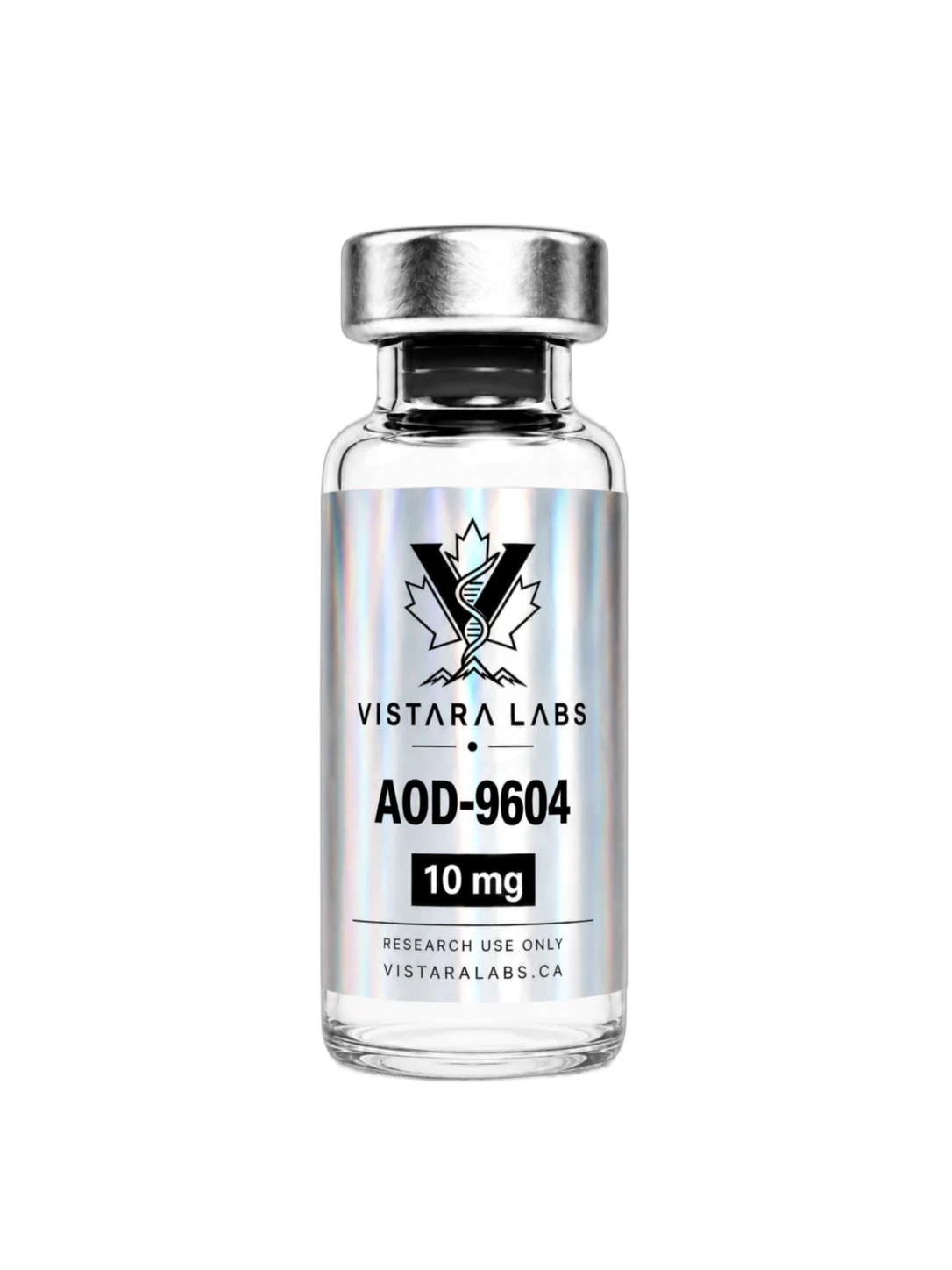
AOD-9604 is a synthetic 16-amino-acid fragment of human growth hormone, built from the hormone’s C-terminal 177–191 sequence with an added tyrosine at the start, and designed to carry growth hormone’s fat-metabolism signal without its effects on IGF-1 and blood sugar. It came out of a long research programme at Monash University in Australia, reached six randomised, placebo-controlled human trials between 2001 and 2006, and showed a safety profile indistinguishable from placebo. Laboratory studies found it increased fat breakdown and fat oxidation, and later work extended it to cartilage research. Vistara Labs supplies it as an AOD-9604 10 mg lyophilised vial.
Findings
- AOD-9604 is Tyr-hGH 177–191: the last fifteen amino acids of growth hormone with one tyrosine added at the N-terminus, which its developers describe as stabilising the peptide.
- Six randomised, double-blind, placebo-controlled trials in 893 adults gave a safety and tolerability profile indistinguishable from placebo (pooled analysis, 2013).
- In those trials AOD-9604 had no effect on serum IGF-1 and no negative effect on glucose tolerance, the two effects most associated with full-length growth hormone.
- In a 12-week randomised trial, participants receiving AOD-9604 lost an average of 2.6 kg against 0.8 kg on placebo.
- Preclinical studies found AOD-9604 increased lipolysis and fat oxidation without binding the growth hormone receptor, and enhanced cartilage regeneration in a laboratory osteoarthritis model.
 View product →
What is AOD-9604?
Human growth hormone is a 191-amino-acid protein made by the pituitary gland. Besides its effects on growth, it acts on fat tissue: it promotes the breakdown of stored fat (lipolysis) and holds back the building of new fat (lipogenesis). A group in the Department of Biochemistry at Monash University, led by Frank Ng, set out to find which part of the hormone carries that fat-tissue signal.
The answer pointed to the end of the chain. In 1993 the group showed that a synthetic copy of residues 177–191, the hormone’s last fifteen amino acids, had antilipogenic activity identical to that of the intact hormone (Wu and Ng, Biochem Mol Biol Int, 1993). That 15-residue peptide was developed as AOD-9401. Its successor, AOD-9604, adds a tyrosine to the N-terminal end, making a 16-residue peptide, a hexadecapeptide. The pooled safety report describes it as Tyr-hGH 177–191 with an additional tyrosine “that stabilizes the peptide” (Stier et al., J Endocrinol Metab, 2013), and an anti-doping laboratory analysis gives the same structure (Cox et al., Drug Test Anal, 2015).
Where the name comes from
AOD stands for anti-obesity drug (Mendias and Awan, Sports Med, 2026), and the compound was taken into clinical trials by the Australian company Metabolic Pharmaceuticals. Because AOD-9604 covers the same 16 positions as hGH 176–191, with a tyrosine where the native hormone has phenylalanine, it is often sold as “HGH Fragment 176–191”. The relationship between the two names is set out in AOD-9604 vs HGH Fragment 176–191.
How AOD-9604 is thought to work
Full-length growth hormone acts through the growth hormone receptor, and much of its effect on growth runs through IGF-1, made in the liver in response. That route also explains growth hormone’s best-known metabolic drawbacks: higher IGF-1 and reduced insulin sensitivity. AOD-9604 was designed to step around it.
Laboratory work supports that design. In receptor-binding assays AOD-9604 did not compete for the growth hormone receptor, and it did not trigger cell proliferation through that receptor, unlike growth hormone itself (Heffernan et al., Int J Obes, 2001). Yet it still reproduced the hormone’s fat-tissue actions: earlier work with the 177–191 peptide showed it stimulated hormone-sensitive lipase, the enzyme that releases stored fat, and inhibited acetyl-CoA carboxylase, a key enzyme in fat synthesis (Ng et al., J Mol Endocrinol, 2000). The authors of the 2001 study concluded that growth hormone fragments can work through routes distinct from the classical growth hormone pathway.
A second line of work looked at beta-3 adrenergic receptors, the main lipolytic receptors on fat cells. In a preclinical obesity model, both growth hormone and AOD-9604 reduced body weight and body fat over 14 days and raised beta-3 receptor expression back to the levels seen in lean controls. AOD-9604 still increased energy expenditure and fat oxidation acutely in models lacking that receptor, which led the authors to conclude that it raises beta-3 receptor expression without acting through the receptor directly (Heffernan et al., Endocrinology, 2001).
What the human studies have shown
Six trials from 2001 to 2006
Metabolic Pharmaceuticals ran six randomised, double-blind, placebo-controlled trials between 2001 and 2006, with 893 adults taking part. The first was in healthy men; the other five were in adults with obesity. The first two gave AOD-9604 by intravenous infusion, and the other four by mouth, as capsules or, in the last trial, tablets. The two largest trials ran for 12 weeks in 300 adults and for 24 weeks in more than 500 (Stier et al., J Endocrinol Metab, 2013, supplementary data).
Safety and tolerability
The pooled safety analysis focused on the effects that would be expected if AOD-9604 behaved like growth hormone: rising IGF-1, insulin resistance and impaired glucose tolerance. It found none of them. AOD-9604 had no effect on serum IGF-1 levels; oral glucose tolerance tests showed that, in contrast with growth hormone, it had no negative effect on carbohydrate metabolism; and no antibodies against AOD-9604 were detected in any participant tested. In none of the six trials did a withdrawal or serious adverse event occur that was related to AOD-9604. The authors concluded that it showed a very good safety and tolerability profile, indistinguishable from placebo (Stier et al., J Endocrinol Metab, 2013).
Body weight
In the 12-week randomised trial, participants receiving AOD-9604 lost an average of 2.6 kg, compared with 0.8 kg in the placebo group. The developer’s larger 24-week trial found a difference that did not reach statistical significance, and its obesity programme ended in 2007 (Valentino et al., Clin Pharmacol Ther, 2010).
GRAS status
With the safety data published, AOD-9604 was designated Generally Recognised As Safe (GRAS) in the United States in 2014, allowing its use as an ingredient in foods, drinks and dietary supplements (LabOnline, 2014).
What the preclinical studies showed
Weight gain and insulin sensitivity
In a preclinical obesity model, AOD-9604 given by mouth every day for 19 days cut weight gain by more than half compared with controls, and fat tissue from the treated group showed increased lipolytic activity. Unlike long-term treatment with intact growth hormone, it had no adverse effect on insulin sensitivity, measured by euglycaemic clamp (Ng et al., Horm Res, 2000).
Fat oxidation and lipolysis
Over 14 days of continuous delivery, both growth hormone and AOD-9604 reduced weight gain, increased fat oxidation and raised plasma glycerol, a marker of fat breakdown. Unlike growth hormone, AOD-9604 did not cause high blood sugar or reduce insulin secretion (Heffernan et al., Int J Obes, 2001).
Human fat tissue in the laboratory
The parent 177–191 peptide, AOD-9401, increased lipolytic activity and decreased lipogenic activity in isolated adipose tissue, including human adipose tissue studied in the laboratory. Given by mouth for 30 days in a preclinical obesity model, it lowered weight gain from day 16 onward without changing food intake (Heffernan et al., Am J Physiol Endocrinol Metab, 2000).
Cartilage and joints
Later research moved beyond fat metabolism. In a laboratory model of knee osteoarthritis, weekly ultrasound-guided injections of AOD-9604 into the joint enhanced cartilage regeneration on both gross and microscopic scoring. Combining AOD-9604 with hyaluronic acid gave better scores than either alone, and the combined group recovered normal joint function soonest (Kwon and Park, Ann Clin Lab Sci, 2015).
AOD-9604 at a glance
| Question | AOD-9604 |
|---|---|
| Structure | Tyr-hGH 177–191, 16 amino acids |
| Molecular weight | About 1815 Da |
| Growth hormone receptor | Does not compete for it |
| Serum IGF-1 in trials | No effect |
| Human trials | Six placebo-controlled, 893 adults |
| Routes in human trials | Intravenous and oral |
| Main research areas | Lipolysis, fat oxidation, cartilage |
| US status | GRAS food ingredient, 2014 |
How AOD-9604 compares with other compounds
AOD-9604 acts on fat tissue directly, which separates it from tesamorelin, a GHRH analogue that works at the pituitary and raises the body’s own growth hormone and IGF-1 (AOD-9604 vs Tesamorelin). Other compounds in metabolism research act on different targets again: MOTS-c is a mitochondrial peptide, 5-Amino-1MQ is a small-molecule NNMT inhibitor, and cagrilintide is an amylin analogue. Our weight loss and metabolism research notes cover them side by side.
How Vistara Labs supplies AOD-9604
AOD-9604 comes as a 10 mg lyophilised vial, reconstituted with bacteriostatic water; the concentration arithmetic is in how much bacteriostatic water for AOD-9604. Certificates of analysis for our catalogue are on the lab reports page, and ordering details are in Buy AOD-9604.
AOD-9604 is supplied by Vistara Labs for laboratory research use only. The human studies above were clinical research using pharmaceutical preparations given intravenously or by mouth under medical supervision.
Frequently asked questions
What is AOD-9604?
AOD-9604 is a synthetic 16-amino-acid fragment of human growth hormone, the C-terminal 177-191 sequence with an added tyrosine at the start. It was designed to keep growth hormone’s effect on fat metabolism without its effects on IGF-1 and blood sugar.
What did the human AOD-9604 trials show?
Six randomised, double-blind, placebo-controlled trials in 893 adults gave a safety and tolerability profile indistinguishable from placebo. AOD-9604 had no effect on serum IGF-1, no negative effect on glucose tolerance, and no antibodies against it were detected.
What did AOD-9604 research show for body weight?
In a 12-week randomised trial, participants receiving AOD-9604 lost an average of 2.6 kg, compared with 0.8 kg on placebo. In preclinical studies it cut weight gain by more than half over 19 days and increased fat oxidation and lipolysis.
Does AOD-9604 act like growth hormone?
Only on fat tissue. Laboratory studies found it reproduced growth hormone’s effects on lipolysis and fat synthesis but did not compete for the growth hormone receptor, did not trigger cell proliferation and did not raise blood sugar.
What did AOD-9604 cartilage research show?
In a laboratory model of knee osteoarthritis, injections of AOD-9604 into the joint enhanced cartilage regeneration, and AOD-9604 combined with hyaluronic acid worked better than either alone (2015).
Product details from vistaralabs.ca, October 2026. Sources: Wu Z, Ng FM. Antilipogenic action of synthetic C-terminal sequence 177-191 of human growth hormone. Biochem Mol Biol Int. 1993. PMID 8358331. Ng FM et al. Metabolic studies of a synthetic lipolytic domain (AOD9604) of human growth hormone. Horm Res. 2000. PMID 11146367. Ng FM et al. J Mol Endocrinol. 2000. PMID 11116208. Heffernan MA et al. Effects of oral administration of a synthetic fragment of human growth hormone on lipid metabolism. Am J Physiol Endocrinol Metab. 2000. PMID 10950816. Heffernan MA et al. Int J Obes Relat Metab Disord. 2001. PMID 11673763. Heffernan M et al. Endocrinology. 2001. PMID 11713213. Valentino MA et al. Central and peripheral molecular targets for antiobesity pharmacotherapy. Clin Pharmacol Ther. 2010. PMID 20445536. Stier H, Vos E, Kenley D. Safety and tolerability of the hexadecapeptide AOD9604 in humans. J Endocrinol Metab. 2013. doi:10.4021/jem157w. AOD9604 awarded safe status in US. LabOnline. 2014. labonline.com.au. Cox HD et al. Detection and in vitro metabolism of AOD9604. Drug Test Anal. 2015. PMID 25208511. Kwon DR, Park GY. Ann Clin Lab Sci. 2015. PMID 26275694. Mendias CL, Awan TM. Safety and efficacy of approved and unapproved peptide therapies for musculoskeletal injuries and athletic performance. Sports Med. 2026. PMID 41966639.
More on this: AOD-9604 vs HGH Fragment 176–191: How the Two Peptides Relate.
All products supplied by Vistara Labs are intended for laboratory research use only. They are not drugs, are not approved for human or veterinary use, and are not intended to diagnose, treat, cure or prevent any condition. Nothing on this page constitutes medical advice or guidance for use in humans.