How Long Does Bacteriostatic Water Last?
An unopened vial of bacteriostatic water lasts until the expiry date printed on its label. Once the stopper has been punctured, the standard convention is 28 days: the CDC says an opened multi-dose vial should be dated and discarded within 28 days unless the manufacturer specifies otherwise, and never past the original expiry. Below is where the 28-day figure comes from, how the water is stored, and the signs that mean a vial is discarded sooner.
Findings
- Unopened: the CDC says an unopened multi-dose vial is discarded according to the manufacturer’s expiration date.
- Opened: once needle-punctured, the vial is dated and discarded within 28 days unless the manufacturer gives a different date (CDC), the same default set for multiple-dose containers in USP chapter <797>.
- The 28 days lines up with the 28-day antimicrobial effectiveness test in USP chapter <51>, which the preservative in bacteriostatic water has to pass.
- Hospira’s label gives a storage range of 20 to 25 °C; cloudiness, particles, discolouration or a damaged stopper mean the vial is discarded regardless of date.
 View product →
How long does unopened bacteriostatic water last?
Until the expiry date on the vial. Bacteriostatic water for injection is a sealed, sterile pharmaceutical-grade product, and the manufacturer assigns the expiry from its own stability data. The CDC’s injection safety guidance puts it plainly: an unopened multi-dose vial “should be discarded according to the manufacturer’s expiration date” (CDC, Preventing Unsafe Injection Practices).
Storage conditions are part of that promise. Hospira’s label for Bacteriostatic Water for Injection, USP specifies storage at 20 to 25 °C (68 to 77 °F) (Hospira, Bacteriostatic Water for Injection label, 2019). A vial kept within that range, sealed and out of direct heat and light, holds to its printed date.
How long does bacteriostatic water last once opened?
The working rule is 28 days from the first puncture. The CDC states that “once a multi-dose vial is opened (e.g., needle-punctured) the vial should be dated and discarded within 28 days unless the manufacturer specifies a different (shorter or longer) date for that opened vial”, and adds that this beyond-use date “should never exceed the manufacturer’s original expiration date” (CDC, Preventing Unsafe Injection Practices).
Two consequences follow. First, the clock starts at the first needle, not at purchase, so the date of first puncture is written on the vial. Second, whichever comes first wins: a vial opened ten days before its printed expiry is finished at the printed expiry, not 28 days later.
Where the 28 days comes from
The figure is a pharmacy and infection-control convention for preserved multi-dose containers. USP chapter <797>, the US standard for sterile compounding, sets the beyond-use date after “initially entering or opening (e.g., needle-punctured multiple-dose containers)” at 28 days unless the manufacturer specifies otherwise (Minnesota Department of Health, summarising USP <797>).
It also matches the way preservatives are tested. Under USP chapter <51>, a preserved injectable is deliberately inoculated with organisms and sampled at 7, 14 and 28 days. To pass, bacteria must fall by at least 1.0 log (90%) by day 7 and 3.0 log (99.9%) by day 14, then show no increase to day 28 (USP 32, chapter <51>). The USP monograph for bacteriostatic water requires its preservative, usually 0.9% benzyl alcohol, to meet that test (USP 35, Bacteriostatic Water for Injection monograph). Twenty-eight days is the period over which preservative performance has actually been demonstrated.
The 28-day rule applies to the bacteriostatic water vial. A peptide solution made with it has its own stability limits, which depend on the compound. See how long peptides last after mixing, with compound pages for BPC-157 and retatrutide.
Unopened vs opened at a glance
| State | How long | Source |
|---|---|---|
| Sealed, never punctured | To the printed expiry date | CDC; manufacturer label |
| Punctured (multi-dose vial) | 28 days from first entry, unless the manufacturer says otherwise | CDC; USP <797> |
| Punctured, expiry sooner than 28 days | To the printed expiry date | CDC |
| Sterility in doubt | Discard at once | CDC |
| Plain sterile water, opened | Discard unused portion | Hospira sterile water label |
How should bacteriostatic water be stored?
The manufacturer’s range for the water itself is controlled room temperature, 20 to 25 °C, so an unopened vial does not need the refrigerator. Some laboratories keep an opened vial cold alongside their reconstituted peptides, which keeps everything for a study in one place; either way, the 28-day limit still applies from the date of first puncture.
What protects an opened vial most is handling. The rubber stopper is swabbed with alcohol and allowed to dry before every entry, a fresh sterile needle is used each time, and the vial is kept capped and upright between uses. Those habits matter more than temperature, because the preservative slows growth but cannot undo a heavy contamination. The full bench routine is in how to reconstitute peptides with bacteriostatic water, and storage for the peptides themselves is in how to store research peptides.
Signs a vial is discarded early
The CDC’s rule is to “always discard medication vials whenever sterility is compromised or questionable”, whatever the date. Hospira’s label also instructs that parenteral products are “inspected visually for particulate matter and discoloration”. In practice a vial is discarded when any of these appear:
- Cloudiness or haze. Bacteriostatic water is clear and colourless. Any turbidity suggests growth or contamination.
- Visible particles or strands. Floating matter, flakes or fibres in the liquid.
- Discolouration. Any yellow or other tint.
- A damaged closure. A cracked vial, a stopper that is cored, torn or pushed in, or a flip-off cap missing on a vial that was never opened.
- An unknown first-puncture date. If nobody recorded when the vial was first entered, there is no way to apply the 28-day rule.
- Past either date. More than 28 days since first puncture, or past the printed expiry.
A cloudy peptide solution is a separate question from cloudy water; peptides can gel or turn hazy for chemical reasons, covered in why peptides gel or go cloudy.
Does sterile water last as long?
No. Plain sterile water for injection has no preservative and is labelled for single use: “Do not reuse single-dose containers. Discard unused portion” (Hospira, Sterile Water for Injection label). It carries no 28-day window after opening. The comparison is laid out in bacteriostatic water vs sterile water, and the saline equivalent in bacteriostatic water vs saline.
Planning vial use around 28 days
Because the window is fixed, a multi-dose vial suits typical peptide work: a 10 mg vial reconstituted with 2 mL, as in the BPC-157 reconstitution page, draws a small fraction of one water vial, and several peptide vials can be prepared from the same water within its 28 days. The peptide calculator shows the concentration for any vial size and water volume, and the retatrutide reconstitution page works through the 10 mg and 20 mg vials.
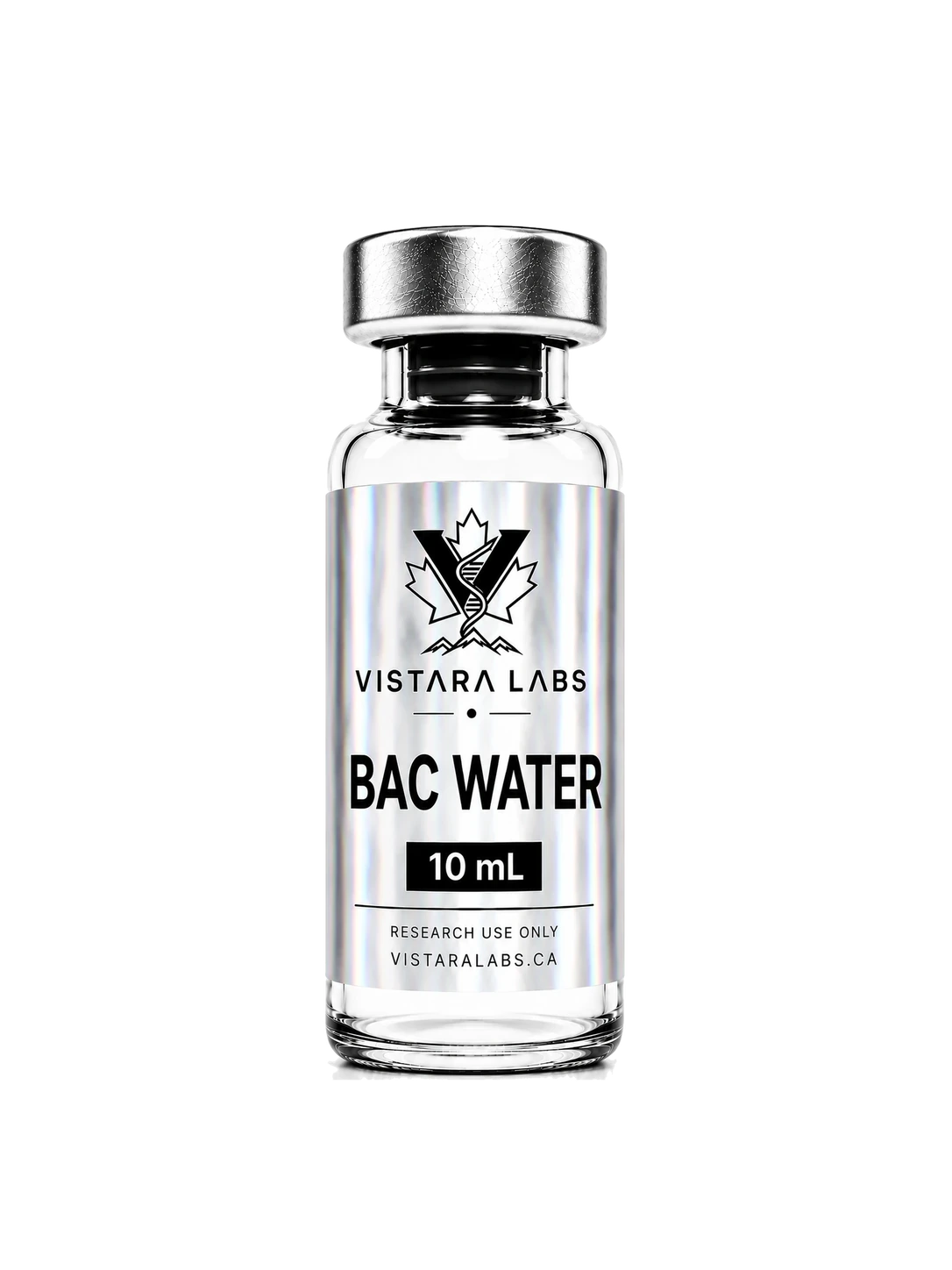
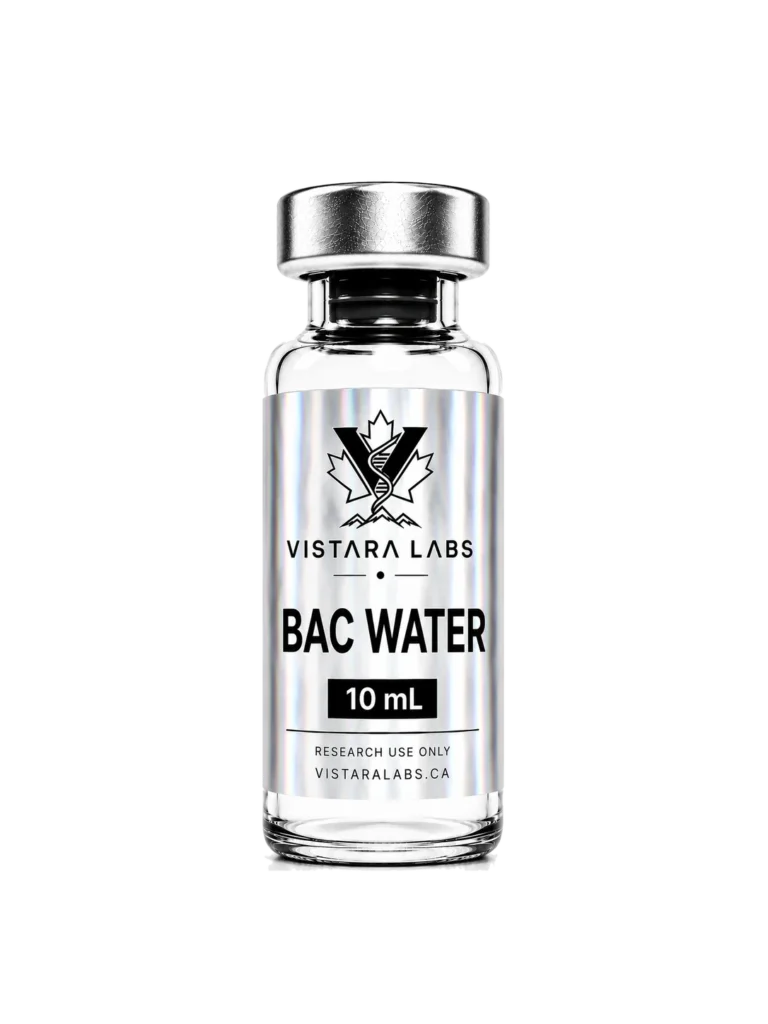
Vistara Labs supplies bacteriostatic water in multi-dose vials of sterile water with 0.9% benzyl alcohol, shipped from within Canada by Canada Post Xpresspost. More on the product itself is in bacteriostatic water explained.
Frequently asked questions
How long does bacteriostatic water last?
Unopened, until the expiry date printed on the vial. Once punctured, the CDC and USP chapter 797 convention is 28 days, unless the manufacturer specifies a different period, and never beyond the printed expiry.
How long is bacteriostatic water good for after opening?
28 days from the first needle puncture. The vial is dated when first entered and discarded at 28 days or at the printed expiry, whichever comes first, or immediately if sterility is in doubt.
Does bacteriostatic water need to be refrigerated?
The manufacturer label specifies storage at 20 to 25 °C, so unopened vials are kept at room temperature. Some laboratories keep opened vials refrigerated with their reconstituted peptides; the 28-day limit applies either way.
Why is opened bacteriostatic water discarded after 28 days?
It is the beyond-use date set for opened multi-dose containers by USP chapter 797 and the CDC, and it matches the 28-day antimicrobial effectiveness test in USP chapter 51 that the benzyl alcohol preservative has to pass.
What does bad bacteriostatic water look like?
Good bacteriostatic water is clear and colourless. Cloudiness, visible particles or strands, discolouration, or a damaged stopper are reasons to discard a vial regardless of its date.
Product details from vistaralabs.ca, October 2026. Sources: Centers for Disease Control and Prevention. Preventing Unsafe Injection Practices. CDC. Minnesota Department of Health. Safe injection practices webinar (USP <797> beyond-use dating). MDH. United States Pharmacopeia. Chapter <51> Antimicrobial Effectiveness Testing. USP 32. Chapter text. United States Pharmacopeia. Bacteriostatic Water for Injection monograph. USP 35. Monograph text. Hospira. Bacteriostatic Water for Injection, USP, prescribing information. Revised 2019. Pfizer labeling. Hospira. Sterile Water for Injection, USP, prescribing information. Pfizer labeling.
More on this: Bacteriostatic Water: What It Is and Why Labs Use It and Buy Bacteriostatic Water in Canada.
All products supplied by Vistara Labs are intended for laboratory research use only. They are not drugs, are not approved for human or veterinary use, and are not intended to diagnose, treat, cure or prevent any condition. Nothing on this page constitutes medical advice or guidance for use in humans.