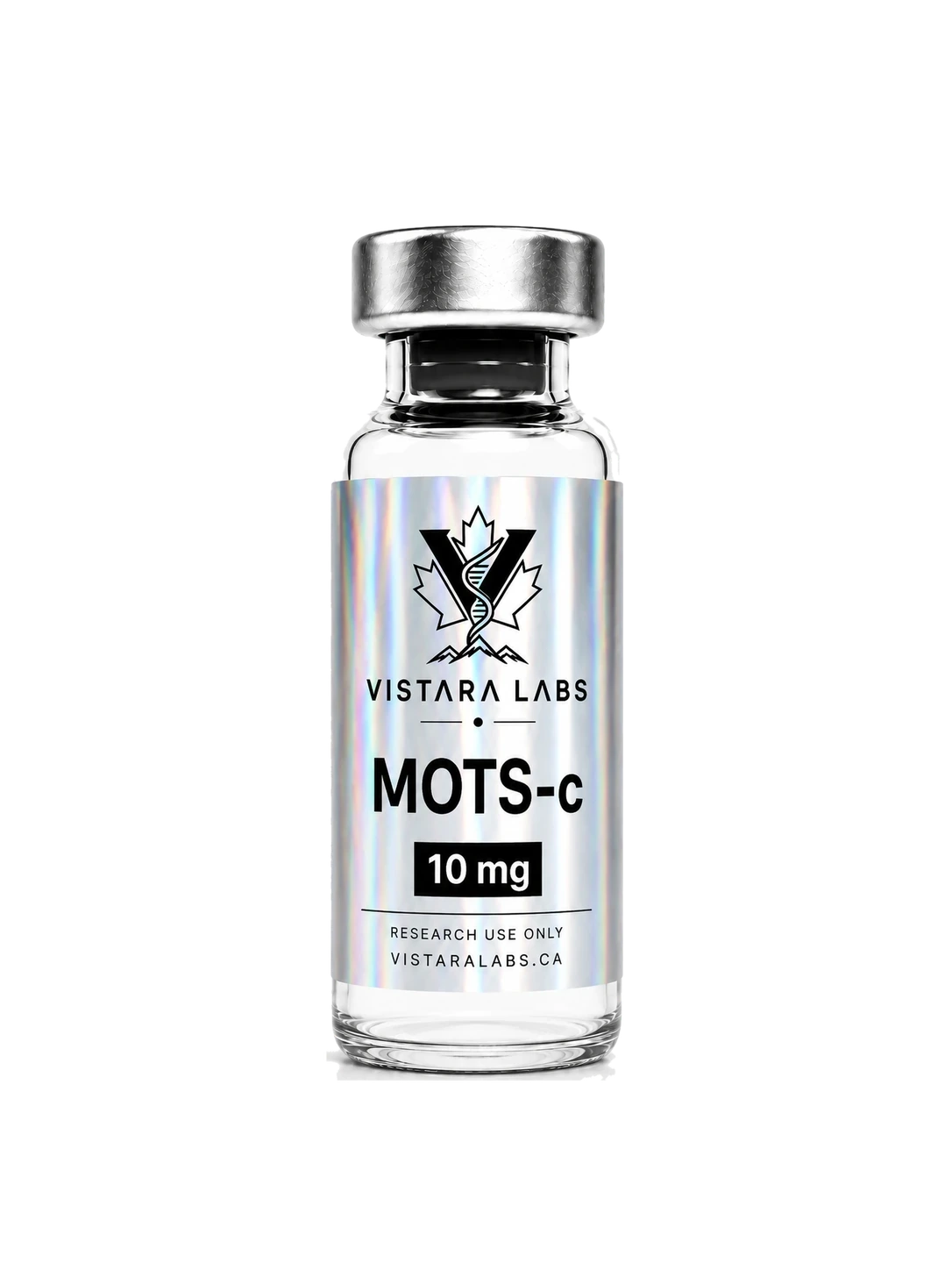
MOTS-c Side Effects: What the Research Reports
Cellular Energy & Mitochondrial Research
In the mouse studies that defined MOTS-c, treatment prevented diet-induced obesity and insulin resistance and improved physical capacity in young and old animals, and the recorded side observations were modest: small falls in food intake, body weight and blood glucose (Lee et al., Cell Metab, 2015; Reynolds et al., Nat Commun, 2021). The published work to date is laboratory research: no peer-reviewed human trial of MOTS-c itself has reported adverse events. This page sets out what the animal work recorded, what is known about MOTS-c in the human body, and the closest human data, from an engineered analogue.
Findings
- MOTS-c is a 16-amino-acid peptide encoded in mitochondrial DNA, found in human and rodent plasma, whose main target appears to be skeletal muscle (Lee et al., 2015).
- In mice, short-term treatment produced modest reductions in body weight, food intake and blood glucose, and lowered the inflammatory markers IL-6 and TNF-alpha (Lee et al., 2015).
- Old mice treated three times a week from late life kept body weight comparable to untreated mice, ate less in total and were more physically capable (Reynolds et al., 2021).
- In humans, a bout of exercise raised MOTS-c in muscle 11.9-fold and in blood 1.5-fold, so the body is already exposed to changing levels (Reynolds et al., 2021).
 View product →
What is MOTS-c?
MOTS-c (mitochondrial open reading frame of the 12S rRNA type-c) is a short peptide coded by the DNA inside mitochondria, the structures that produce most of a cell’s energy. Its first description in 2015 showed that mitochondria send signals to the rest of the body, not only to their own cell. In cells, MOTS-c inhibits the folate cycle and the purine-building pathway tied to it, which leads to activation of AMPK, an enzyme that acts as the cell’s energy sensor (Lee et al., Cell Metab, 2015). More background is in What Is MOTS-c? and MOTS-c: Exercise, Heat and the Mitochondrial Signal.
What did the animal studies record?
Metabolism, 2015
The founding study tested MOTS-c in several mouse models. In normal-diet mice treated for four days, the researchers observed modest reductions in body weight, food intake and blood glucose, together with lower circulating IL-6 and TNF-alpha, two inflammatory signals linked to insulin resistance. In mice on a high-fat diet, MOTS-c prevented diet-induced obesity and insulin resistance; the difference in body weight was not explained by food, because caloric intake was identical between groups. Treatment also prevented age-dependent insulin resistance (Lee et al., Cell Metab, 2015).
Physical capacity and ageing, 2021
A follow-up study treated young, middle-aged and old mice. MOTS-c improved treadmill and rotarod performance at every age, slowed fat gain and, at the higher level tested, increased lean mass in young mice. Old mice given intermittent treatment from 23.5 months of age had better-maintained blood glucose, body weight comparable to untreated animals, lower total food intake and higher activity, and the authors reported increased physical capacity and healthspan (Reynolds et al., Nat Commun, 2021).
Neither study reported toxicity findings. The changes recorded alongside the main results, lower food intake, lower blood glucose and slower fat gain, are the same metabolic effects the studies set out to measure. A formal toxicology programme of the kind run for licensed medicines has not been published.
Other laboratory models
Researchers have since studied MOTS-c in cell and animal models of lung injury after heart-lung bypass (Shen et al., Am J Respir Cell Mol Biol, 2025), osteoarthritis (Li et al., Free Radic Biol Med, 2025), sepsis-related brain injury (Bai et al., Int J Neurosci, 2026) and paracetamol-induced liver injury (Li et al., Protein Pept Lett, 2026), with protective effects reported in each. These are early-stage studies, and they add to the picture of where MOTS-c acts rather than to the human safety record.
What is known in humans?
MOTS-c is made by the human body. It circulates in plasma, and its levels fall with fasting in some tissues and decline with age in mice (Lee et al., 2015). In healthy young men who cycled on a stationary bike, MOTS-c in thigh muscle rose 11.9-fold after exercise and stayed raised after four hours of rest, while blood levels rose 1.6-fold during and 1.5-fold after exercise, then returned to baseline (Reynolds et al., Nat Commun, 2021). That natural rise and fall is part of why researchers describe it as an exercise-responsive “mitokine”.
Data from an engineered analogue
The closest human dosing data come from CB4211, an analogue of MOTS-c developed by CohBar, a company whose founder, Pinchas Cohen, co-discovered MOTS-c. In 2021 the company reported a phase 1a study in 65 healthy adults and a four-week, randomised, double-blind, placebo-controlled phase 1b study in 20 adults with obesity and fatty liver (11 on CB4211, 9 on placebo). It reported that CB4211 was well tolerated with no serious adverse events, and that the only adverse events in more than 10% of CB4211 participants were transient, generally mild to moderate injection-site reactions (CohBar, 2021). These are company-reported topline results for a modified molecule, not MOTS-c itself, and have not appeared as a full peer-reviewed paper.
How does MOTS-c compare with related compounds?
MOTS-c is often studied alongside other mitochondrial and metabolic compounds that act through different routes. SS-31 targets the inner mitochondrial membrane, NAD+ is a cofactor in energy metabolism, and 5-Amino-1MQ inhibits the enzyme NNMT. The comparisons are in MOTS-c vs SS-31, NAD+ vs MOTS-c and 5-Amino-1MQ vs MOTS-c.
Why research-grade quality and storage matter
With laboratory data as the main evidence base, the identity and purity of the peptide in each experiment carry extra weight. Every Vistara Labs product is third-party tested, with certificates on the lab reports page. MOTS-c is supplied as a lyophilised (freeze-dried) powder and is also part of the Mitochondrial Energy stack. Storage before and after mixing is covered in How Long Does MOTS-c Last? and the MOTS-c reconstitution guide. Orders ship from within Canada by Canada Post Xpresspost.
MOTS-c is supplied for laboratory research use only. The published work on MOTS-c itself is laboratory research.
Frequently asked questions
What side effects have MOTS-c studies reported?
The published work on MOTS-c itself is laboratory research. In mice, short-term treatment produced modest reductions in body weight, food intake and blood glucose, and neither of the two main studies reported toxicity findings.
Has MOTS-c been tested in human trials?
No peer-reviewed human trial of MOTS-c itself has reported adverse events. An engineered analogue, CB4211, was reported in 2021 to be well tolerated in early trials, with transient, generally mild to moderate injection-site reactions as the only adverse events in more than 10% of participants.
What did MOTS-c research show in older mice?
Old mice treated from 23.5 months of age had better-maintained blood glucose, body weight comparable to untreated mice, lower food intake, higher activity and increased physical capacity.
Does the human body make MOTS-c?
Yes. MOTS-c is encoded in mitochondrial DNA and circulates in human plasma. In healthy young men, exercise raised muscle MOTS-c 11.9-fold and blood levels 1.5-fold after exercise.
Where can I buy MOTS-c in Canada?
Vistara Labs supplies MOTS-c as a lyophilised vial for laboratory research, third-party tested and shipped from within Canada by Canada Post Xpresspost.
Product details from vistaralabs.ca, October 2026. Sources: Lee C et al. The mitochondrial-derived peptide MOTS-c promotes metabolic homeostasis and reduces obesity and insulin resistance. Cell Metab. 2015. PMID 25738459. Reynolds JC et al. MOTS-c is an exercise-induced mitochondrial-encoded regulator of age-dependent physical decline and muscle homeostasis. Nat Commun. 2021. PMID 33473109. CohBar Inc. CohBar announces positive topline results from the phase 1a/1b study of CB4211. Press release, 10 August 2021. BioSpace. Shen Z et al. MOTS-c promotes glycolysis via AMPK-HIF-1a-PFKFB3 pathway to ameliorate cardiopulmonary bypass-induced lung injury. Am J Respir Cell Mol Biol. 2025. PMID 40035775. Li K et al. MOTS-c attenuates mitochondrial dysfunction induces pyroptosis and cartilage degradation in osteoarthritis via an Nrf2-dependent mechanism. Free Radic Biol Med. 2025. PMID 41043625. Bai Y et al. A mitochondrial-derived peptide MOTS-c contributes to the protective effect against brain injury associated with LPS-induced sepsis. Int J Neurosci. 2026. PMID 40753494. Li N et al. MOTS-c protects against acetaminophen-induced liver injury through the MAPK signaling pathway. Protein Pept Lett. 2026. PMID 41764620.
More on this: Buy MOTS-c in Canada.
All products supplied by Vistara Labs are intended for laboratory research use only. They are not drugs, are not approved for human or veterinary use, and are not intended to diagnose, treat, cure or prevent any condition. Nothing on this page constitutes medical advice or guidance for use in humans.
References
Human MOTS-c studies measure the peptide the body already makes; no controlled trial administering native synthetic MOTS-c was identified. (CB4211, which has completed phase 1, is an optimised analogue, not native MOTS-c.)
- The mitochondrial-derived peptide MOTS-c promotes metabolic homeostasis and reduces obesity and insulin resistanceFoundational paper identifying MOTS-c; laboratory studies of insulin sensitivity and diet-induced obesity.
- Acute endurance exercise stimulates circulating levels of mitochondrial-derived peptides in humansHuman study measuring naturally occurring (endogenous) mitochondrial-derived peptides after acute endurance exercise — not administration of synthetic MOTS-c.
Links open the study record on PubMed so the source can be checked directly. Listing a study is not a claim that its findings apply to any other use, product or route of administration. Research use only.