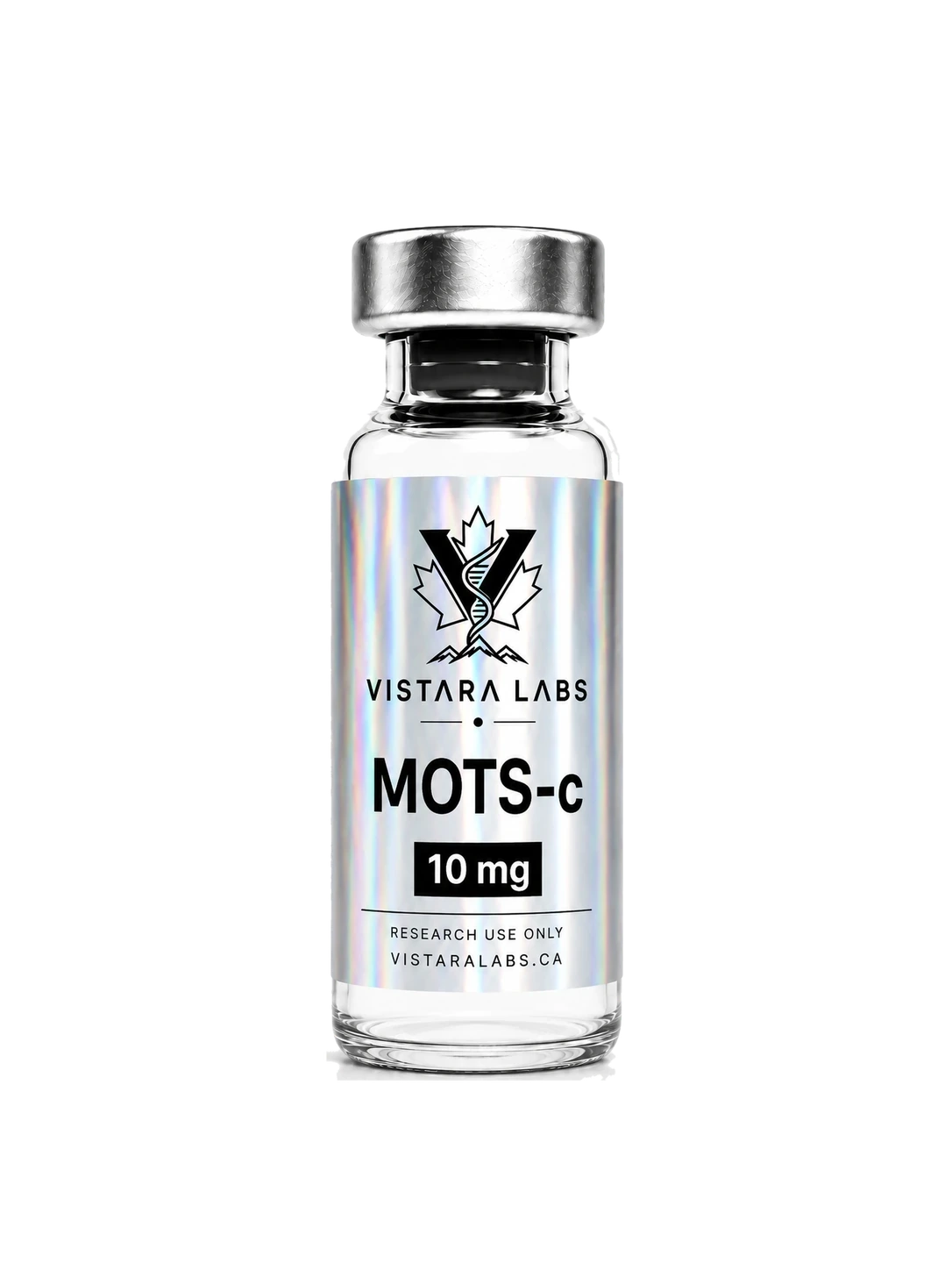
MOTS-c Half-Life: What Is and Isn’t Published
Cellular Energy & Mitochondrial Research
No plasma half-life for administered MOTS-c has been published in humans or in animals: we could find no formal pharmacokinetic study of the peptide in the peer-reviewed literature. What has been published is how the body’s own MOTS-c moves: in young men, circulating levels rose 1.6-fold during exercise and returned to baseline after four hours of rest, while levels in muscle rose 11.9-fold (Reynolds et al., Nat Commun, 2021). This page sets out what is and is not known, what a validated anti-doping assay revealed about how MOTS-c breaks down, and how half-life differs from how long a vial keeps.
Findings
- MOTS-c is a 16-amino-acid peptide encoded in mitochondrial DNA, in the 12S rRNA gene, described in 2015 as a regulator of insulin sensitivity and metabolism that acts mainly on skeletal muscle (Lee et al.).
- In 10 young men, plasma MOTS-c rose 1.6-fold during and 1.5-fold after cycling exercise, then returned to baseline after a 4-hour rest; muscle levels rose 11.9-fold and stayed raised (Reynolds et al., 2021).
- A validated LC/MS test for MOTS-c in human plasma detects it down to 100 pg/mL and also tracks four laboratory-derived metabolites and two oxidation products (Knoop et al., 2019).
- A modified MOTS-c with a cell-penetrating tail showed a longer half-life than MOTS-c in laboratory tests, confirming that stability can be engineered (Jiang et al., 2023).
 View product →
What is MOTS-c?
MOTS-c (mitochondrial open reading frame of the 12S rRNA type-c) is a 16-amino-acid peptide encoded in a short reading frame within the mitochondrial 12S rRNA gene. It was reported in 2015 by researchers at the University of Southern California, who found that it acts mainly on skeletal muscle, inhibits the folate cycle and its linked purine synthesis, and activates AMPK, the cell’s energy sensor. In mice, MOTS-c treatment prevented age-dependent and high-fat-diet-induced insulin resistance as well as diet-induced obesity (Lee et al., Cell Metab, 2015). Its background is in What is MOTS-c?
What does half-life mean?
A half-life is the time it takes for the concentration of a compound in the blood to fall by half. It is measured by giving a known amount by a known route and sampling blood repeatedly as levels fall, which is a formal pharmacokinetic study. For MOTS-c, that study has not been published, so any single figure quoted for its half-life is an estimate rather than a measurement. Figures quoted online without a primary source are not used here.
What has been published about MOTS-c in the blood?
The human exercise study
The clearest human data describe the body’s own MOTS-c. Sedentary, healthy young men (average age 24.5) cycled on a stationary bike, with muscle biopsies before, after and following a 4-hour rest, and blood samples also taken during the ride. Relative to each man’s pre-exercise value, muscle MOTS-c rose 11.9-fold after exercise and remained elevated after the rest, with a trend back towards baseline. Circulating MOTS-c rose 1.6-fold during exercise and 1.5-fold after it, then returned to baseline after 4 hours of rest (Reynolds et al., Nat Commun, 2021).
That four-hour return is useful context, but it is not a half-life. It reflects release, distribution and clearance of the body’s own peptide together, and the study was not designed to separate them. The same paper found that MOTS-c enhanced physical performance in young, middle-aged and old mice; the exercise research is covered in MOTS-c: exercise, heat and the mitochondrial signal.
The anti-doping assay
Because MOTS-c drew interest in sport, the German Sport University Cologne developed and validated a liquid chromatography and mass spectrometry (LC/MS) test for it in human plasma, to the World Anti-Doping Agency’s laboratory standard. The test detects MOTS-c down to 100 pg/mL. The team also studied its long-term stability and its metabolism in the laboratory, and built four in vitro metabolites and two oxidation products into the test, which they said could further improve the traceability of the peptide (Knoop et al., Rapid Commun Mass Spectrom, 2019).
The same work compared methods. Using a commercial immunoassay (ELISA), endogenous levels in 20 healthy people measured 45.9-218.5 ng/mL, but those levels could not be confirmed by LC/MS, and the authors reported considerable differences between the two methods (Knoop et al., 2019).
Engineering a longer-lived MOTS-c
A 2023 colitis study linked a cell-penetrating sequence, (PRR)5, to the end of MOTS-c to improve its uptake into the colon lining. In laboratory tests the modified molecule had a longer half-life than MOTS-c itself, and given by mouth it significantly improved experimental colitis. MOTS-c itself, given by intraperitoneal injection, also significantly reduced symptoms and inflammation in the same model (Jiang et al., Eur J Pharmacol, 2023).
What is and is not published
| Question | Status | Source |
|---|---|---|
| Half-life of administered MOTS-c | Not published | No formal PK study |
| Response of the body’s own MOTS-c | Plasma back to baseline 4 h after exercise | Reynolds, 2021 |
| Breakdown products | Four metabolites, two oxidation products | Knoop, 2019 |
| Engineered stability | Modified form lasted longer in vitro | Jiang, 2023 |
How does MOTS-c compare with related compounds?
MOTS-c is often studied alongside other mitochondrial and metabolic compounds, including SS-31, NAD+ and 5-Amino-1MQ. These differ in structure and target, and a fair comparison of half-lives needs published figures for each. For MOTS-c that figure does not yet exist, so we do not place it in a ranking. The mechanisms are compared in MOTS-c vs SS-31, NAD+ vs MOTS-c and 5-Amino-1MQ vs MOTS-c.
What does this mean for study design?
Three points follow from the published work. First, the measurement method matters: the gap between ELISA and LC/MS results means a study should name its assay and, where possible, confirm levels with mass spectrometry. Second, MOTS-c forms metabolites and oxidation products, so sample handling and the choice of what to measure (the intact peptide, its fragments, or both) shape the result. Third, exercise raises the body’s own MOTS-c, so the timing of sampling relative to physical activity is a variable worth controlling. Studies that set out to measure the half-life of administered MOTS-c would fill the main gap in the literature.
Half-life in the body vs how long a vial keeps
Half-life describes what happens inside a living system; shelf life describes the product. How long a lyophilised (freeze-dried) MOTS-c vial keeps before mixing, and how long it keeps once reconstituted, depends on temperature, light and handling, and is covered in How long does MOTS-c last? and How to store research peptides. Vials are reconstituted with bacteriostatic water (see the MOTS-c reconstitution guide), and certificates for every product are on the lab reports page.
MOTS-c is supplied for laboratory research use only. The published work on administered MOTS-c to date is laboratory research; the human data above describe the body’s own MOTS-c.
Frequently asked questions
What is the half-life of MOTS-c?
No half-life for administered MOTS-c has been published in humans or animals; we could find no formal pharmacokinetic study in the peer-reviewed literature. Any single figure quoted for it is an estimate.
What did research show about MOTS-c levels after exercise?
In young men, circulating MOTS-c rose 1.6-fold during cycling exercise and 1.5-fold after it, then returned to baseline after a 4-hour rest. Muscle MOTS-c rose 11.9-fold and stayed elevated.
How is MOTS-c measured in blood?
A validated LC/MS method detects MOTS-c in human plasma down to 100 pg/mL and also tracks four laboratory-derived metabolites and two oxidation products. Its developers found considerable differences between LC/MS and ELISA results.
What did research show about making MOTS-c last longer?
In a 2023 study, MOTS-c linked to a cell-penetrating sequence had a longer half-life than MOTS-c in laboratory tests and improved experimental colitis when given by mouth.
Is half-life the same as how long MOTS-c lasts in the vial?
No. Half-life describes the peptide inside a living system. How long a vial keeps before and after mixing depends on storage temperature, light and handling, covered in the MOTS-c storage guide.
Sources: Lee C et al. The mitochondrial-derived peptide MOTS-c promotes metabolic homeostasis and reduces obesity and insulin resistance. Cell Metab. 2015. PMID 25738459. Reynolds JC et al. MOTS-c is an exercise-induced mitochondrial-encoded regulator of age-dependent physical decline and muscle homeostasis. Nat Commun. 2021. PMID 33473109. Knoop A et al. Development of a mass spectrometry based detection method for the mitochondrion-derived peptide MOTS-c in plasma samples for doping control purposes. Rapid Commun Mass Spectrom. 2019. PMID 30394592. Jiang J et al. Orally administered MOTS-c analogue ameliorates dextran sulfate sodium-induced colitis by inhibiting inflammation and apoptosis. Eur J Pharmacol. 2023. PMID 36528071.
More on this: Buy MOTS-c in Canada and MOTS-c Side Effects.
All products supplied by Vistara Labs are intended for laboratory research use only. They are not drugs, are not approved for human or veterinary use, and are not intended to diagnose, treat, cure or prevent any condition. Nothing on this page constitutes medical advice or guidance for use in humans.
References
Human MOTS-c studies measure the peptide the body already makes; no controlled trial administering native synthetic MOTS-c was identified. (CB4211, which has completed phase 1, is an optimised analogue, not native MOTS-c.)
- The mitochondrial-derived peptide MOTS-c promotes metabolic homeostasis and reduces obesity and insulin resistanceFoundational paper identifying MOTS-c; laboratory studies of insulin sensitivity and diet-induced obesity.
- Acute endurance exercise stimulates circulating levels of mitochondrial-derived peptides in humansHuman study measuring naturally occurring (endogenous) mitochondrial-derived peptides after acute endurance exercise — not administration of synthetic MOTS-c.
Links open the study record on PubMed so the source can be checked directly. Listing a study is not a claim that its findings apply to any other use, product or route of administration. Research use only.