Tesamorelin Half-Life: How Long It Stays Active
Hormonal, Growth Hormone & Body Composition Research
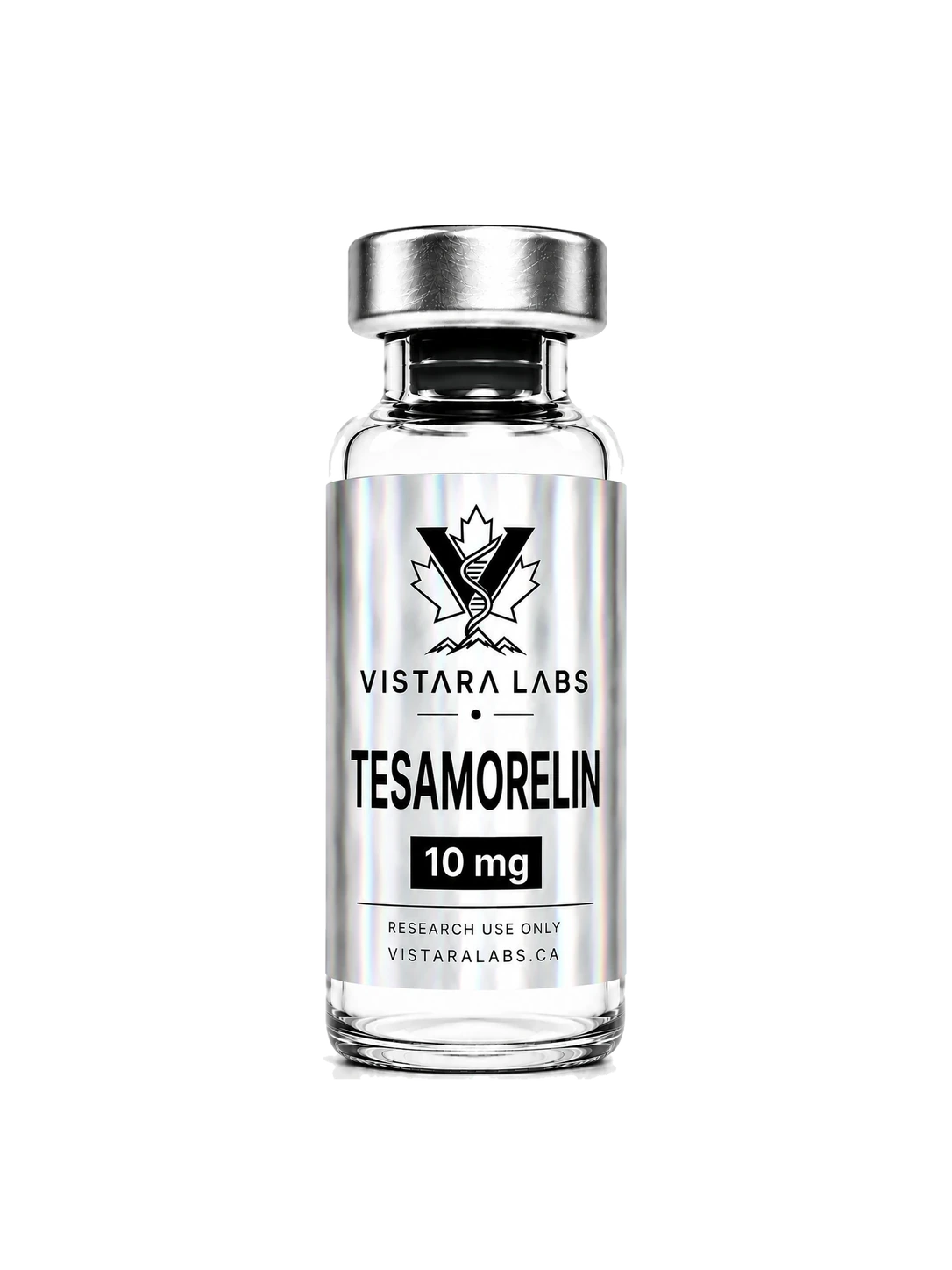
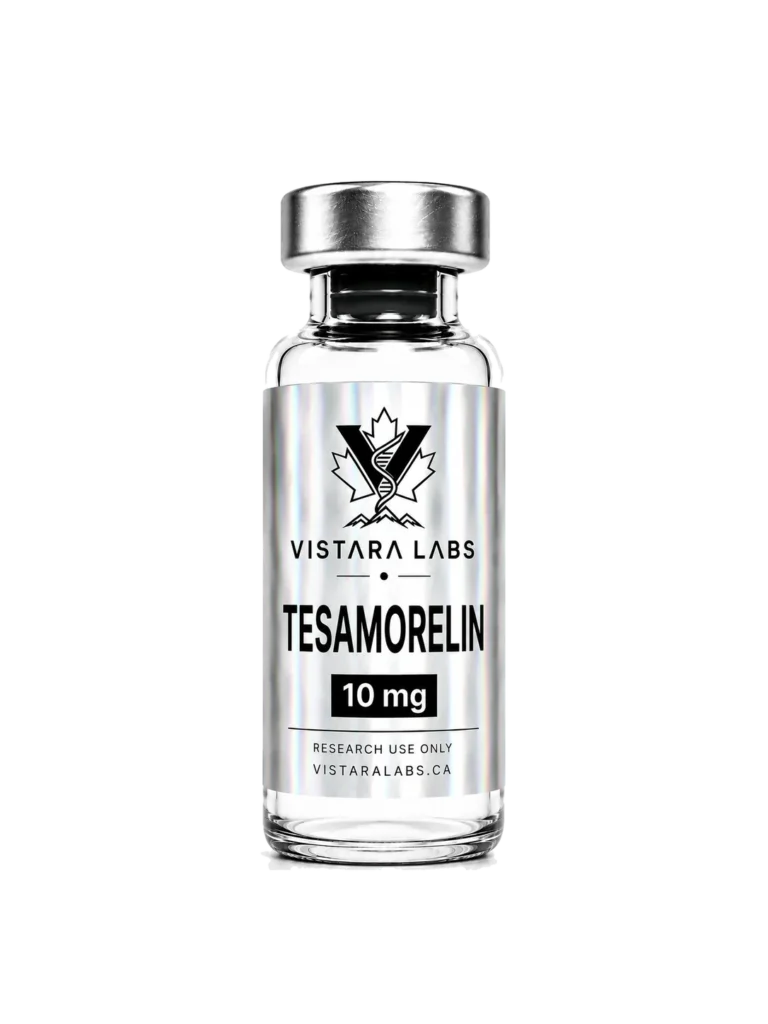
Tesamorelin’s elimination half-life in humans is measured in minutes: the original FDA label gives 26 minutes in healthy adults and 38 minutes in people with HIV after 14 days of subcutaneous administration, and the current label for the newer 2 mg/vial formulation gives 8 minutes after a single subcutaneous dose in healthy adults. Peak levels arrive about 9 minutes after injection. Its effect on the growth hormone system lasts far longer than that: in a 26-week trial of 412 adults, IGF-1 rose by 81% (Falutz et al., N Engl J Med, 2007). This page explains those figures, why tesamorelin outlasts natural GHRH, and how body half-life differs from how long a vial keeps. Vistara Labs supplies Tesamorelin as a 10 mg lyophilised vial and in the Tesamorelin + Ipamorelin Stack.
Findings
- FDA labelling reports a mean elimination half-life of 26 minutes in healthy adults and 38 minutes in HIV-infected patients (original 1 mg/vial formulation), and 8 minutes for the current 2 mg/vial formulation.
- Median time to peak plasma concentration was 0.15 hours, about 9 minutes, in both healthy and HIV-infected adults.
- Natural growth hormone-releasing hormone (GHRH) lasted 6.8 minutes in human blood after intravenous injection, cut by a plasma enzyme into an inactive form (Frohman et al., 1986).
- Tesamorelin’s added hexenoyl group made it resistant to that enzyme and slowed its breakdown in rat, dog and human plasma (Ferdinandi et al., 2007).
- Two weeks of once-daily tesamorelin in 13 healthy men raised overnight growth hormone and IGF-1 while keeping natural pulses (Stanley et al., 2011).
 View product →
What does half-life mean?
Elimination half-life is the time it takes for a compound’s concentration in the blood to fall by half. After one half-life half remains, after two a quarter, after four about one-sixteenth. It describes how fast the molecule is cleared, not how long its downstream effects last and not how long a product keeps in storage. Tesamorelin is a clear example of the gap between the first two: the peptide is gone from the blood within an hour or two, while the IGF-1 rise it triggers is read over weeks and months.
What do the FDA labels report?
Tesamorelin is the active ingredient of an FDA-approved prescription product for excess abdominal fat in HIV-associated lipodystrophy, and its labels publish the human pharmacokinetics.
- Original label, 2010 (1 mg/vial formulation): mean elimination half-life of 26 minutes in healthy subjects and 38 minutes in HIV-infected patients after subcutaneous administration for 14 consecutive days. Median time to peak was 0.15 hours in both groups.
- Current label (2 mg/vial formulation): mean elimination half-life of 8 minutes in healthy subjects after a single subcutaneous dose, with a median time to peak of 0.15 hours and exposure similar to the original formulation.
- Current label (11.6 mg/vial formulation): mean elimination half-life of 11 minutes in healthy subjects after a single subcutaneous dose.
The figures come from different formulations and sampling schedules, so they are best read together: tesamorelin’s half-life sits in the range of minutes, not hours. The labels also note that no formal metabolism studies have been carried out in humans.
Why is tesamorelin’s half-life short, and longer than GHRH’s?
Tesamorelin is the full 44-amino-acid sequence of human GHRH, the hypothalamic hormone that tells the pituitary to release growth hormone, with one addition: a hexenoyl group, a six-carbon chain with a double bond at position 3, attached to the tyrosine at the start of the chain (FDA label). That single change matters because of how natural GHRH is destroyed. A plasma enzyme, dipeptidyl peptidase-4 (DPP-4), snips the first two amino acids off GHRH; the product, GHRH(3-44), has less than one-thousandth of the original activity. After intravenous injection in healthy people, intact GHRH had a half-life of 6.8 minutes (Frohman et al., J Clin Invest, 1986), and later work confirmed DPP-4 as the main enzyme responsible (Frohman et al., J Clin Invest, 1989).
In preclinical studies, the hexenoyl cap made tesamorelin resistant to DPP-4, slowed its breakdown in rat, dog and human plasma compared with natural GHRH, and prolonged its elimination; the apparent half-life in dogs ranged from 21 to 45 minutes (Ferdinandi et al., Basic Clin Pharmacol Toxicol, 2007). What the cap does not add is a way to bind albumin, the long-lived blood protein that some modified peptides latch onto, so tesamorelin still clears in minutes. Its structure is covered in Tesamorelin: One Small Change to a Natural Hormone.
How does tesamorelin compare with related compounds?
| Compound | Published half-life | Species and route |
|---|---|---|
| Natural GHRH | 6.8 min | Humans (IV) |
| Tesamorelin | 8 to 38 min | Humans (SC, FDA labels) |
| Ipamorelin | About 2 h | Humans (IV infusion) |
| CJC-1295 with DAC | 5.8 to 8.1 days | Humans (SC) |
Ipamorelin’s figure comes from a study of 40 healthy men (Gobburu et al., Pharm Res, 1999) and CJC-1295’s from two placebo-controlled trials in healthy adults (Teichman et al., J Clin Endocrinol Metab, 2006). Both are explained in Ipamorelin Half-Life and CJC-1295 Half-Life, and the compounds are compared in CJC-1295 + Ipamorelin vs Tesamorelin.
Why the effect outlasts the half-life
Tesamorelin acts at the top of a cascade. It stimulates the pituitary to release growth hormone in pulses, and growth hormone in turn drives the liver and other tissues to make IGF-1, which circulates far longer than either peptide. In 13 healthy men, two weeks of once-daily tesamorelin increased mean overnight growth hormone, the size of growth hormone pulses and basal secretion, and raised IGF-1 by 181 micrograms per litre, while insulin-stimulated glucose uptake was preserved (Stanley et al., J Clin Endocrinol Metab, 2011). In the 26-week placebo-controlled trial of 412 adults with HIV, IGF-1 rose by 81% and visceral fat fell by 15.2% (Falutz et al., 2007). The full trial record is in Tesamorelin and Visceral Fat: The Trial Record.
What does this mean for study design?
- Plasma sampling is front-loaded. With a peak at about 9 minutes and a half-life in minutes, drug-level measurements cluster in the first hour.
- Pulse studies need frequent overnight sampling. The Stanley study measured growth hormone by overnight frequent blood sampling to capture pulse size, number and basal secretion.
- IGF-1 is the integrated readout. Because IGF-1 reflects growth hormone output over time, trials use it alongside imaging endpoints such as visceral fat by CT.
The tolerability record from the same trials is covered in Tesamorelin Side Effects.
Half-life in the body vs how long a vial keeps
A half-life of minutes describes clearance from the blood. How long a vial stays usable is a separate question of chemical stability, which depends on temperature, light, moisture and whether the lyophilised (freeze-dried) powder has been reconstituted. Those timelines are covered in How Long Does Tesamorelin Last? Before and After Mixing, with the chemistry in Tesamorelin Stability: How It Degrades and How to Slow It. Vials are reconstituted with bacteriostatic water (see the tesamorelin reconstitution guide). Every product is third-party tested, with certificates on the lab reports page, and orders ship from within Canada by Canada Post Xpresspost.
Tesamorelin is supplied by Vistara Labs for laboratory research use only. The human figures above come from FDA labelling and clinical research using a pharmaceutical preparation.
Frequently asked questions
What is the half-life of tesamorelin?
FDA labelling reports a mean elimination half-life of 26 minutes in healthy adults and 38 minutes in HIV-infected patients for the original formulation, and 8 minutes for the current 2 mg/vial formulation, all after subcutaneous administration.
How quickly does tesamorelin reach peak levels?
The labels give a median time to peak plasma concentration of 0.15 hours, about 9 minutes, in both healthy and HIV-infected adults.
Why does tesamorelin last longer than natural GHRH?
Natural GHRH is cut by the plasma enzyme DPP-4 and had a half-life of 6.8 minutes in humans. Tesamorelin’s added hexenoyl group made it resistant to DPP-4 and slowed its breakdown in plasma.
What did research show about tesamorelin’s effect on IGF-1?
In a 26-week trial of 412 adults with HIV, IGF-1 rose by 81% with tesamorelin. In 13 healthy men, two weeks of once-daily tesamorelin raised IGF-1 and overnight growth hormone with natural pulses preserved.
Is tesamorelin’s half-life the same as how long a vial lasts?
No. Half-life describes clearance from the body. How long a vial keeps depends on storage and whether it has been reconstituted, which is covered in the tesamorelin storage guide.
Product details from vistaralabs.ca, October 2026. Sources: EGRIFTA (tesamorelin) prescribing information, US FDA, 2010. FDA label. EGRIFTA SV and EGRIFTA WR (tesamorelin) prescribing information, DailyMed, 2026. EGRIFTA SV label; EGRIFTA WR label. Frohman LA et al. Rapid enzymatic degradation of growth hormone-releasing hormone by plasma in vitro and in vivo to a biologically inactive product cleaved at the NH2 terminus. J Clin Invest. 1986. PMID 3093533. Frohman LA et al. Dipeptidylpeptidase IV and trypsin-like enzymatic degradation of human growth hormone-releasing hormone in plasma. J Clin Invest. 1989. PMID 2565342. Ferdinandi ES et al. Non-clinical pharmacology and safety evaluation of TH9507, a human growth hormone-releasing factor analogue. Basic Clin Pharmacol Toxicol. 2007. PMID 17214611. Stanley TL et al. Effects of a growth hormone-releasing hormone analog on endogenous GH pulsatility and insulin sensitivity in healthy men. J Clin Endocrinol Metab. 2011. PMID 20943777. Falutz J et al. Metabolic effects of a growth hormone-releasing factor in patients with HIV. N Engl J Med. 2007. PMID 18057338. Gobburu JV et al. Pharmacokinetic-pharmacodynamic modeling of ipamorelin, a growth hormone releasing peptide, in human volunteers. Pharm Res. 1999. PMID 10496658. Teichman SL et al. Prolonged stimulation of growth hormone and insulin-like growth factor I secretion by CJC-1295, a long-acting analog of GH-releasing hormone, in healthy adults. J Clin Endocrinol Metab. 2006. PMID 16352683.
More on this: Tesamorelin: Research Reference.
All products supplied by Vistara Labs are intended for laboratory research use only. They are not drugs, are not approved for human or veterinary use, and are not intended to diagnose, treat, cure or prevent any condition. Nothing on this page constitutes medical advice or guidance for use in humans.
References
Tesamorelin has been studied in randomised placebo-controlled trials measuring body composition and liver fat directly.
- Effects of tesamorelin, a growth hormone-releasing factor, in HIV-infected patients with abdominal fat accumulation: a randomized placebo-controlled trial with a safety extensionRandomised placebo-controlled trial with safety extension; 404 people with HIV-associated abdominal fat accumulation.
- Effects of tesamorelin on non-alcoholic fatty liver disease in HIV: a randomised, double-blind, multicentre trialRandomised, double-blind, multicentre trial in people with HIV and non-alcoholic fatty liver disease, 12 months.
Links open the study record on PubMed so the source can be checked directly. Listing a study is not a claim that its findings apply to any other use, product or route of administration. Research use only.