Ipamorelin Half-Life: How Long It Stays Active
Hormonal, Growth Hormone & Body Composition Research
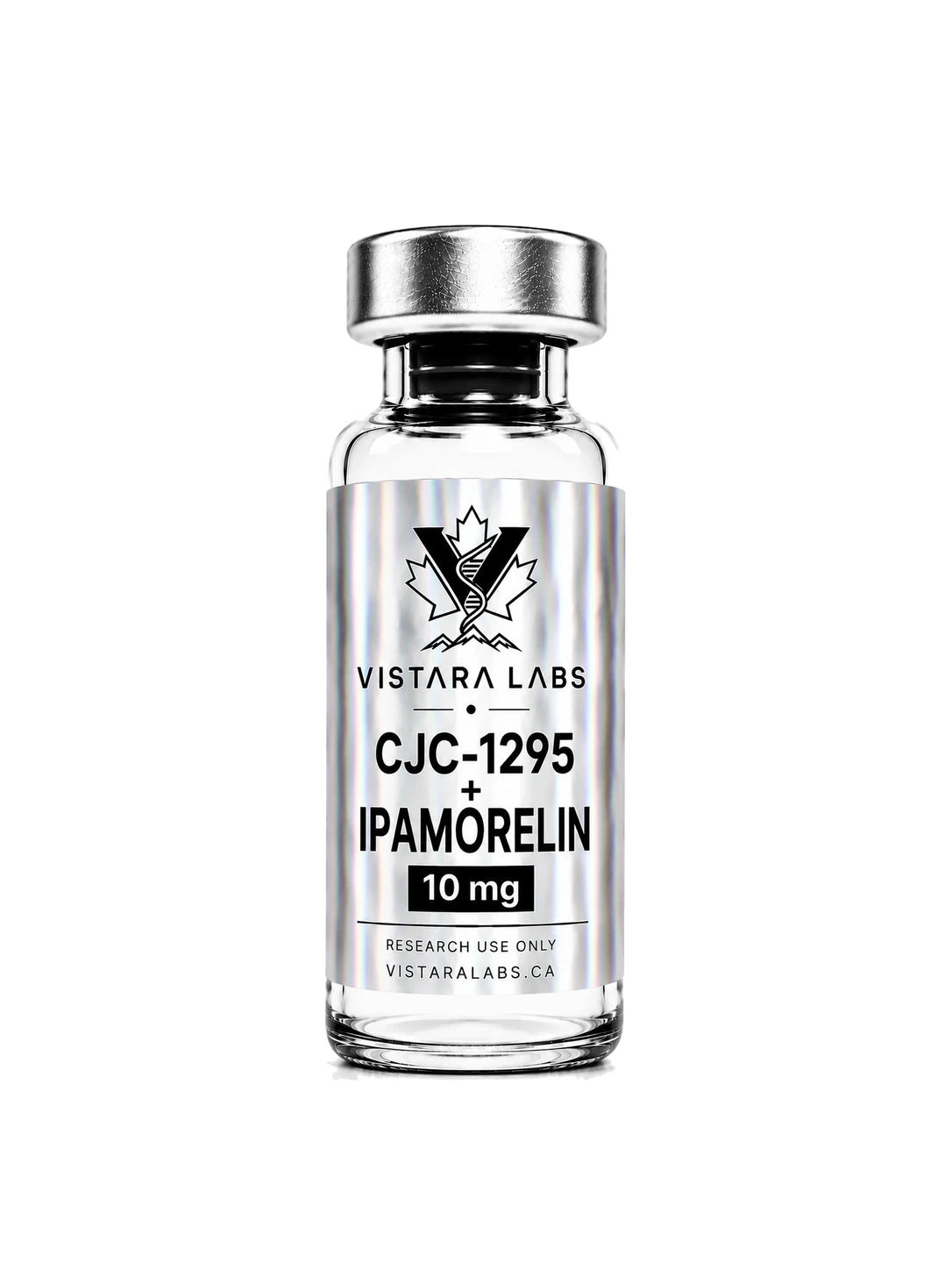
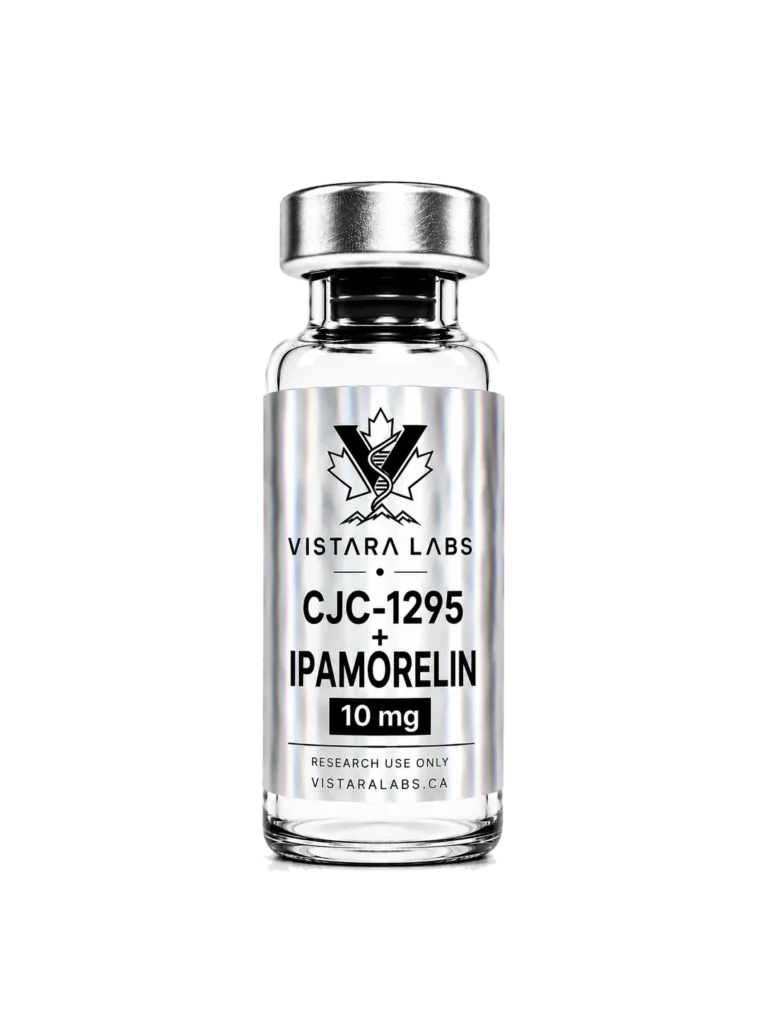
Ipamorelin has a terminal half-life of about 2 hours in humans, measured in 40 healthy men who received it by 15-minute intravenous infusion (Gobburu et al., Pharm Res, 1999). Growth hormone peaked at 0.67 hours, about 40 minutes, and then fell back to negligible levels at every amount tested, a single clean pulse. This page explains the figure, what makes ipamorelin longer-lived than many peptides of its class, and how body half-life differs from how long a vial or spray keeps. Vistara Labs supplies ipamorelin in the CJC-1295 + Ipamorelin (No DAC) vial, the ready-mixed CJC-1295 + Ipamorelin Nasal Spray and the Tesamorelin + Ipamorelin Stack.
Findings
- In 40 healthy men, ipamorelin showed dose-proportional pharmacokinetics and a terminal half-life of 2 hours (Gobburu et al., 1999).
- Growth hormone release came as a single episode peaking at 0.67 hours, then declined exponentially at all five infusion rates.
- In rats, ipamorelin’s clearance was 5-fold lower than GHRP-6’s, and 60-80% of the administered peptide was recovered intact in urine and bile (Johansen et al., Xenobiotica, 1998).
- The same rat work found ipamorelin crossed the nasal lining into the bloodstream, and the authors called the nasal route promising for this peptide family.
- Ipamorelin was the first growth hormone secretagogue selective for growth hormone, with no rise in ACTH or cortisol in swine even at 200-fold the effective amount (Raun et al., 1998).
 View product →
What does half-life mean?
Elimination half-life is the time it takes for a compound’s concentration in the blood to fall by half. After one half-life half remains, after two a quarter, after four about one-sixteenth. Terminal half-life, the figure Gobburu reported, describes the final, slowest phase of that decline. It measures how fast the body clears the molecule, not how long its effect lasts: for ipamorelin, the growth hormone pulse it triggers is over well before the peptide itself is gone.
What did the human study measure?
Gobburu and colleagues ran a dose-escalation trial with five infusion rates, eight healthy men at each level, each infusion lasting 15 minutes. They measured ipamorelin and growth hormone in the blood and built a pharmacokinetic-pharmacodynamic model linking the two (Gobburu et al., Pharm Res, 1999).
- Pharmacokinetics: terminal half-life 2 hours, clearance 0.078 L/h/kg and volume of distribution at steady state 0.22 L/kg, with exposure rising in proportion to the amount given.
- Growth hormone response: one episode of release peaking at 0.67 hours, then an exponential fall to negligible levels at all doses.
- Variability: differences between people were larger for the growth hormone response than for the drug levels themselves.
The small volume of distribution means ipamorelin stays mostly in blood and the fluid around cells rather than spreading deep into tissues, which fits a peptide that acts on receptors in the pituitary.
Why ipamorelin lasts about 2 hours
Ipamorelin is a pentapeptide, five amino acids long: Aib-His-D-2-Nal-D-Phe-Lys-NH2 (Raun et al., Eur J Endocrinol, 1998). Three of those building blocks are not standard: Aib (aminoisobutyric acid) and two D-amino acids, mirror-image forms that the body’s protein-cutting enzymes recognise far less readily. It came out of a Novo Nordisk chemistry programme as a trimmed-down relative of the earlier growth hormone-releasing peptides (GHRPs).
The rat data show what that design achieved. After intravenous injection, ipamorelin’s systemic clearance was 5-fold lower than that of GHRP-6, it was excreted mainly in urine (GHRP-6 mainly in bile), and 60-80% of the dose was recovered as intact peptide, which the authors described as moderate resistance to metabolism (Johansen et al., 1998). A peptide that leaves the body largely unchanged through the kidneys, rather than being broken down, is consistent with the 2-hour human half-life.
The nasal route
The same study compared routes. After intranasal application, ipamorelin reached the bloodstream with a bioavailability of about 20% in rats, and the authors concluded that these peptides were easily transported across the nasal lining and that the nasal route looked promising for systemic delivery (Johansen et al., 1998). The two formats are compared in Peptide Nasal Spray vs Vial: How the Two Formats Differ.
How does ipamorelin compare with related compounds?
| Compound | Published half-life | Species and route |
|---|---|---|
| Ipamorelin | About 2 h | Humans (IV infusion) |
| Natural GHRH | 6.8 min | Humans (IV) |
| Tesamorelin | 8 to 38 min | Humans (SC, FDA labels) |
| CJC-1295 with DAC | 5.8 to 8.1 days | Humans (SC) |
Ipamorelin acts through the GHRP receptor, the same pathway as GHRP-6, rather than the GHRH receptor that GHRH, tesamorelin and CJC-1295 use (Raun et al., 1998). The GHRH figure is from Frohman et al. (J Clin Invest, 1986) and the CJC-1295 figure from Teichman et al. (J Clin Endocrinol Metab, 2006). The partner peptide is covered in CJC-1295 Half-Life and Tesamorelin Half-Life, and the two mechanisms are compared in CJC-1295 vs Ipamorelin: Which Growth Hormone Peptide to Choose.
Why selectivity matters alongside half-life
Earlier GHRPs were less selective. In swine, GHRP-6 and GHRP-2 both raised the stress hormones ACTH and cortisol, while ipamorelin did not raise ACTH or cortisol beyond the levels seen with GHRH, even at more than 200 times the amount needed for half its maximum growth hormone effect; it also left FSH, LH, prolactin and TSH unchanged (Raun et al., 1998). For research, a clean growth hormone signal and a predictable 2-hour clearance make ipamorelin’s effect easier to separate from other hormonal changes.
What does this mean for study design?
- Sampling around the pulse. With growth hormone peaking at about 40 minutes and returning to baseline afterwards, the informative window is the first few hours.
- Model-based analysis. Gobburu used an indirect response model, which links drug concentration to the rate of growth hormone release rather than to growth hormone levels directly.
- Expect variable responses. Response differed more between people than drug levels did, which affects how many subjects a study needs.
The research on the CJC-1295 pairing is in CJC-1295 + Ipamorelin: The Research.
Half-life in the body vs how long a vial or spray keeps
A 2-hour half-life describes clearance after ipamorelin enters a living system. How long a vial or spray stays usable is a separate question of chemical stability, which depends on temperature, light, moisture and whether the lyophilised (freeze-dried) powder has been mixed. Those timelines are covered in How Long Does CJC-1295 + Ipamorelin Last? Storage Guide, and mixing in the ipamorelin reconstitution guide. The nasal spray arrives ready-mixed in a sealed metered pump. Every product is third-party tested, with certificates on the lab reports page, and orders ship from within Canada by Canada Post Xpresspost.
Ipamorelin is supplied for laboratory research use only. The human figures above come from clinical research using a pharmaceutical preparation.
Frequently asked questions
What is the half-life of ipamorelin?
In a study of 40 healthy men given ipamorelin by 15-minute intravenous infusion, its terminal half-life was 2 hours, with clearance of 0.078 L/h/kg (Gobburu et al., 1999).
How long did ipamorelin’s growth hormone response last in research?
Growth hormone came as a single pulse that peaked at 0.67 hours, about 40 minutes, and then fell exponentially to negligible levels at every dose tested.
Why does ipamorelin last longer than many similar peptides?
Ipamorelin contains Aib and two D-amino acids that resist enzyme breakdown. In rats its clearance was 5-fold lower than GHRP-6’s, and 60-80% was recovered intact.
What did research show about ipamorelin and the nasal route?
In rats, intranasal ipamorelin reached the bloodstream with about 20% bioavailability, and the authors concluded the nasal route looked promising for systemic delivery of this peptide family.
Is ipamorelin’s half-life the same as how long a vial lasts?
No. Half-life describes clearance from the body. How long a vial or nasal spray keeps depends on storage and whether the powder has been mixed, which is covered in the CJC-1295 + Ipamorelin storage guide.
Product details from vistaralabs.ca, October 2026. Sources: Gobburu JV et al. Pharmacokinetic-pharmacodynamic modeling of ipamorelin, a growth hormone releasing peptide, in human volunteers. Pharm Res. 1999. PMID 10496658. Johansen PB et al. Pharmacokinetic evaluation of ipamorelin and other peptidyl growth hormone secretagogues with emphasis on nasal absorption. Xenobiotica. 1998. PMID 9879640. Raun K et al. Ipamorelin, the first selective growth hormone secretagogue. Eur J Endocrinol. 1998. PMID 9849822. Frohman LA et al. Rapid enzymatic degradation of growth hormone-releasing hormone by plasma in vitro and in vivo to a biologically inactive product cleaved at the NH2 terminus. J Clin Invest. 1986. PMID 3093533. Teichman SL et al. Prolonged stimulation of growth hormone and insulin-like growth factor I secretion by CJC-1295, a long-acting analog of GH-releasing hormone, in healthy adults. J Clin Endocrinol Metab. 2006. PMID 16352683. EGRIFTA (tesamorelin) prescribing information, US FDA, 2010. FDA label.
More on this: Buy Ipamorelin in Canada.
All products supplied by Vistara Labs are intended for laboratory research use only. They are not drugs, are not approved for human or veterinary use, and are not intended to diagnose, treat, cure or prevent any condition. Nothing on this page constitutes medical advice or guidance for use in humans.
References
The published human CJC-1295 trial used the long-acting DAC analogue, not the no-DAC form. Ipamorelin has its own human pharmacokinetic study. No trial of the two combined was identified.
- Prolonged stimulation of growth hormone (GH) and insulin-like growth factor I secretion by CJC-1295, a long-acting analog of GH-releasing hormone, in healthy adultsRandomised placebo-controlled trial in healthy adults — of the LONG-ACTING (DAC) CJC-1295 analogue, not the no-DAC form.
- Pharmacokinetic-pharmacodynamic modeling of ipamorelin, a growth hormone releasing peptide, in human volunteersHuman pharmacokinetic/pharmacodynamic study; five escalating infusion levels, eight healthy male subjects per level.
Links open the study record on PubMed so the source can be checked directly. Listing a study is not a claim that its findings apply to any other use, product or route of administration. Research use only.