


Pourquoi les peptides gélifient ou deviennent troubles — et le problème du diluant
You add the diluent, and instead of dissolving cleanly the vial goes cloudy — or worse, it thickens into something like a gel and will not clear no matter how long you leave it. It is one of the more demoralising things that can happen to a vial of research peptide, and it is almost always chemistry rather than a defective peptide. There are four causes, they are well understood, and three of them are controllable.
First: cloudy is not automatically ruined
Worth saying before anything else, because it saves a lot of discarded material. Some cloudiness is suspended microparticulate that resolves on its own within ten or fifteen minutes, particularly if the vial is cold or the diluent went in quickly. A vial that clears with time was never a problem.
A vial that is still opaque an hour later, or that has visibly thickened, is a different matter. That is aggregation, and aggregation does not reverse.
Cause one: concentration
The most common cause, and the least glamorous. Too little diluent for the quantity of peptide.
Peptide molecules in a crowded solution encounter each other constantly, and peptide-to-peptide interaction is what produces cloudiness, thickening and eventually gelling. The same vial reconstituted in a larger volume frequently dissolves without complaint. If a peptide has gelled and nothing else changed, this is the first thing to examine.
Cause two: mechanical stress
Shaking a peptide vial is genuinely bad for it. Agitation introduces air, creates an air–liquid interface, and that interface is where peptides unfold and aggregate. Swirling gently and letting the vial sit is the standard laboratory practice for a reason, and it is not fussiness.
This is the cause most often behind a vial that gelled when the same product dissolved fine last time.
Cause three: temperature
Reconstituting straight from the fridge slows everything down. Cold solutions dissolve more slowly and hold less in solution, and the resulting cloudiness is frequently mistaken for a failed vial when it is a vial that simply needed to reach room temperature and be left alone for a quarter of an hour.
Cause four: the diluent — and this is the one people miss
The first three are handling. The fourth is the material itself, and it is invisible.
Why pH decides solubility
Every peptide has an isoelectric point — the pH at which its positive and negative charges balance out to zero net charge. It is a property of the amino acid sequence, so it is different for every compound.
At that pH, a peptide is at its least soluble. The reason is simple: charged molecules repel each other, and that repulsion is what keeps them apart and in solution. Strip the net charge away and the repulsion goes with it, so the molecules are free to associate, aggregate and drop out of solution. Move the pH in either direction and solubility improves again.
So the pH of your diluent is not a detail. It determines how close each specific peptide sits to its own point of minimum solubility.
What the specification actually says
Bacteriostatic Water for Injection USP is specified at pH 5.7, with an acceptable range of 4.5 to 7.0, and contains benzyl alcohol at 0.9% as the bacteriostatic preservative.
Read that range again, because it is the crux of the matter. A 4.5 and a 7.0 are both within specification and they are not remotely the same solution. For a peptide whose isoelectric point sits near the middle of that window, a diluent at one end of the range dissolves it and a diluent at the other end may not. Two vials of water that both pass can behave completely differently.
Which compounds it shows up in
Not evenly. The peptides that generate the most reconstitution complaints are those with high hydrophobic amino acid content or an isoelectric point near neutral — the ones with the least margin for a diluent that drifts.
- Tesamorelin is the one most consistently reported as gel-prone, particularly at higher concentrations or after agitation.
- CJC-1295 / Ipamorelin is slower to homogenise than most, and its cloudiness is frequently suspended particulate that resolves with time rather than true aggregation.
- MOTS-c is a short, comparatively hydrophobic sequence with known handling considerations — peptide manufacturers routinely publish specific reconstitution and storage notes for it, which they do not do for easy compounds.
The forgiving peptides tolerate a mediocre diluent. These do not, which is why they are where diluent problems surface first.
The uncomfortable part: none of this is visible. Water is water to look at. Out-of-specification pH cannot be seen, and a benzyl alcohol concentration that is too low — or substituted with a different alcohol entirely — cannot be seen either. Only an assay catches it. Which means the diluent is an uncontrolled variable in your work unless you know where it came from.
Why the diluent is worth being fussy about
Bacteriostatic water is the cheapest item in any peptide order, and it is the one that touches every other item in it. That asymmetry is the entire argument. A diluent that is out of specification does not cost you the price of the diluent — it costs you whatever was in the vial it ruined, and it does so silently, because a peptide that aggregated on contact with the wrong solution looks exactly like a peptide that arrived degraded.
That confusion is the real damage. People blame the peptide supplier, switch, and hit the same problem again with the same bottle of water.
Where the water comes from
Provenance is the practical answer to a problem you cannot inspect. If the specification is invisible, the only thing left to evaluate is the supply chain — who made it, where, and whether anyone will put their name to a certificate for the lot in your hand.
This is the plain argument for buying the diluent domestically rather than importing it, and it is the same argument as for the peptides themselves. A bottle that has come through an unidentifiable overseas chain, been repackaged, and arrived without lot documentation is not cheaper in any sense that matters — it is the one uncontrolled variable sitting underneath every other vial in your order.
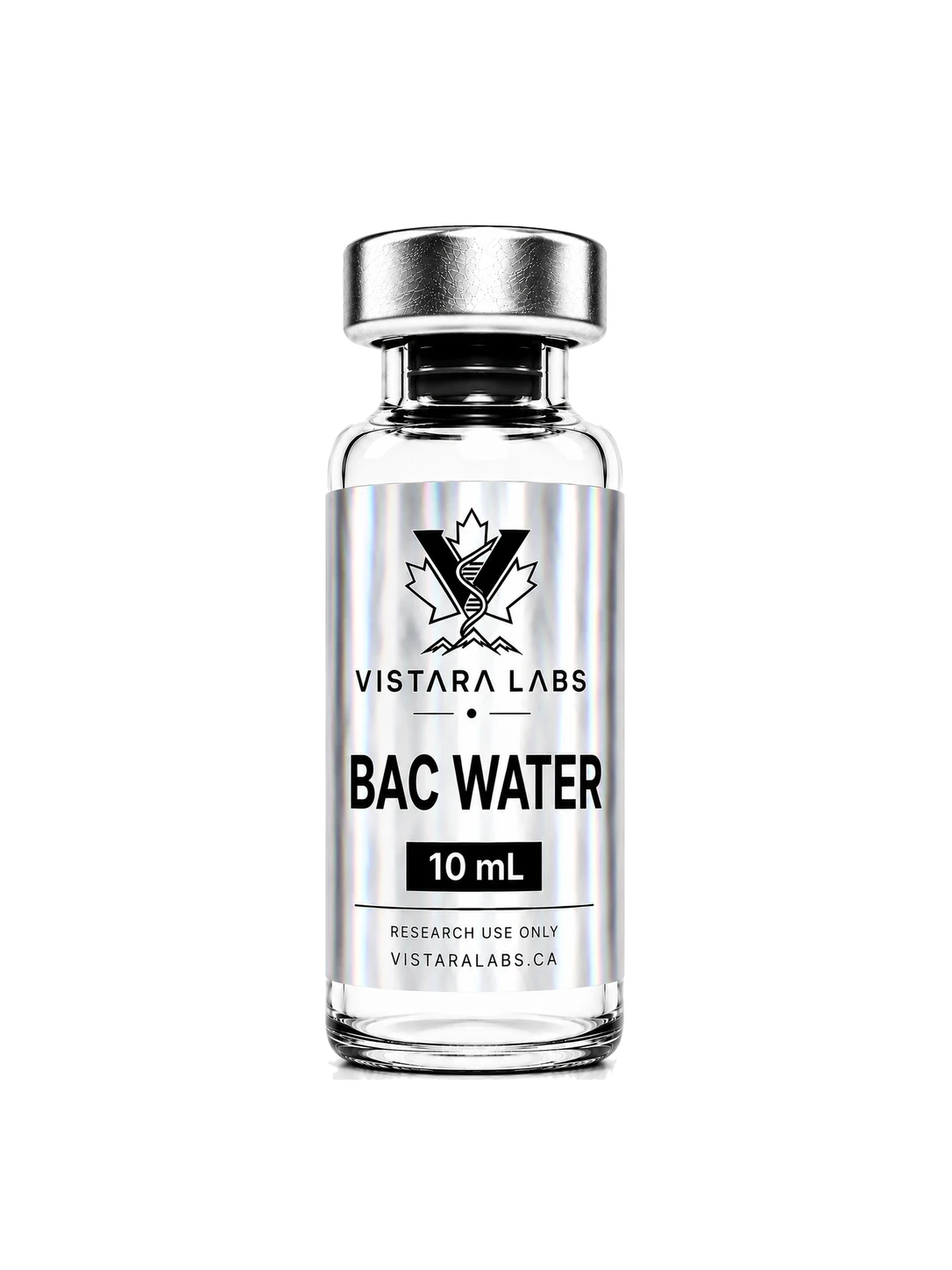
Vistara’s bacteriostatic water is bottled in British Columbia. It ships domestically alongside the compounds it will be used with, which means no border, no customs exposure on the diluent, and a known origin for the one item in the order that touches everything else.
What to check
- A stated benzyl alcohol concentration. 0.9% is the USP figure. A product that will not state it has not told you what is in the bottle.
- Known provenance. You want to know who made it and where. An unidentifiable supply chain is the thing that makes the invisible risk unmanageable.
- An intact seal and clear solution. Basic, but check it.
- A vial size matched to actual use. Buying a larger vial than you will get through before it ages out is a false economy.
- Certificate of analysis available. For the diluent, not just the peptide.
If a vial has already gelled
Work through the controllable causes in order: was the concentration higher than usual, was the vial shaken rather than swirled, was it cold going in, and has it been given time to resolve. If all four are ruled out and the same compound has now failed with the same bottle of water twice, the diluent is the remaining variable — and it is the one worth replacing before writing off another vial.
Vistara Labs supplies eau bactériostatique in 3 mL and 10 mL vials. Ours is bottled in British Columbia rather than imported — which means the diluent and the compound arrive from the same known source, in one parcel, with a certificate of analysis available on request. Background reading: what bacteriostatic water is and why it is used.
Frequently asked questions
Why did my peptide turn cloudy after adding bacteriostatic water?
Most often suspended microparticulate that clears in ten to fifteen minutes, especially if the vial was cold or the diluent was added quickly. Cloudiness that persists for an hour or more indicates aggregation, which does not reverse.
Why did my peptide gel or go thick?
Usually too little diluent for the amount of peptide, or agitation from shaking rather than swirling. Both increase peptide-to-peptide interaction. Diluent pH is the fourth cause and the one that is invisible.
Does the pH of bacteriostatic water matter?
Yes. Every peptide has an isoelectric point — the pH of its minimum solubility — and the USP specification for bacteriostatic water permits anything from pH 4.5 to 7.0. Two in-specification products at opposite ends of that range can behave very differently with the same compound.
Which peptides are most likely to gel?
Those with high hydrophobic content or an isoelectric point near neutral. Tesamorelin is the most consistently reported, with CJC-1295 and MOTS-c also known for requiring more care than average.
Can a gelled peptide be recovered?
Aggregation is not reversible. This is why the controllable causes — concentration, agitation, temperature — are worth getting right before the diluent goes in rather than after.
Where can I buy bacteriostatic water in Canada?
Vistara Labs supplies it in 3 mL and 10 mL vials, bottled in British Columbia and shipped domestically to every province, with a certificate of analysis available on request. Buying the diluent domestically avoids customs exposure on the one item in the order that touches every other vial in it.
All products supplied by Vistara Labs are intended for laboratory research use only. They are not drugs, are not approved for human or veterinary use, and are not intended to diagnose, treat, cure or prevent any condition. Nothing on this page constitutes medical advice or guidance for use in humans.