


Retatrutide Weight-Loss Trials: What the Data Shows
Recherche sur la perte de poids et le métabolisme
Retatrutide produced some of the largest weight-reduction figures yet reported for a peptide in a controlled trial. It is a triple-hormone-receptor agonist, and the two published trials below, in the New England Journal of Medicine and The Lancet, put real numbers to why the research community has paid such close attention to it.
 View product →
Findings
- Phase 3 is here: the TRIUMPH registrational program is testing retatrutide in obesity, obstructive sleep apnea and knee osteoarthritis.
- In a 48-week trial of 338 adults (New England Journal of Medicine), the highest dose of retatrutide cut body weight by about 24% on average.
- More than 8 in 10 people on that dose lost at least 15% of their body weight.
- Weight loss had not levelled off when the trial ended.
- In a separate diabetes trial, retatrutide lowered long-term blood sugar (HbA1c) by close to 2 points.
- Side effects were mostly stomach-related, showed up early, and were milder with gradual dose increases.
The Phase 2 obesity trial (NEJM, 2023)
Jastreboff and colleagues ran a 48-week, double-blind, randomized, placebo-controlled Phase 2 trial in 338 adults with obesity. Participants received subcutaneous retatrutide once weekly at doses up to 12 mg, or placebo.
- At 24 weeks: body weight fell a least-squares mean of 17.5% on 12 mg, versus 1.6% on placebo.
- At 48 weeks: the reductions reached 24.2% on 12 mg and 22.8% on 8 mg, versus 2.1% on placebo.
- Responders: on 12 mg, 100% of participants lost at least 5%, 93% lost at least 10%, and 83% lost at least 15% of body weight.
The most common adverse events were gastrointestinal, dose-related, and mostly mild to moderate; a lower starting dose reduced them.
The Phase 3 diabetes trial (Lancet, 2026)
The TRANSCEND-T2D-1 trial randomized 537 adults with type 2 diabetes inadequately controlled by diet and exercise to retatrutide 4, 9, or 12 mg, or placebo, for 40 weeks. On 12 mg, HbA1c fell 1.94% (versus 0.81% on placebo) and body weight fell 15.3% (versus 2.6%), with 91% of participants completing treatment on the study drug.
What retatrutide is
Retatrutide (LY3437943) activates three receptors at once: the glucose-dependent insulinotropic polypeptide (GIP) receptor, the glucagon-like peptide-1 (GLP-1) receptor, and the glucagon receptor. That triple-agonist design is the feature setting it apart from single-target compounds like semaglutide and dual-target compounds like tirzepatide. Our retatrutide vs tirzepatide comparison covers the distinction in more depth.
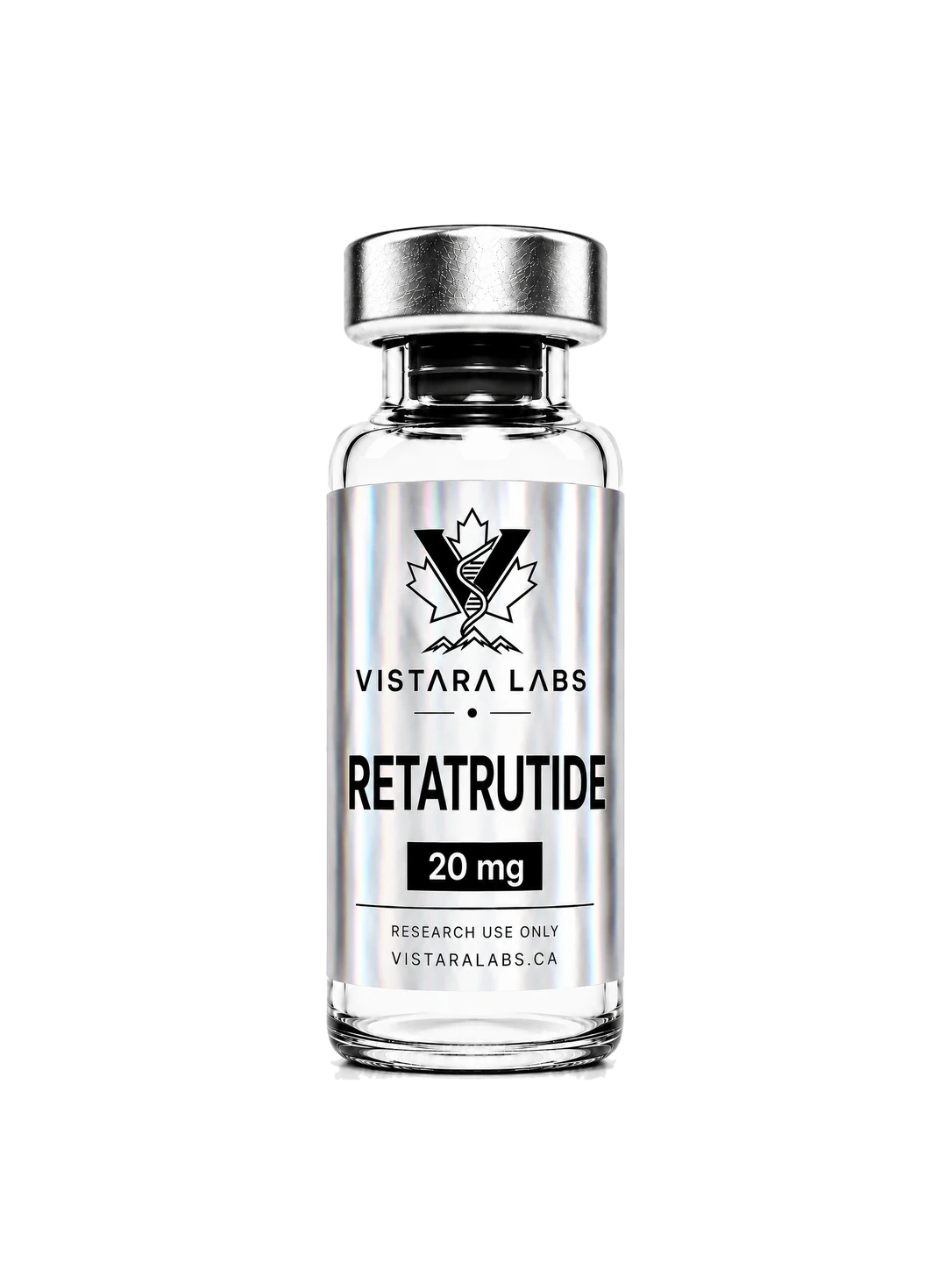
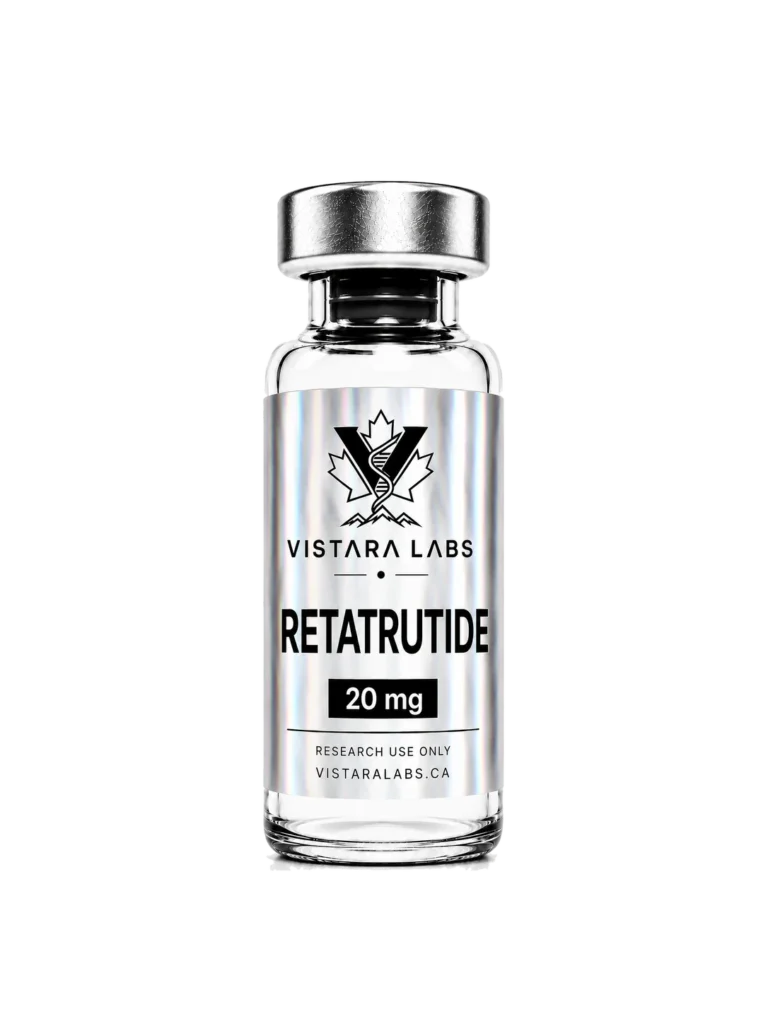
Vistara Labs stocks retatrutide in 10 mg and 20 mg research vials, shipped from within Canada to every province.
The Phase 3 program: TRIUMPH
Retatrutide’s registrational Phase 3 program is now published (Diabetes, Obesity and Metabolism, 2026). TRIUMPH tests the compound in adults with obesity and two of its most common companions: obstructive sleep apnea and knee osteoarthritis. A separate 2026 analysis of the Phase 2 trials also reported improvements across cardiovascular risk biomarkers, including lipoprotein and inflammatory markers.
Frequently asked questions
How much weight did retatrutide produce in its Phase 2 trial?
In the 2023 NEJM Phase 2 trial, adults on the 12 mg dose lost a least-squares mean of 24.2% of body weight at 48 weeks, versus 2.1% on placebo. At that dose, 83% of participants lost at least 15% of their body weight.
Is retatrutide the same as tirzepatide?
No. Tirzepatide acts on two receptors (GIP and GLP-1); retatrutide adds a third, the glucagon receptor, making it a triple agonist. That third target is what distinguishes retatrutide’s profile.
What did retatrutide do for blood sugar?
In the 2026 Lancet TRANSCEND-T2D-1 Phase 3 trial, retatrutide 12 mg lowered HbA1c by 1.94% and reduced body weight by 15.3% as a monotherapy in adults with type 2 diabetes.
Sources: Jastreboff AM, et al. Triple-Hormone-Receptor Agonist Retatrutide for Obesity — A Phase 2 Trial. N Engl J Med. 2023;389:514-526. PMID 37366315. Bajaj HS, et al. Retatrutide in type 2 diabetes (TRANSCEND-T2D-1). Lancet. 2026. PMID 42250575.
References
Retatrutide has been evaluated in randomised, placebo-controlled human trials through phase 3.
- Triple-Hormone-Receptor Agonist Retatrutide for Obesity - A Phase 2 TrialRandomised, double-blind, placebo-controlled phase 2 obesity trial, 48 weeks.
- Retatrutide, a GIP, GLP-1 and glucagon receptor agonist, for people with type 2 diabetes: a randomised, double-blind, placebo and active-controlled, parallel-group, phase 2 trial conducted in the USARandomised, double-blind, placebo- and active-controlled phase 2 trial; 281 participants with type 2 diabetes.
- Triple hormone receptor agonist retatrutide for metabolic dysfunction-associated steatotic liver disease: a randomized phase 2a trialRandomised phase 2a substudy; 98 participants with metabolic dysfunction-associated steatotic liver disease.
- Efficacy and safety of retatrutide, a GIP, GLP-1, and glucagon receptor agonist, in people with type 2 diabetes and inadequate glycaemic control with diet and exercise (TRANSCEND-T2D-1): a double-blind, randomised, phase 3 trialDouble-blind randomised phase 3 trial in type 2 diabetes (TRANSCEND-T2D-1).
Links open the study record on PubMed so the source can be checked directly. Listing a study is not a claim that its findings apply to any other use, product or route of administration. Research use only.