

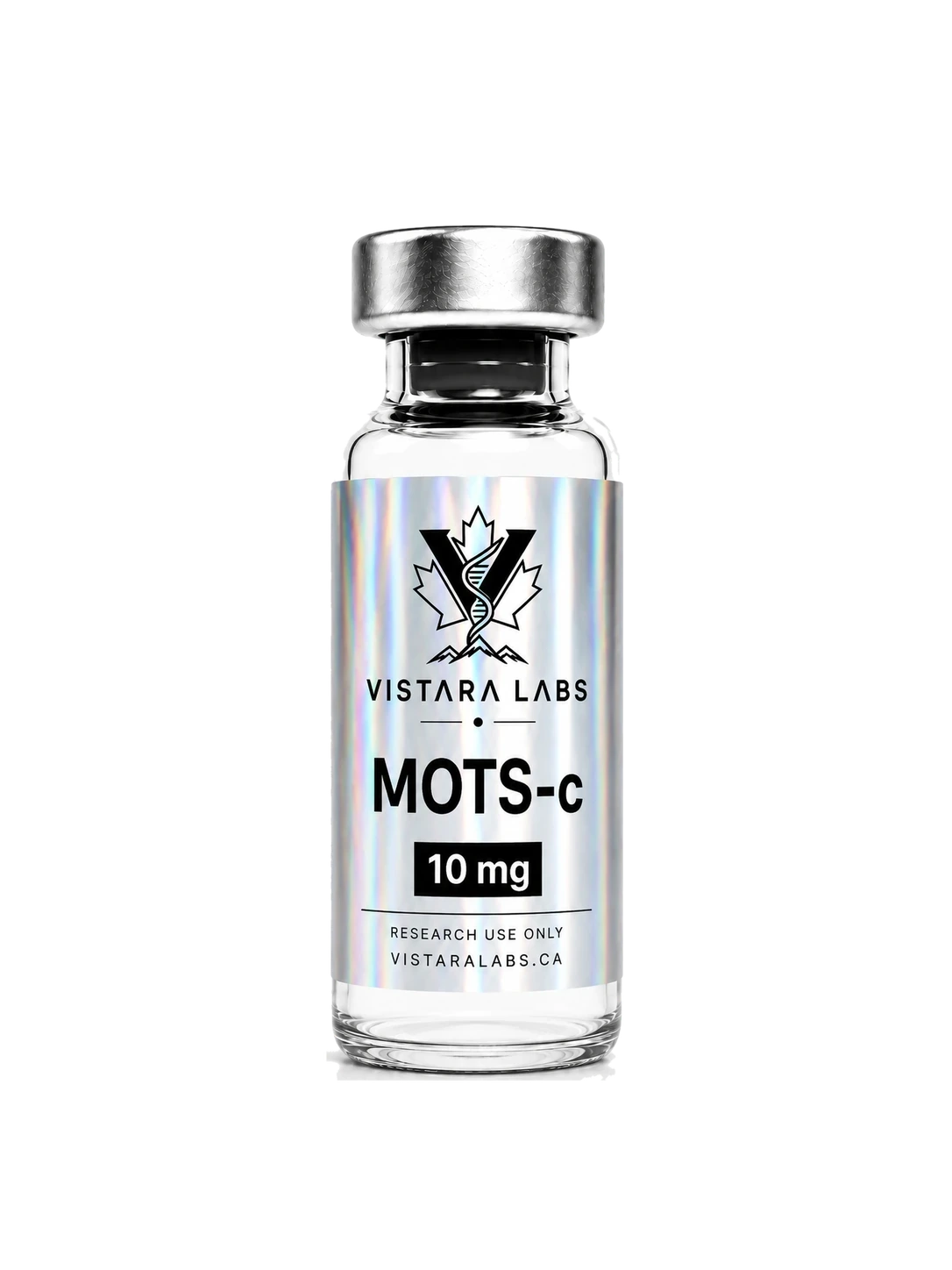
MOTS-c vs SS-31 : deux peptides mitochondriaux comparés
Recherche sur l'énergie cellulaire et les mitochondries
MOTS-c and SS-31 are the two mitochondrial peptides in this catalogue, and researchers regularly ask which one a given question calls for. They are not interchangeable. One is a signal the mitochondrion itself encodes; the other is a synthetic molecule built to lodge in the mitochondrial membrane. Their human evidence is different in kind, not just in size. This comparison lays the two side by side so the research question can pick the molecule.
 Voir le produit →
Findings
- MOTS-c is a 16 amino acid peptide encoded in mitochondrial DNA, studied as a metabolic signal. SS-31 is a synthetic four amino acid peptide that binds cardiolipin in the inner mitochondrial membrane.
- MOTS-c’s human data is observational: circulating levels rise after endurance exercise and repeated heat exposure. An analogue has entered clinical development.
- SS-31, as elamipretide, has been through large randomised trials and received its first FDA approval in late 2025, for Barth syndrome. One pivotal trial in mitochondrial myopathy missed its primary endpoints.
- Both arrive lyophilised and are reconstituted with bacteriostatic water. MOTS-c is stocked in 10 mg and 40 mg vials, SS-31 in 10 mg.
Two different kinds of molecule
| MOTS-c | SS-31 (elamipretide) | |
|---|---|---|
| Origin | Naturally occurring; encoded in the mitochondrial genome, in the 12S rRNA gene | Synthetic; designed in the laboratory |
| Length | 16 amino acids | 4 amino acids (a tetrapeptide) |
| Where it acts | Released as a signal; studied in metabolic and exercise-adaptation pathways | Accumulates in the inner mitochondrial membrane and binds cardiolipin |
| Research framing | What the mitochondrion tells the rest of the cell | How the membrane that produces cellular energy holds its structure |
| Human evidence | Observational measurements in people; analogue in clinical development | Randomised trials; FDA approval for Barth syndrome (2025) |
| Vistara Labs vials | 10 mg and 40 mg, 99.6% purity | 10 mg, 99.7% purity |
MOTS-c: the signal the mitochondrion sends
Almost every peptide in a research catalogue is encoded in nuclear DNA. MOTS-c is written into the mitochondrial genome, the small circular strand of roughly 16,500 base pairs that mitochondria carry separately from the cell nucleus. Identified in 2015, it supports the idea that mitochondria send signals outward rather than only taking instructions. The research concentrates on metabolic signalling: glucose handling, insulin pathways and the adaptations that follow physical exertion.
The human data is observational and consistent. Circulating MOTS-c rises after acute endurance exercise but not after resistance exercise (Journal of Applied Physiology, 2021), and a 2025 randomised study found repeated heat exposure raised it in a similar pattern (Medicine and Science in Sports and Exercise). Analogues of the peptide have entered clinical development for metabolic disease. Our MOTS-c explainer et the exercise and heat studies cover both in more depth.
SS-31: the synthetic peptide that reached approval
SS-31 is a mitochondria-targeted tetrapeptide that concentrates in the inner mitochondrial membrane and binds cardiolipin, the lipid that organises the machinery of energy production. In the clinic it is called elamipretide, and its record is the reverse of MOTS-c’s: less about what the body does naturally, much more about controlled trials.
In Barth syndrome, a 168-week open-label extension of the TAZPOWER trial reported a cumulative 96.1 metre improvement on the six-minute walk test (Genetics in Medicine, 2024), and in late 2025 elamipretide received its first FDA approval for that condition, the first for a cardiolipin-targeted mitochondrial therapeutic. In dry age-related macular degeneration, the phase 2 ReCLAIM-2 trial missed its primary endpoints but reported a 43% reduction in the progression of ellipsoid-zone loss on a secondary measure (Ophthalmology Science, 2024). The pivotal MMPOWER-3 trial in primary mitochondrial myopathy, with 218 patients, did not meet its primary endpoints (Neurology, 2023). The full record is in our SS-31 trials article.
The trials above concern a pharmaceutical product in defined patient groups and are reported here as published research. Vistara Labs supplies MOTS-c and SS-31 as research materials, for laboratory use only.
Which one the research question calls for
- Signalling, metabolism, exercise adaptation: MOTS-c is the molecule the literature uses for these questions, because it is the one the body itself produces in response to metabolic stress.
- Membrane integrity, cardiolipin, energy production under stress: SS-31 is the tool, and the one with a clinical trial record to design against.
- Both at once: some laboratories study the two together because they address different layers of the same organelle, one a signal, one a structural target. That is a study-design decision, not a property of the compounds.
At the bench: sizes, reconstitution, storage
Both peptides arrive as lyophilised powder in sealed vials and are reconstituted with eau bactériostatique, then kept cold and out of light. MOTS-c is stocked in 10 mg and 40 mg vials; the 40 mg size suits laboratories running larger or repeated experiments, since it works out cheaper per milligram. SS-31 is stocked in 10 mg vials. Reconstitution volumes and the resulting concentrations depend on the protocol; our calculateur de peptides does the arithmetic for any vial size and volume. Both are third-party tested, with certificates of analysis on the lab reports page.
Questions fréquentes
Is SS-31 the same as elamipretide?
Yes. SS-31 is the research name; elamipretide is the name used in clinical trials and for the approved medicine.
Does MOTS-c have human data?
Observational data, yes. Human studies have measured circulating MOTS-c rising after endurance exercise and after repeated heat exposure. An analogue has entered clinical development, but there are no completed randomised trials of MOTS-c itself in people.
Which is more studied?
In controlled human trials, SS-31 by a wide margin. In the biology of mitochondrial signalling, MOTS-c is the more active area of discovery. They are studied for different reasons.
Can I buy MOTS-c and SS-31 in Canada?
Vistara Labs supplies both as research materials, shipped from within Canada to every province. Laboratory research use only.
Sources: Lee C, et al. The mitochondrial-derived peptide MOTS-c promotes metabolic homeostasis. Cell Metab. 2015. PMID 25738459. Mitochondrial-derived peptides in exercise (endurance vs resistance). J Appl Physiol. 2021. PMID 34351816. Repeated heat exposure and circulating MOTS-c. Med Sci Sports Exerc. 2025. PMID 40674654. Thompson WR, et al. Long-term elamipretide in Barth syndrome (TAZPOWER 168-week extension). Genet Med. 2024. PMID 38602181. Ehlers JP, et al. ReCLAIM-2: elamipretide in dry age-related macular degeneration. Ophthalmol Sci. 2024. PMID 39605874. Karaa A, et al. Elamipretide in primary mitochondrial myopathy (MMPOWER-3). Neurology. 2023. PMID 37268435.
Références
Les études humaines sur le MOTS-c mesurent le peptide que le corps produit déjà; aucun essai contrôlé administrant du MOTS-c synthétique natif n'a été recensé. (Le CB4211, qui a complété une phase 1, est un analogue optimisé, pas du MOTS-c natif.)
- The mitochondrial-derived peptide MOTS-c promotes metabolic homeostasis and reduces obesity and insulin resistanceFoundational paper identifying MOTS-c; laboratory studies of insulin sensitivity and diet-induced obesity.
- Acute endurance exercise stimulates circulating levels of mitochondrial-derived peptides in humansÉtude humaine mesurant les peptides d'origine mitochondriale naturels (endogènes) après un exercice d'endurance aigu — pas l'administration de MOTS-c synthétique.
Les liens ouvrent la fiche de l'étude sur PubMed afin que la source puisse être vérifiée directement. Citer une étude ne signifie pas que ses résultats s'appliquent à un autre usage, produit ou mode d'administration. Usage laboratoire uniquement.