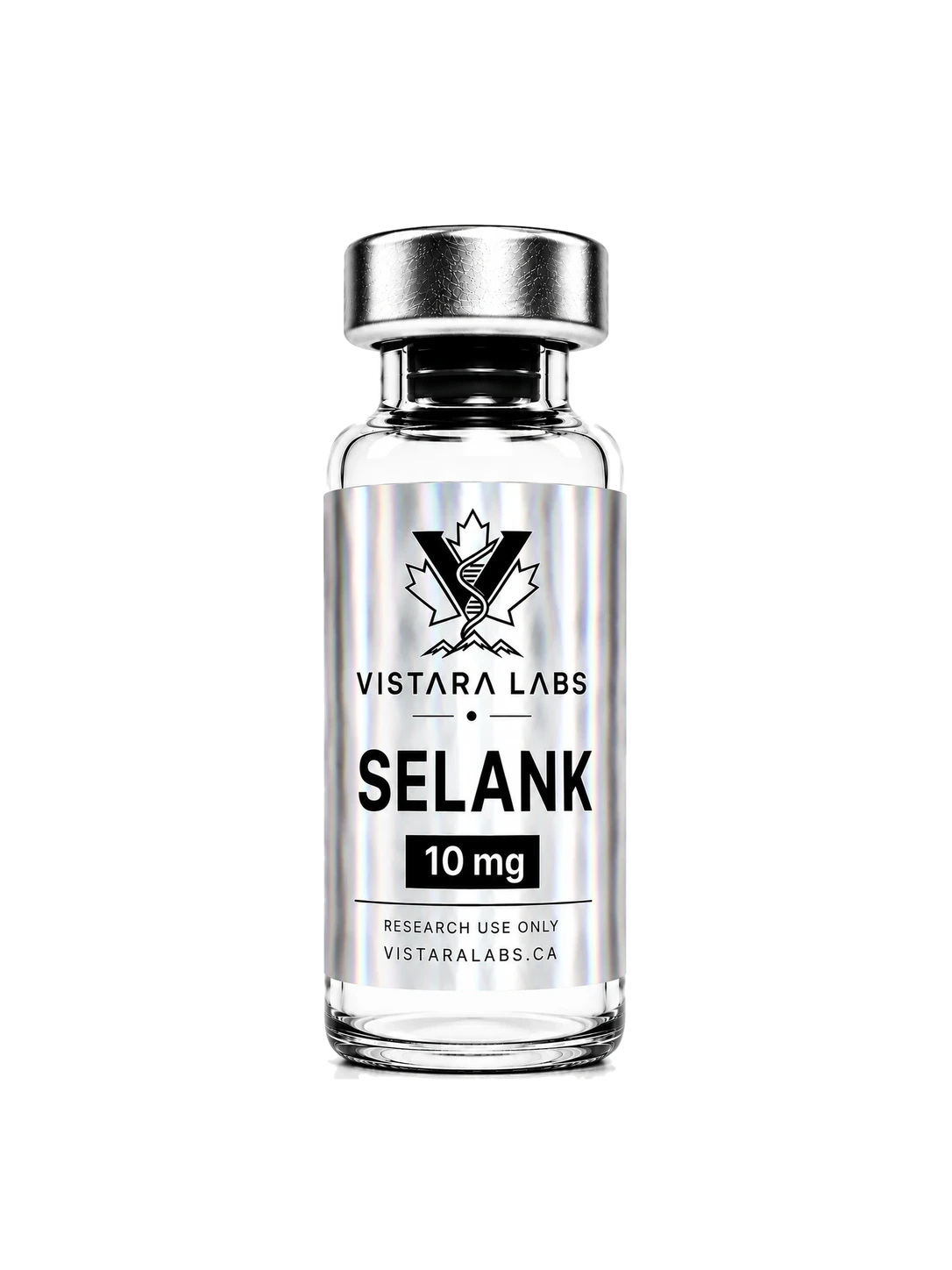
Le peptide Selank : ce que couvre la recherche
Le Selank a été conçu dans un but précis : réduire l’anxiété sans sédation. C’était l’objectif explicite du programme russe qui l’a produit dans les années 1990 : les benzodiazépines fonctionnaient déjà, et il s’agissait de trouver quelque chose qui agisse autrement. L’histoire de la recherche derrière cet objectif de conception est claire et intéressante.
Constats
- Le Selank a été conçu en Russie pour réduire l’anxiété sans sédation.
- Des études cliniques menées là-bas ont rapporté des effets anxiolytiques sans les problèmes de sédation et de dépendance des tranquillisants.
- Principaux axes de recherche : le système apaisant du GABA dans le cerveau, et le ralentissement de la dégradation des peptides apaisants produits par l’organisme.
- Habituellement étudié sous forme de solution nasale, la voie utilisée par le produit homologué en Russie.
Ce qu’est le Selank
Le Selank est un peptide synthétique construit à partir de la tuftsine, un court fragment peptidique d’origine naturelle qui provient d’une molécule d’anticorps et qui est normalement étudié dans la signalisation immunitaire.
Comme pour le Semax, le fragment naturel est fragile à lui seul : les enzymes le dégradent presque immédiatement. La conception du Selank ajoute une séquence Pro-Gly-Pro au noyau de tuftsine, ce qui stabilise suffisamment la molécule pour qu’elle puisse être étudiée. C’est la même astuce de stabilisation, appliquée à un peptide parent complètement différent, par le même institut de recherche.
Cette lignée de conception commune explique pourquoi les deux sont si souvent mentionnés d’un même souffle. Ce n’est pas parce qu’ils font la même chose.
Où pointe la recherche
- Modulation GABAergique. L’axe le plus cité. Le GABA est le principal signal inhibiteur du cerveau (le système sur lequel agissent les benzodiazépines), et le Selank est étudié comme modulateur de ce système, quoique par une voie différente de celle de cette classe de médicaments.
- Inhibition de l’enképhalinase. Il a été démontré que le Selank inhibe les enzymes qui dégradent les enképhalines, de courts peptides de signalisation de type opioïde produits par l’organisme. Plutôt que d’ajouter quoi que ce soit, il est étudié pour sa capacité à ralentir la dégradation de ce qui est déjà présent.
- Modèles d’anxiété. Les travaux cliniques russes portent principalement sur l’anxiété généralisée et la neurasthénie, et c’est l’indication pour laquelle le Selank y est utilisé.
- Signalisation immunitaire et inflammatoire. Un axe plus modeste, qui découle naturellement de l’origine de la tuftsine, issue d’un anticorps.
Où en est la recherche
Le Selank occupe la même position que le Semax, avec un peu moins de données à l’appui.
Il est entré en usage clinique en Russie dans les années 1990 et y est utilisé pour les troubles anxieux. Les rapports d’essais russes décrivent un profil de tolérabilité favorable, et l’allégation précise formulée à son sujet (une activité anxiolytique sans la sédation, la tolérance et la dépendance associées aux benzodiazépines) est la raison même pour laquelle il a suscité de l’intérêt hors de Russie.
En contrepartie : les essais proviennent en grande partie d’un seul pays et sont publiés surtout en russe, et aucun organisme de réglementation occidental n’a évalué le Selank. Le composé a un véritable historique clinique en Russie, et la littérature internationale à son sujet est encore en construction.
Une distinction utile lorsqu’on lit sur l’un ou l’autre composé : homologué en Russie et établi à l’international sont deux étapes différentes. Les deux ont un long historique clinique en Russie, et cet historique est le point de départ naturel de nouvelles recherches.
Pourquoi on l’étudie habituellement par voie intranasale
La formulation clinique russe est une solution nasale, et les travaux publiés suivent cette voie. Le raisonnement est le même que pour le Semax : les peptides traversent mal la barrière hémato-encéphalique, et l’administration intranasale est étudiée comme une voie qui atteint le système nerveux central par la voie olfactive plutôt que par la circulation générale. Nous abordons en détail la question de la voie d’administration dans voies de recherche intranasale et sous-cutanée.
Le Selank aux côtés du Semax
L’association est assez courante dans le milieu de la recherche pour avoir reçu un surnom : la combinaison nootrope russe. La justification est que les deux agissent sur des systèmes complémentaires plutôt que qui se chevauchent : le Semax sur la plasticité et la signalisation neurotrophique, le Selank sur la signalisation inhibitrice et liée au stress. Notre comparatif Semax vs Selank expose ce qui les distingue réellement, et pourquoi les chercheurs combinent des peptides présente la logique générale de ce type d’association.
Ce que le Selank n’est pas
- Pas une benzodiazépine. Il est étudié comme modulateur du même grand système, mais il n’appartient pas à cette classe de médicaments et ne partage pas son mécanisme.
- Pas un sédatif. Toute l’intention de conception était une activité sans sédation. Les sources qui le décrivent comme un composé pour le sommeil se trompent; le peptide le plus associé à l’architecture du sommeil dans cette catégorie est le DSIP, une molécule entièrement différente.
- Pas approuvé au Canada. Santé Canada n’a pas évalué le Selank et il ne détient aucune autorisation de mise en marché canadienne.
Vistara Labs offre le Selank sous forme de poudre lyophilisée, expédiée depuis le Canada vers toutes les provinces. Il figure aussi aux côtés du Semax et de la Cerebrolysin dans nos combinaisons de recherche.
Questions fréquentes
Qu’est-ce que le Selank?
Un peptide synthétique dérivé de la tuftsine, un fragment de signalisation immunitaire d’origine naturelle, auquel on a ajouté une séquence Pro-Gly-Pro pour le stabiliser. Il a été mis au point en Russie dans les années 1990.
Que couvre la recherche sur le Selank?
Principalement la modulation GABAergique, l’inhibition des enzymes qui dégradent les enképhalines et les modèles d’anxiété. Un axe plus modeste de travaux porte sur la signalisation immunitaire et inflammatoire, dans le prolongement des origines de la tuftsine.
Le Selank est-il approuvé quelque part?
Il est en usage clinique en Russie depuis les années 1990, principalement pour l’anxiété généralisée et la neurasthénie. Il n’est approuvé ni au Canada, ni aux États-Unis, ni dans l’Union européenne, et aucun organisme de réglementation occidental ne l’a évalué.
Le Selank est-il une benzodiazépine?
Non. Il est étudié comme modulateur de la signalisation GABAergique, le grand système sur lequel agit cette classe de médicaments, mais le Selank n’est pas une benzodiazépine et ne partage ni son mécanisme ni son profil de dépendance.
Quelle est la différence entre le Selank et le Semax?
Ils proviennent de peptides parents différents (le Selank de la tuftsine, le Semax de l’ACTH) et sont étudiés en lien avec des systèmes différents. Le Selank se situe du côté inhibiteur et anxiolytique, le Semax du côté de la plasticité et de l’attention. Ils partagent un institut de recherche et une conception stabilisatrice, pas un mécanisme.
Tous les produits fournis par Vistara Labs sont destinés uniquement à la recherche en laboratoire. Ce ne sont pas des médicaments, ils ne sont pas approuvés pour un usage humain ou vétérinaire et ne sont pas destinés à diagnostiquer, traiter, guérir ou prévenir une maladie. Rien sur cette page ne constitue un avis médical ni une indication d’usage chez l’humain.