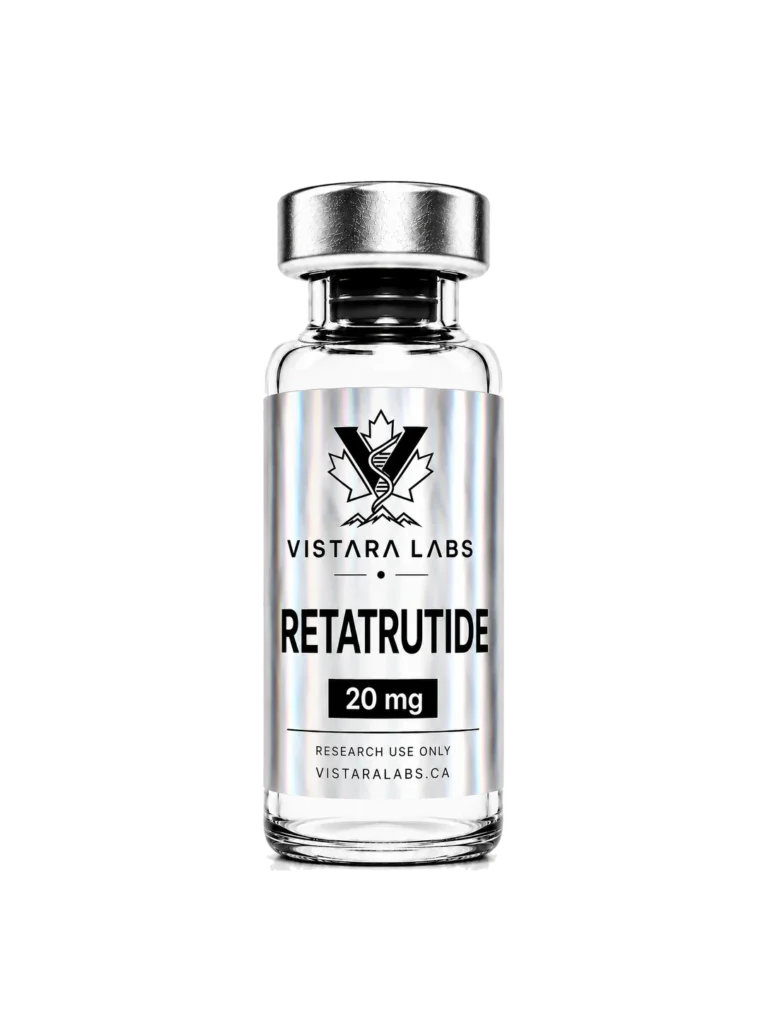
Reta Side Effects: What the Trials Reported
Across the published phase 2 and phase 3 trials, the most common reta side effects were gastrointestinal (nausea, diarrhoea, constipation and vomiting), mostly mild to moderate, concentrated in the weeks when doses were stepped up and easing over time. Reta is the short name for retatrutide, also called GLP-3, a single peptide that activates the GIP, GLP-1 and glucagon receptors. In the 80-week phase 3 obesity trial of 2,339 adults, 4.1% of the lowest-dose group stopped treatment because of an adverse event, against 4.9% on placebo. Here is what each trial reported, by journal, year and size, and how the reta (GLP-3) safety record compares with the GLP-1 class.
Findings
- The authors of the phase 3 diabetes trials describe reta’s adverse event profile as consistent with other molecules with GLP-1 receptor activity (Lancet, 2026).
- In the 40-week phase 3 trial of 537 adults with type 2 diabetes, no severe hypoglycaemia was reported and gastrointestinal events subsided over time; 2% to 5% stopped because of an adverse event (Lancet, 2026).
- In the 2023 phase 2 obesity trial (NEJM, 338 adults), serious adverse events ran at 0% to 6% on reta against 4% on placebo, and a lower starting dose partly reduced gastrointestinal effects.
- In the fatty liver substudy (Nature Medicine, 2024, 98 adults), there were no liver toxicity signals through 48 weeks.
- Beyond the gut, the trials recorded dysesthesia (an altered skin sensation), a heart-rate rise that peaked at 24 weeks and then declined, and occasional low blood pressure.
What reta is, and why its side effects look like the GLP-1 class
Reta is a 39-amino-acid peptide with a half-life of about six days, studied as a once-weekly injection. Two of its three targets, GIP and GLP-1, are the receptors tirzepatide acts on; GLP-1 alone is semaglutide’s target. The GLP-1 receptor slows stomach emptying and acts on appetite centres in the brain, which is the usual explanation for why nausea and other gut effects lead the side-effect tables of every peptide in the class. The third target, the glucagon receptor, is what reta vs tirzepatide turns on.
Reta side effects trial by trial
| Trial | Size and length | Safety headline |
|---|---|---|
| Phase 2 obesity, NEJM 2023 | 338 adults, 48 weeks | GI events dose-related, mostly mild to moderate |
| Phase 2 diabetes, Lancet 2023 | 281 adults, 36 weeks | No severe hypoglycaemia; GI rate matched the GLP-1 comparator |
| Phase 2 liver, Nat Med 2024 | 98 adults, 48 weeks | No liver toxicity signals |
| Phase 3 diabetes, Lancet 2026 | 537 adults, 40 weeks | No severe hypoglycaemia; 2% to 5% stopped |
| Phase 3 obesity and diabetes, Lancet 2026 | 1,152 adults, 80 weeks | GI events most frequent; dysesthesia up to 7% |
| Phase 3 obesity, NEJM 2026 | 2,339 adults, 80 weeks | GI events most common |
Phase 2 obesity trial (NEJM, 2023)
This double-blind trial randomised 338 adults with obesity, or overweight plus a weight-related condition, to placebo or one of several reta dose levels for 48 weeks. The most common adverse events were gastrointestinal; they were dose-related, mostly mild to moderate, and partly reduced in groups that began at a lower starting dose. Adverse events of any kind were reported in 73% to 94% of the reta groups and 70% of the placebo group, serious adverse events in 0% to 6% against 4%, and 6% to 16% of reta participants stopped because of an adverse event. Heart rate rose in a dose-dependent way up to week 24 and declined after that.
Phase 2 diabetes trial (Lancet, 2023)
Run at 42 centres in the United States with 281 adults with type 2 diabetes, this trial compared reta with placebo and with dulaglutide, a GLP-1-only peptide. Mild to moderate gastrointestinal events (nausea, diarrhoea, vomiting and constipation) were reported in 35% of reta participants, the same 35% as on dulaglutide, against 13% on placebo, ranging from 13% in the lowest-dose group upward. There were no reports of severe hypoglycaemia and no deaths during the study.
Phase 2 fatty liver substudy (Nature Medicine, 2024)
In the 98 participants with fatty liver, transient and generally mild to moderate gastrointestinal events were the most frequent adverse events, occurring mainly during dose escalation. The authors found no liver toxicity signals in this group or in the whole obesity trial through 48 weeks, and rises in beta-hydroxybutyrate, a marker of fat burning, were not linked with ketoacidosis in anyone. The liver results themselves are in reta and fatty liver.
Phase 3 diabetes trial (Lancet, 2026)
This 40-week double-blind trial randomised 537 adults with type 2 diabetes at 48 sites in the United States, Mexico and India, and 91% completed treatment. The most frequent adverse events were generally mild to moderate gastrointestinal events that subsided over time. No severe hypoglycaemia was reported, and treatment discontinuation because of adverse events was 2% to 5% on reta against 0% on placebo. Efficacy results are in reta for diabetes.
Phase 3 obesity and diabetes trial (Lancet, 2026)
Over 80 weeks at 92 centres in eight countries, 1,152 adults with obesity and type 2 diabetes received one of three reta doses or placebo, and 84% completed treatment. Gastrointestinal events were the most frequent: diarrhoea in 27% to 34% of the reta groups against 13% on placebo, and nausea in 14% to 28% against 8%. Hypotension (low blood pressure) was reported in 1% to 6% against under 1%, and dysesthesia in 4% to 7% against 1%. Discontinuation for adverse events or death was 4% at the lowest dose, close to placebo’s 5%, and 8% to 12% at the two higher doses; investigators judged every death in the trial unrelated to the study drug.
Phase 3 obesity trial (NEJM, 2026)
The largest reta trial so far randomised 2,339 adults with obesity and without diabetes to three doses or placebo for 80 weeks, with weight changes of 17.6% to 25.0% against 3.9% on placebo. The journal paper reports gastrointestinal events as the most common adverse events. Figures released with the headline results in May 2026 put the detail at:
| Adverse event | Reta groups | Placebo |
|---|---|---|
| Nausea | 28.6% to 42.4% | 14.8% |
| Diarrhoea | 25.2% to 34.1% | 13.5% |
| Constipation | 23.8% to 26.1% | 10.9% |
| Vomiting | 10.6% to 25.3% | 4.8% |
| Dysesthesia | 5.1% to 12.5% | 0.9% |
| Stopped for an adverse event | 4.1% to 11.3% | 4.9% |
Dysesthesia events were reported as generally mild to moderate, most resolved during treatment, and most participants continued.
Reta side effects beyond the gut
- Skin sensation (dysesthesia): reported more often on reta than on placebo, in 4% to 7% in the 80-week diabetes trial and 5.1% to 12.5% in the headline obesity figures, mostly mild to moderate and mostly resolving.
- Heart rate: a dose-dependent rise that peaked at 24 weeks and declined afterwards in the phase 2 obesity trial.
- Blood pressure: hypotension in up to 6% in the 80-week diabetes trial.
- Blood sugar: no severe hypoglycaemia in the phase 2 or the 40-week phase 3 diabetes trial.
- Liver: no liver toxicity signals through 48 weeks.
How reta side effects compare with tirzepatide and semaglutide
Gastrointestinal effects lead the tables for all three peptides. In the 2021 NEJM head-to-head of tirzepatide and semaglutide in 1,879 adults with type 2 diabetes, nausea ran at 17% to 22% on tirzepatide and 18% on semaglutide, a reminder that rates depend heavily on trial length, dose steps and population, so figures from different trials are not directly comparable. Our comparison pages are reta vs tirzepatide and reta vs semaglutide.
Reta (GLP-3) is supplied for laboratory research use only, shipped from within Canada by Canada Post Xpresspost. The studies above were clinical research using pharmaceutical preparations. Reconstitution arithmetic is in the reta reconstitution calculator and storage in how long does reta last.
Frequently asked questions
What were the most common reta side effects in the trials?
Gastrointestinal effects: nausea, diarrhoea, constipation and vomiting. Across the phase 2 and phase 3 trials they were mostly mild to moderate, concentrated in the weeks when doses were stepped up, and eased over time.
How many trial participants stopped reta because of side effects?
In the 80-week phase 3 obesity trial of 2,339 adults, 4.1% of the lowest-dose group stopped for an adverse event, against 4.9% on placebo, and 11.3% at the highest dose. In the 40-week phase 3 diabetes trial of 537 adults, the figure was 2% to 5%.
What is dysesthesia in the reta trials?
An altered skin sensation, such as tingling or sensitivity. It was reported in 4% to 7% of reta participants in the 80-week diabetes trial, against 1% on placebo, and was described as mostly mild to moderate and mostly resolving during treatment.
What did the reta trials show about blood sugar and the liver?
No severe hypoglycaemia was reported in the phase 2 or the 40-week phase 3 diabetes trial, and the 2024 Nature Medicine fatty liver substudy found no liver toxicity signals through 48 weeks.
Where can I buy reta (GLP-3) in Canada?
Vistara Labs supplies reta (GLP-3) as lyophilised vials, shipped from within Canada by Canada Post Xpresspost.
Product details from vistaralabs.ca, October 2026. Sources: Jastreboff AM, Kaplan LM, Frías JP, et al. Triple-hormone-receptor agonist retatrutide for obesity: a phase 2 trial. N Engl J Med. 2023. PMID 37366315. Rosenstock J et al. Retatrutide, a GIP, GLP-1 and glucagon receptor agonist, for people with type 2 diabetes: a randomised, double-blind, placebo and active-controlled, parallel-group, phase 2 trial conducted in the USA. Lancet. 2023. PMID 37385280. Sanyal AJ et al. Triple hormone receptor agonist retatrutide for metabolic dysfunction-associated steatotic liver disease: a randomized phase 2a trial. Nat Med. 2024. PMID 38858523. Bajaj HS et al. Efficacy and safety of retatrutide, a GIP, GLP-1, and glucagon receptor agonist, in people with type 2 diabetes and inadequate glycaemic control with diet and exercise: a double-blind, randomised, phase 3 trial. Lancet. 2026. PMID 42250575. Bellido V et al. Retatrutide in adults with obesity and type 2 diabetes: a double-blind, parallel-group, randomised, placebo-controlled, phase 3 trial. Lancet. 2026. PMID 42810372. Jastreboff AM, Kaplan LM, Davies MJ, et al. Retatrutide, a triple hormone receptor agonist, for treatment of obesity. N Engl J Med. 2026. PMID 42814954. Headline phase 3 obesity safety figures as reported by HCPLive, 21 May 2026. hcplive.com. Frías JP et al. Tirzepatide versus semaglutide once weekly in patients with type 2 diabetes. N Engl J Med. 2021. PMID 34170647.
More on this: Peptides for Weight Loss and Weight Loss and Metabolism Research.
All products supplied by Vistara Labs are intended for laboratory research use only. They are not drugs, are not approved for human or veterinary use, and are not intended to diagnose, treat, cure or prevent any condition. Nothing on this page constitutes medical advice or guidance for use in humans.