What Is 5-Amino-1MQ? The NNMT Inhibitor Explained
Weight Loss & Metabolism Research
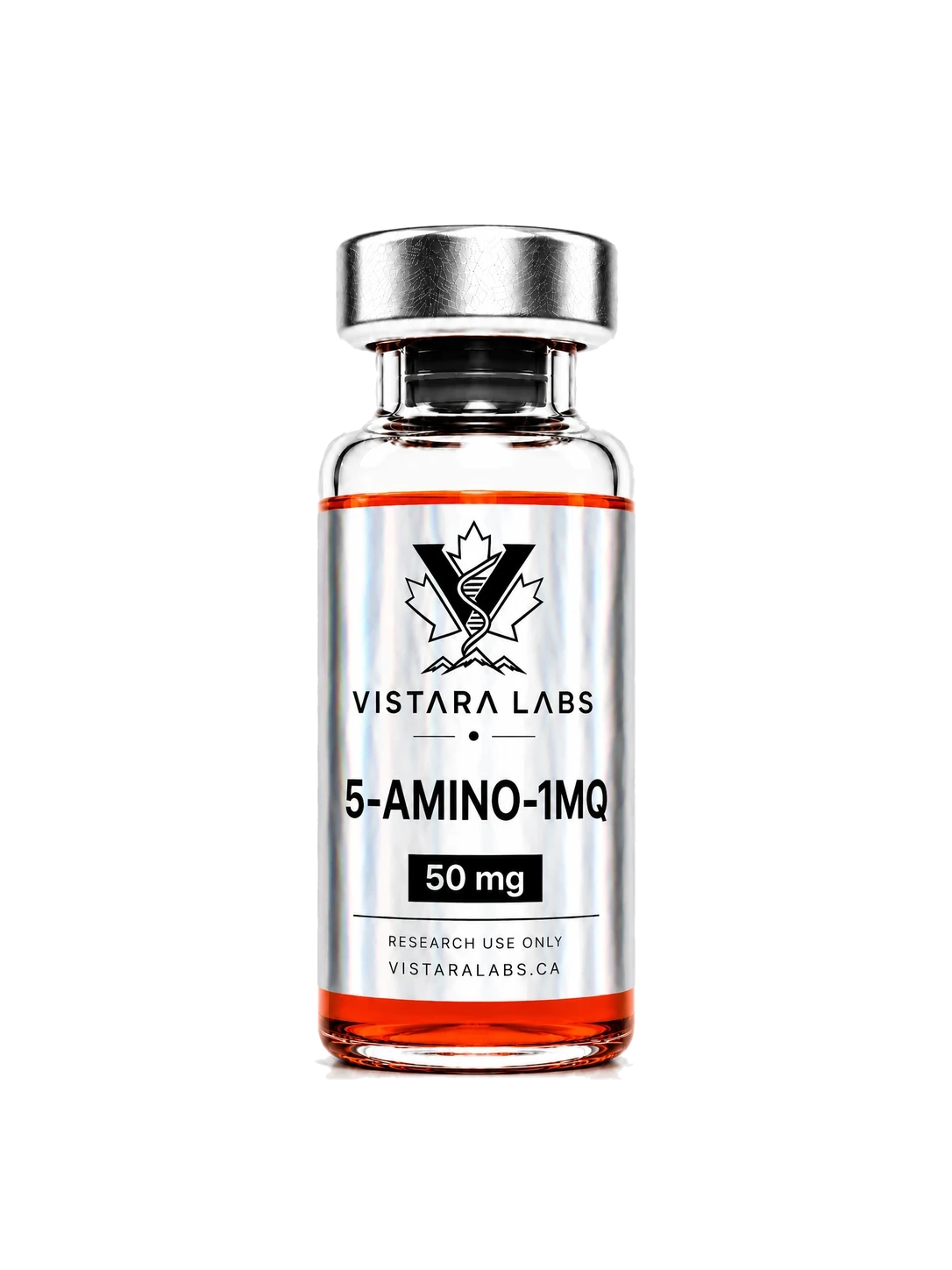
5-Amino-1MQ (5-amino-1-methylquinolinium) is a small, synthetic molecule that blocks nicotinamide N-methyltransferase (NNMT), an enzyme in fat, liver and muscle cells that uses up vitamin B3 and the cell’s main methyl donor, and so sits at a junction of energy metabolism. It was developed at the University of Texas Medical Branch in Galveston, and laboratory studies since 2017 have linked it to less fat build-up in fat cells, lower body weight and fat mass in diet-induced obese mice, and stronger muscle regeneration in aged mice. Vistara Labs supplies it as a 5-Amino-1MQ 50 mg lyophilised vial.
Findings
- 5-Amino-1MQ is a methylquinolinium, not a peptide: a single ring-based molecule with a molecular weight of about 159, far smaller than any amino-acid chain.
- It inhibits NNMT at about 1 micromolar and did not inhibit related methyltransferases or enzymes of the NAD+ recycling pathway (2018).
- In fat cells it raised NAD+ 1.2-1.6-fold and cut new fat formation by 50-70% (2018).
- Diet-induced obese mice treated for 11 days lost about 5% of body weight while controls gained, with about 35% less white fat mass and about 30% lower cholesterol, and no change in food intake (2018).
- In aged mice it activated muscle stem cells, nearly doubled the size of regenerating muscle fibres and raised peak muscle force by about 70% (2019).
 View product →
What is 5-Amino-1MQ?
5-Amino-1MQ is short for 5-amino-1-methylquinolinium. Quinoline is a two-ring structure common in medicinal chemistry; adding a methyl group to its nitrogen makes a quinolinium, a molecule that carries a permanent positive charge, and the 5-amino group sits on the second ring. PubChem lists the cation as C10H11N2+ with a molecular weight of 159.21. That makes it a small molecule rather than a peptide, even though it is often sold and discussed alongside peptides. Our NAD+ Is Not a Peptide article makes the same point about another popular metabolic compound.
Where it came from
The story starts with a 2014 discovery at Harvard. Studying fat tissue, Barbara Kahn’s group found that NNMT was the gene most strongly regulated in the opposite direction to GLUT4, the glucose transporter that fat cells lose in obesity and type 2 diabetes. NNMT levels were higher in the fat and liver of obese and diabetic mice, and switching the enzyme down in those tissues protected mice against diet-induced obesity by raising energy expenditure (Kraus et al., Nature, 2014).
That made NNMT a drug target. Stanley Watowich’s group at the University of Texas Medical Branch set out to build small inhibitors, published the structure-activity work behind a series of quinolinium compounds (Neelakantan et al., J Med Chem, 2017), and identified 5-amino-1MQ as a potent, selective, membrane-permeable member of the series (Neelakantan et al., Biochem Pharmacol, 2018).
How 5-Amino-1MQ works
NNMT takes nicotinamide (a form of vitamin B3) and attaches a methyl group to it, using S-adenosylmethionine (SAM), the cell’s general methyl donor. The product, 1-methylnicotinamide (1-MNA), is a dead end that leaves the cell (Kraus et al., 2014). That matters for two reasons:
- NAD+ supply. Nicotinamide is the raw material cells recycle into NAD+, the coenzyme at the centre of energy metabolism. Every molecule NNMT methylates is one less available for that recycling.
- Methyl balance. Each reaction spends a molecule of SAM, which the cell also needs for gene regulation through histone methylation.
In the 2014 work, blocking NNMT raised SAM and NAD+ in fat tissue, increased polyamine turnover and raised oxygen consumption in fat cells (Kraus et al., 2014). 5-Amino-1MQ was designed to produce the same effect with a drug-like molecule: in cultured fat cells it lowered 1-MNA to about 40% of untreated levels, raised NAD+ about 1.2-1.6-fold and raised SAM (Neelakantan et al., 2018). For the NAD+ side of this story, see NAD+ vs 5-Amino-1MQ and What Is NAD+?
What the research has shown
The published work on 5-amino-1MQ covers fat cells, obese mice and ageing muscle.
Fat cells
Cultured fat cells treated with 5-amino-1MQ made much less new fat: lipogenesis, the building of fat from smaller molecules, fell by 50% at one test concentration and 70% at a higher one. The compound inhibited NNMT with an IC50 of about 1.2 micromolar (the concentration that halves enzyme activity), passed readily through membranes in two permeability assays, and left related SAM-dependent enzymes and the NAD+ recycling enzymes untouched (Neelakantan et al., 2018).
Diet-induced obesity in mice
In an 11-day study in mice made obese on a high-fat diet, animals given 5-amino-1MQ lost 2.0 grams, about 5.1% of their starting weight, while controls gained about 1.4%. White fat mass was about 35% lower, fat cells were more than 30% smaller and plasma total cholesterol was about 30% lower. Food intake did not differ between groups, so the weight change did not come from eating less (Neelakantan et al., 2018).
Later studies from the same group extended this. Combined with a switch to a lean diet, 5-amino-1MQ sped up and improved weight and fat loss, raised lean mass relative to body weight and reduced fat in the liver, bringing body composition into line with mice kept lean throughout (Sampson et al., Sci Rep, 2021). In a 28-day study in obese mice it limited weight and fat gain, improved glucose tolerance and insulin sensitivity, reduced fatty liver, and reached fat, muscle and liver after administration under the skin (Babula et al., Diabetes Obes Metab, 2024).
Ageing muscle
In 24-month-old mice with an acute muscle injury, 5-amino-1MQ increased muscle stem cell proliferation and fusion, produced regenerating fibres with nearly twice the cross-sectional area of controls, and raised the peak force of the injured muscle by about 70% (Neelakantan et al., Biochem Pharmacol, 2019). In a 2024 study, aged sedentary mice given 5-amino-1MQ for eight weeks had about 40% greater grip strength than sedentary controls, against about 20% for exercise alone, and the two together gave about 60% (Dimet-Wiley et al., Sci Rep, 2024).
The published work to date is laboratory research. The fuller study-by-study write-up is on 5-Amino-1MQ Benefits: What the NNMT Research Shows.
5-Amino-1MQ at a glance
| Question | Answer |
|---|---|
| Type | Small molecule (methylquinolinium), not a peptide |
| Target | NNMT enzyme |
| Main effects | More NAD+ and SAM in cells; less fat formation |
| Key models | Fat cells, obese mice, aged muscle |
| Research stage | Laboratory research |
Forms Vistara Labs stocks
5-Amino-1MQ comes as a 50 mg lyophilised vial. The concentration arithmetic is in how much bacteriostatic water for a 5-Amino-1MQ 50 mg vial, and certificates of analysis are on the lab reports page. Researchers comparing metabolic signals may also want 5-Amino-1MQ vs MOTS-c. Ordering details are in Buy 5-Amino-1MQ in Canada.
5-Amino-1MQ is supplied by Vistara Labs for laboratory research use only. The studies above were laboratory research.
Frequently asked questions
What is 5-Amino-1MQ?
5-Amino-1MQ is 5-amino-1-methylquinolinium, a small synthetic molecule developed at the University of Texas Medical Branch that inhibits the enzyme nicotinamide N-methyltransferase (NNMT). It is a small molecule, not a peptide.
What has 5-Amino-1MQ research shown?
In laboratory studies it raised NAD+ and cut fat formation in fat cells, reduced body weight by about 5% and white fat mass by about 35% in obese mice without changing food intake (2018), and improved muscle regeneration and strength in aged mice (2019, 2024).
How does 5-Amino-1MQ work?
NNMT uses up nicotinamide, the raw material for NAD+, and the methyl donor SAM. By blocking NNMT, 5-Amino-1MQ leaves more of both available to the cell, which in the 2014 enzyme studies was linked to higher energy expenditure in fat tissue.
Is 5-Amino-1MQ a peptide?
No. It is a methylquinolinium with a molecular weight of about 159, much smaller than a peptide. It is often grouped with peptides because researchers study it alongside metabolic peptides such as MOTS-c.
What did the research show about 5-Amino-1MQ and muscle?
In aged mice with a muscle injury it activated muscle stem cells, nearly doubled the size of regenerating fibres and raised peak force by about 70%. In a 2024 study it raised grip strength by about 40% in aged sedentary mice, and by about 60% when combined with exercise.
Product details from vistaralabs.ca, October 2026. Compound data from PubChem (CID 950107). Sources: Kraus D et al. Nicotinamide N-methyltransferase knockdown protects against diet-induced obesity. Nature. 2014. PMID 24717514. Neelakantan H et al. Structure-activity relationship for small molecule inhibitors of nicotinamide N-methyltransferase. J Med Chem. 2017. PMID 28548833. Neelakantan H et al. Selective and membrane-permeable small molecule inhibitors of nicotinamide N-methyltransferase reverse high fat diet-induced obesity in mice. Biochem Pharmacol. 2018. PMID 29155147. Neelakantan H et al. Small molecule nicotinamide N-methyltransferase inhibitor activates senescent muscle stem cells and improves regenerative capacity of aged skeletal muscle. Biochem Pharmacol. 2019. PMID 30753815. Sampson CM et al. Combined nicotinamide N-methyltransferase inhibition and reduced-calorie diet normalizes body composition and enhances metabolic benefits in obese mice. Sci Rep. 2021. PMID 33707534. Dimet-Wiley AL et al. Nicotinamide N-methyltransferase inhibition mimics and boosts exercise-mediated improvements in muscle function in aged mice. Sci Rep. 2024. PMID 38969654. Babula JJ et al. Nicotinamide N-methyltransferase inhibition mitigates obesity-related metabolic dysfunction. Diabetes Obes Metab. 2024. PMID 39161060.
More on this: Weight Loss & Metabolism Research.
All products supplied by Vistara Labs are intended for laboratory research use only. They are not drugs, are not approved for human or veterinary use, and are not intended to diagnose, treat, cure or prevent any condition. Nothing on this page constitutes medical advice or guidance for use in humans.
References
5-Amino-1MQ is a small-molecule NNMT inhibitor rather than a peptide. No completed human clinical trial was identified; the research below is preclinical.
- Selective and membrane-permeable small molecule inhibitors of nicotinamide N-methyltransferase reverse high fat diet-induced obesity in miceCharacterises 5-Amino-1MQ as a selective, cell-permeable NNMT inhibitor in laboratory studies. No human trial identified.
Links open the study record on PubMed so the source can be checked directly. Listing a study is not a claim that its findings apply to any other use, product or route of administration. Research use only.