NAD+ Is Not a Peptide. Here Is What It Is.
Cellular Energy & Mitochondrial Research
NAD+ is not a peptide. It sits in peptide catalogues, gets ordered alongside peptides, and is discussed in the same research conversations — but structurally it belongs to a different class of molecule entirely. That distinction is useful context for anyone researching it, because it changes what the purity figure on the certificate of analysis is actually measuring.
 View product →
Findings
- NAD+ is not a peptide: it is a coenzyme, a different class of molecule with no amino acids in it.
- Its job is electron transfer, the core of cellular energy metabolism, which is why it appears wherever mitochondria are studied.
- Its certificate of analysis reports small-molecule purity; there is no peptide sequence to confirm.
- Its research territory overlaps most with MOTS-c.
What NAD+ actually is
NAD+ (nicotinamide adenine dinucleotide) is a coenzyme: a small molecule built from two nucleotides joined through their phosphate groups. Peptides are chains of amino acids. NAD+ contains no amino acids at all.
Its role in the cell is electron transfer. NAD+ accepts electrons and becomes NADH; NADH donates them and reverts to NAD+. That cycle runs continuously in every cell, and it is the reason the molecule appears wherever cellular energy metabolism is being studied.
The practical consequence: a NAD+ certificate of analysis reports the purity of a small organic molecule, typically by HPLC. It is not a peptide-sequence confirmation, because there is no sequence to confirm.
Why it sits alongside peptides
Classification aside, NAD+ shares the research territory. Work on mitochondrial function, cellular energy metabolism and metabolic regulation tends to involve both, which is why the same laboratories order both.
It overlaps particularly with MOTS-c, a mitochondrial-derived peptide studied in the same energy-metabolism context, and with SS-31, which is investigated in connection with mitochondrial membranes.
Handling: this one is fussier
NAD+ is more sensitive than most of the lyophilised peptides beside it on the shelf. It is hygroscopic — it draws moisture from the air — and it degrades faster in solution than in the dry state, with stability falling off as pH and temperature rise.
In practice that means keeping the vial sealed until it is needed, minimising the time it spends open, and refrigerating anything reconstituted. As with any research material, specific handling protocols are set by the researcher.
Buying NAD+ in Canada
Because NAD+ is a small molecule rather than a synthesised peptide chain, its certificate of analysis reads a little differently: it reports HPLC purity for a single defined compound rather than confirming a sequence. Certificates of analysis from independent laboratories are published for each compound, with purity above 99 percent, and every vial is supplied sealed.
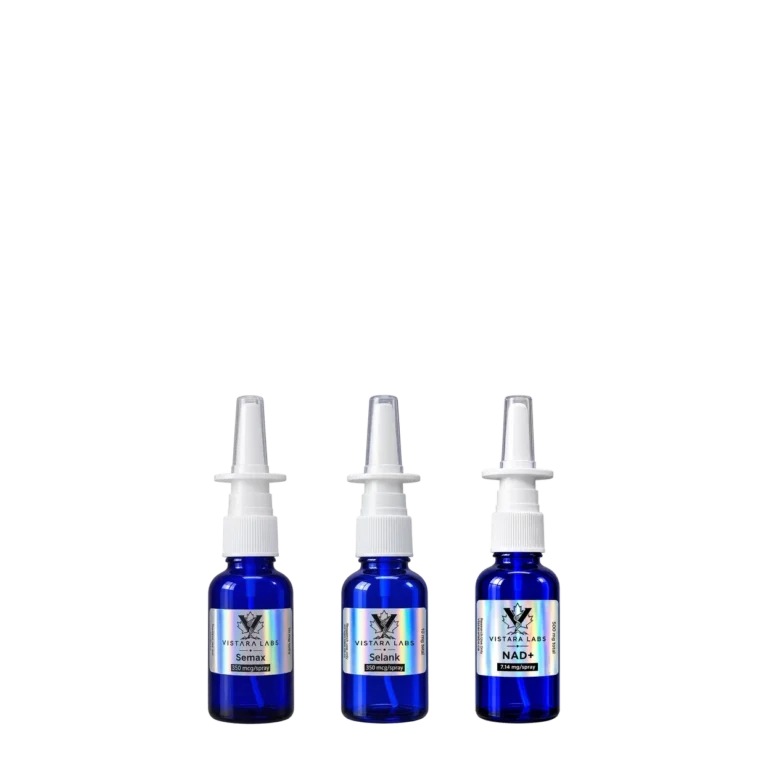
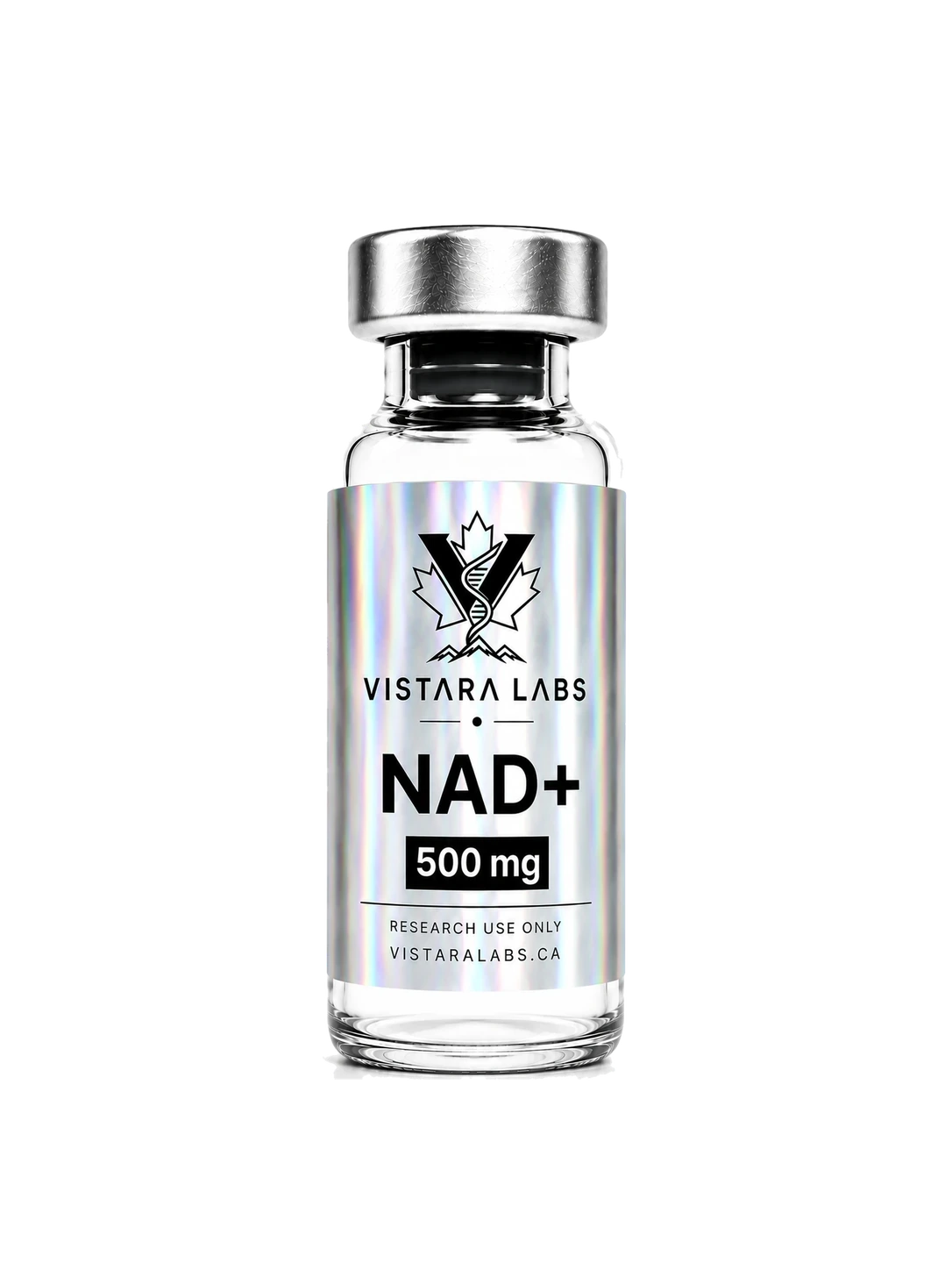
Vistara Labs supplies NAD+ in 500 mg vials, third-party tested, with the published certificates on the lab reports page. Every order ships from within Canada, with free shipping on larger orders.
All products supplied by Vistara Labs are intended for laboratory research use only. They are not drugs, are not approved for human or veterinary use, and are not intended to diagnose, treat, cure or prevent any condition. Nothing on this page constitutes medical advice or guidance for use in humans.
References
Human NAD+ work is largely pharmacology and tolerability rather than clinical outcomes. A 2026 systematic review reports no eligible clinical-outcome trial of intravenous or intramuscular NAD+ itself for anti-ageing or wellness.
- NAD⁺ supplementation for anti-aging and wellness: A PRISMA-guided systematic review of preclinical and clinical evidencePRISMA systematic review; 113 intervention studies including 33 human studies. Reports no eligible clinical-outcome trial of intravenous or intramuscular NAD+ itself for anti-ageing or wellness.
- A Pilot Study Investigating Changes in the Human Plasma and Urine NAD+ Metabolome During a 6 Hour Intravenous Infusion of NADHuman pilot pharmacology study; plasma and urine NAD+ metabolome during a 6-hour intravenous infusion. Not an efficacy trial.
- Intravenous infusion of nicotinamide adenine dinucleotide (NAD(+)) versus nicotinamide riboside (NR): a retrospective tolerability pilot study in a real-world settingRetrospective tolerability pilot comparing four days of intravenous NAD+ with intravenous nicotinamide riboside in a real-world setting.
- Oral LNAD+ rapidly elevates whole blood intracellular NAD and metabolic flux without elevating plasma NAD: evidence from a randomized controlled trialRandomised controlled trial of a specific modified ORAL NAD+ formulation; clinical outcomes exploratory and formulation-specific.
Links open the study record on PubMed so the source can be checked directly. Listing a study is not a claim that its findings apply to any other use, product or route of administration. Research use only.