What Is Semax? The ACTH-Derived BDNF Peptide
Cognitive & Nootropic Research
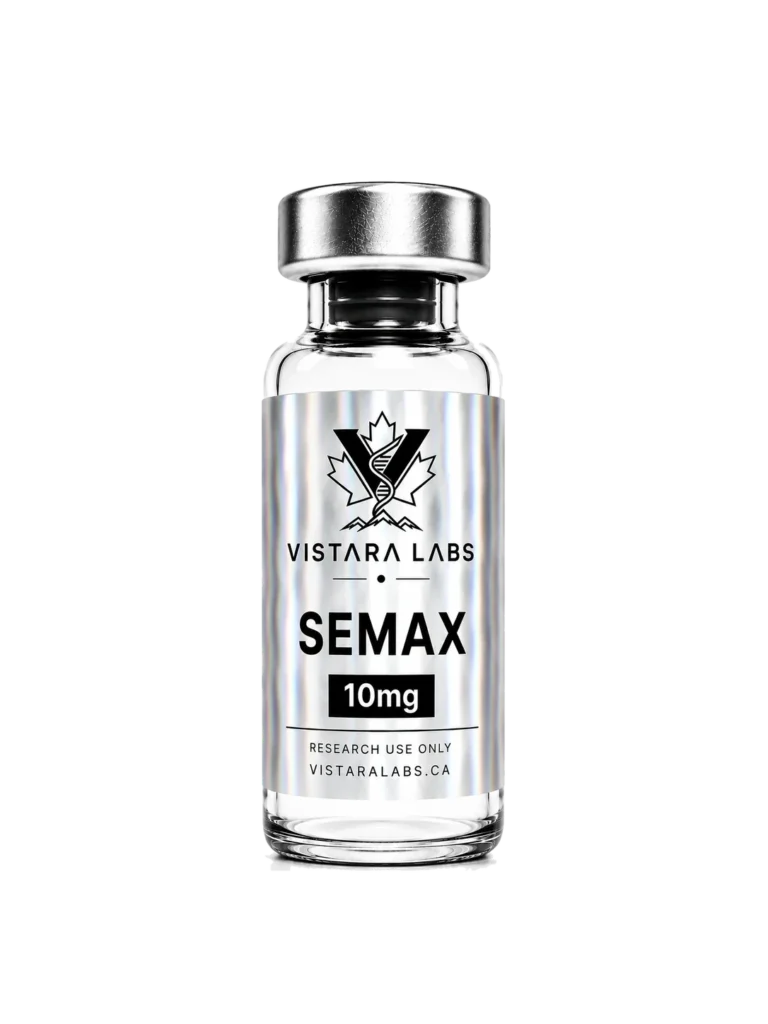
Semax is a synthetic seven-amino-acid peptide, Met-Glu-His-Phe-Pro-Gly-Pro, made from a fragment of the pituitary hormone ACTH and studied for its effects on the brain, especially on BDNF, the growth factor that helps neurons survive and form new connections. It was developed by Russian Academy of Sciences researchers in Moscow, the same Institute of Molecular Genetics group behind Selank, and in a 2018 study of 110 patients recovering from ischaemic stroke it raised blood BDNF and sped up functional recovery. Vistara Labs supplies it as a Semax 10 mg lyophilised vial, a ready-mixed Semax Nasal Spray and a combined Selank + Semax Nasal Spray.
Findings
- Semax is ACTH(4-7) plus a Pro-Gly-Pro tail, a seven-amino-acid analogue of the ACTH(4-10) fragment (Sudarkina et al., 2021).
- In 110 stroke patients, Semax raised plasma BDNF, which stayed high through the study, and sped up improvement on the Barthel index of daily living (2018).
- In healthy volunteers, functional MRI showed changes in the brain’s default mode network within 5-20 minutes of intranasal Semax (2018).
- In rat brain it bound specific sites with nanomolar affinity and raised BDNF protein in the basal forebrain within 3 hours (2006).
- After experimental stroke, over 50% of the genes it changed were immune-response genes, with further effects on blood-vessel genes (2014).
 View product →
What is Semax?
Semax is a heptapeptide, a chain of seven amino acids. Its first four, methionine, glutamic acid, histidine and phenylalanine, are positions 4 to 7 of adrenocorticotropic hormone (ACTH), the pituitary hormone that signals the adrenal glands. The developers added proline, glycine and proline to the end, which is why the literature often writes it as ACTH(4-7)PGP and describes it as an analogue of ACTH(4-10) (Sudarkina et al., Int J Mol Sci, 2021; Kolbaev et al., Bull Exp Biol Med, 2025).
Where it came from
Semax came out of the Russian Academy of Sciences in Moscow. Academician Nikolai Myasoedov’s group at the Institute of Molecular Genetics appears on much of its research, from the receptor-binding work to the stroke and brain-imaging studies cited on this page. Selank was developed by the same institute, and the two peptides share the same Pro-Gly-Pro ending, a tail that researchers added to Selank to improve its metabolic stability (Volkova et al., Front Pharmacol, 2016).
Related compounds
N-acetyl Semax amidate is a modified form with capped ends (N-Acetyl Semax Amidate: What It Is and How It Differs from Semax), and Adamax is a newer analogue (What Is Adamax?). Selank, its sibling, is built on tuftsin instead of ACTH and is studied for anxiety (What Is Selank?).
How Semax works
BDNF: the brain’s growth signal
Brain-derived neurotrophic factor (BDNF) is a protein that keeps neurons alive, helps them grow new branches and supports learning and memory. A 2006 study in rats found that Semax binds specific sites on basal forebrain membranes, with a dissociation constant (a measure of how tightly it binds, lower is tighter) of 2.4 nanomolar. Given intranasally, it rapidly increased BDNF protein in the basal forebrain, a region central to attention and memory, three hours later. The authors linked its cognitive effects to that rise (Dolotov et al., J Neurochem, 2006).
Immune and blood-vessel genes after ischaemia
Genome-wide studies have looked at what Semax changes when blood flow to part of the brain is cut off. In a rat model of focal stroke, more than half of the genes Semax altered were immune-response genes, including those for immunoglobulins and chemokines, and the effect grew between 3 and 24 hours. It also changed 24 vascular genes at 3 hours and 12 at 24 hours, involved in blood-vessel growth and repair. The authors proposed that these immune and vascular effects are central to its protective action (Medvedeva et al., BMC Genomics, 2014). A 2021 protein-level study in an ischaemia-reperfusion model confirmed a protective profile (Sudarkina et al., 2021).
Effects on neurons
In isolated rat neurons, Semax modulated GABA- and glycine-activated ion currents (Sharonova et al., Bull Exp Biol Med, 2018) and affected intracellular calcium dynamics (Kolbaev et al., 2025), which shows it acts directly on nerve-cell signalling as well as through growth factors.
What the research has shown
Recovery after ischaemic stroke
The largest recent human study followed 110 patients (43 men, 67 women, average age 58) in rehabilitation after ischaemic stroke, starting either about three months or about seven months after the stroke. Semax raised plasma BDNF regardless of when rehabilitation began, and the higher levels persisted through the study. Semax and higher BDNF both sped up improvement on the Barthel index, a standard score of independence in daily activities, and improved the final score. Early rehabilitation combined with Semax produced the largest BDNF increases, the fastest functional recovery and the best motor performance (Gusev et al., Zh Nevrol Psikhiatr Im S S Korsakova, 2018). The trial is reviewed in depth on Semax and Stroke Recovery: The BDNF Research.
Brain networks in healthy volunteers
Two imaging studies from Moscow measured Semax’s effect on the healthy brain. In 24 healthy volunteers scanned before and 5 and 20 minutes after intranasal Semax or placebo, the Semax group showed a larger rostral part of the default mode network, the set of regions active during rest and self-directed thought, centred on the medial frontal cortex (Lebedeva et al., Bull Exp Biol Med, 2018). In a second study of 52 healthy participants, Semax and Selank each changed connectivity between the right amygdala and temporal-lobe regions (Panikratova et al., Dokl Biol Sci, 2020).
Laboratory models
Animal and cell work has extended the picture: Semax attenuated the effects of chronic unpredictable stress in rats (Yatsenko et al., Dokl Biol Sci, 2013), and recent studies have examined it in Alzheimer’s disease models (Radchenko et al., Acta Naturae, 2025) and spinal cord injury (Liu et al., Br J Pharmacol, 2025).
Semax at a glance
| Question | Answer |
|---|---|
| Type | Synthetic heptapeptide |
| Sequence | Met-Glu-His-Phe-Pro-Gly-Pro |
| Parent molecule | ACTH fragment 4-7 |
| Main system studied | BDNF and brain repair |
| Strongest human data | Stroke rehabilitation, 110 patients (2018) |
The full research record is on Semax Benefits: What the Research Shows and our Semax: Research Reference. For comparisons, see Semax vs Selank and Semax vs Cerebrolysin. Its tolerability is covered in Semax Side Effects.
Forms we stock
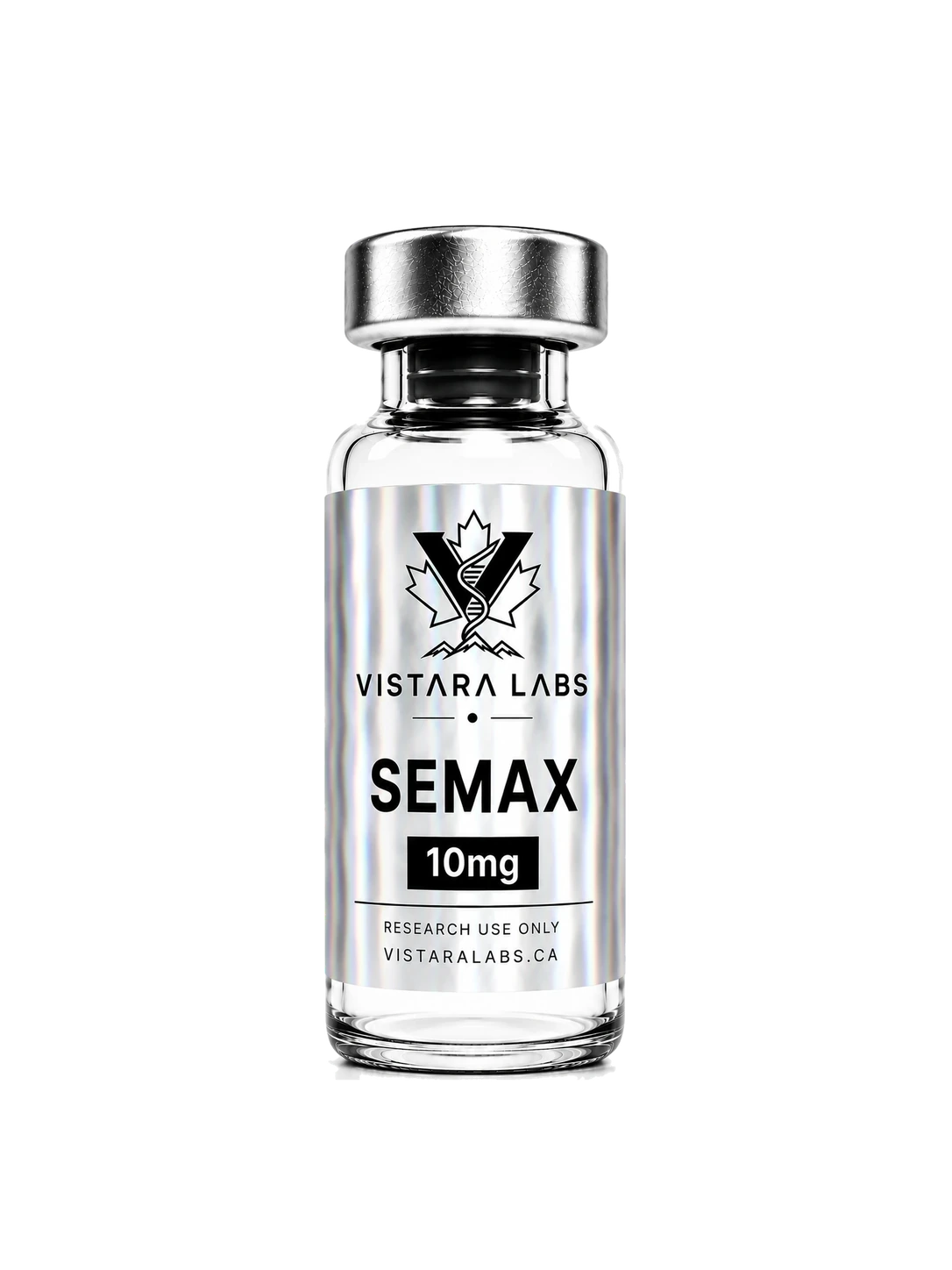
Semax comes as a 10 mg lyophilised vial (freeze-dried powder for laboratory reconstitution) and as a ready-mixed metered Semax Nasal Spray, matching the intranasal route used in the imaging and BDNF studies above. It is paired with Selank in the Selank + Semax Nasal Spray and appears in the Cognitive Clarity Spray Stack. Concentration arithmetic is in How Much Bacteriostatic Water for a Semax 10 mg Vial? and storage in How Long Does Semax Last?. Certificates of analysis are on the lab reports page, and orders ship from within Canada by Canada Post Xpresspost (see Buy Semax in Canada).
Semax is supplied by Vistara Labs for laboratory research use only. The clinical studies above are described as published research findings.
Frequently asked questions
What is Semax?
Semax is a synthetic seven-amino-acid peptide, Met-Glu-His-Phe-Pro-Gly-Pro, made from positions 4 to 7 of the hormone ACTH with a Pro-Gly-Pro tail. It was developed by Russian Academy of Sciences researchers in Moscow and is studied for its effects on BDNF and brain recovery.
What has Semax research shown?
In a 2018 study of 110 patients in rehabilitation after ischaemic stroke, Semax raised plasma BDNF and sped up improvement in daily-living scores. Imaging studies in healthy volunteers showed changes in brain network activity within 20 minutes of intranasal Semax.
How does Semax work?
It binds specific sites in the brain and raises BDNF, a growth factor that supports neuron survival and new connections. After experimental stroke it also changes the activity of immune and blood-vessel genes, which researchers link to its protective effect.
What did research show about Semax and BDNF?
In rats, intranasal Semax raised BDNF protein in the basal forebrain within 3 hours (2006). In stroke patients, it raised plasma BDNF, which stayed high through the study, and higher BDNF went with faster functional recovery (2018).
Is Semax a hormone?
No. It contains a four-amino-acid fragment of ACTH, but it is a separate synthetic peptide with a Pro-Gly-Pro tail, studied for its effects on the brain rather than on the adrenal glands.
Product details from vistaralabs.ca, October 2026. Sources: Dolotov OV et al. Semax, an analogue of adrenocorticotropin (4-10), binds specifically and increases levels of brain-derived neurotrophic factor protein in rat basal forebrain. J Neurochem. 2006. PMID 16635254. Yatsenko KA et al. Heptapeptide semax attenuates the effects of chronic unpredictable stress in rats. Dokl Biol Sci. 2013. PMID 24385169. Medvedeva EV et al. The peptide semax affects the expression of genes related to the immune and vascular systems in rat brain focal ischemia. BMC Genomics. 2014. PMID 24661604. Volkova A et al. Selank administration affects the expression of some genes involved in GABAergic neurotransmission. Front Pharmacol. 2016. doi:10.3389/fphar.2016.00031. Gusev EI et al. The efficacy of semax in the treatment of patients at different stages of ischemic stroke. Zh Nevrol Psikhiatr Im S S Korsakova. 2018. PMID 29798983. Lebedeva IS et al. Effects of Semax on the default mode network of the brain. Bull Exp Biol Med. 2018. PMID 30225715. Sharonova IN et al. Modulation of GABA- and glycine-activated ionic currents with Semax in isolated cerebral neurons. Bull Exp Biol Med. 2018. PMID 29577196. Panikratova YR et al. Functional connectomic approach to studying Selank and Semax effects. Dokl Biol Sci. 2020. PMID 32342318. Sudarkina OY et al. Brain protein expression profile confirms the protective effect of the ACTH(4-7)PGP peptide (Semax) in a rat model of cerebral ischemia-reperfusion. Int J Mol Sci. 2021. PMID 34201112. Kolbaev SN et al. The effect of peptide Semax, an ACTH(4-10) analogue, on intracellular calcium dynamics in rat brain neurons. Bull Exp Biol Med. 2025. PMID 41171324. Radchenko AI et al. The potential of the peptide drug Semax and its derivative for correcting pathological impairments in the animal model of Alzheimer’s disease. Acta Naturae. 2025. PMID 41479572. Liu R et al. Semax peptide targets the mu opioid receptor gene Oprm1 to promote deubiquitination and functional recovery after spinal cord injury in female mice. Br J Pharmacol. 2025. PMID 40692165.
More on this: Nootropic Peptide Nasal Sprays in Canada: Semax, Selank and Combinations.
All products supplied by Vistara Labs are intended for laboratory research use only. They are not drugs, are not approved for human or veterinary use, and are not intended to diagnose, treat, cure or prevent any condition. Nothing on this page constitutes medical advice or guidance for use in humans.
References
Semax has human research, mostly small studies concentrated in Russian-language literature rather than large modern placebo-controlled trials.
- [The efficacy of semax in the tretament of patients at different stages of ischemic stroke]Clinical study of 110 people after ischaemic stroke, with and without Semax; not a large modern placebo-controlled randomised trial.
- Effects of Semax on the Default Mode Network of the BrainSmall human study; 24 healthy volunteers, intranasal Semax versus placebo, resting-state fMRI. Mechanistic — does not establish improved cognition.
- [Effectiveness of semax in acute period of hemispheric ischemic stroke (a clinical and electrophysiological study)]Clinical study; 30 acute ischaemic stroke patients against an 80-patient conventional-treatment control cohort.
Links open the study record on PubMed so the source can be checked directly. Listing a study is not a claim that its findings apply to any other use, product or route of administration. Research use only.