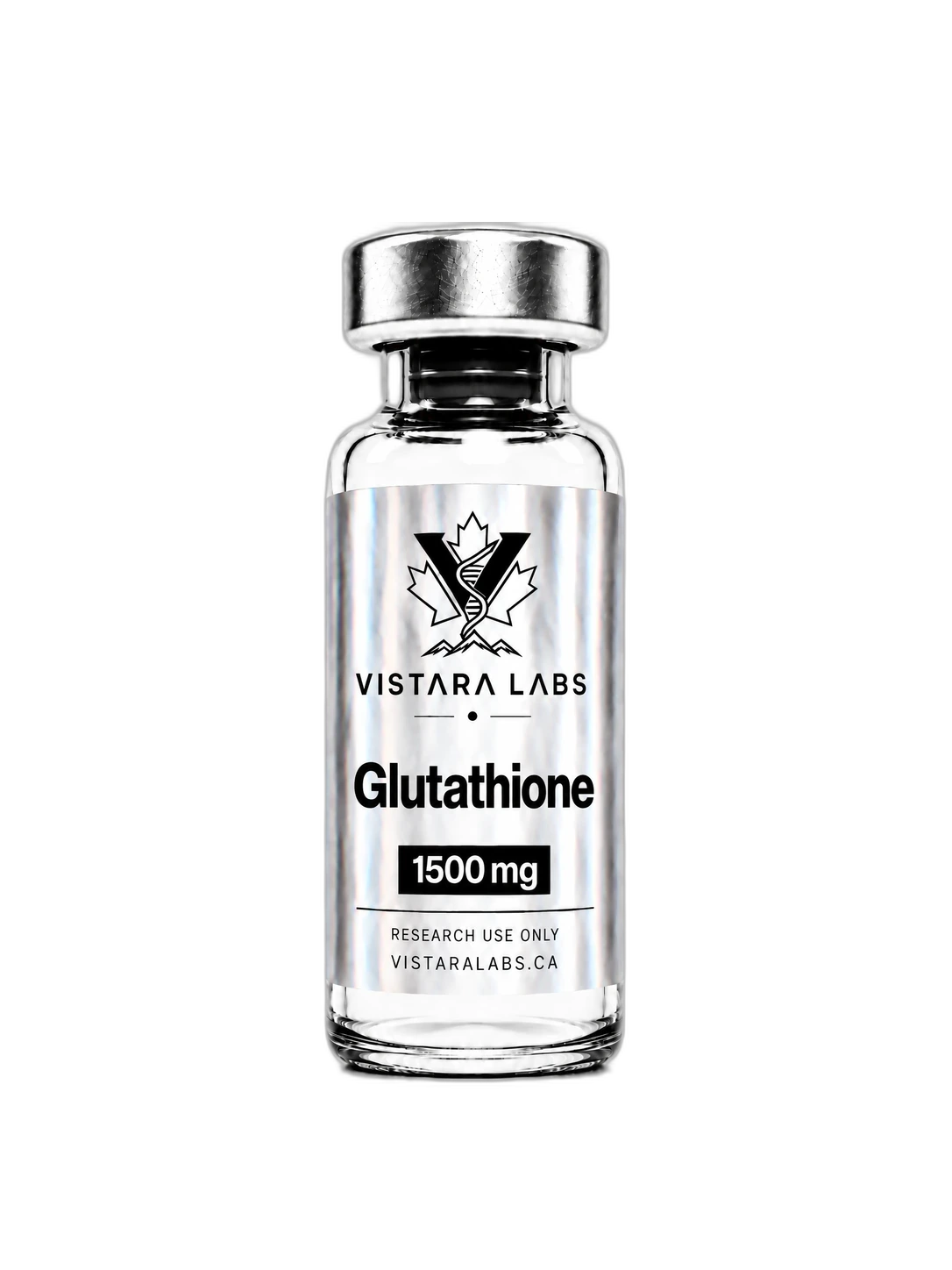
How Much Bacteriostatic Water for a Glutathione 600 mg or 1500 mg Vial?
A 1500 mg vial of Glutathione takes 10 to 20 mL of bacteriostatic water, and most vials need 15 to 20 mL before they run clear. Start with 10 mL, with the vial and the water at room temperature, swirl, and give it five minutes; if particles remain, add 5 mL and swirl again, up to 20 mL, which is as much as the vial holds. Glutathione is the one vial in our catalogue that needs this much water: at the volumes used for ordinary peptide vials the powder will not dissolve. Make sure an order with Glutathione includes enough bacteriostatic water for it. The calculation below depends only on the quantity in the vial and the volume of water added.
Adding more water does not change how much is in the vial. It spreads the same quantity through a larger volume, which changes how many syringe units correspond to a given amount. For Glutathione the lower limit is set by solubility, and it varies from vial to vial with the temperature of the water and of the powder: our own 1500 mg vial needed the full 20 mL to clear, so the tables run from 10 mL to 20 mL. The 1500 mg vial holds 20 mL with little room to spare, so do not go past it. Whatever volume is used, write the resulting concentration on the vial.
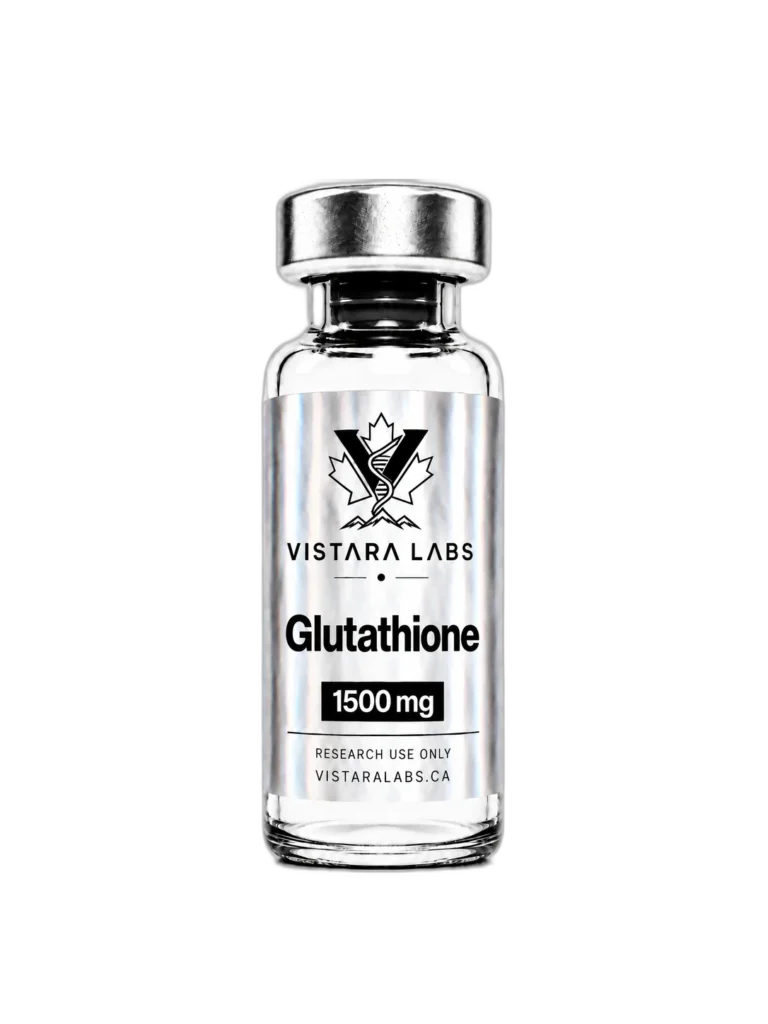 View product →
Glutathione reconstitution calculator
Set to this vial below. Change the vial size, water volume, amount or syringe and it recalculates the concentration and the syringe units. For laboratory research use only.
All products are sold strictly for laboratory research use only and are not for human or veterinary consumption. This calculator is provided as a general reference tool.
Concentration by water volume
Concentration is the quantity in the vial divided by the water volume. A 600 mg vial holds 600 mg whether it receives 6 mL or 8 mL; only the mg/mL figure moves. The right-hand column converts each concentration into the number of U-100 units that contain 100 mg.
| Vial | Bacteriostatic water added | Concentration | Units containing 100 mg |
|---|---|---|---|
| 1500 mg glutathione | 10 mL (starting volume) | 150 mg/mL | 67 units (0.67 mL) |
| 1500 mg | 15 mL | 100 mg/mL | 100 units (1 mL) |
| 1500 mg | 20 mL (vial capacity) | 75 mg/mL | 133 units (1.33 mL) |
| 600 mg glutathione | 4 mL (starting volume) | 150 mg/mL | 67 units (0.67 mL) |
| 600 mg | 6 mL | 100 mg/mL | 100 units (1 mL) |
| 600 mg | 8 mL | 75 mg/mL | 133 units (1.33 mL) |
Twenty millilitres is the capacity of the 1500 mg vial; the 600 mg vial has room for 8 mL. Because these volumes are far larger than for any other vial, a research order with Glutathione needs more bacteriostatic water than usual: count 20 mL per 1500 mg vial and 8 mL per 600 mg vial when adding water to the order, so the full volume is on hand if the vial needs it.
Reading the concentration on a U-100 syringe
A U-100 insulin syringe is graduated in units, and 100 units equal 1 mL. Units are therefore millilitres multiplied by 100: 0.1 mL is 10 units and 0.25 mL is 25 units. At Glutathione concentrations the draws are large: above 100 units they no longer fit a 1 mL insulin syringe, and a 3 mL syringe graduated in millilitres, or two draws, is the practical choice.
To find the volume that contains a given amount, divide the amount by the concentration. At 100 mg/mL (a 1500 mg vial with 15 mL of water), the volume that contains 100 mg is 100 divided by 100, which is 1 mL, or 100 units: a full 1 mL syringe. At 20 mL the same 100 mg is 1.33 mL, more than the syringe holds. The table below runs the same calculation for four arbitrary amounts at 100 mg/mL. They illustrate the arithmetic and nothing else.
| Amount (illustrative) | Volume at 100 mg/mL | U-100 units |
|---|---|---|
| 20 mg | 0.2 mL | 20 units |
| 50 mg | 0.5 mL | 50 units |
| 100 mg | 1 mL | 100 units |
| 150 mg | 1.5 mL | 150 units (two draws, or a 3 mL syringe) |
At 75 mg/mL, which the 1500 mg vial gives with 20 mL of water, every volume in the table grows by a third: a 100 mg draw measures 133 units instead of 100. Draws above 100 units do not fit a 1 mL insulin syringe; a 3 mL syringe graduated in millilitres, or two draws, is the usual choice at these volumes.
Glutathione is supplied by Vistara Labs as a lyophilised material for research use. The quantities on this page illustrate the arithmetic of dilution and measurement only.
The Glutathione vial
Glutathione is a tripeptide of glutamic acid, cysteine and glycine, supplied in 600 mg and 1500 mg vials, by far the largest masses in the catalogue. Both need far more water than a 10 mg vial, 10 to 20 mL for 1500 mg and 4 to 8 mL for 600 mg, and the powder dissolves slowly: roll the vial between the hands and swirl, then give it several minutes, rather than shaking. A faint sulphurous smell from the cysteine is normal for glutathione and is not a sign of a problem. Certificates of analysis for the catalogue are published on the Lab Results page.
Glutathione needs one handling note that no other vial here does. Its cysteine carries a free thiol group, which reacts with oxygen: in solution, reduced glutathione (GSH) slowly oxidises to its disulphide form (GSSG). Keep the reconstituted vial capped, cold and dark, draw from it with minimal air exchange, and date the label so the solution is not kept open-ended. The research behind it is covered in glutathione: the research behind the antioxidant.
Reconstitution technique
Let the vial reach room temperature, swab both stoppers, and run the measured water slowly down the inside wall of the vial rather than onto the powder. For Glutathione, start with 10 mL (4 mL for the 600 mg vial), with the vial and the water at room temperature: cold water straight from the fridge dissolves noticeably less, and warming the vial is not an option because warmth oxidises glutathione. Roll the vial between the hands and swirl or tilt it, never shake, and give it five minutes. If particles or haze remain, add 5 mL (2 mL for the 600 mg vial), swirl again and wait again; repeat up to 20 mL (8 mL), which is as much as the vial holds. Most 1500 mg vials run clear between 15 and 20 mL. A vial this full of powder takes noticeably longer than a small peptide vial. Label the vial with the date and the concentration, then keep it refrigerated at 2 to 8 °C and protected from light. The full method, with the reason behind each step, is in how to reconstitute peptides with bacteriostatic water.
Why the solution should look clear
Properly reconstituted Glutathione forms a clear, colourless solution. Haze or undissolved powder that will not clear almost always means too little water: add 5 mL at a time, up to the 20 mL a 1500 mg vial holds. Strands or a gel usually mean the water went in too fast or the vial was shaken; haze that appears later points to warm or bright storage. The causes are covered in why peptides gel or go cloudy.
Bacteriostatic water, not sterile water
Bacteriostatic water is sterile water with 0.9% benzyl alcohol, a preservative that allows a refrigerated vial to be accessed more than once; plain sterile water is intended for single access. The difference is explained in bacteriostatic water explained.
How much bacteriostatic water for 600 mg Glutathione?
A 600 mg Glutathione vial takes 4 to 8 mL of bacteriostatic water: start with 4 mL (150 mg/mL) and add 2 mL at a time until it runs clear, up to 8 mL (75 mg/mL). The table shows how much Glutathione each 0.1 mL of solution contains at each volume. Adding more water does not change the 600 mg in the vial; it only lowers the concentration.
| Water added | Concentration | Amount in 0.1 mL (10 units on a U-100 syringe) |
|---|---|---|
| 4 mL (starting volume) | 150 mg/mL | 15 mg |
| 6 mL | 100 mg/mL | 10 mg |
| 8 mL | 75 mg/mL | 7.5 mg |
For any other water volume, enter it in the peptide calculator on this page and it works out the concentration.
How much bacteriostatic water for 1500 mg Glutathione?
A 1500 mg Glutathione vial takes 10 to 20 mL of bacteriostatic water: start with 10 mL (150 mg/mL) and add 5 mL at a time until it runs clear, up to 20 mL (75 mg/mL), the full capacity of the vial. Most vials need 15 to 20 mL. The table shows how much Glutathione each 0.1 mL of solution contains at each volume. Adding more water does not change the 1500 mg in the vial; it only lowers the concentration.
| Water added | Concentration | Amount in 0.1 mL (10 units on a U-100 syringe) |
|---|---|---|
| 10 mL (starting volume) | 150 mg/mL | 15 mg |
| 15 mL | 100 mg/mL | 10 mg |
| 20 mL (vial capacity) | 75 mg/mL | 7.5 mg |
For any other water volume, enter it in the peptide calculator on this page and it works out the concentration.
Frequently asked questions
How much bacteriostatic water do I add to a 600 mg vial of Glutathione?
4 to 8 mL: start with 4 mL at room temperature, swirl, wait five minutes, and add 2 mL at a time until it runs clear, up to 8 mL. The 1500 mg vial takes 10 to 20 mL the same way, and most need 15 to 20 mL. Adding more water does not change the quantity in the vial, it spreads it through a larger volume, so write the final concentration on the vial.
How many 600 mg vials does one vial of bacteriostatic water cover?
Fewer than for any other peptide: count 8 mL per 600 mg vial and 20 mL per 1500 mg vial, so the full volume is on hand if the vial needs it, and add enough bacteriostatic water to the order to cover every Glutathione vial in it.
How many units on a U-100 syringe contain 100 mg at 100 mg/mL?
At 100 mg/mL (a 1500 mg vial with 15 mL of water), the volume that contains 100 mg is 100 divided by 100, which is 1 mL, or 100 units, a full 1 mL syringe. At 20 mL (75 mg/mL) it is 1.33 mL, or 133 units, which needs a 3 mL syringe or two draws. Units are millilitres multiplied by 100, so 0.1 mL is 10 units. The amounts on this page illustrate the arithmetic only.
What should reconstituted Glutathione look like?
Properly reconstituted Glutathione forms a clear, colourless solution. Haze or undissolved powder that will not clear almost always means too little water: add 5 mL at a time, up to the 20 mL a 1500 mg vial holds. Strands or a gel usually mean the water went in too fast or the vial was shaken; haze that appears later points to warm or bright storage. More on the causes in why peptides gel or go cloudy.
Can I use sterile water instead of bacteriostatic water?
Only for a vial that will be accessed once. Bacteriostatic water is sterile water with 0.9% benzyl alcohol, a preservative that allows a refrigerated vial to be accessed more than once; plain sterile water is intended for single access. Details in bacteriostatic water explained.
How should a reconstituted Glutathione vial be stored?
Refrigerated at 2 to 8 °C, protected from light and labelled with the date and the concentration. Unopened lyophilised vials are kept cold and dark until they are needed. The full storage guide is how to store research peptides.
How much bac water for a 600 mg Glutathione vial?
A 600 mg Glutathione vial takes 4 to 8 mL of bacteriostatic water: start with 4 mL and add 2 mL at a time until it runs clear, up to 8 mL (75 mg/mL). At 100 mg/mL (6 mL) each 0.1 mL (10 units on a U-100 syringe) contains 10 mg.
How much bac water for a 1500 mg Glutathione vial?
A 1500 mg Glutathione vial takes 10 to 20 mL of bacteriostatic water: start with 10 mL at room temperature, swirl, wait five minutes, and add 5 mL at a time until it runs clear, up to 20 mL, the full capacity of the vial. Most vials need 15 to 20 mL. At 100 mg/mL (15 mL) each 0.1 mL (10 units on a U-100 syringe) contains 10 mg.
Work it out for a different vial or concentration
Our peptide calculator opens pre-set for a 1500 mg vial with 15 mL of water and marks the 100 mg draw of 100 units, a full 1 mL syringe. Change the water to 20 mL and it warns that the draw no longer fits and needs a 3 mL syringe or two draws. Change the vial size, water volume, amount or syringe and it recalculates.
Products: Glutathione 600 mg and 1500 mg and bacteriostatic water.
All products supplied by Vistara Labs are intended for laboratory research use only. They are not drugs, are not approved for human or veterinary use, and are not intended to diagnose, treat, cure or prevent any condition. Nothing on this page constitutes medical advice or guidance for use in humans.
References
Glutathione has several human trials. Skin findings are endpoint-specific and a systematic review judged the overall evidence inconclusive; an intravenous Parkinson's pilot found no significant benefit.
- Glutathione as an oral whitening agent: a randomized, double-blind, placebo-controlled studyRandomised, double-blind, placebo-controlled trial; 60 healthy participants, oral glutathione, 4 weeks. Significant between-group differences at only two of the measured sites.
- The clinical effect of glutathione on skin color and other related skin conditions: A systematic reviewSystematic review of four clinical skin studies including three placebo-controlled randomised trials; authors concluded the evidence remains inconclusive.
- Randomized, double-blind, pilot evaluation of intravenous glutathione in Parkinson's diseaseRandomised, double-blind pilot; 21 patients, intravenous glutathione in Parkinson's disease. No statistically significant improvement in UPDRS outcomes versus placebo.
Links open the study record on PubMed so the source can be checked directly. Listing a study is not a claim that its findings apply to any other use, product or route of administration. Research use only.