Retatrutide vs Tesamorelin: How They Differ
Retatrutide is an investigational once-weekly peptide that acts on three metabolic hormone receptors (GIP, GLP-1 and glucagon) and is studied for whole-body weight, blood sugar and liver fat, while tesamorelin is an approved growth hormone releasing hormone analogue studied for visceral, deep abdominal, fat. One works through gut-hormone and glucagon receptors that govern appetite and energy use; the other works through the pituitary and growth hormone. Here is how they compare, what the human trials found, and which research questions each one answers.
Findings
- Reta (GLP-3) is a single peptide with activity at the GIP, GLP-1 and glucagon receptors, with a half-life of about 6 days in its first multiple-dose study (Urva et al., Lancet, 2022).
- In a phase 3 trial of 2,339 adults with obesity, 80 weeks of reta lowered body weight by 25.0% at the highest dose, against 3.9% with placebo (Jastreboff et al., N Engl J Med, 2026).
- Tesamorelin is the full 44-amino-acid sequence of human growth hormone releasing factor with a hexenoyl group attached. In 412 patients with HIV, 26 weeks cut visceral fat by 15.2% while it rose 5.0% on placebo (Falutz et al., N Engl J Med, 2007).
- Both have liver-fat data: reta brought liver fat into the normal range in up to 86% of a 98-person substudy at 24 weeks, and tesamorelin cut hepatic fat fraction by 37% (relative) over 12 months in 61 people with HIV.
What is reta (GLP-3)?
Reta is one peptide built on the GIP hormone backbone, with non-natural amino acids (Aib and alpha-methyl leucine) and a fatty diacid chain attached at lysine 17 (Li et al., Cell Discov, 2024). In its discovery work, GIP and GLP-1 receptor activity reduced calorie intake while glucagon receptor activity added a rise in energy expenditure in obese mice, and a single dose in humans lowered body weight for up to 43 days (Coskun et al., Cell Metab, 2022). The half-life of about 6 days suits once-weekly administration (Urva et al., Lancet, 2022). It remains investigational: at the time of writing it had not been approved in Canada or the United States.
The human trials
The 2023 phase 2 obesity trial enrolled 338 adults for 48 weeks. Weight fell 24.2% at the highest dose against 2.1% on placebo, and 83% of that group lost 15% or more of their body weight (Jastreboff et al., N Engl J Med, 2023). The 2026 phase 3 trial confirmed the scale over 80 weeks, and also reported less knee pain in 574 participants with knee osteoarthritis and fewer breathing interruptions per hour in 243 with obstructive sleep apnea (Jastreboff et al., N Engl J Med, 2026).
In type 2 diabetes, a 281-person phase 2 trial reported HbA1c down 2.02 percentage points at 24 weeks and body weight down 16.94% at 36 weeks at the highest dose (Rosenstock et al., Lancet, 2023). A 537-person phase 3 trial reported HbA1c down 1.94 points against 0.81 on placebo, and weight down 15.3% against 2.6%, over 40 weeks (Bajaj et al., Lancet, 2026). A body-composition substudy measured by DXA scan found total fat mass down 23.2% to 26.1% in the higher-dose groups at 36 weeks (Coskun et al., Lancet Diabetes Endocrinol, 2025). The most common side effects across these trials were gastrointestinal, mostly mild to moderate.
In 98 participants with fatty liver disease, liver fat fell 82.4% (relative) at 24 weeks at the highest dose, and 86% of that group reached normal liver fat, against 0% on placebo (Sanyal et al., Nat Med, 2024).
What is tesamorelin?
Tesamorelin carries the complete 44-amino-acid sequence of human growth hormone releasing factor, with a hexenoyl group, a six-carbon chain, attached to the tyrosine at its start (US prescribing information). It binds and stimulates the human GRF receptor with potency similar to the body’s own hormone (US prescribing information), so the pituitary releases more growth hormone; in the first phase 3 trial, IGF-1 rose 81.0% against a 5.0% fall on placebo (Falutz et al., N Engl J Med, 2007). Its elimination half-life is short, 26 minutes in healthy subjects and 38 minutes in patients with HIV (US prescribing information). It was approved in the United States in 2010 and by Health Canada in 2014 to reduce excess visceral fat in adults with HIV, and its Canadian indication states it is not for weight-loss management. More on the molecule is in Tesamorelin: One Small Change to a Natural Hormone.
The human trials
A pooled analysis of the two phase 3 trials (806 patients) reported a 15.4% treatment effect on visceral fat at 26 weeks, while fat under the skin of the abdomen barely changed (treatment effect 0.6%), and triglycerides fell 12.3% (Falutz et al., J Clin Endocrinol Metab, 2010). That selectivity for deep abdominal fat is the defining feature of the tesamorelin record, covered in Tesamorelin and Visceral Fat.
In a 50-person trial at Massachusetts General Hospital, six months of tesamorelin reduced visceral fat by 34 cm² (placebo: up 8 cm²) and lowered liver fat, a net effect of 2.9 percentage points in lipid-to-water ratio (Stanley et al., JAMA, 2014). A 61-person, 12-month trial in HIV and fatty liver disease then found a 37% relative fall in hepatic fat fraction, with 35% on tesamorelin reaching normal liver fat against 4% on placebo (Stanley et al., Lancet HIV, 2019). That trial is covered in Tesamorelin and Liver Fat.
How do reta and tesamorelin compare side by side?
| Question | Reta (GLP-3) | Tesamorelin |
|---|---|---|
| What is it? | Triple hormone receptor agonist | Growth hormone releasing hormone analogue |
| Size | One acylated peptide on a GIP backbone | 44 amino acids plus a hexenoyl group |
| Main research area | Body weight, blood sugar, liver fat | Visceral fat, liver fat in HIV |
| Mechanism | GIP, GLP-1 and glucagon receptors | Pituitary GHRH receptor, then growth hormone and IGF-1 |
| Half-life | About 6 days | 26 to 38 minutes |
| Human evidence | Phase 2 and phase 3 trials, 2023 to 2026 | Phase 3 trials and liver studies, 2007 to 2019 |
| Status | Investigational | Approved medicine for HIV-associated visceral fat |
| Forms we supply | 10 mg, 20 mg and 30 mg vials | 10 mg vial |
Which one fits which research question?
- Total body weight, appetite and glucose control: reta, whose trials measured weight, HbA1c and DXA fat mass in large populations.
- Visceral fat specifically, with subcutaneous fat left alone: tesamorelin, whose phase 3 trials separated the two fat depots by CT scan.
- The growth hormone and IGF-1 axis: tesamorelin, which works through the body’s own pituitary release.
- Liver fat: both, in different populations: reta in general obesity with fatty liver disease, tesamorelin in people with HIV.
Neither has been tested against the other. A total-weight figure and a visceral-fat figure measure different things, so the numbers above are not a ranking. Reta’s place among other metabolic peptides is covered in Reta vs Tirzepatide, and tesamorelin’s against growth hormone in Tesamorelin vs HGH.
Can reta and tesamorelin be studied together?
No published human trial has combined them. Their mechanisms do not overlap: one acts on incretin and glucagon receptors, the other on the pituitary growth hormone axis, so a laboratory design using both could keep the two pathways as distinguishable variables. That rationale comes from each compound’s separate literature, not from combined data.
How are they supplied?
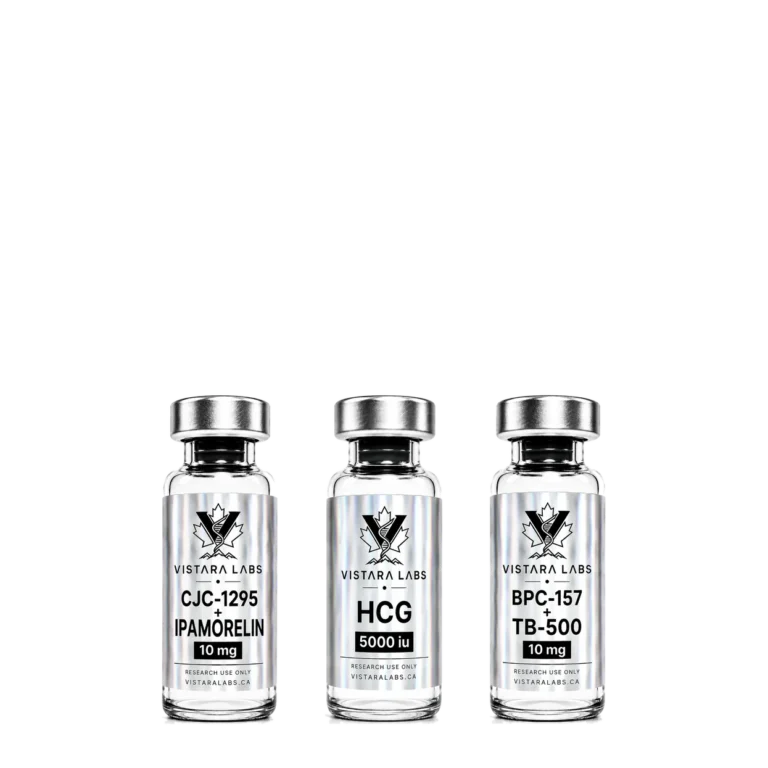
Reta comes as 10 mg, 20 mg and 30 mg lyophilised vials and tesamorelin as a 10 mg vial; tesamorelin is also paired with ipamorelin in the Tesamorelin + Ipamorelin Stack. Both are reconstituted with bacteriostatic water (see the tesamorelin reconstitution guide and the peptide calculator). Their storage differs sharply once mixed: reta follows the general 8 to 12 week fridge window, while tesamorelin lasts about a week at most, as explained in how long reta lasts and how long tesamorelin lasts. Certificates of analysis are on the lab reports page, and every order ships from within Canada by Canada Post Xpresspost.
Reta and tesamorelin are supplied for laboratory research use only. The studies above were clinical research using pharmaceutical preparations.
Frequently asked questions
What is the difference between reta (GLP-3) and tesamorelin?
Reta is an investigational weekly peptide that activates the GIP, GLP-1 and glucagon receptors and is studied for body weight, blood sugar and liver fat. Tesamorelin is an approved growth hormone releasing hormone analogue that raises growth hormone and IGF-1 and is studied for visceral fat.
Is reta stronger than tesamorelin?
They have never been compared directly and their trials measure different outcomes. Reta’s phase 3 trial reported a 25.0% fall in total body weight at the highest dose over 80 weeks; tesamorelin’s phase 3 trials reported a 15.2% fall in visceral fat over 26 weeks, with little change in fat under the skin.
Does tesamorelin cause weight loss?
Its trials targeted visceral fat rather than total weight, and its Canadian approval states it is not indicated for weight-loss management. In the pooled phase 3 analysis of 806 patients, visceral fat fell while subcutaneous abdominal fat was essentially unchanged.
Can reta and tesamorelin be studied together?
No human trial has combined them. Because one works through incretin and glucagon receptors and the other through the pituitary growth hormone axis, a laboratory study using both can keep the two pathways as separate variables.
Where can I buy reta and tesamorelin in Canada?
Vistara Labs supplies reta (GLP-3) as 10 mg, 20 mg and 30 mg lyophilised vials and tesamorelin as a 10 mg vial, with certificates of analysis on the lab reports page, shipped from within Canada by Canada Post Xpresspost.
Product details from vistaralabs.ca, October 2026. Sources: Urva S et al. Phase 1b multiple-ascending-dose trial of a GIP, GLP-1 and glucagon receptor agonist in type 2 diabetes. Lancet. 2022. PMID 36354040. Coskun T et al. Discovery and clinical proof of concept of a triple glucagon, GIP and GLP-1 receptor agonist. Cell Metab. 2022. PMID 35985340. Li W et al. Structural insights into triple agonism at GLP-1R, GIPR and GCGR. Cell Discov. 2024. PMID 39019866. Jastreboff AM et al. Phase 2 trial of a triple-hormone-receptor agonist for obesity. N Engl J Med. 2023. PMID 37366315. Jastreboff AM et al. Phase 3 trial of a triple hormone receptor agonist for obesity. N Engl J Med. 2026. PMID 42814954. Rosenstock J et al. Phase 2 trial of a GIP, GLP-1 and glucagon receptor agonist in type 2 diabetes. Lancet. 2023. PMID 37385280. Bajaj HS et al. Phase 3 trial of a GIP, GLP-1 and glucagon receptor agonist in type 2 diabetes. Lancet. 2026. PMID 42250575. Coskun T et al. Body composition substudy of a phase 2 trial in type 2 diabetes. Lancet Diabetes Endocrinol. 2025. PMID 40609566. Sanyal AJ et al. Triple hormone receptor agonist for metabolic dysfunction-associated steatotic liver disease: a randomized phase 2a trial. Nat Med. 2024. PMID 38858523. Falutz J et al. Metabolic effects of a growth hormone-releasing factor in patients with HIV. N Engl J Med. 2007. PMID 18057338. Falutz J et al. Effects of tesamorelin in HIV-infected patients with excess abdominal fat: a pooled analysis of two phase 3 trials. J Clin Endocrinol Metab. 2010. PMID 20554713. Stanley TL et al. Effect of tesamorelin on visceral fat and liver fat in HIV-infected patients with abdominal fat accumulation. JAMA. 2014. PMID 25038357. Stanley TL et al. Effects of tesamorelin on non-alcoholic fatty liver disease in HIV. Lancet HIV. 2019. PMID 31611038. US prescribing information for tesamorelin for injection (2012 label). Health Canada notice of compliance for tesamorelin, April 2014.
More on this: Peptides for Weight Loss: What People Actually Mean and MOTS-c vs Tesamorelin.
All products supplied by Vistara Labs are intended for laboratory research use only. They are not drugs, are not approved for human or veterinary use, and are not intended to diagnose, treat, cure or prevent any condition. Nothing on this page constitutes medical advice or guidance for use in humans.