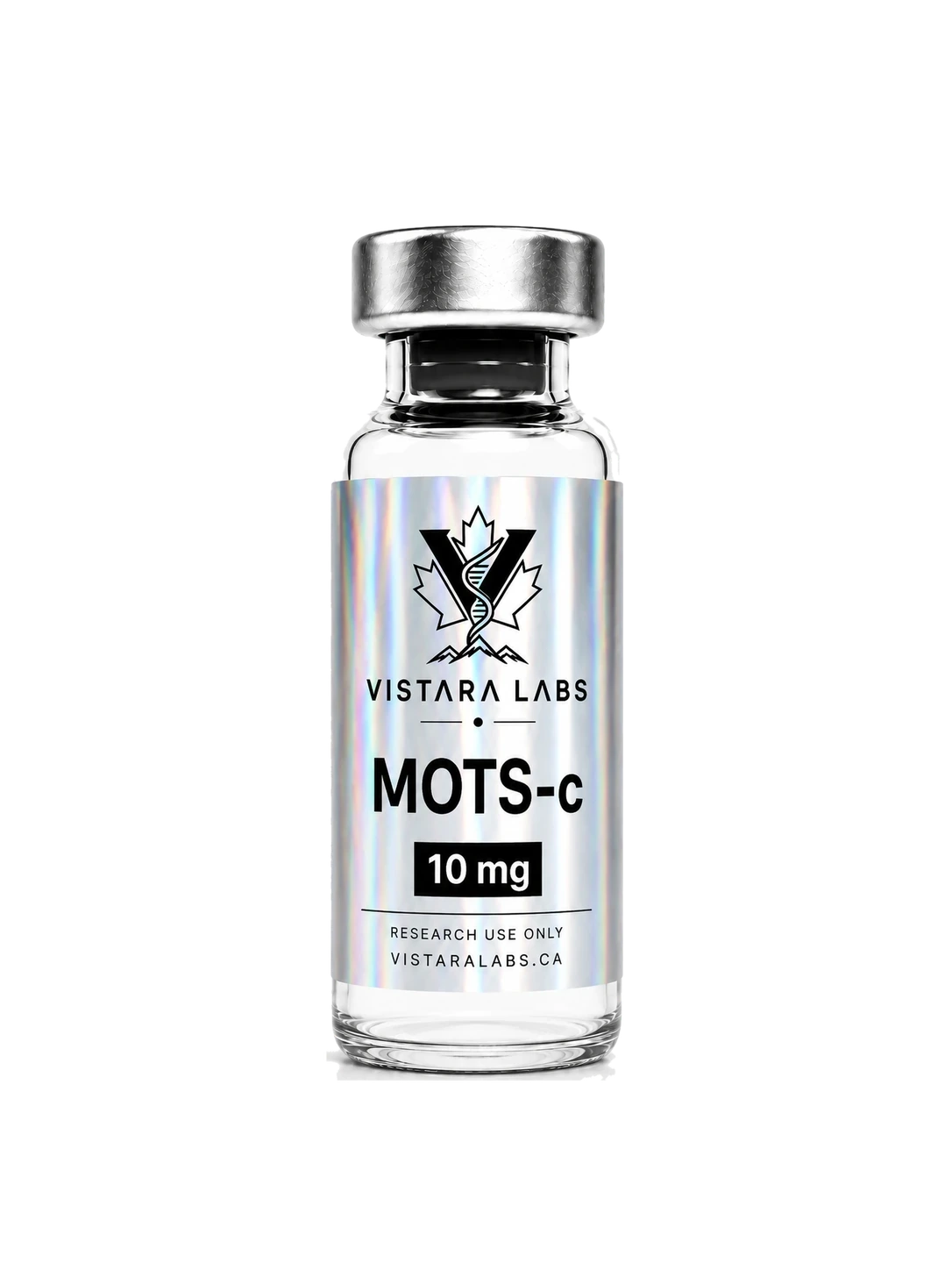
NAD+ vs MOTS-c: How They Differ
Cellular Energy & Mitochondrial Research
NAD+ is a coenzyme, a small non-peptide molecule that cells use to carry electrons in energy metabolism, while MOTS-c is a 16-amino-acid peptide encoded in mitochondrial DNA that acts as a signal. One is the material the energy machinery runs on; the other is a message about how that machinery is coping. Their human research differs in the same way: NAD+ has randomised trials of the precursors that raise it, and MOTS-c has studies of how the body’s own levels respond to exercise and heat.
 View product →
Findings
- NAD+ is not a peptide: it is the coenzyme for redox reactions and a cofactor for sirtuins, CD38 and PARP enzymes, and tissue NAD+ declines gradually with age (2021 review).
- In a randomised crossover trial of 30 adults aged 55 to 79, the precursor nicotinamide riboside raised NAD+ in blood immune cells by about 60% against placebo (2018).
- Precursor trials have moved functional measures: muscle insulin sensitivity rose 25% on NMN in women with prediabetes (2021), and nicotinamide riboside improved six-minute walk distance in peripheral artery disease (2024).
- MOTS-c rises with exertion: after cycling, muscle MOTS-c rose 11.9-fold and blood levels 1.6-fold in 10 young men (2021), and repeated heat sessions raised blood levels too (2025).
What is NAD+?
NAD+ (nicotinamide adenine dinucleotide) is a coenzyme with no amino acids in it, as covered in NAD+ is not a peptide. It is the coenzyme for redox reactions, which puts it at the centre of energy metabolism, and an essential cofactor for enzymes that use it outside redox chemistry, including sirtuins, CD38 and poly(ADP-ribose) polymerases (PARPs), which link it to DNA repair and immune-cell function. Tissue and cellular NAD+ levels decline gradually with age in several species, humans included (Covarrubias et al., Nat Rev Mol Cell Biol, 2021).
The human NAD+ research
Most human trials give a precursor that cells convert into NAD+, usually nicotinamide riboside (NR) or nicotinamide mononucleotide (NMN). In a 2018 randomised, double-blind, placebo-controlled crossover trial, 30 adults aged 55 to 79 took NR and placebo for six weeks each. NR was well tolerated and raised NAD+ in blood immune cells (PBMCs) by about 60% against placebo (Martens et al., Nat Commun).
Functional results have followed. In a 10-week randomised trial in 25 postmenopausal women with prediabetes and overweight or obesity, muscle insulin sensitivity rose 25% on NMN and did not change on placebo (Yoshino et al., Science, 2021). In a 6-month randomised, double-blind trial in 90 people with peripheral artery disease, NR improved six-minute walk distance by 17.6 metres against placebo, and by 31.0 metres among participants who took at least 75% of their study pills (McDermott et al., Nat Commun, 2024). A 2026 systematic review of 33 human intervention studies (28 randomised) found that oral NR and NMN consistently raised NAD-related metabolites and were generally well tolerated, with effects on other outcomes varying by endpoint (Gallagher and Emmanuel, Ageing Res Rev).
NAD+ itself has been tracked too: in a 2019 pilot in which 8 men received NAD+ by intravenous infusion over 6 hours, it was cleared from the plasma so quickly that plasma levels did not change for the first 2 hours, and urinary NAD+ and its metabolite methylnicotinamide had risen by 6 hours (Grant et al., Front Aging Neurosci). The trial record is in NAD+ restoration: what the research shows.
What is MOTS-c?
MOTS-c (mitochondrial open reading frame of the 12S rRNA type-c) is a 16-amino-acid peptide encoded inside the mitochondrial 12S rRNA gene, reported in 2015. Like humanin, it is written into the mitochondrion’s own genome rather than the nucleus, which is why it is studied as evidence that mitochondria send signals of their own. In early-stage laboratory research its primary target appeared to be skeletal muscle, where its actions led to activation of AMPK, a central energy sensor, and it countered age-related and diet-related insulin resistance (Lee et al., Cell Metab, 2015). The background is in What is MOTS-c?
The human MOTS-c research
Human MOTS-c studies measure the peptide the body makes. In a 2021 study, 10 sedentary young men did interval cycling: MOTS-c in their thigh muscle rose 11.9-fold after exercise and remained elevated after 4 hours of rest, while blood levels rose 1.6-fold during exercise and 1.5-fold after, returning to baseline by 4 hours (Reynolds et al., Nat Commun). In 2025, 19 physically active men had one ankle immobilised for 2 weeks and were randomised to repeated heat sessions or a sham; heat raised circulating MOTS-c (P = 0.033), in a pattern the authors compared with exercise (Elhusseiny et al., Med Sci Sports Exerc). Both studies are covered in MOTS-c: exercise, heat and the mitochondrial signal.
How do NAD+ and MOTS-c compare side by side?
| Question | NAD+ | MOTS-c |
|---|---|---|
| What kind of molecule? | Coenzyme, not a peptide | Peptide of 16 amino acids |
| Where it comes from | Built from precursors such as NR and NMN | Encoded in mitochondrial DNA |
| Main role | Carries electrons; cofactor for sirtuins and PARPs | Metabolic signal; AMPK in laboratory work |
| Human research | Randomised precursor trials | Natural levels with exercise and heat |
| Formats we stock | 500 mg vial and nasal spray | 10 mg and 40 mg vials |
Which one fits which research question?
- Energy substrate, redox balance, sirtuin and PARP pathways, or age-related NAD+ decline: NAD+.
- Mitochondrial signalling, exercise adaptation and muscle glucose handling: MOTS-c.
- Comparing mitochondrial peptides: MOTS-c against SS-31, the membrane-targeted peptide, is covered in MOTS-c vs SS-31.
Can NAD+ and MOTS-c be studied together?
Yes. They sit at different levels of the same energy system, so a study that uses both keeps two distinguishable variables: substrate and signal. That rationale is built from each compound’s own literature.
No single stack pairs the two; both are stocked as individual vials. MOTS-c also appears in Mitochondrial Energy, with glutathione and SS-31, and Total Glow Up, with reta (GLP-3) and GLOW Blend. The NAD+ Nasal Spray is part of the Cognitive Clarity Spray Stack, with the Semax Nasal Spray and Selank Nasal Spray.
How are NAD+ and MOTS-c supplied?
NAD+ comes as a 500 mg lyophilised vial and as a ready-mixed nasal spray; MOTS-c comes as 10 mg and 40 mg lyophilised vials. Vials are reconstituted with bacteriostatic water. Certificates of analysis are on the lab reports page, and every order ships from within Canada.
NAD+ and MOTS-c are supplied for laboratory research use only. The human studies above used precursor supplements, an intravenous infusion, or measurements of the body’s own MOTS-c.
Frequently asked questions
What is the difference between NAD+ and MOTS-c?
NAD+ is a coenzyme, a small non-peptide molecule with no amino acids, that carries electrons in energy metabolism and is used by enzymes such as sirtuins and PARPs. MOTS-c is a 16-amino-acid peptide encoded in mitochondrial DNA and studied as a metabolic signal.
What has NAD+ research shown in people?
Nicotinamide riboside raised NAD+ in blood immune cells by about 60% against placebo in 30 adults aged 55 to 79 (2018). NMN raised muscle insulin sensitivity by 25% in 25 women with prediabetes (2021), and nicotinamide riboside improved six-minute walk distance against placebo in 90 people with peripheral artery disease (2024).
What has MOTS-c research shown in people?
Human studies measure the MOTS-c the body makes. After cycling exercise, muscle MOTS-c rose 11.9-fold and blood levels 1.6-fold in 10 young men (2021), and in a randomised study of 19 active men (2025), repeated heat sessions raised circulating MOTS-c.
Can NAD+ and MOTS-c be studied together?
Yes. NAD+ is the coenzyme the energy machinery runs on and MOTS-c is a signal about it, so a study using both keeps two distinguishable variables. Both are stocked as individual vials.
Where can I buy NAD+ and MOTS-c in Canada?
Vistara Labs supplies NAD+ as a 500 mg vial and a ready-mixed nasal spray, and MOTS-c in 10 mg and 40 mg vials, shipped from within Canada by Canada Post Xpresspost.
Product details from vistaralabs.ca, October 2026. Sources: Covarrubias AJ et al. NAD+ metabolism and its roles in cellular processes during ageing. Nat Rev Mol Cell Biol. 2021. PMID 33353981. Martens CR et al. Chronic nicotinamide riboside supplementation is well-tolerated and elevates NAD+ in healthy middle-aged and older adults. Nat Commun. 2018. PMID 29599478. Yoshino M et al. Nicotinamide mononucleotide increases muscle insulin sensitivity in prediabetic women. Science. 2021. PMID 33888596. McDermott MM et al. Nat Commun. 2024. PMID 38871717. Gallagher C, Emmanuel OO. NAD+ supplementation for anti-aging and wellness: a PRISMA-guided systematic review of preclinical and clinical evidence. Ageing Res Rev. 2026. PMID 41655607. Grant R et al. A pilot study investigating changes in the human plasma and urine NAD+ metabolome during a 6 hour intravenous infusion of NAD. Front Aging Neurosci. 2019. PMID 31572171. Lee C et al. The mitochondrial-derived peptide MOTS-c promotes metabolic homeostasis and reduces obesity and insulin resistance. Cell Metab. 2015. PMID 25738459. Reynolds JC et al. MOTS-c is an exercise-induced mitochondrial-encoded regulator of age-dependent physical decline and muscle homeostasis. Nat Commun. 2021. PMID 33473109. Elhusseiny R et al. Repeated heat stress modulates the levels of the mitokines MOTS-c and FGF21 in active men during calf muscle immobilization. Med Sci Sports Exerc. 2025. PMID 40674654.
All products supplied by Vistara Labs are intended for laboratory research use only. They are not drugs, are not approved for human or veterinary use, and are not intended to diagnose, treat, cure or prevent any condition. Nothing on this page constitutes medical advice or guidance for use in humans.
References
Human MOTS-c studies measure the peptide the body already makes; no controlled trial administering native synthetic MOTS-c was identified. (CB4211, which has completed phase 1, is an optimised analogue, not native MOTS-c.)
- The mitochondrial-derived peptide MOTS-c promotes metabolic homeostasis and reduces obesity and insulin resistanceFoundational paper identifying MOTS-c; laboratory studies of insulin sensitivity and diet-induced obesity.
- Acute endurance exercise stimulates circulating levels of mitochondrial-derived peptides in humansHuman study measuring naturally occurring (endogenous) mitochondrial-derived peptides after acute endurance exercise — not administration of synthetic MOTS-c.
Links open the study record on PubMed so the source can be checked directly. Listing a study is not a claim that its findings apply to any other use, product or route of administration. Research use only.