Peptides for Focus and Anxiety: What the Research Shows
Cognitive & Nootropic Research
The peptides for focus and anxiety with the most human research are Selank, Semax and Cerebrolysin, each tested in controlled clinical studies. In a 62-person trial, Selank’s anti-anxiety effect matched that of a benzodiazepine; in 110 people recovering from stroke, Semax raised the brain growth factor BDNF; and in a 242-person trial, Cerebrolysin improved a standard cognition score by 10.6 points against 4.4 on placebo. Below: what each study found, how the Selank and Semax pairing fits, and the matching sprays, vials and stacks.
 View product →
Findings
- In a 2008 trial of 62 people with generalised anxiety disorder or neurasthenia, Selank’s anti-anxiety effect matched the benzodiazepine medazepam, and Selank also showed anti-fatigue and psychostimulant effects.
- Against phenazepam in 60 people with anxiety disorders (2014), Selank showed a pronounced anti-anxiety effect and a mild nootropic one, and the anti-anxiety effect lasted a week after the last administration.
- In 110 people after ischemic stroke, Semax raised blood BDNF, a growth factor tied to learning and brain plasticity, and sped functional recovery (2018).
- Over 24 weeks in 242 people with vascular dementia, Cerebrolysin improved the ADAS-cog+ cognition score by 10.6 points against 4.4 on placebo, and 67.5% against 27.0% met the combined response criteria (2011).
- After moderate to severe brain injury, Cerebrolysin outperformed placebo on the Stroop and Color Trails tests, standard measures of attention and mental flexibility (2020).
Which peptides have been studied for focus and anxiety?
Three peptides carry most of the human research. Selank and Semax are short synthetic peptides from the same Russian research group: Selank is built on tuftsin, an immune-signalling peptide, and Semax on a fragment of the hormone ACTH. Cerebrolysin is a peptide preparation derived from porcine brain tissue. Selank research centres on anxiety, Semax on attention, memory and stroke recovery, and Cerebrolysin on cognition after stroke, brain injury and dementia.
| Peptide | Study | Result |
|---|---|---|
| Selank | 62 adults with anxiety or neurasthenia (2008) | Anti-anxiety effect matched medazepam |
| Selank | 60 adults with anxiety disorders (2014) | Effect lasted a week after the course |
| Selank with phenazepam | 70 adults with anxiety disorders (2015) | Earlier effect, fewer side effects |
| Semax | 110 adults after stroke (2018) | Higher BDNF, better recovery scores |
| Semax | 24 healthy adults, brain imaging (2018) | Larger frontal resting-state network |
| Cerebrolysin | 242 adults with vascular dementia (2011) | Cognition up 10.6 points vs 4.4 |
| Cerebrolysin | 32 adults after mild brain injury (2013) | Cognition up 21.0 points vs 7.6 |
What has Selank research shown for anxiety?
Selank’s clinical record comes from Russian studies in anxiety disorders, each measured against a benzodiazepine.
- Against medazepam, 2008. 62 people with generalised anxiety disorder or neurasthenia received Selank (30) or medazepam (32). The anti-anxiety effects of the two were similar on the Hamilton, Zung and CGI scales, and Selank added anti-fatigue (antiasthenic) and psychostimulant effects. The blood half-life of leu-enkephalin, one of the body’s own opioid-like signalling peptides, was shortened at the start and lengthened during Selank use, mostly in generalised anxiety disorder (Zozulia et al., Zh Nevrol Psikhiatr Im S S Korsakova, 2008).
- Against phenazepam, 2014. In 60 people with phobic-anxiety and somatoform disorders, Selank showed a pronounced anti-anxiety effect and a mild nootropic one. The anti-anxiety effect lasted for a week after the last administration, and quality of life improved (Medvedev et al., 2014).
- Alongside phenazepam, 2015. 70 people with anxiety disorders took phenazepam alone (30) or with Selank (40). With Selank added, the anti-anxiety effect arrived earlier, and the benzodiazepine’s side effects, including impaired attention and memory, sedation and fatigue, eased, lifting quality-of-life scores (Medvedev et al., 2015).
In early-stage laboratory research, Selank acts as a positive allosteric modulator of GABA receptors, the brain’s main calming system, which the authors link to its anti-anxiety effects (Vyunova et al., Protein Pept Lett, 2018). The 2015 study is covered in detail in Selank and anxiety: the research.
What has Semax research shown for attention, memory and BDNF?
Semax is a seven-amino-acid analogue of the ACTH 4-10 fragment (Met-Glu-His-Phe-Pro-Gly-Pro). A 1997 review of its first 15 years reported significant gains in memory and attention in healthy men working under extreme conditions, and that it had moved into clinical use for disorders of the central nervous system (Asmarin et al., Zh Vyssh Nerv Deiat Im I P Pavlova, 1997).
Stroke recovery. In a 1997 study of acute ischemic stroke, 30 patients given Semax alongside standard care were compared with 80 on standard care alone, and Semax sped the regression of neurological deficits, especially motor ones (Gusev et al., 1997). In 2018, a study of 110 people after ischemic stroke found that Semax raised plasma BDNF and sped and improved recovery on the Barthel index of daily function (Gusev et al., 2018). In 187 people with chronic cerebrovascular insufficiency, Semax brought significant clinical improvement and a reduced risk of stroke and transient ischemic attacks (Gusev et al., 2005). Semax and stroke recovery covers the 2018 study.
Brain imaging in healthy people. In 24 healthy volunteers scanned before and 5 and 20 minutes after intranasal Semax (14) or placebo (10), the Semax group showed a larger rostral, medial frontal component of the default mode network, a core resting-state network of the brain (Lebedeva et al., Bull Exp Biol Med, 2018).
Why BDNF matters. BDNF (brain-derived neurotrophic factor) is a key regulator of synaptic plasticity, the brain’s capacity to reorganise connections. In early-stage laboratory research, a single application of Semax raised hippocampal BDNF protein up to 1.4-fold and activation of its receptor, TrkB, 1.6-fold, alongside improved conditioned learning (Dolotov et al., Brain Res, 2006).
What does the research say about Selank and Semax together?
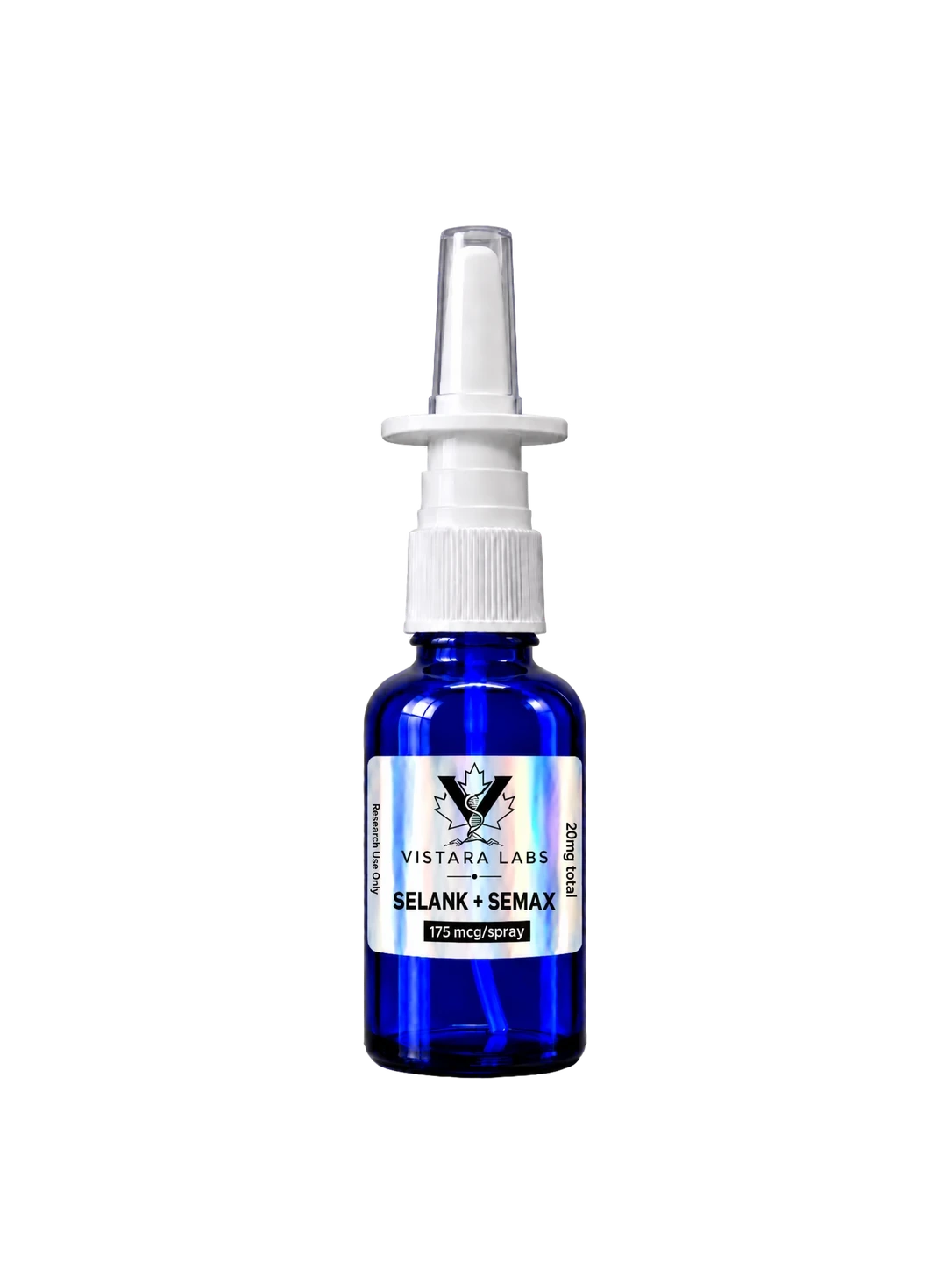
Selank and Semax share a stabilising Pro-Gly-Pro tail but act on different systems: Selank on calming, GABA-linked signalling and Semax on BDNF and plasticity. That split is why they are paired. In a 2020 imaging study, 52 healthy participants were scanned before and 5 and 20 minutes after Semax, Selank or placebo, and the researchers identified shared and distinct effects of the two peptides on connectivity between the right amygdala, a key region for anxiety, and the right temporal cortex (Panikratova et al., Dokl Biol Sci, 2020). No published trial has yet tested the combination as a single preparation. The Selank + Semax Nasal Spray holds 10 mg of each in one 10 mL bottle, and Semax vs Selank compares the two in depth.
What has Cerebrolysin research shown for cognition?
Cerebrolysin has the largest set of randomised, placebo-controlled trials of the three, published in international journals.
- Vascular dementia, 2011. In a 242-person double-blind trial, Cerebrolysin added to acetylsalicylic acid improved the ADAS-cog+ cognition score by 10.6 points at 24 weeks against 4.4 on placebo (P < .0001). 67.5% against 27.0% met the combined cognitive and global response (Guekht et al., J Stroke Cerebrovasc Dis).
- Mild brain injury, 2013. In 32 people with mild traumatic brain injury, the Cognitive Abilities Screening Instrument score rose 21.0 points by week 12 on Cerebrolysin against 7.6 on placebo (p = 0.0461), with long-term memory and drawing function also improved (Chen et al., Br J Neurosurg).
- Moderate to severe brain injury, 2020. In a 46-person trial, Cerebrolysin beat placebo on the Stroop interference test and both Color Trails tests, and its pooled result across 14 outcome scales was significant in the per-protocol analysis (p = 0.024) (Poon et al., Neurol Sci).
- Alzheimer’s disease, 2015. Pooling six randomised placebo-controlled trials in mild to moderate Alzheimer’s disease, a meta-analysis found Cerebrolysin improved cognitive function at 4 weeks and global clinical change at 4 weeks and 6 months, with odds ratios of 3.32 and 4.98 (Gauthier et al., Dement Geriatr Cogn Disord).
In stroke, a 208-person trial in Stroke (2016) found a large advantage over placebo in arm and hand recovery at day 90 (Muresanu et al.). That trial and the brain-injury research are covered in Cerebrolysin: stroke and brain-injury research.
Which sprays, vials and stacks match this research?
Cognitive Clarity Spray Stack
The Cognitive Clarity Spray Stack combines the Semax Nasal Spray, the Selank Nasal Spray and the NAD+ Nasal Spray, all ready-mixed in sterile saline in metered atomisers, so there is nothing to reconstitute. NAD+ is a coenzyme rather than a peptide, and its research centres on cellular energy. Shop the Cognitive Clarity Spray Stack
Cognitive Axis
The Cognitive Axis stack brings together Semax, Selank and Cerebrolysin as research vials, reconstituted with bacteriostatic water. Shop Cognitive Axis
Single sprays and vials
Semax and Selank are each sold as a lyophilised vial or a ready-mixed nasal spray. For calm and sleep research, the Sleep & Calm Spray Stack pairs the Selank spray with DSIP. Semax and Selank: intranasal vs subcutaneous research routes explains the two formats; certificates of analysis are on the lab reports page.
Semax, Selank, Cerebrolysin and NAD+ are supplied for laboratory research use only; the studies above were conducted under medical supervision. Orders ship from within Canada by Xpresspost. More studies are in Research Notes.
Frequently asked questions
Which peptides have been studied for anxiety?
Selank has the most anxiety-specific human research. In Russian studies of 62, 60 and 70 people with anxiety disorders, its anti-anxiety effect matched medazepam, lasted a week after the course against phenazepam, and arrived earlier with fewer side effects when added to phenazepam.
What has Semax research shown for focus and memory?
A 1997 review reported significant gains in memory and attention in healthy men working under extreme conditions. In 110 people after ischemic stroke, Semax raised blood BDNF and sped recovery (2018), and in 24 healthy volunteers the Semax group showed a larger frontal component of the brain’s default mode network than placebo.
What has research shown about Selank and Semax together?
A 2020 imaging study scanned 52 healthy participants after Semax, Selank or placebo and found shared and distinct effects of the two peptides on connectivity between the right amygdala and the right temporal cortex.
What has Cerebrolysin research shown for cognition?
In a 242-person vascular dementia trial, the ADAS-cog+ cognition score improved 10.6 points on Cerebrolysin against 4.4 on placebo over 24 weeks. In 32 people after mild brain injury, a cognitive screening score rose 21.0 points against 7.6 by week 12.
Where can I buy Semax and Selank in Canada?
Vistara Labs supplies Semax and Selank as lyophilised vials and ready-mixed nasal sprays, the Selank + Semax Nasal Spray, Cerebrolysin, and the Cognitive Clarity Spray Stack and Cognitive Axis stacks, shipped from within Canada.
Product details from vistaralabs.ca, October 2026. Sources: Zozulia AA et al. Efficacy and possible mechanisms of action of a new peptide anxiolytic selank in the therapy of generalized anxiety disorders and neurasthenia. Zh Nevrol Psikhiatr Im S S Korsakova. 2008. PMID 18454096. Medvedev VE et al. A comparison of the anxiolytic effect and tolerability of selank and phenazepam in the treatment of anxiety disorders. Zh Nevrol Psikhiatr Im S S Korsakova. 2014. PMID 25176261. Medvedev VE et al. Optimization of the treatment of anxiety disorders with selank. Zh Nevrol Psikhiatr Im S S Korsakova. 2015. PMID 26356395. Vyunova TV et al. Peptide-based Anxiolytics: The Molecular Aspects of Heptapeptide Selank Biological Activity. Protein Pept Lett. 2018. PMID 30255741. Asmarin IP et al. A nootropic adrenocorticotropin analog 4-10-semax (15 years experience in its design and study). Zh Vyssh Nerv Deiat Im I P Pavlova. 1997. PMID 9173745. Gusev EI et al. Effectiveness of semax in acute period of hemispheric ischemic stroke (a clinical and electrophysiological study). Zh Nevrol Psikhiatr Im S S Korsakova. 1997. PMID 11517472. Gusev EI et al. Semax in prevention of disease progress and development of exacerbations in patients with cerebrovascular insufficiency. Zh Nevrol Psikhiatr Im S S Korsakova. 2005. PMID 15792140. Gusev EI et al. The efficacy of semax in the treatment of patients at different stages of ischemic stroke. Zh Nevrol Psikhiatr Im S S Korsakova. 2018. PMID 29798983. Lebedeva IS et al. Effects of Semax on the Default Mode Network of the Brain. Bull Exp Biol Med. 2018. PMID 30225715. Dolotov OV et al. Semax, an analog of ACTH(4-10) with cognitive effects, regulates BDNF and trkB expression in the rat hippocampus. Brain Res. 2006. PMID 16996037. Panikratova YR et al. Functional Connectomic Approach to Studying Selank and Semax Effects. Dokl Biol Sci. 2020. PMID 32342318. Guekht AB et al. Cerebrolysin in vascular dementia: improvement of clinical outcome in a randomized, double-blind, placebo-controlled multicenter trial. J Stroke Cerebrovasc Dis. 2011. PMID 20656516. Chen CC et al. Cerebrolysin enhances cognitive recovery of mild traumatic brain injury patients: double-blind, placebo-controlled, randomized study. Br J Neurosurg. 2013. PMID 23656173. Poon W et al. Neurol Sci. 2020. PMID 31494820. Gauthier S et al. Cerebrolysin in mild-to-moderate Alzheimer’s disease: a meta-analysis of randomized controlled clinical trials. Dement Geriatr Cogn Disord. 2015. PMID 25832905. Muresanu DF et al. Stroke. 2016. PMID 26564102.
More on this: Peptides for Sleep: What the Research Shows.
All products supplied by Vistara Labs are intended for laboratory research use only. They are not drugs, are not approved for human or veterinary use, and are not intended to diagnose, treat, cure or prevent any condition. Nothing on this page constitutes medical advice or guidance for use in humans.