Insulin Syringes Explained: U-100 Units, Sizes and Gauges
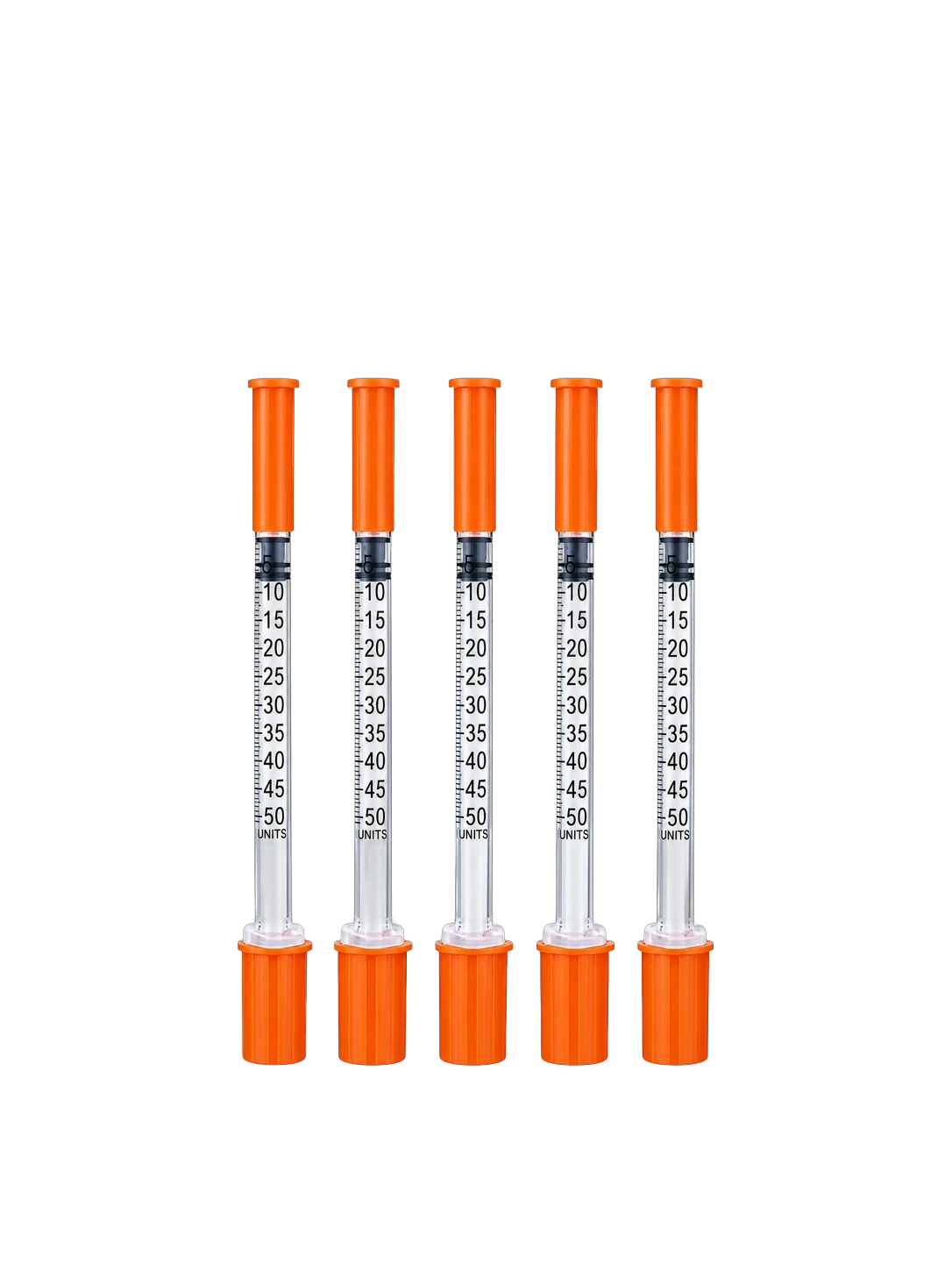
An insulin syringe is a small, sterile, single-use syringe graduated in units instead of millilitres, and on a U-100 syringe every unit is exactly 0.01 mL, so 100 units fill 1 mL. That fixed conversion makes U-100 syringes a convenient way to measure small volumes of a reconstituted solution in the laboratory. This guide explains the U-100 scale, the common barrel sizes, what gauge and needle-length numbers mean, and why a larger 3 mL syringe is used to transfer diluent while small 0.5 mL U-100 syringes are used to read volumes.
Findings
- U-100 means 100 units per mL, the most common insulin concentration, so one unit on a U-100 syringe is 0.01 mL.
- Insulin syringes are made to ISO 8537, the standard for empty, sterile, single-use plastic syringes, with or without a needle, filled by the user.
- U-100 barrels come in 0.3 mL, 0.5 mL and 1 mL sizes, holding 30, 50 and 100 units; some 0.3 mL models carry half-unit marks.
- A higher gauge number means a thinner needle: a 32G needle is roughly 0.24 mm across, a 27G about 0.41 mm.
 View product →
What is an insulin syringe?
An insulin syringe is a plastic syringe whose barrel is printed with a unit scale that matches a specific insulin concentration. The international standard for them is ISO 8537:2016, Sterile single-use syringes, with or without needle, for insulin. Its scope covers empty, sterile, single-use syringes made of plastic and intended to be filled by the end user shortly before use; earlier editions named both U-40 and U-100 scales. Pre-filled syringes, glass syringes and syringes meant to store their contents fall outside it. General-purpose syringes such as the 3 mL size are covered by a separate standard, ISO 7886-1:2017, which explicitly leaves insulin syringes to ISO 8537.
The practical point for laboratory work is that an insulin syringe is a measuring device with a fine, well-defined scale. Each barrel is individually packed and sterile, which is why searches for an insulin syringe and a sterile needle often lead to the same product.
What does U-100 mean?
The “U” number is the concentration of insulin the scale was designed for, in units per millilitre. U-100 insulin contains 100 units per mL, and it is the concentration in which insulin is most commonly prescribed (Johnson et al., J Diabetes Sci Technol, 2017). A U-100 syringe is therefore marked so that 100 units equals 1 mL, and every unit mark represents 0.01 mL.
For any solution other than insulin, the unit marks are simply a volume scale:
- Units to millilitres: divide by 100. 25 units is 0.25 mL.
- Millilitres to units: multiply by 100. 0.1 mL is 10 units.
The scale only works with U-100 markings. Concentrated insulins such as U-500 use dedicated syringes with their own scale, and safety literature describes how reading one scale against the other produces fivefold errors (Johnson et al., 2017). In a laboratory setting, the lesson is the same: confirm the “U-100” print on the barrel before recording a volume.
Common barrel sizes and their markings
U-100 syringes come in three standard capacities. The unit is always 0.01 mL; a smaller barrel just spreads the same marks over a longer distance, which makes small volumes easier to read.
| Barrel | Capacity on a U-100 scale | Typical use in the lab |
|---|---|---|
| 0.3 mL | 30 units (some models have half-unit marks) | The smallest volumes, finest resolution |
| 0.5 mL | 50 units | Small volumes with a little more range |
| 1 mL | 100 units | Volumes up to 1 mL in a single fill |
Distributor listings for embecta (formerly BD) Ultra-Fine syringes show the 0.3 mL barrel offered with a “U-100 insulin / half-unit scale”, where each half-unit mark is 0.005 mL. The 0.5 mL and 1 mL barrels carry whole-unit scales. Reading accuracy depends on picking the smallest barrel that holds the full volume in one draw.
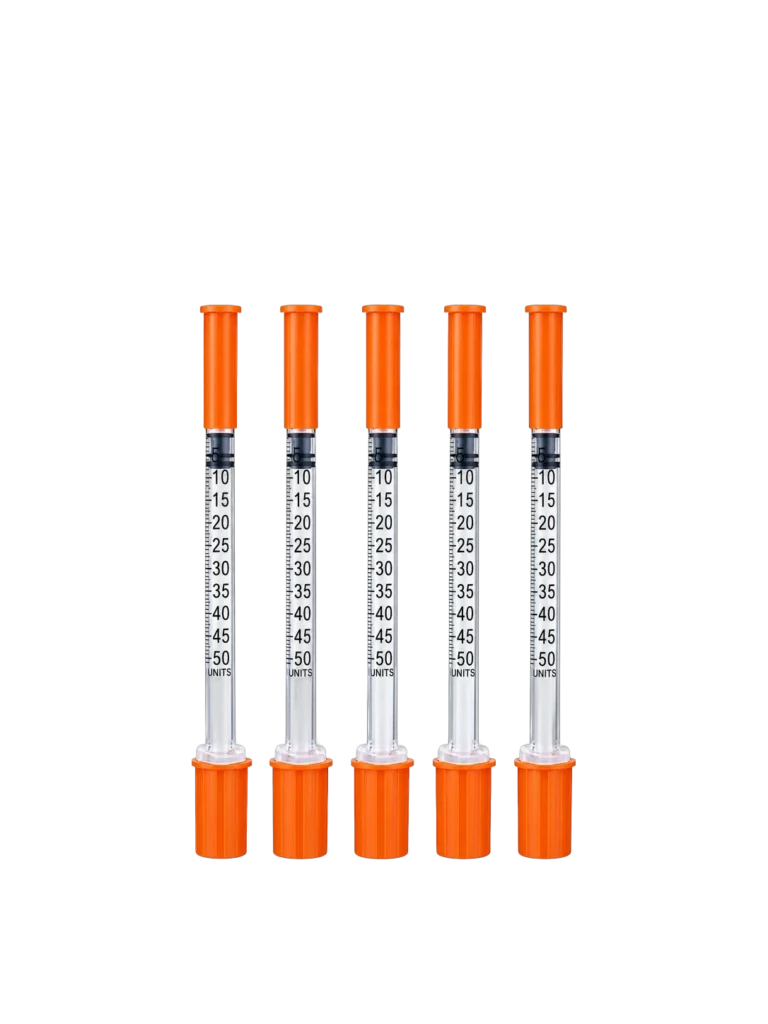
The 0.5 mL U-100 insulin syringes we stock hold 50 units, the middle of the range.
Needle gauge and length
Gauge
Needle gauge is a size number that runs backwards: the higher the gauge, the thinner the needle. Standard gauge tables give an outer diameter of about 0.41 mm for 27G, 0.31 mm for 30G and 0.24 mm for 32G (Darwin Microfluidics gauge table). ISO 9626 sets the dimensions and tolerances for stainless-steel needle tubing across metric sizes from 3.4 mm (10G) down to 0.18 mm (34G). Distributor listings for insulin syringes run from 28G to 31G, and the ones we stock are finer still at 32G.
In laboratory handling, gauge matters mostly for flow and for septum wear. A fine needle leaves a smaller puncture in a rubber vial stopper but moves liquid more slowly, which is one reason transferring a larger volume of diluent is done with a different syringe.
Length
Needle length on insulin syringes is usually given in inches or millimetres. Listings for embecta syringes show 6 mm, 5/16 inch (about 8 mm) and 1/2 inch (12.7 mm) options, paired with 30G and 31G needles. Length and gauge are printed on the package, usually as a pair such as “31G x 5/16 in”.
Why a 3 mL syringe is used for reconstitution
Reconstituting a lyophilised peptide vial means moving a measured volume of bacteriostatic water, usually between 1 and 3 mL, from one vial into another. That job suits a general-purpose syringe better than an insulin syringe:
- One fill instead of several. A 3 mL syringe moves 1 to 3 mL in one draw. Transferring 2 mL with a 0.5 mL insulin syringe would take four separate fills, four stopper punctures and four chances for a reading error.
- A millilitre scale. BD lists its 3 mL Luer-Lok syringe with a 0.1 mL scale, so diluent volumes read directly in mL without conversion.
- Steady handling. The larger barrel and plunger make it easier to push water slowly down the vial wall rather than jetting it onto the powder.
Once the solution is made, the small U-100 syringe takes over for reading volumes. The full method is in How to Reconstitute Peptides with Bacteriostatic Water, and the peptide calculator converts vial size and water volume into concentration and U-100 units, drawing the fill line on a syringe diagram. For a 10 mg vial in 2 mL of water (5 mg/mL), the volume containing 1 mg is 0.2 mL, or 20 units.
The figures on this page describe how syringe scales convert between units and millilitres for laboratory measurement. They are not guidance about any quantity to use for any purpose.
Single use and sharps disposal
Insulin syringes are designed and sterilised for single use, which is written into the scope of ISO 8537: each one is sterile until its package is opened, and it is discarded after one use.
Used syringes and needles belong in a hard, puncture-resistant sharps container. Canadian guidance is consistent on the basics:
- Do not recap, bend, clip or break used sharps (Ontario Sharps Collection Program).
- Keep the needle on the syringe when disposing of it (BC Children’s Hospital).
- Never put sharps in household garbage, recycling or a toilet unless local rules say otherwise (BC Children’s Hospital); the City of Calgary, for example, allows sealed puncture-resistant containers in garbage where no pharmacy option exists.
- Return full containers to a participating pharmacy. Ontario’s program takes back approved containers free of charge, and most pharmacies elsewhere offer a similar service.
Syringes from Vistara Labs
We stock 0.5 mL U-100 insulin syringes with 32G needles for reading volumes, the 3 mL syringe with needle for transferring diluent, and bacteriostatic water in multi-dose vials of sterile water with 0.9% benzyl alcohol, all shipped from within Canada by Canada Post Xpresspost. More on the diluent is in Bacteriostatic Water Explained.
Frequently asked questions
What does U-100 mean on an insulin syringe?
U-100 means the scale is designed for a concentration of 100 units per mL. Each unit mark is 0.01 mL, so 100 units equals 1 mL, 50 units equals 0.5 mL and 10 units equals 0.1 mL.
What sizes do insulin syringes come in?
U-100 insulin syringes come in 0.3 mL (30 units), 0.5 mL (50 units) and 1 mL (100 units) barrels. Some 0.3 mL models have half-unit marks, each worth 0.005 mL.
What does needle gauge mean?
Gauge is a size number for the needle’s outer diameter, and it runs backwards: a higher number is a thinner needle. A 32G needle is roughly 0.24 mm across and a 27G needle about 0.41 mm.
Why is a 3 mL syringe used to add bacteriostatic water?
Diluent volumes are usually 1 to 3 mL, which a 3 mL syringe moves in one draw on a 0.1 mL scale. Doing the same with a 0.5 mL insulin syringe would take several fills and several stopper punctures.
How are used syringes disposed of in Canada?
Used syringes go, with the needle left on and not recapped, into a hard, puncture-resistant sharps container. Full containers are returned to a participating pharmacy or local collection program, following provincial and municipal rules.
Product details from vistaralabs.ca, October 2026. Sources: ISO 8537:2016, Sterile single-use syringes, with or without needle, for insulin (AFNOR listing). ISO 7886-1:2017, Sterile hypodermic syringes for single use, Part 1: syringes for manual use (SIS listing). ISO 9626:2016, Stainless steel needle tubing for the manufacture of medical devices (Standards Council of Canada listing). Johnson JL et al. Novel concentrated insulin delivery devices: developments for safe and simple dose conversions. J Diabetes Sci Technol. 2017. PMID 27898390. Embecta Ultra-Fine insulin syringe listings, McKesson (328440, 324909). BD 3 mL Luer-Lok syringe specification, bd.com. Syringe needle gauge table, Darwin Microfluidics, 2023. Ontario Sharps Collection Program (City of Windsor). Safe disposal of sharps at home, BC Children’s Hospital. Needles and syringes, City of Calgary.
More on this: How to Reconstitute Peptides with Bacteriostatic Water.
All products supplied by Vistara Labs are intended for laboratory research use only. They are not drugs, are not approved for human or veterinary use, and are not intended to diagnose, treat, cure or prevent any condition. Nothing on this page constitutes medical advice or guidance for use in humans.