Oxytocin vs Pitocin: Same Molecule, Different Uses
Cognitive & Nootropic Research
Pitocin is a brand name for synthetic oxytocin injection, so oxytocin and Pitocin are the same nine-amino-acid molecule. The differences are in the formulation and the setting: Pitocin is a preserved hospital injection approved for labour and delivery, while research oxytocin is supplied as a lyophilised vial or a ready-mixed oxytocin nasal spray for laboratory work, the format behind most human research on social cognition and bonding. Here is how the two relate and what each body of research shows.
Findings
- Pitocin and Syntocinon are both brand names for synthetic oxytocin, chemically identical to the hormone stored in the posterior pituitary.
- Oxytocin was the first polypeptide hormone ever synthesised, by Vincent du Vigneaud in 1953; he received the 1955 Nobel Prize in Chemistry for the work.
- Pitocin is approved for starting or strengthening contractions in medically indicated labour and controlling bleeding after delivery, given by intravenous infusion or intramuscular injection in hospital.
- Intranasal oxytocin research has reported higher trust, better reading of emotions from the eyes, more eye contact and more positive couple communication in placebo-controlled studies (2005 to 2012).
 View product →
What is oxytocin?
Oxytocin is a peptide hormone made in the hypothalamus and released from the posterior pituitary. Its sequence, worked out by du Vigneaud’s group in 1953, is Cys-Tyr-Ile-Gln-Asn-Cys-Pro-Leu-Gly-NH2, with a disulfide bridge between the two cysteines that closes the first six residues into a ring (du Vigneaud et al., J Biol Chem, 1953). Chemists of the period called it an octapeptide amide, counting the bridged cystine as one unit; current labels call it a nonapeptide, counting each cysteine. The same group then synthesised it, the first synthesis of a polypeptide hormone (du Vigneaud et al., J Am Chem Soc, 1953).
Oxytocin is a close relative of vasopressin, the antidiuretic hormone. The Pitocin label notes that the two differ at only two amino acid positions, which explains why oxytocin carries some antidiuretic activity at high exposure. In the bloodstream it is short-lived: the label gives a plasma half-life of about 1 to 6 minutes, cleared largely by the kidney and liver.
What is Pitocin?
Pitocin (oxytocin injection, USP) is described on its US label as a sterile, clear, colourless solution of synthetic oxytocin for intravenous infusion or intramuscular injection. It is standardised to 10 units of oxytocic activity per mL and contains 0.5% chlorobutanol as a preservative, with acetic acid and ammonium acetate buffers at a target pH of 3.5. The label explains that the hormone is made synthetically to avoid contamination with vasopressin, which was a problem with the older pituitary extracts.
Syntocinon and other brands
Syntocinon is the brand name used in the United Kingdom, Australia and several European countries. Its UK product information describes the active ingredient as a cyclic nonapeptide obtained by chemical synthesis and identical to the natural hormone, supplied as a 5 IU/mL concentrate in ampoules. Generic “oxytocin injection, USP” products contain the same molecule. Whatever the name on the box, the peptide is oxytocin; the brands differ in strength per mL, preservatives and packaging.
Approved obstetric uses
Pitocin’s label sets out two groups of uses, both under medical supervision in hospital:
- Antepartum: starting or improving uterine contractions where there is a medical reason to achieve vaginal delivery, such as maternal diabetes or Rh problems, and supporting labour that has stalled. The label states it is not indicated for elective induction, meaning induction without a medical reason.
- Postpartum: producing contractions during the third stage of labour and controlling bleeding after delivery.
Antepartum use is by intravenous infusion only; the intramuscular route appears in the postpartum setting. The label records that the uterus responds almost immediately to intravenous oxytocin, with the effect subsiding within an hour, and within 3 to 5 minutes after intramuscular injection, lasting 2 to 3 hours.
Intranasal oxytocin research
Outside obstetrics, the large human literature on oxytocin uses a nasal spray, studying the hormone’s role in social behaviour. Our full review is in Oxytocin Nasal Spray: What the Human Research Shows; the landmark studies are below.
Trust and social cognition
In a 2005 Nature study using an economic trust game, intranasal oxytocin produced a substantial increase in trust between participants, and the effect was specific to social risk rather than a general willingness to take risks (Kosfeld et al., Nature, 2005). In 2007, 30 healthy men performed better on the Reading the Mind in the Eyes Test after oxytocin than after placebo, with the clearest gains on the hardest items (Domes et al., Biol Psychiatry, 2007). A 2008 eye-tracking study of 52 men found that oxytocin increased the number of fixations on, and total gaze time toward, the eye region of faces (Guastella et al., Biol Psychiatry, 2008).
Bonding and relationships
In 47 heterosexual couples, intranasal oxytocin increased positive communication relative to negative behaviour during a laboratory conflict discussion and lowered salivary cortisol afterwards (Ditzen et al., Biol Psychiatry, 2009). A 2012 study found that oxytocin led men in monogamous relationships, but not single men, to keep a greater distance from an attractive woman they had just met, a result the authors linked to the maintenance of established bonds (Scheele et al., J Neurosci, 2012). Comparisons with other social and sexual-health peptides are in Kisspeptin vs Oxytocin and PT-141 vs Oxytocin.
Brain imaging in autism
In 17 children with high-functioning autism, intranasal oxytocin increased activity in the striatum, medial prefrontal cortex and superior temporal sulcus during judgements of eyes, raising activity for social judgements and lowering it for non-social ones (Gordon et al., PNAS, 2013).
Oxytocin vs Pitocin side by side
| Question | Pitocin | Research oxytocin |
|---|---|---|
| Molecule | Synthetic oxytocin | Synthetic oxytocin |
| Form | Preserved injectable solution, 10 units/mL | Lyophilised vial or ready-mixed metered nasal spray |
| Route studied | Intravenous infusion, intramuscular | Mostly intranasal |
| Research or approved focus | Labour induction and postpartum bleeding | Trust, social cognition, bonding |
| Setting | Hospital, under medical supervision | Laboratory research |
How the routes differ in absorption and research design is covered in Oxytocin Nasal Spray vs Injection.
How research oxytocin is supplied
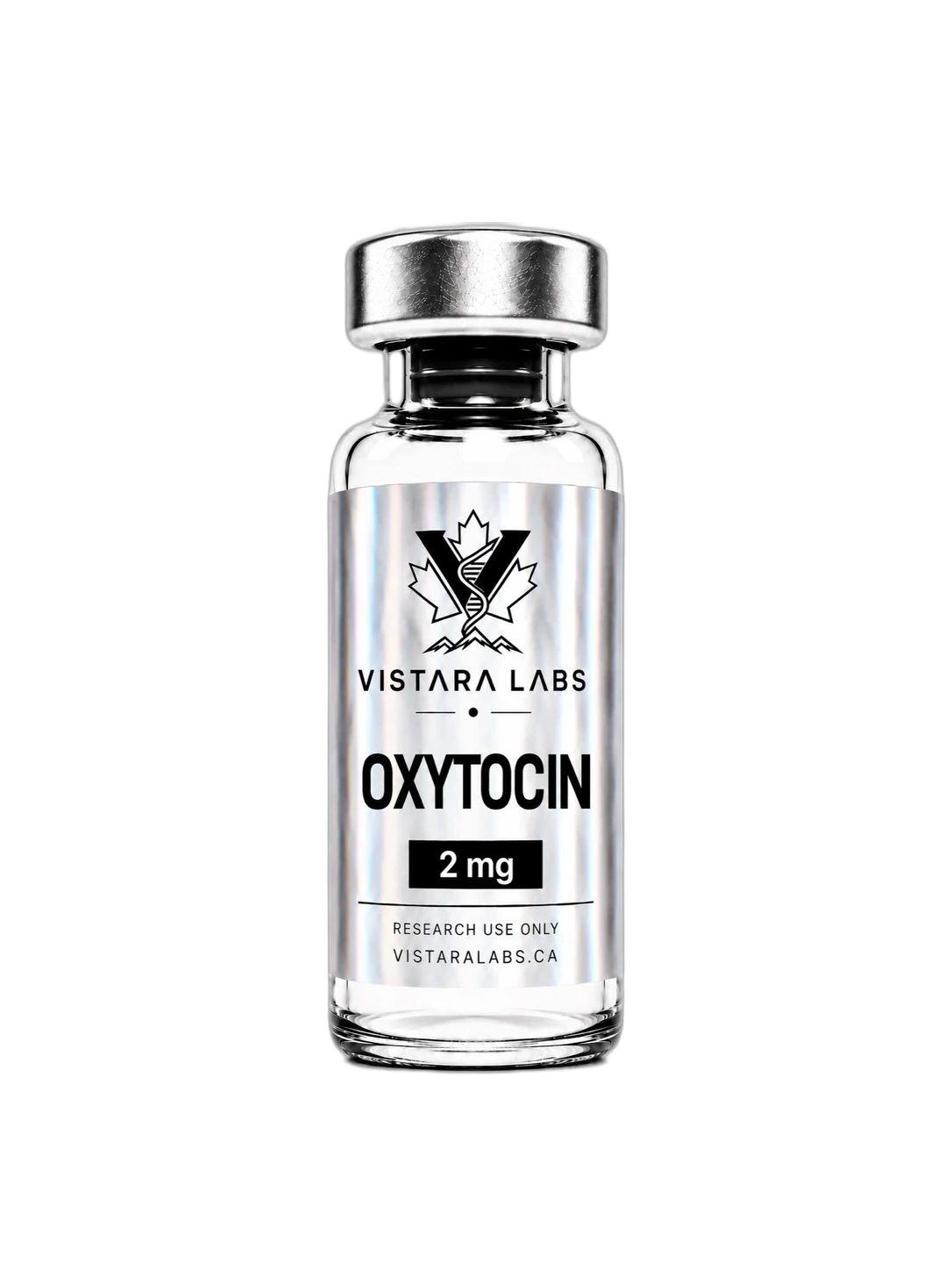
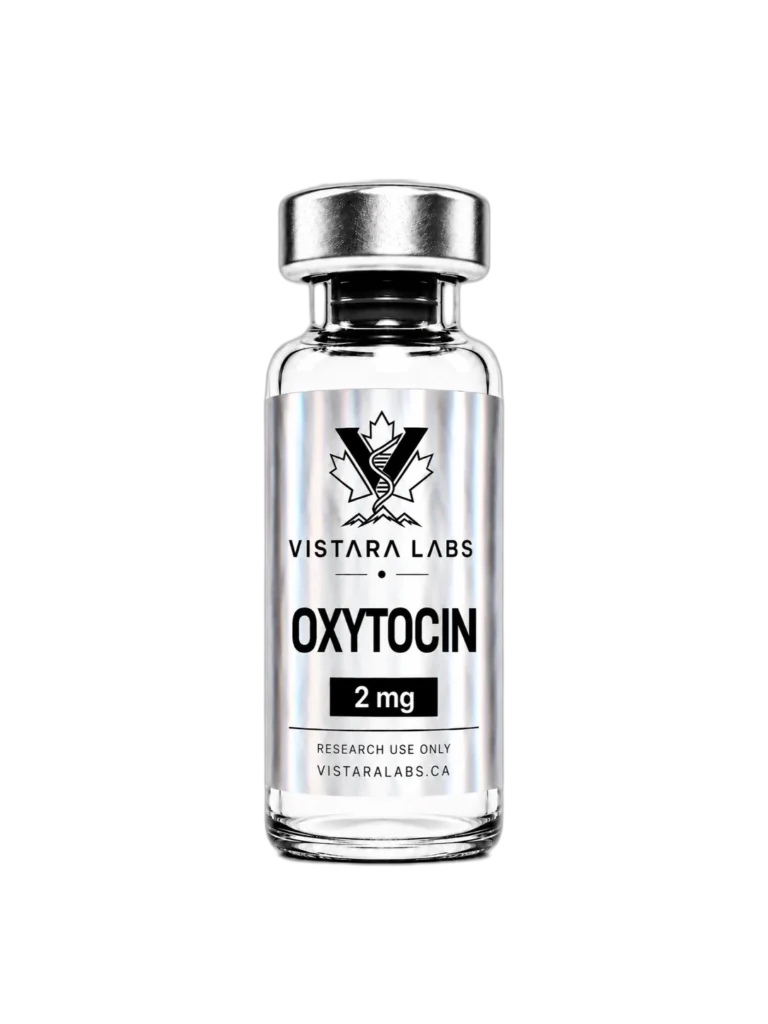
Vistara Labs supplies oxytocin as a lyophilised vial in 2 mg and 10 mg sizes, reconstituted with bacteriostatic water (see the oxytocin reconstitution guide), and as an oxytocin nasal spray, ready-mixed in a metered pump that delivers 0.175 mL per press. Storage is covered in How Long Does Oxytocin Last?, and the buying guides are Buy Oxytocin in Canada and Buy Oxytocin Nasal Spray in Canada. Products are third-party tested, with certificates on the lab reports page.
Oxytocin is supplied for laboratory research use only. Pitocin and Syntocinon are prescription medicines used in hospital; the studies above were clinical research using pharmaceutical preparations.
Frequently asked questions
Is Pitocin the same as oxytocin?
Yes. Pitocin is a brand name for synthetic oxytocin injection. The peptide has the same nine-amino-acid sequence as the natural hormone; Pitocin adds a preservative and buffers and is standardised to 10 units per mL for hospital use.
What is Syntocinon?
Syntocinon is another brand of synthetic oxytocin injection, used in the UK, Australia and several European countries. Its product information describes a cyclic nonapeptide made by chemical synthesis and identical to the natural hormone.
What has intranasal oxytocin research shown?
Placebo-controlled studies reported higher trust in an economic game (2005), better recognition of emotions from the eyes (2007), more gaze to the eye region (2008), more positive communication and lower cortisol during couple conflict (2009), and stronger brain responses to social cues in children with autism (2013).
What are the side effects of oxytocin?
For obstetric injection, the Pitocin label lists nausea and vomiting among maternal reactions, along with effects of excessive uterine stimulation and, with prolonged infusion, water intoxication from oxytocin’s antidiuretic action. For intranasal research use, a 2011 review of 38 randomised trials with 1,529 participants found side effects did not differ between oxytocin and placebo in short-term controlled settings.
Where can I buy oxytocin in Canada?
Vistara Labs supplies oxytocin as 2 mg and 10 mg lyophilised vials and as a ready-mixed nasal spray, third-party tested and shipped from within Canada by Canada Post Xpresspost.
Product details from vistaralabs.ca, October 2026. Sources: Pitocin (oxytocin injection, USP) prescribing information, Par Health, via DailyMed. Syntocinon 5 IU/ml concentrate for solution for infusion, UK summary of product characteristics, via RxReasoner. du Vigneaud V et al. The sequence of amino acids in oxytocin, with a proposal for the structure of oxytocin. J Biol Chem. 1953. PMID 13129273. du Vigneaud V et al. The synthesis of an octapeptide amide with the hormonal activity of oxytocin. J Am Chem Soc. 1953;75:4879-80. Nobel Prize in Chemistry 1955, nobelprize.org. Kosfeld M et al. Oxytocin increases trust in humans. Nature. 2005. PMID 15931222. Domes G et al. Oxytocin improves “mind-reading” in humans. Biol Psychiatry. 2007. PMID 17137561. Guastella AJ et al. Oxytocin increases gaze to the eye region of human faces. Biol Psychiatry. 2008. PMID 17888410. Ditzen B et al. Intranasal oxytocin increases positive communication and reduces cortisol levels during couple conflict. Biol Psychiatry. 2009. PMID 19027101. Scheele D et al. Oxytocin modulates social distance between males and females. J Neurosci. 2012. PMID 23152592. Gordon I et al. Oxytocin enhances brain function in children with autism. Proc Natl Acad Sci U S A. 2013. PMID 24297883. MacDonald E et al. A review of safety, side-effects and subjective reactions to intranasal oxytocin in human research. Psychoneuroendocrinology. 2011. PMID 21429671.
More on this: Sexual Health & Intimacy Research.
All products supplied by Vistara Labs are intended for laboratory research use only. They are not drugs, are not approved for human or veterinary use, and are not intended to diagnose, treat, cure or prevent any condition. Nothing on this page constitutes medical advice or guidance for use in humans.