IGF-1 LR3 Reconstitution: How Much Bacteriostatic Water
A 1 mg (1,000 mcg) vial of IGF-1 LR3 reconstituted with 2 mL of bacteriostatic water gives 500 mcg/mL; a 0.1 mg (100 mcg) vial with 1 mL gives 100 mcg/mL. The calculation depends only on the quantity in the vial and the volume of water added, so the figures below apply to any vial of these sizes.
There is no single correct volume. Adding more water does not change how much is in the vial. It spreads the same quantity through a larger volume, which changes how many syringe units correspond to a given amount. IGF-1 LR3 is commonly supplied in 0.1 mg and 1 mg vials in research catalogues, and at these quantities micrograms are the clearer unit, so this page works in mcg (1 mg = 1,000 mcg).
 View product →
Peptide reconstitution calculator
Set to this vial below. Change the vial size, water volume, amount or syringe and it recalculates the concentration and the syringe units. For laboratory research use only.
All products are sold strictly for laboratory research use only and are not for human or veterinary consumption. This calculator is provided as a general reference tool.
How much bacteriostatic water for 0.1 mg (100 mcg) IGF-1 LR3?
Add 1 mL of bacteriostatic water to a 0.1 mg (100 mcg) IGF-1 LR3 vial for 100 mcg/mL, so 0.1 mL (10 units) holds 10 mcg; 0.5 mL gives 200 mcg/mL and 2 mL gives 50 mcg/mL. The vial holds 100 mcg whichever volume you choose, and only the concentration moves.
| Water added | Concentration | Amount in 0.1 mL (10 units on a U-100 syringe) |
|---|---|---|
| 0.5 mL | 200 mcg/mL | 20 mcg |
| 1 mL | 100 mcg/mL | 10 mcg |
| 2 mL | 50 mcg/mL | 5 mcg |
How much bacteriostatic water for 1 mg IGF-1 LR3?
Add 2 mL of bacteriostatic water to a 1 mg (1,000 mcg) IGF-1 LR3 vial for 500 mcg/mL, so 0.1 mL (10 units) holds 50 mcg; 1 mL gives 1,000 mcg/mL, 4 mL gives 250 mcg/mL and 5 mL gives 200 mcg/mL.
| Water added | Concentration | Amount in 0.1 mL (10 units on a U-100 syringe) |
|---|---|---|
| 1 mL | 1,000 mcg/mL | 100 mcg |
| 2 mL | 500 mcg/mL | 50 mcg |
| 4 mL | 250 mcg/mL | 25 mcg |
| 5 mL | 200 mcg/mL | 20 mcg |
Small vials have limited headspace, so check that the vial can take the volume before choosing a larger one. One multi-dose vial of bacteriostatic water covers several research vials.
Reading the concentration on a U-100 syringe
A U-100 insulin syringe is graduated in units, and 100 units equal 1 mL. Units are therefore millilitres multiplied by 100: 0.1 mL is 10 units and 0.25 mL is 25 units. A 0.5 mL syringe carries 50 units and a 0.3 mL syringe carries 30 units on the same scale, with finer markings that make small volumes easier to read.
To find the volume that contains a given amount, divide the amount by the concentration. At 500 mcg/mL (a 1 mg vial with 2 mL of water), the volume that contains 50 mcg is 50 divided by 500, which is 0.1 mL, or 10 units. The table below runs the same calculation for four arbitrary amounts. They illustrate the arithmetic and nothing else.
| Amount (illustrative) | Volume at 500 mcg/mL | U-100 units |
|---|---|---|
| 10 mcg | 0.02 mL | 2 units |
| 25 mcg | 0.05 mL | 5 units |
| 50 mcg | 0.1 mL | 10 units |
| 100 mcg | 0.2 mL | 20 units |
At 100 mcg/mL, which a 0.1 mg vial gives with 1 mL of water, every volume in the table is five times larger: 10 mcg measures 10 units. Volumes below about 0.1 mL are hard to read accurately on a 1 mL syringe. Either move to a 0.3 mL or 0.5 mL syringe, or reconstitute with more water so that the same mass occupies a larger, more legible volume.
IGF-1 LR3 is a lyophilised research material. The quantities on this page illustrate the arithmetic of dilution and measurement only.
The IGF-1 LR3 vial
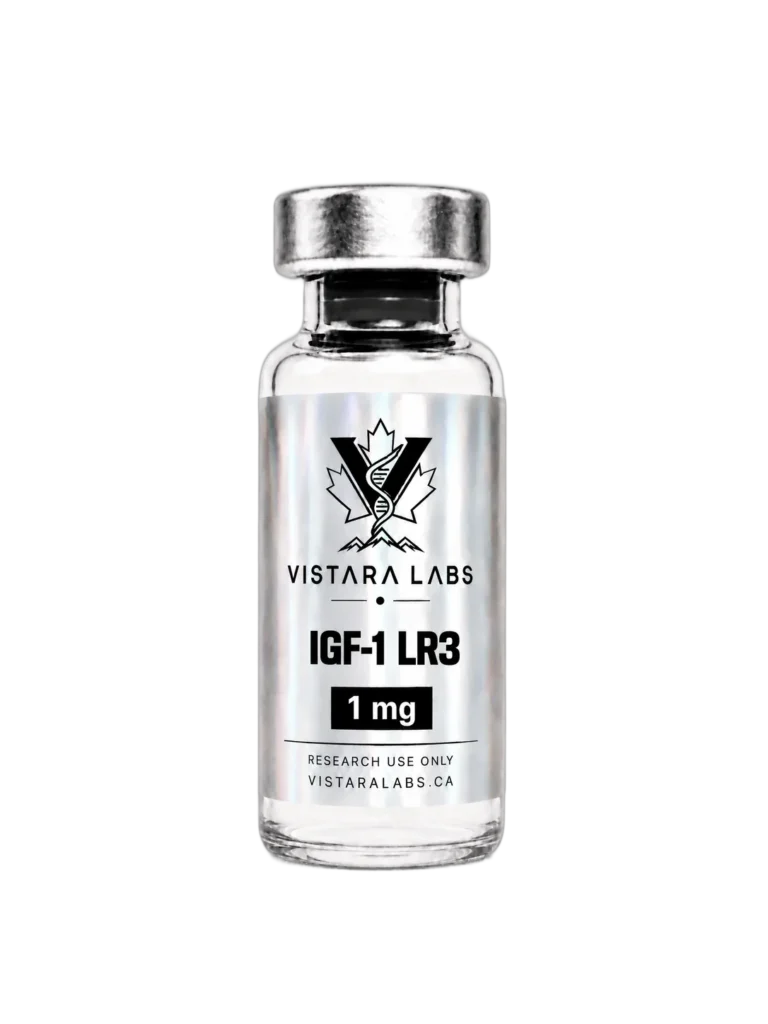
Vistara Labs stocks IGF-1 LR3 as a 1 mg lyophilised vial. The calculator on this page works for any vial. IGF-1 LR3 is commonly supplied in 0.1 mg and 1 mg lyophilised vials in research catalogues, and every figure on this page follows from those two sizes. Related compounds we do carry are listed in the peptide library.
What IGF-1 LR3 is
IGF-1 LR3 (Long R3 IGF-I) is a recombinant analogue of insulin-like growth factor-I with a 13-amino-acid N-terminal extension and arginine in place of glutamic acid at position 3. It was developed as a laboratory reagent for studying IGF-I action, and its research is in cell culture and animal models (Francis 1992).
In myoblast cell cultures, the Long IGF-I analogues were more potent than native IGF-I at stimulating protein and DNA synthesis and inhibiting protein breakdown, and the authors attribute the gain mainly to reduced interaction with IGF-binding proteins (Francis 1992). In an animal study, LR3IGF-I was approximately 2.5-fold more potent than IGF-I in reversing a catabolic state, even though it binds the type 1 IGF receptor 3-fold less strongly than IGF-I (Tomas 1992).
Sources: Francis GL et al. Novel recombinant fusion protein analogues of insulin-like growth factor (IGF)-I indicate the relative importance of IGF-binding protein and receptor binding for enhanced biological potency. J Mol Endocrinol. 1992. PMID 1378742. Tomas FM et al. Insulin-like growth factor-I (IGF-I) and especially IGF-I variants are anabolic in dexamethasone-treated rats. Biochem J. 1992. PMID 1371669.
Reconstitution technique
Let the vial reach room temperature, swab both stoppers, and run the measured water slowly down the inside wall of the vial rather than onto the powder. Swirl or tilt gently until the cake dissolves, never shake, and give any remaining powder a few minutes to settle into solution. Label the vial with the date and the concentration, then keep it refrigerated at 2 to 8 °C and protected from light. The full method, with the reason behind each step, is in how to reconstitute peptides with bacteriostatic water.
Why the solution should look clear
Properly reconstituted IGF-1 LR3 forms a clear, colourless solution. Cloudiness, strands or a gel that will not disperse usually mean the water went in too fast or the vial was shaken; haze that appears later points to warm or bright storage. The causes are covered in why peptides gel or go cloudy.
Bacteriostatic water, not sterile water
Bacteriostatic water is sterile water with 0.9% benzyl alcohol, a preservative that allows a refrigerated vial to be accessed more than once; plain sterile water is intended for single access. The difference is explained in bacteriostatic water explained.
Frequently asked questions
How much bac water for a 0.1 mg (100 mcg) IGF-1 LR3 vial?
There is no single correct volume. With 1 mL of bacteriostatic water a 0.1 mg (100 mcg) vial of IGF-1 LR3 gives 100 mcg/mL, so 0.1 mL (10 units) holds 10 mcg; with 2 mL it gives 50 mcg/mL. Write the concentration you chose on the vial.
How much bac water for a 1 mg IGF-1 LR3 vial?
There is no single correct volume. With 2 mL of bacteriostatic water a 1 mg (1,000 mcg) vial of IGF-1 LR3 gives 500 mcg/mL, so 0.1 mL (10 units) holds 50 mcg; with 5 mL it gives 200 mcg/mL. Write the concentration you chose on the vial.
How many units on a U-100 syringe contain 50 mcg of IGF-1 LR3 at 500 mcg/mL?
At 500 mcg/mL (a 1 mg vial with 2 mL of water), the volume that contains 50 mcg is 50 divided by 500, which is 0.1 mL, or 10 units. Units are millilitres multiplied by 100. The amounts on this page illustrate the arithmetic only.
What should reconstituted IGF-1 LR3 look like?
Properly reconstituted IGF-1 LR3 forms a clear, colourless solution. Cloudiness, strands or a gel that will not disperse usually mean the water went in too fast or the vial was shaken; haze that appears later points to warm or bright storage. More on the causes in why peptides gel or go cloudy.
Can I use sterile water instead of bacteriostatic water?
Only for a vial that will be accessed once. Bacteriostatic water is sterile water with 0.9% benzyl alcohol, a preservative that allows a refrigerated vial to be accessed more than once; plain sterile water is intended for single access. Details in bacteriostatic water explained.
How should a reconstituted IGF-1 LR3 vial be stored?
Refrigerated at 2 to 8 °C, protected from light and labelled with the date and the concentration. Unopened lyophilised vials are kept cold and dark until they are needed. The full storage guide is how to store research peptides.
Work it out for a different vial or concentration
Our peptide calculator opens pre-set for a 1 mg vial with 2 mL of water and marks a 0.05 mg (50 mcg) draw of 10 units on a syringe diagram. For a 0.1 mg vial, set the vial to 0.1 mg. Change the vial size, water volume, amount or syringe and it recalculates.
Vistara Labs stocks IGF-1 LR3 as a 1 mg lyophilised vial. For reconstitution supplies: bacteriostatic water.
All products supplied by Vistara Labs are intended for laboratory research use only. They are not drugs, are not approved for human or veterinary use, and are not intended to diagnose, treat, cure or prevent any condition. Nothing on this page constitutes medical advice or guidance for use in humans.