What Is IGF-1 LR3? How the IGF-1 Analogue Works
Hormonal, Growth Hormone & Body Composition Research
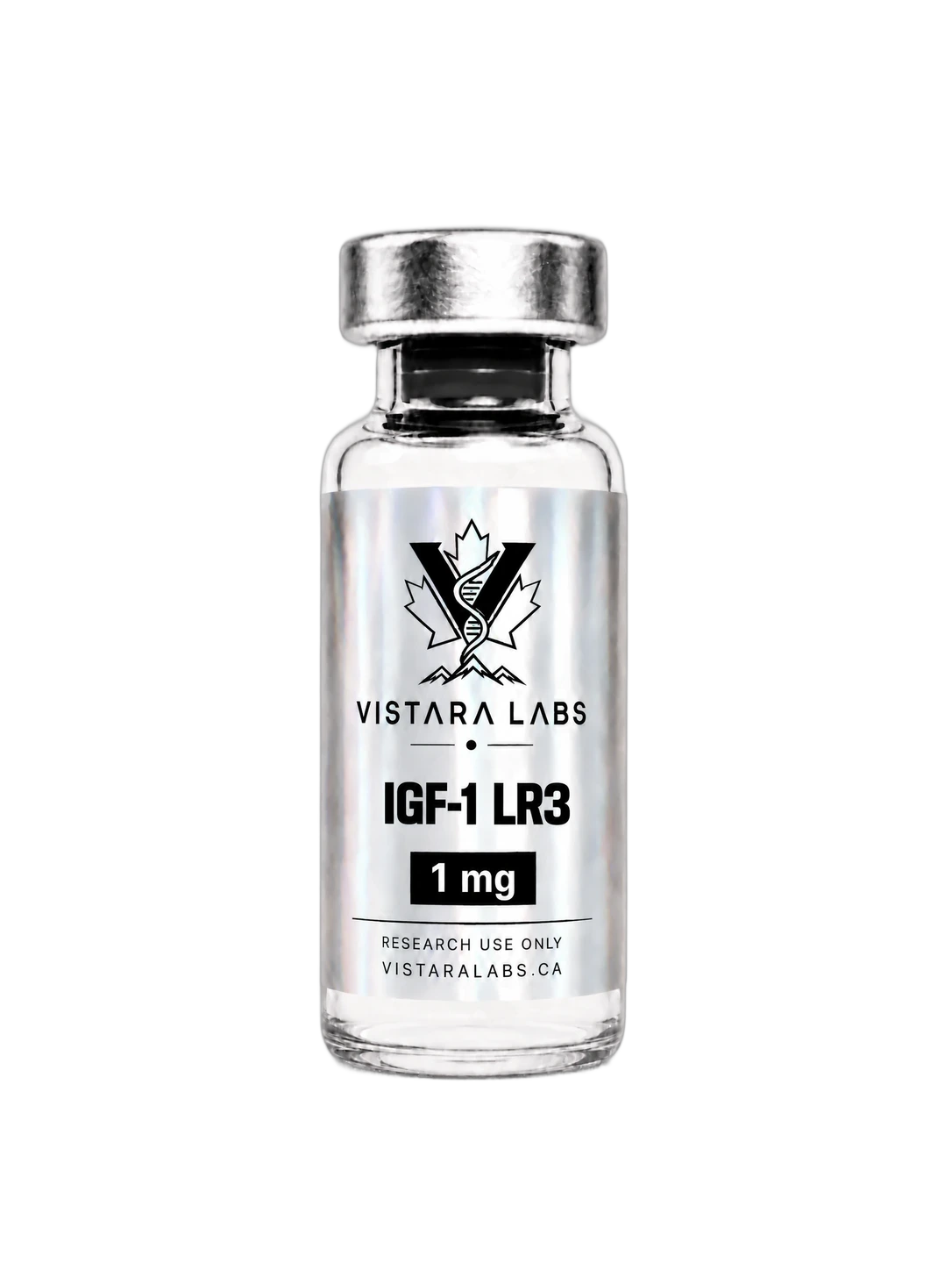
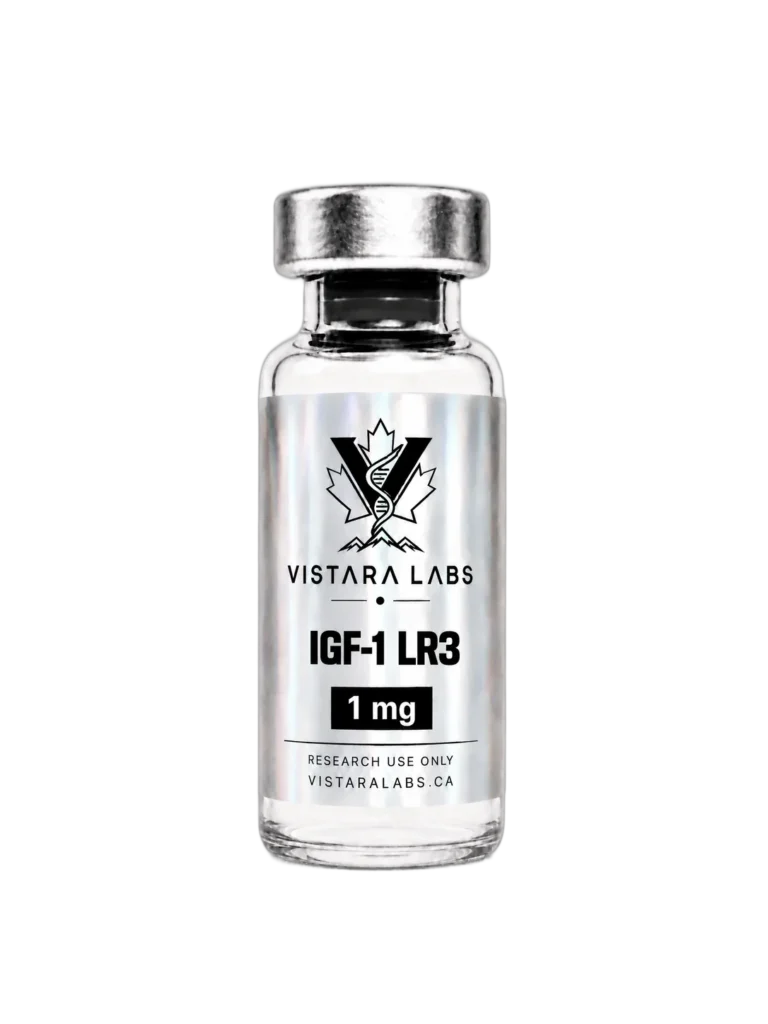
IGF-1 LR3 (Long R3 IGF-1) is an engineered version of the growth hormone IGF-1, 83 amino acids long, with two changes that let it escape the binding proteins that normally hold IGF-1 inactive in blood and tissue fluid. Glutamic acid at position 3 is replaced by arginine (the “R3”), and a 13-amino-acid extension is added to the front of the chain (the “Long”). It was developed at the CSIRO and the University of Adelaide in 1992, where it proved several times more potent than natural IGF-1 in cell and animal studies, and it remains a standard growth factor in cell culture. Vistara Labs supplies it as an IGF-1 LR3 1 mg lyophilised vial.
Findings
- Natural IGF-1 is 70 amino acids long, and more than 80% of it in blood is held in a complex with IGF-binding protein 3 and the acid-labile subunit (FDA label).
- IGF-I binds IGF-binding proteins about 1,000-fold more strongly than LR3 IGF-I, which gave LR3 a 5-10-fold potency advantage in cultured muscle cells (1993).
- LR3 IGF-I binds the IGF-1 receptor about 3-fold less strongly than IGF-I, yet was about 2.5-fold more potent in a catabolic rat model (1992).
- In rats, most LR3 IGF-I circulated as free peptide, and more of it reached the gut: 37-50% more per gram of intestinal tissue than IGF-I (2003).
- In pigs, LR3 and related analogues were 2-3 times more potent than IGF-I at lowering blood glucose, and the effect lasted longer (1997).
 View product →
What is IGF-1 LR3 and where did it come from?
IGF-1, the parent hormone
Insulin-like growth factor 1 is a single chain of 70 amino acids held in shape by three disulfide bridges. Growth hormone from the pituitary acts on the liver and other tissues to make IGF-1, and IGF-1 then acts through its own receptor, the type 1 IGF receptor, a close relative of the insulin receptor, to drive cell growth, bone lengthening and uptake of glucose and amino acids. Recombinant human IGF-1, mecasermin, is an approved medicine in the United States for children with severe primary IGF-1 deficiency (FDA, Increlex prescribing information).
Most IGF-1 in the body is not free. Six IGF-binding proteins (IGFBPs) attach to it, and more than 80% of circulating IGF-1 sits in a large complex with IGFBP-3 and the acid-labile subunit. That complex keeps IGF-1 in the bloodstream and controls how much reaches cells.
The clue from des(1-3)IGF-I
The Adelaide group’s route to LR3 started with a natural variant, found through bioassays in cultured muscle cells (Ballard, J Nutr, 1994). Des(1-3)IGF-I, which lacks the first three amino acids of IGF-1, had been isolated from bovine colostrum, human brain and porcine uterus, and it was about 10-fold more potent than IGF-I at stimulating cultured cells. The reason was the missing glutamic acid at position 3: without it, binding to IGFBPs dropped sharply (Ballard et al., Int J Biochem Cell Biol, 1996).
Building Long R3
The team produced IGF-1 in bacteria as a fusion protein and made versions with glycine or arginine at position 3. Both were more potent than IGF-I in rat L6 myoblasts and bound IGF-binding protein 2 very weakly, while binding the receptor only slightly less well, so the authors concluded that reduced IGFBP binding, not stronger receptor binding, explained the gain (King et al., J Mol Endocrinol, 1992). The team then used a shorter N-terminal extension, the first 11 amino acids of porcine growth hormone plus a Val-Asn linker, and left it in place on the finished molecule. It helped the protein fold correctly, and Long [Arg3]-IGF-I ranked among the most potent analogues in cells that secrete IGFBPs (Francis et al., J Mol Endocrinol, 1992).
How IGF-1 LR3 works
IGF-1 LR3 acts on the same type 1 IGF receptor as natural IGF-1. What changes is how much of it is free to get there. In direct comparisons, IGF-I had roughly 1,000-fold higher affinity than LR3 IGF-I for IGFBP-3, IGFBP-4 and total rat plasma binding proteins (Ballard et al., Growth Regul, 1993). LR3 IGF-I binds the receptor itself about 3-fold less well than IGF-I, so its extra potency comes entirely from escaping the binding proteins (Tomas et al., Biochem J, 1992).
Clearance and half-life
Because it is not held in the large binding-protein complex, LR3 IGF-I behaves differently in blood. In non-pregnant rats given a labelled dose, most LR3 IGF-I was found as free peptide, and its metabolic clearance rate was about 9.8 mL/min per kg against about 0.9 for IGF-I. When pregnancy lowered binding-protein levels, IGF-I clearance rose towards that of LR3 (Bastian et al., J Endocrinol, 1993). Faster clearance did not cancel the potency advantage: given by once-daily injection rather than infusion, LR3 remained more potent than IGF-I for several effects (Tomas et al., J Endocrinol, 1996). We found no published human pharmacokinetic study of IGF-1 LR3.
Tissue delivery
Free peptide leaves the bloodstream more easily. After an intravenous dose in rats, levels of labelled LR3 IGF-I per gram of gastrointestinal tissue were 37-50% higher than IGF-I, a ratio of about 2:1, in both young and adult animals (Shoubridge and Read, Endocrinology, 2003).
Insulin-like activity
IGF-1 shares part of insulin’s metabolic action. In pigs, analogues with weak IGFBP binding, LR3 among them, were 2-3 times more potent than IGF-I at lowering plasma glucose, and their cumulative glucose-lowering over four hours was about 4- to 8-fold greater. A related analogue showed the same pattern in marmoset monkeys (Tomas et al., J Endocrinol, 1997).
| Feature | IGF-1 | IGF-1 LR3 |
|---|---|---|
| Length | 70 amino acids | 83 amino acids |
| Position 3 | Glutamic acid | Arginine |
| IGFBP binding | Strong | About 1,000-fold weaker |
| In rat plasma | Mostly bound | Mostly free |
What the research has shown
The published work on IGF-1 LR3 to date is laboratory research. Its findings fall into three groups.
Whole-body growth and protein balance
Over 14 days in growing female rats, LR3 IGF-I was about 6-fold more potent than IGF-I for gains in body weight, nitrogen retention and food conversion efficiency (Ballard et al., 1993). In diabetic rats, it restored growth at 2.5-3 times the potency of IGF-I, and the IGF peptides raised muscle protein synthesis rates and RNA levels by up to 50% (Tomas et al., Biochem J, 1993).
The intestine
The gut proved especially responsive. Three days of LR3 IGF-I increased small and large intestine weight by about 20%, lengthened duodenal and ileal crypts by 13% and 22% and raised crypt cell numbers, changes not seen with IGF-I over the same period (Steeb et al., Gut, 1995). After removal of 70% of the small bowel, IGF-I peptides reduced malabsorption of fat and nitrogen, and LR3 was the more potent for weight gain (Lemmey et al., Growth Factors, 1994).
Skeletal muscle
In a mouse model of Duchenne muscular dystrophy, four weeks of continuous LR3 IGF-I reduced the force lost after lengthening contractions in limb muscles and the diaphragm, through a mechanism separate from the shift in muscle metabolism seen with IGF-I (Gehrig et al., Exp Physiol, 2008).
Outside animal research, LR3 is a cell-culture growth factor: in serum-free Chinese hamster ovary cultures it sustained viability better than insulin (Morris and Schmid, Biotechnol Prog, 2000).
Forms we stock
Vistara Labs supplies IGF-1 LR3 as a 1 mg lyophilised vial, third-party tested, with certificates on the lab reports page. Reconstitution arithmetic is on IGF-1 LR3 reconstitution, and ordering details are in Buy IGF-1 LR3 in Canada. For compounds that act further up the growth hormone axis, see Tesamorelin: One Small Change to a Natural Hormone and CJC-1295 vs Ipamorelin.
Frequently asked questions
What is IGF-1 LR3?
IGF-1 LR3 is an 83-amino-acid analogue of insulin-like growth factor 1, with arginine in place of glutamic acid at position 3 and a 13-amino-acid N-terminal extension. It was developed in Adelaide, Australia, in 1992.
What does LR3 stand for?
“L” stands for Long, after the N-terminal extension, and “R3” for the arginine (R in the one-letter amino acid code) at position 3.
How does IGF-1 LR3 work?
It acts on the type 1 IGF receptor like natural IGF-1, but binds IGF-binding proteins about 1,000-fold more weakly, so far more of it stays free to reach cells.
What did research show about the half-life of IGF-1 LR3?
In rats, most LR3 IGF-I circulated as free peptide and was cleared from plasma faster than IGF-I, yet it kept a potency advantage when given by once-daily injection. No published human pharmacokinetic study was found.
What has IGF-1 LR3 research shown?
In laboratory studies it was about 6-fold more potent than IGF-I for growth in rats, increased intestinal growth, restored growth in diabetic rats and protected dystrophic mouse muscle from contraction-induced damage.
Product details from vistaralabs.ca, October 2026. Sources: Increlex (mecasermin) prescribing information. DailyMed. King R, et al. J Mol Endocrinol. 1992. PMID 1311930. Francis GL, et al. J Mol Endocrinol. 1992. PMID 1378742. Tomas FM, et al. Biochem J. 1992. PMID 1371669. Ballard FJ, et al. Growth Regul. 1993. PMID 7683526. Bastian SE, et al. J Endocrinol. 1993. PMID 7693845. Tomas FM, et al. Biochem J. 1993. PMID 7683875. Lemmey AB, et al. Growth Factors. 1994. PMID 7803042. Steeb CB, et al. Gut. 1995. PMID 8549937. Ballard FJ. J Nutr. 1994. PMID 7520484. Ballard FJ, et al. Int J Biochem Cell Biol. 1996. PMID 8930132. Tomas FM, et al. J Endocrinol. 1996. PMID 8708565. Tomas FM, et al. J Endocrinol. 1997. PMID 9415072. Morris AE, Schmid J. Biotechnol Prog. 2000. PMID 11027158. Shoubridge CA, Read LC. Endocrinology. 2003. PMID 12697696. Gehrig SM, et al. Exp Physiol. 2008. PMID 18567600.
More on this: Buy IGF-1 LR3 in Canada: The 1 mg Long R3 IGF-1 Vial.
All products supplied by Vistara Labs are intended for laboratory research use only. They are not drugs, are not approved for human or veterinary use, and are not intended to diagnose, treat, cure or prevent any condition. Nothing on this page constitutes medical advice or guidance for use in humans.