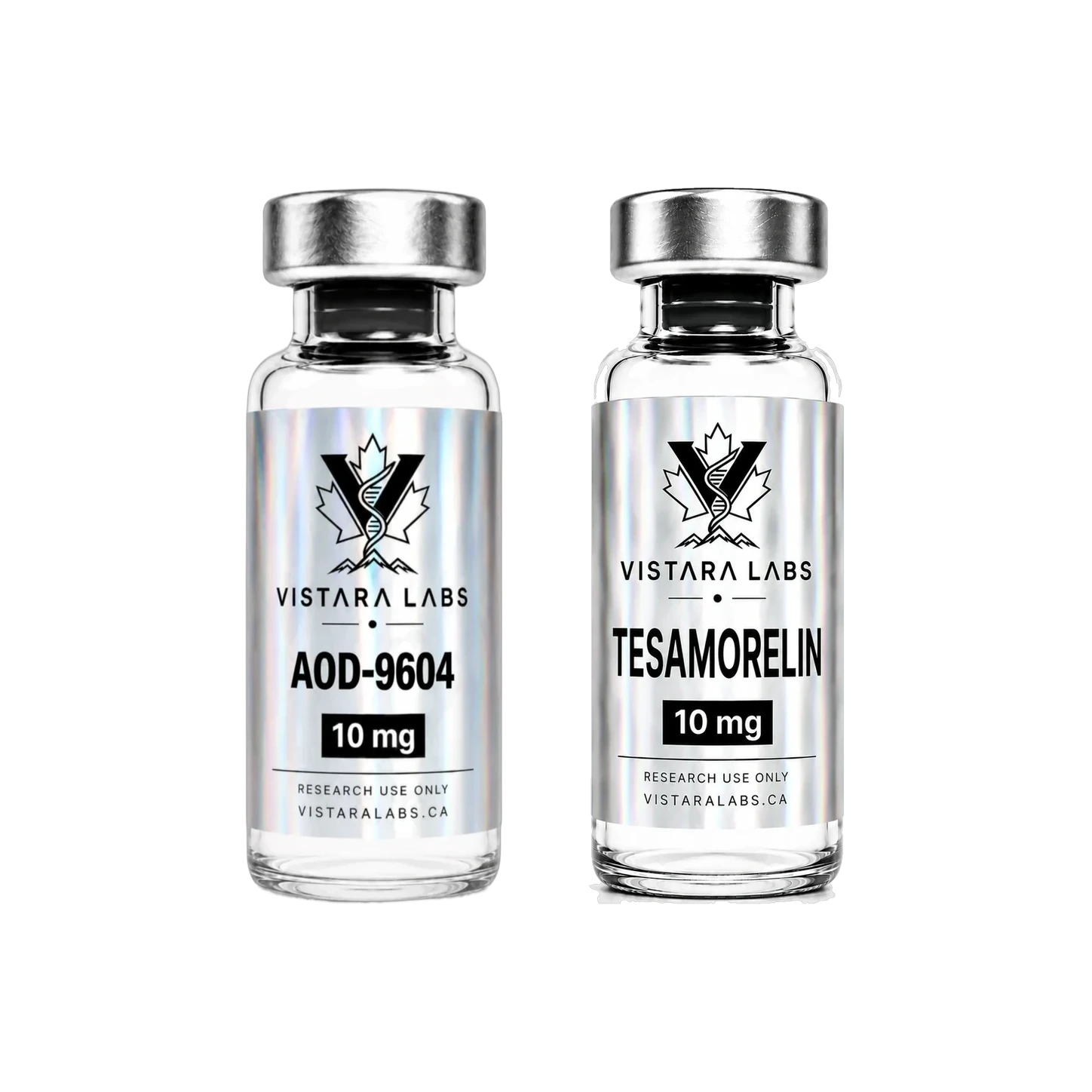
AOD-9604 vs Tesamorelin: Growth Hormone Fragment vs GHRH Analogue
AOD-9604 and tesamorelin both come out of growth hormone research and both were developed with body fat in mind, but they work at opposite ends of the growth hormone system. Tesamorelin works at the top: it is a GHRH analogue that prompts the pituitary to release the body’s own growth hormone, which then raises IGF-1. AOD-9604 works at the far end: it is a fragment of the growth hormone molecule itself, built to act on fat tissue without touching the growth hormone receptor or IGF-1. Here is how that difference shows up in the human research, and what each one is suited to study.
Findings
- Tesamorelin reduced visceral fat by 15.2% over 26 weeks in a 412-person trial in people with HIV, against a 5.0% increase on placebo, and was approved by the US FDA as Egrifta in 2010.
- Tesamorelin raised IGF-1 by 81% in that trial, the expected result for a compound that releases the body’s own growth hormone (2007).
- AOD-9604 left IGF-1 unchanged. Across six placebo-controlled trials in 893 adults it had no effect on serum IGF-1 and a safety profile indistinguishable from placebo (2013).
- AOD-9604 does not bind the growth hormone receptor, yet in preclinical studies it still increased lipolysis and fat oxidation (2001).
- In a 61-person trial, tesamorelin cut liver fat by 37% relative to baseline over 12 months (2019).
What is AOD-9604?
AOD-9604 is a synthetic 16-amino-acid peptide: residues 177–191 from the C-terminal end of human growth hormone, with a tyrosine added at the N-terminus to stabilise it (Stier et al., J Endocrinol Metab, 2013). It was developed at Monash University in Australia from the finding that this short end of the hormone carries much of its effect on fat tissue (Wu and Ng, Biochem Mol Biol Int, 1993).
In laboratory assays AOD-9604 did not compete for the growth hormone receptor and did not trigger cell proliferation through it. In a preclinical obesity model it still reduced weight gain, increased fat oxidation and raised plasma glycerol, a marker of fat breakdown, without causing high blood sugar (Heffernan et al., Int J Obes, 2001). Earlier, given by mouth for 19 days, it cut weight gain by more than half compared with controls, with no adverse effect on insulin sensitivity (Ng et al., Horm Res, 2000).
In people
Six randomised, double-blind, placebo-controlled trials ran between 2001 and 2006, with 893 adults, giving AOD-9604 intravenously or by mouth. The pooled analysis found no effect on serum IGF-1, no negative effect on glucose tolerance, no antibodies against the peptide and a safety and tolerability profile indistinguishable from placebo (Stier et al., J Endocrinol Metab, 2013). In a 12-week randomised trial, participants receiving AOD-9604 lost an average of 2.6 kg against 0.8 kg on placebo (Valentino et al., Clin Pharmacol Ther, 2010). The full research story is in What is AOD-9604?
What is tesamorelin?
Tesamorelin is a stabilised analogue of growth hormone releasing hormone (GHRH). It keeps the full 44-amino-acid GHRH sequence (Falutz et al., J Acquir Immune Defic Syndr, 2010) and adds a trans-3-hexenoyl group at the N-terminus, which protects it from the enzyme that breaks native GHRH down within minutes. It binds the GHRH receptor in the pituitary, so the growth hormone it produces is the body’s own, and IGF-1 rises in turn. Our tesamorelin research note covers the mechanism.
In people
In the first phase 3 trial, 412 people with HIV and excess abdominal fat were randomised to tesamorelin or placebo for 26 weeks. Visceral fat fell by 15.2% with tesamorelin and rose by 5.0% with placebo; triglycerides and the ratio of total to HDL cholesterol improved; and IGF-1 rose by 81.0%. Glycaemic measures did not differ between the groups (Falutz et al., N Engl J Med, 2007). A pooled analysis of the two phase 3 trials, 806 people in all, put the treatment effect on visceral fat at 15.4%, and in people who stayed on tesamorelin the reduction was maintained to 52 weeks, at 17.5% below baseline (Falutz et al., J Clin Endocrinol Metab, 2010).
The US FDA approved tesamorelin as Egrifta in November 2010 for excess abdominal fat in HIV-associated lipodystrophy. Research then turned to the liver: in a 12-month randomised trial of 61 people with HIV and fatty liver, tesamorelin reduced liver fat by 37% relative to baseline compared with placebo, and 35% of the tesamorelin group reached a liver fat fraction below 5%, against 4% on placebo (Stanley et al., Lancet HIV, 2019).
How do AOD-9604 and tesamorelin compare side by side?
| Question | AOD-9604 | Tesamorelin |
|---|---|---|
| What is it? | Fragment of growth hormone | Analogue of GHRH |
| Size | 16 amino acids | 44 amino acids |
| Where it acts | Fat tissue, downstream | GHRH receptor in the pituitary |
| Growth hormone release | None; it mimics one part of it | Raises the body’s own |
| IGF-1 in trials | No effect | Rose 81% (2007) |
| Routes in human trials | Intravenous and oral | Subcutaneous injection |
| Human evidence | Six trials, 893 adults | Phase 3 trials, 806 people |
| Regulatory history | US GRAS ingredient, 2014 | FDA-approved drug, 2010 |
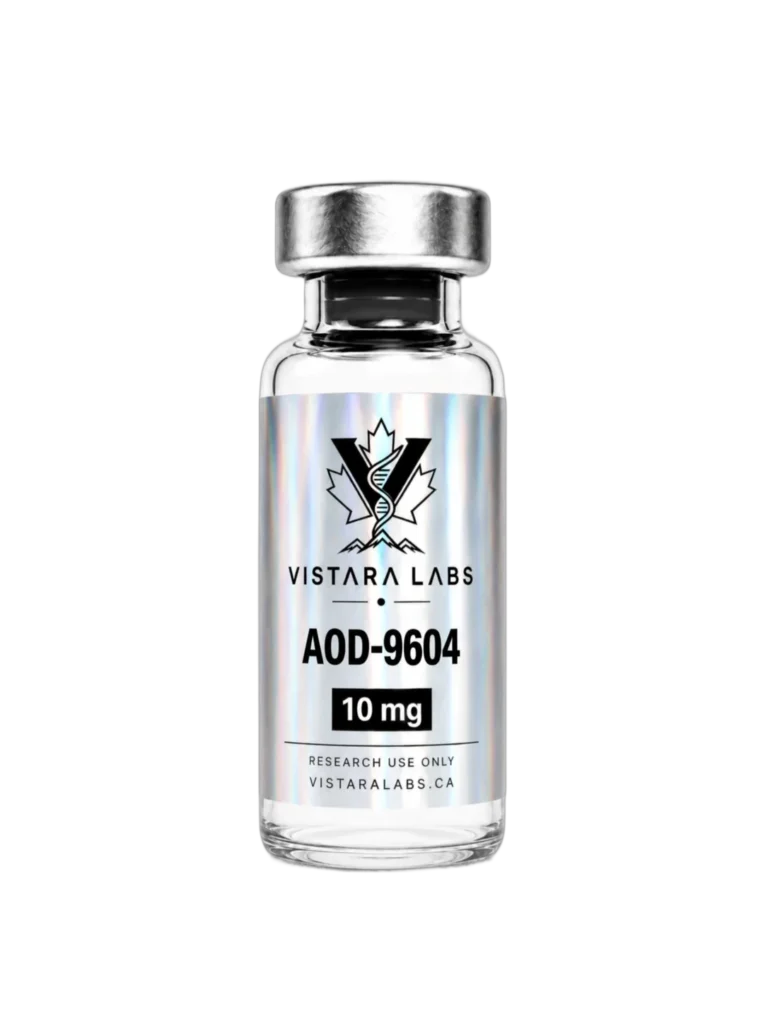
| Forms we supply | 10 mg vial | 10 mg vial |
Which one fits which research question?
- Fat-tissue signalling apart from growth hormone and IGF-1: AOD-9604. It reproduces the hormone’s lipolytic action without binding the growth hormone receptor, so any effect can be separated from IGF-1.
- The whole growth hormone axis: tesamorelin. It works through the pituitary, so it raises growth hormone and IGF-1 together, the way the body does.
- Visceral fat and liver fat in people: tesamorelin has the imaging-based phase 3 data and the 2019 liver fat trial.
- Joint and cartilage research: AOD-9604, which enhanced cartilage regeneration in a laboratory osteoarthritis model (Kwon and Park, Ann Clin Lab Sci, 2015).
Can AOD-9604 and tesamorelin be studied together?
They act at two different levels of the same system, so in study design they work as complementary probes: tesamorelin tests what happens when the body’s own growth hormone output rises, and AOD-9604 tests one downstream action of that hormone in isolation. Each one’s role here is drawn from its own literature; we found no published human trial that gave the two together. Related comparisons are in CJC-1295 and Ipamorelin vs Tesamorelin, Tesamorelin vs HGH and AOD-9604 vs HGH Fragment 176–191.
How are AOD-9604 and tesamorelin supplied?
Both come as 10 mg lyophilised vials, reconstituted with bacteriostatic water: see the AOD-9604 reconstitution guide and the tesamorelin reconstitution guide, or work out any volume with the peptide calculator. Certificates of analysis for our catalogue are on the lab reports page. Buying details are in Buy AOD-9604 and Buy Tesamorelin.
AOD-9604 and tesamorelin are supplied for laboratory research use only. The studies above were clinical research using pharmaceutical preparations.
Frequently asked questions
What is the difference between AOD-9604 and tesamorelin?
Tesamorelin is a GHRH analogue that acts on the pituitary, raising the body’s own growth hormone and IGF-1. AOD-9604 is a 16-amino-acid fragment of growth hormone itself, designed to act on fat tissue without binding the growth hormone receptor or raising IGF-1.
Does AOD-9604 raise IGF-1 like tesamorelin?
No. Across six placebo-controlled trials in 893 adults, AOD-9604 had no effect on serum IGF-1. Tesamorelin raised IGF-1 by 81% in its 2007 phase 3 trial, as expected for a compound that releases the body’s own growth hormone.
What did tesamorelin research show?
In 412 people with HIV and excess abdominal fat, tesamorelin reduced visceral fat by 15.2% over 26 weeks against a 5.0% rise on placebo, and improved triglycerides. In a 2019 trial it reduced liver fat by 37% relative to baseline.
What did AOD-9604 research show?
Six placebo-controlled trials in 893 adults gave a safety profile indistinguishable from placebo, with no effect on IGF-1 or glucose tolerance. In a 12-week trial, participants lost an average of 2.6 kg against 0.8 kg on placebo, and preclinical studies found increased lipolysis and fat oxidation.
How were AOD-9604 and tesamorelin given in the human studies?
AOD-9604 was given intravenously in two trials and by mouth, as capsules or tablets, in four. Tesamorelin was given by daily subcutaneous injection in its phase 3 trials.
Product details from vistaralabs.ca, October 2026. Sources: Wu Z, Ng FM. Antilipogenic action of synthetic C-terminal sequence 177-191 of human growth hormone. Biochem Mol Biol Int. 1993. PMID 8358331. Ng FM et al. Metabolic studies of a synthetic lipolytic domain (AOD9604) of human growth hormone. Horm Res. 2000. PMID 11146367. Heffernan MA et al. Int J Obes Relat Metab Disord. 2001. PMID 11673763. Falutz J et al. Metabolic effects of a growth hormone-releasing factor in patients with HIV. N Engl J Med. 2007. PMID 18057338. Falutz J et al. Effects of tesamorelin, a growth hormone-releasing factor, in HIV-infected patients with abdominal fat accumulation: a randomized placebo-controlled trial with a safety extension. J Acquir Immune Defic Syndr. 2010. PMID 20101189. Falutz J et al. Effects of tesamorelin (TH9507), a growth hormone-releasing factor analog, in HIV-infected patients with excess abdominal fat: a pooled analysis of two multicenter, double-blind placebo-controlled phase 3 trials with safety extension data. J Clin Endocrinol Metab. 2010. PMID 20554713. Valentino MA et al. Central and peripheral molecular targets for antiobesity pharmacotherapy. Clin Pharmacol Ther. 2010. PMID 20445536. Stier H, Vos E, Kenley D. Safety and tolerability of the hexadecapeptide AOD9604 in humans. J Endocrinol Metab. 2013. doi:10.4021/jem157w. Kwon DR, Park GY. Ann Clin Lab Sci. 2015. PMID 26275694. Stanley TL et al. Effects of tesamorelin on non-alcoholic fatty liver disease in HIV: a randomised, double-blind, multicentre trial. Lancet HIV. 2019. PMID 31611038.
More on this: What Is AOD-9604? The Human and Laboratory Research.
All products supplied by Vistara Labs are intended for laboratory research use only. They are not drugs, are not approved for human or veterinary use, and are not intended to diagnose, treat, cure or prevent any condition. Nothing on this page constitutes medical advice or guidance for use in humans.