AOD-9604 vs HGH Fragment 176–191: How the Two Peptides Relate
HGH Fragment 176–191 and AOD-9604 are two names for almost the same peptide: the last 16 amino acids of human growth hormone, differing at a single position. In the native hormone, position 176 is phenylalanine. AOD-9604 has a tyrosine there instead, which is why its developers describe it as Tyr-hGH 177–191: the hormone’s last fifteen residues with a tyrosine added at the front. Here is what that one-residue difference means, where the two names come from, and why catalogues so often use them interchangeably.
Findings
- Residues 176–191 of human growth hormone read FLRIVQCRSVEGSCGF; AOD-9604 reads YLRIVQCRSVEGSCGF. The only difference is the first residue, phenylalanine (F) in the hormone and tyrosine (Y) in AOD-9604.
- A synthetic copy of residues 177–191 showed antilipogenic activity identical to the intact hormone in 1993, the starting point for both peptides.
- The 177–191 peptide, developed as AOD-9401, increased lipolysis and reduced fat synthesis in human fat tissue studied in the laboratory (2000).
- The tyrosine version, AOD-9604, went on to six placebo-controlled human trials in 893 adults, with a safety profile indistinguishable from placebo and no effect on IGF-1 (2013).
- The names overlap even in the medical literature: a 2026 review lists the compound as “AOD9604 (hGH 176-191)”.
What is HGH Fragment 176–191?
Human growth hormone is a single chain of 191 amino acids. Numbered from the start of the mature hormone, positions 176 to 191 are its C-terminal tail, the last 16 residues: phenylalanine, then leucine, arginine, isoleucine, valine, glutamine, cysteine, arginine, serine, valine, glutamic acid, glycine, serine, cysteine, glycine and phenylalanine (UniProt P01241). The two cysteines in that stretch, at positions 182 and 189, are joined by a disulfide bond in the intact hormone.
Much of the fat-metabolism research on this tail came from Monash University in Australia. In 1993, a synthetic copy of residues 177–191 showed antilipogenic activity identical to that of the whole hormone, which suggested that the domain responsible for growth hormone’s effect on fat synthesis sits at the C-terminal end (Wu and Ng, Biochem Mol Biol Int, 1993). The group developed that 15-residue peptide as AOD-9401.
What AOD-9401 showed
In isolated fat tissue, AOD-9401 stimulated hormone-sensitive lipase, the enzyme that releases stored fat, and inhibited acetyl-CoA carboxylase, a key enzyme in fat synthesis, much as the intact hormone does. In a preclinical obesity model, 20 days of treatment reduced weight gain and shrank average fat cell diameter from 110 to 80 micrometres, without the insulin resistance or glucose intolerance seen with growth hormone (Ng et al., J Mol Endocrinol, 2000). Added to human adipose tissue in the laboratory, it increased lipolytic activity and decreased lipogenic activity, and given by mouth for 30 days in a preclinical obesity model it lowered weight gain without changing food intake (Heffernan et al., Am J Physiol Endocrinol Metab, 2000).
What is AOD-9604?
AOD-9604 is the next step in the same programme. It takes the 177–191 sequence of AOD-9401 and adds one tyrosine at the N-terminal end, giving a 16-residue peptide, a hexadecapeptide. The pooled safety report describes it as Tyr-hGH 177–191 with an additional tyrosine that stabilises the peptide (Stier et al., J Endocrinol Metab, 2013), and an anti-doping laboratory analysis gives the same structure (Cox et al., Drug Test Anal, 2015).
Laid next to the hormone’s own 176–191 tail, the added tyrosine sits exactly where the native phenylalanine would be. Tyrosine is phenylalanine with one hydroxyl group on its ring, so AOD-9604 is the native 176–191 sequence with a single conservative substitution, and it is 16 Da heavier: about 1815 Da against about 1799 Da for the unmodified tail.
What AOD-9604 showed
AOD-9604 is the version that reached people. Six randomised, double-blind, placebo-controlled trials ran from 2001 to 2006 in 893 adults, giving it intravenously or by mouth. It had no effect on serum IGF-1, no negative effect on glucose tolerance and no antibodies against it were detected, and its safety and tolerability profile was indistinguishable from placebo (Stier et al., J Endocrinol Metab, 2013). In a 12-week randomised trial, participants receiving AOD-9604 lost an average of 2.6 kg against 0.8 kg on placebo (Valentino et al., Clin Pharmacol Ther, 2010). In preclinical work it increased fat oxidation and lipolysis without competing for the growth hormone receptor (Heffernan et al., Int J Obes, 2001). The full story is in What is AOD-9604?
How do the related peptides compare?
| Peptide | Sequence | Research |
|---|---|---|
| hGH 177–191 (AOD-9401) | LRIVQCRSVEGSCGF, 15 residues | Laboratory studies, 1993 to 2000 |
| Native hGH 176–191 | FLRIVQCRSVEGSCGF, 16 residues | The hormone’s own C-terminal tail |
| AOD-9604 (Tyr-hGH 177–191) | YLRIVQCRSVEGSCGF, 16 residues | Six human trials, 2001 to 2006 |
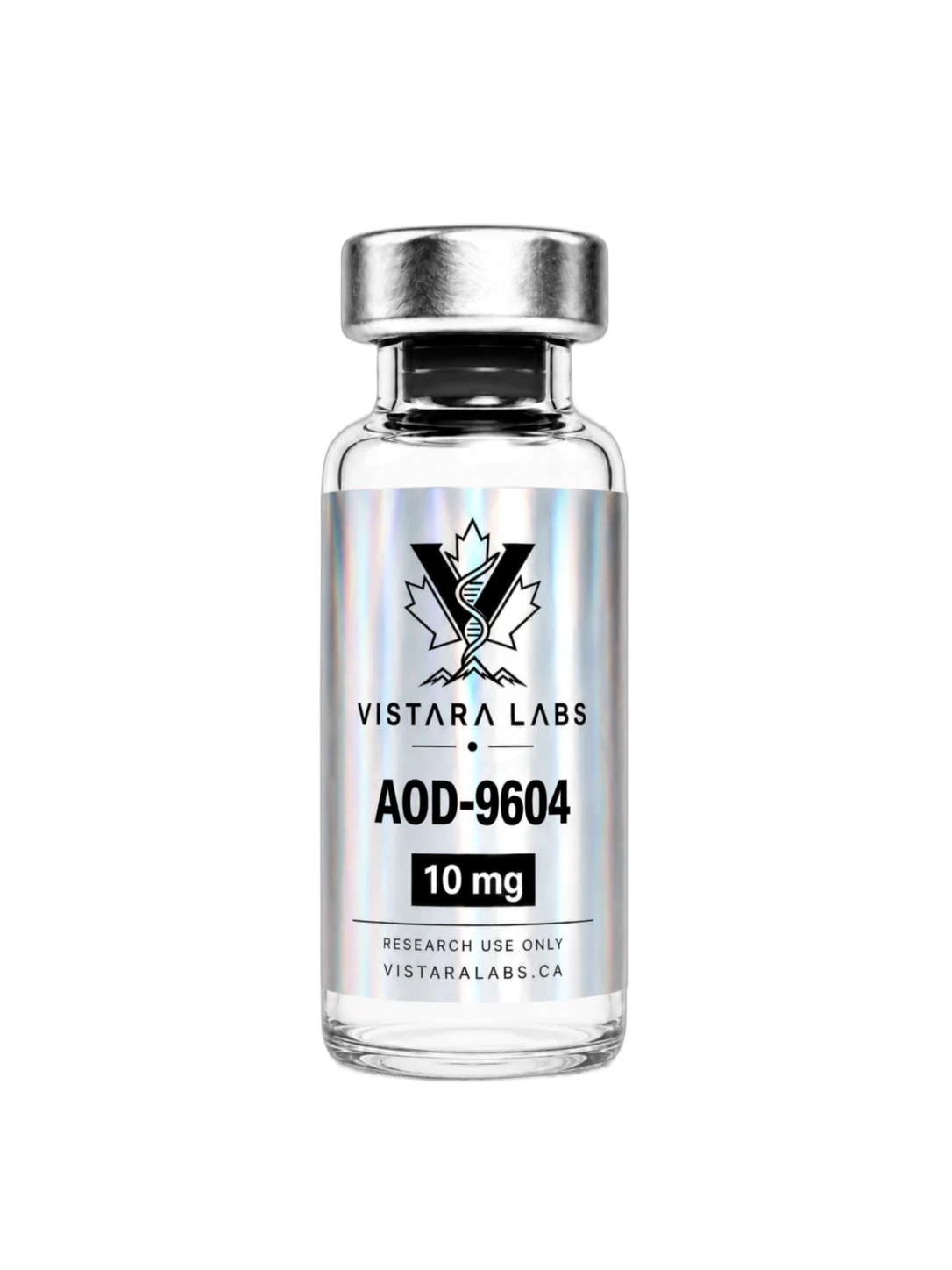
All three share residues 177–191. The tyrosine-led sequence in the last row is the one the human trials used and the one in our AOD-9604 10 mg vial.
Why the two names overlap
The confusion comes from counting. AOD-9604 spans 16 positions, the same 16 that make up the hormone’s 176–191 tail, so it is natural to label it by that range. Its developers counted differently, as a tyrosine plus residues 177–191. Both descriptions point at the same molecule, and “HGH Fragment 176–191”, “HGH Frag 176–191”, “Fragment 176–191”, “Tyr-hGH 177–191” and “AOD9604” are all used for it. The overlap reaches the medical literature too: a 2026 review in Frontiers in Endocrinology lists the compound as “AOD9604 (hGH 176-191)” (Dominikowski et al., 2026).
Listings sold under the 176–191 name do not all print the same sequence, so the sequence itself is the reliable identifier. A listing that starts with tyrosine (Y, Tyr) at about 1815 Da is the AOD-9604 structure; one that starts with phenylalanine (F, Phe) at about 1799 Da is the unmodified tail of the hormone.
Which name should a protocol use?
- To match the human literature: AOD-9604, or Tyr-hGH 177–191. Those are the names on the six clinical trials and the 2013 safety report.
- To match the early laboratory work: hGH 177–191 or AOD-9401, the 15-residue peptide studied from 1993 to 2000.
- When a supplier says 176–191: record the full sequence alongside the name, so the first residue is never in doubt.
How Vistara Labs supplies AOD-9604
We stock AOD-9604 as a 10 mg lyophilised vial with the tyrosine-led sequence used in the human trials, reconstituted with bacteriostatic water as set out in the AOD-9604 reconstitution guide. Certificates of analysis for our catalogue are on the lab reports page, and ordering details are in Buy AOD-9604. For a growth hormone compound that works at the pituitary instead, see AOD-9604 vs Tesamorelin.
AOD-9604 is supplied for laboratory research use only. The human studies above were clinical research using pharmaceutical preparations.
Frequently asked questions
Is HGH Fragment 176-191 the same as AOD-9604?
Nearly. Both are 16-residue peptides from the end of human growth hormone. The native 176-191 sequence starts with phenylalanine; AOD-9604 has tyrosine in that position. The tyrosine version is often sold under the 176-191 name.
What is the structural difference between AOD-9604 and hGH 176-191?
One residue. Native hGH 176-191 reads FLRIVQCRSVEGSCGF and AOD-9604 reads YLRIVQCRSVEGSCGF. Tyrosine carries one extra hydroxyl group, so AOD-9604 is 16 Da heavier, about 1815 Da.
What did research on the hGH 177-191 fragment show?
A synthetic 177-191 peptide had antilipogenic activity identical to the intact hormone (1993). Developed as AOD-9401, it stimulated hormone-sensitive lipase and increased lipolysis in fat tissue, including human fat tissue in the laboratory, without causing insulin resistance (2000).
What did the human AOD-9604 trials show?
Six randomised, double-blind, placebo-controlled trials in 893 adults gave a safety profile indistinguishable from placebo, with no effect on IGF-1 or glucose tolerance. In a 12-week trial, participants lost an average of 2.6 kg against 0.8 kg on placebo.
Why was a tyrosine added to make AOD-9604?
Its developers describe the additional N-terminal tyrosine as stabilising the peptide. It sits where the native hormone has phenylalanine, a closely related amino acid.
Product details from vistaralabs.ca, October 2026. Sources: UniProt P01241, Somatotropin (human growth hormone). uniprot.org. Wu Z, Ng FM. Antilipogenic action of synthetic C-terminal sequence 177-191 of human growth hormone. Biochem Mol Biol Int. 1993. PMID 8358331. Ng FM et al. Molecular and cellular actions of a structural domain of human growth hormone (AOD9401) on lipid metabolism. J Mol Endocrinol. 2000. PMID 11116208. Heffernan MA et al. Effects of oral administration of a synthetic fragment of human growth hormone on lipid metabolism. Am J Physiol Endocrinol Metab. 2000. PMID 10950816. Heffernan MA et al. Int J Obes Relat Metab Disord. 2001. PMID 11673763. Valentino MA et al. Central and peripheral molecular targets for antiobesity pharmacotherapy. Clin Pharmacol Ther. 2010. PMID 20445536. Stier H, Vos E, Kenley D. Safety and tolerability of the hexadecapeptide AOD9604 in humans. J Endocrinol Metab. 2013. doi:10.4021/jem157w. Cox HD et al. Detection and in vitro metabolism of AOD9604. Drug Test Anal. 2015. PMID 25208511. Dominikowski A et al. The emerging landscape of performance-enhancing peptides modulating GH-IGF1 axis. Front Endocrinol. 2026. PMID 42395176.
More on this: What Is AOD-9604? The Human and Laboratory Research.
All products supplied by Vistara Labs are intended for laboratory research use only. They are not drugs, are not approved for human or veterinary use, and are not intended to diagnose, treat, cure or prevent any condition. Nothing on this page constitutes medical advice or guidance for use in humans.