Dihexa vs Cerebrolysin: How They Differ
Dihexa and Cerebrolysin are both studied for neurotrophic, growth-factor-like support of the brain, but they sit at opposite ends of the chemistry. Cerebrolysin is a peptide preparation derived from animal brain tissue, a mixture with properties similar to the body’s own neurotrophic factors, tested in randomised placebo-controlled trials in stroke, dementia and brain injury. Dihexa is one small, defined molecule built from angiotensin IV and engineered to strengthen a single growth-factor system, hepatocyte growth factor (HGF) and its receptor c-Met, with laboratory research on new synapses and learning. Here is how they compare and what each one suits as a research tool.
Findings
- Cerebrolysin after stroke: in the randomised, double-blind CARS trial, Cerebrolysin showed a large superiority over placebo on arm and hand function at day 90, with safety comparable to placebo (2016).
- Cerebrolysin in Alzheimer’s disease: a meta-analysis of six randomised placebo-controlled trials found it better than placebo on global clinical change at 4 weeks and 6 months (2015).
- Dihexa and synapses: at picomolar concentrations Dihexa nearly tripled dendritic spine counts in cultured hippocampal neurons and was active when given by mouth in preclinical studies (2013).
- Dihexa and working memory: after repeated mild traumatic brain injury, Dihexa restored working memory to 81.5% correct against 67.1% with vehicle (2025).
What is Cerebrolysin?
Cerebrolysin is a parenterally administered, animal brain-derived peptide preparation with pharmacodynamic properties similar to those of the body’s own neurotrophic factors (Plosker and Gauthier, Drugs Aging, 2009). It is not one molecule: it is a mixture of low-molecular-weight peptides and amino acids, and its activity is attributed to the preparation as a whole. The clinical product, a solution given by infusion or injection, has been used for decades in stroke units across a number of countries in Europe and Asia.
The stroke trials
The Cerebrolysin and Recovery After Stroke (CARS) trial was randomised, double-blind and placebo-controlled, with treatment starting 24 to 72 hours after stroke alongside a standardised rehabilitation programme. On the Action Research Arm Test at day 90, Cerebrolysin showed a large superiority over placebo (Mann-Whitney estimator 0.71), with a small-to-medium advantage across 12 global outcome scales and a dropout rate of 3.8% (Muresanu et al., Stroke, 2016). Pooling CARS-1 and CARS-2, 442 patients in all, confirmed the arm-function advantage at day 90 and showed an early benefit on the NIH Stroke Scale at days 14 and 21 (Guekht et al., Neurol Sci, 2017).
Dementia and brain injury
A meta-analysis of six randomised, double-blind, placebo-controlled trials in mild-to-moderate Alzheimer’s disease found Cerebrolysin significantly better than placebo on cognitive function at 4 weeks and on global clinical change at both 4 weeks and 6 months, with safety comparable to placebo (Gauthier et al., Dement Geriatr Cogn Disord, 2015). In the CAPTAIN I trial after moderate-to-severe traumatic brain injury, Cerebrolysin showed significant advantages on attention and processing tests, including the Stroop and Color Trails tests, and a significant overall benefit in the per-protocol analysis (Poon et al., Neurol Sci, 2020). The trials are covered in Cerebrolysin: stroke and brain-injury research.
What is Dihexa?
Dihexa is N-hexanoic-Tyr-Ile-(6) aminohexanoic amide, a single synthetic molecule developed at Washington State University from angiotensin IV. Angiotensin IV peptides had long been linked to learning but broke down within minutes. Dihexa lasted about 335 minutes in serum against under 2 minutes for its parent compound, was active when given by mouth and concentrated in brain tissue relative to blood (McCoy et al., J Pharmacol Exp Ther, 2013).
Where Cerebrolysin offers broad neurotrophic-factor-like activity, Dihexa targets one system. Its developers describe it as a positive modulator of HGF and c-Met, which drives dendrite growth and synapse formation in the brain (Wright and Harding, J Alzheimers Dis, 2015), and stem-cell groups have used it in place of recombinant HGF (Siller et al., Stem Cell Reports, 2015).
The laboratory research
The published work on Dihexa itself to date is laboratory research. At 10-12 M it raised spine density in cultured hippocampal neurons from about 15 to about 41 per 50 micrometres of dendrite, and given by mouth it fully reversed a scopolamine-induced learning deficit and improved learning in an ageing model (McCoy et al., 2013). In an Alzheimer’s disease model it restored spatial learning, raised synaptophysin and neuron counts, and lowered IL-1β and TNF-α (Sun et al., Brain Sci, 2021). After repeated mild traumatic brain injury it rescued working memory, an effect a MET antagonist blocked (Martino et al., Neurotrauma Rep, 2025).
How do Dihexa and Cerebrolysin compare side by side?
| Question | Dihexa | Cerebrolysin |
|---|---|---|
| What is it? | One synthetic angiotensin IV analogue | Animal brain-derived peptide preparation |
| Composition | Defined structure, C27H44N4O5 | Mixture of small peptides |
| Mechanism focus | HGF and c-Met | Neurotrophic-factor-like activity |
| Main research area | Synapses, learning, brain injury | Stroke, dementia, brain injury |
| Human evidence | Laboratory research | Randomised placebo-controlled trials |
| Usual research route | Oral in preclinical work | Intravenous infusion |
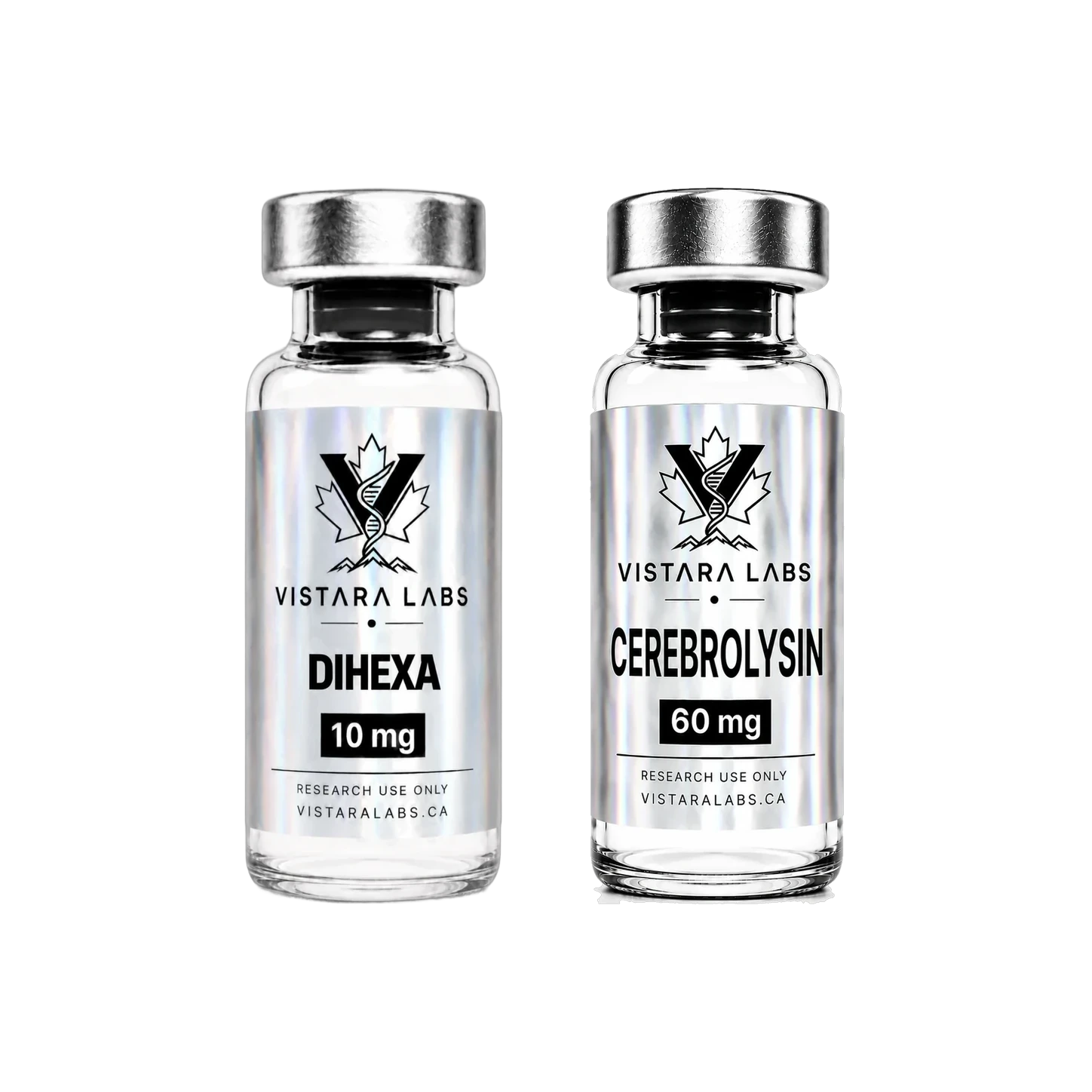
| Forms we supply | 10 mg vial | 60 mg vial |
Which one fits which research question?
- A single, known variable: Dihexa. Its structure is fixed, so a result can be traced to one molecule and one pathway.
- Synapse formation and the HGF/c-Met system: Dihexa, with spine counts, synaptic currents and a MET-antagonist test.
- Replicating the published clinical record: Cerebrolysin, which has the randomised placebo-controlled trials in stroke, dementia and brain injury.
- Broad neurotrophic support as a whole: Cerebrolysin, where the question is what the preparation does rather than any one peptide in it.
Can Dihexa and Cerebrolysin be studied together?
They approach neurotrophic support from different directions, one targeted and one broad, so in study design they are complementary rather than interchangeable. Each one’s role here is drawn from its own literature; we found no published study that gave the two together, so a combined design would use separate arms to tell their contributions apart. Cerebrolysin is also compared with Semax in Semax vs Cerebrolysin, and Dihexa with Semax in Dihexa vs Semax.
How are Dihexa and Cerebrolysin supplied?
Dihexa comes as a 10 mg lyophilised vial; it has limited solubility in plain water, and the concentration arithmetic is in the Dihexa reconstitution guide. Cerebrolysin comes as a 60 mg lyophilised vial, reconstituted with bacteriostatic water as set out in the Cerebrolysin reconstitution guide. Both sit alongside Semax and Selank in cognitive research, and Cerebrolysin is part of the Cognitive Axis Stack. Certificates of analysis are on the lab reports page, and every order ships from within Canada by Canada Post Xpresspost. Buying guides: Dihexa and Cerebrolysin.
Dihexa and Cerebrolysin are supplied for laboratory research use only. The Cerebrolysin trials above were clinical research using a pharmaceutical preparation; the Dihexa studies were laboratory research.
Frequently asked questions
What is the difference between Dihexa and Cerebrolysin?
Dihexa is one small synthetic molecule built from angiotensin IV and studied around hepatocyte growth factor and its receptor c-Met. Cerebrolysin is a animal brain-derived mixture of small peptides with neurotrophic-factor-like properties. Both are studied for brain recovery and cognition.
What has Cerebrolysin research shown in people?
In the CARS stroke trial, Cerebrolysin showed a large superiority over placebo on arm function at day 90 (2016), and a meta-analysis of six trials in Alzheimer’s disease found it better than placebo on global clinical change at 4 weeks and 6 months (2015).
What has Dihexa research shown?
In laboratory studies, Dihexa nearly tripled dendritic spine counts in cultured neurons, reversed a drug-induced learning deficit (2013), restored spatial learning in an Alzheimer’s disease model (2021) and rescued working memory after repeated mild brain injury (2025).
Is Dihexa a peptide like Cerebrolysin?
Dihexa is built on a two-amino-acid core, tyrosine and isoleucine, capped at both ends, so it is a small peptide analogue with one defined structure. Cerebrolysin is a preparation containing many peptides.
How does Vistara Labs supply Dihexa and Cerebrolysin?
Dihexa comes as a 10 mg lyophilised vial and Cerebrolysin as a 60 mg lyophilised vial. Both ship by Canada Post Xpresspost.
Product details from vistaralabs.ca, October 2026. Sources: Plosker GL, Gauthier S. Cerebrolysin: a review of its use in dementia. Drugs Aging. 2009. PMID 19848437. Muresanu DF et al. Cerebrolysin and Recovery After Stroke (CARS): a randomized, placebo-controlled, double-blind, multicenter trial. Stroke. 2016. PMID 26564102. Guekht A et al. Safety and efficacy of Cerebrolysin in motor function recovery after stroke: a meta-analysis of the CARS trials. Neurol Sci. 2017. PMID 28707130. Gauthier S et al. Cerebrolysin in mild-to-moderate Alzheimer’s disease: a meta-analysis of randomized controlled clinical trials. Dement Geriatr Cogn Disord. 2015. PMID 25832905. Poon W et al. Safety and efficacy of Cerebrolysin in acute brain injury and neurorecovery: CAPTAIN I, a randomized, placebo-controlled, double-blind, Asian-Pacific trial. Neurol Sci. 2020. PMID 31494820. McCoy AT et al. Evaluation of metabolically stabilized angiotensin IV analogs as procognitive/antidementia agents. J Pharmacol Exp Ther. 2013. PMID 23055539. Wright JW, Harding JW. The brain hepatocyte growth factor/c-Met receptor system: a new target for the treatment of Alzheimer’s disease. J Alzheimers Dis. 2015. PMID 25649658. Siller R et al. Small-molecule-driven hepatocyte differentiation of human pluripotent stem cells. Stem Cell Reports. 2015. PMID 25937370. Sun X et al. AngIV-analog Dihexa rescues cognitive impairment and recovers memory via the PI3K/AKT signaling pathway. Brain Sci. 2021. PMID 34827486. Martino KA et al. Hepatocyte growth factor/MET activator rescues working memory deficits after repeated mild traumatic brain injury. Neurotrauma Rep. 2025. PMID 42825082.
More on this: What Is Dihexa? The Angiotensin IV Analogue and What the Research Showed.
All products supplied by Vistara Labs are intended for laboratory research use only. They are not drugs, are not approved for human or veterinary use, and are not intended to diagnose, treat, cure or prevent any condition. Nothing on this page constitutes medical advice or guidance for use in humans.