Kisspeptin vs Oxytocin: How They Differ
Kisspeptin and oxytocin are both hypothalamic peptides tied to sex and bonding, but they sit at different points in the sequence: kisspeptin drives the reproductive hormones and shapes how the brain responds to sexual cues, while oxytocin is released during arousal and orgasm and is studied for trust, closeness and the after-sex experience. Kisspeptin works upstream through GnRH, LH and testosterone; oxytocin acts at its own receptor, with no direct effect on that hormone chain. Here is what the human research on each shows, and why the Libido Trifecta Spray Stack includes both.
Findings
- Kisspeptin enhanced limbic brain activity in 29 healthy men specifically in response to sexual and couple-bonding images, and reduced negative mood (2017).
- In 32 men with hypoactive sexual desire disorder, kisspeptin raised penile tumescence to sexual stimuli by up to 56% more than placebo and increased happiness about sex (2023).
- Plasma oxytocin rose during sexual arousal in 9 men and 13 women and was significantly higher at orgasm than at baseline (1987).
- In 29 couples, intranasal oxytocin increased the intensity of orgasm and contentment after sex, with women reporting feeling more relaxed (2014).
What is kisspeptin?
Kisspeptin is the product of the KiSS-1 gene, isolated from human placenta in 2001 as a 54-amino-acid peptide and the natural ligand of the receptor GPR54, also called KISS1R (Ohtaki et al., Nature, 2001). People with loss-of-function mutations in that receptor do not go through puberty (Seminara et al., N Engl J Med, 2003). Kisspeptin signals directly to GnRH neurons to control pulsatile GnRH release (Skorupskaite et al., Hum Reprod Update, 2014), and a 90-minute infusion raised LH, FSH and testosterone in men (Dhillo et al., J Clin Endocrinol Metab, 2005). We supply kisspeptin-10, the ten-amino-acid form, which raised LH in healthy men after an intravenous bolus (Jayasena et al., J Clin Endocrinol Metab, 2011).
The sexual-processing trials
The Imperial College London group showed that kisspeptin’s reach goes beyond hormones. In 29 healthy young men, kisspeptin enhanced limbic activity in response to sexual and couple-bonding stimuli, and the size of that enhancement tracked measures of reward, drive and mood (Comninos et al., J Clin Invest, 2017). In 32 premenopausal women with hypoactive sexual desire disorder, a 75-minute kisspeptin-54 infusion modulated sexual and facial-attraction brain processing (Thurston et al., JAMA Netw Open, 2022). In 32 men with the same diagnosis, it changed activity across the sexual-processing network and increased penile tumescence and happiness about sex (Mills et al., JAMA Netw Open, 2023). Those trials used kisspeptin-54 by intravenous infusion.
What is oxytocin?
Oxytocin is a nonapeptide, a chain of nine amino acids, best known for its roles in birth and lactation. It is made by magnocellular neurons in the hypothalamic paraventricular and supraoptic nuclei and released from the posterior pituitary, and it acts at a single identified receptor. Beyond reproduction it is implicated in social memory and attachment, sexual and maternal behaviour, and human bonding and trust (Lee et al., Prog Neurobiol, 2009). In a well-known 2005 experiment, intranasal oxytocin substantially increased trust between people in an investment game, without making them more willing to take non-social risks (Kosfeld et al., Nature, 2005).
Oxytocin and sex
Oxytocin is part of the sexual response itself. Measured continuously through arousal and orgasm in 9 men and 13 women, plasma oxytocin rose during arousal and was significantly higher at orgasm than at baseline (Carmichael et al., J Clin Endocrinol Metab, 1987). When 29 healthy couples received intranasal oxytocin in a naturalistic setting, it increased orgasm intensity, contentment after sex and men’s sexual satiety; women felt more relaxed and some found it easier to share sexual desires with their partner (Behnia et al., Horm Behav, 2014). It did not change drive, arousal, erection or lubrication in that study, and in a 2015 crossover trial of 30 women, sexual function improved with oxytocin and placebo alike (Muin et al., Fertil Steril, 2015). More is in Oxytocin nasal spray: what the human research shows.
How are kisspeptin and oxytocin linked?
The two systems connect in the hypothalamus. In rats, intravenous kisspeptin-10 transiently increased the firing of oxytocin neurons in the supraoptic nucleus, likely through the vagus nerve, and when given into the brain it excited those neurons in late pregnancy and lactation (Scott and Brown, Adv Exp Med Biol, 2013). In humans the link appears at the level of behaviour: kisspeptin’s strongest brain effects in the 2017 study were to couple-bonding images, the same theme much oxytocin research has focused on.
How do kisspeptin and oxytocin compare side by side?
| Question | Kisspeptin | Oxytocin |
|---|---|---|
| What is it? | Hypothalamic neuropeptide from the KiSS-1 gene | Hypothalamic nonapeptide released from the posterior pituitary |
| Size | 54 amino acids (kisspeptin-54) or 10 (kisspeptin-10) | Nine amino acids |
| Main research area | Puberty, reproductive hormones, sexual brain processing | Birth, lactation, bonding, trust, orgasm and after-sex experience |
| Mechanism | KISS1R on GnRH neurons, then LH, FSH, sex steroids | The oxytocin receptor; no direct effect on the gonadal axis |
| Human evidence | Hormone studies since 2005; crossover trials of 32 women (2022) and 32 men (2023) | Many intranasal studies, including 29 couples (2014) |
| Forms we supply | 10 mg vial; 10 mg nasal spray | 2 mg and 10 mg vials; nasal spray in 2 mg, 4 mg and 10 mg |
Which one fits which research question?
- Desire, sexual cue processing and the hormones behind them: kisspeptin.
- Bonding, trust, orgasm and the experience after sex: oxytocin.
- How the reproductive axis talks to the bonding system: both, building on the hypothalamic link in the animal work.
Can kisspeptin and oxytocin be studied together?
Yes. They act through different receptors and cover different phases, kisspeptin the hormonal and desire side, oxytocin the arousal-to-afterglow and bonding side, so each stays a distinguishable variable. That rationale comes from each peptide’s own literature; no published human trial has given the two together.
The Libido Trifecta Spray Stack combines the Kisspeptin Nasal Spray and the Oxytocin Nasal Spray with the PT-141 Nasal Spray. The Libido Spray Stack pairs oxytocin with PT-141 alone, compared in PT-141 vs Oxytocin.
How are kisspeptin and oxytocin supplied?
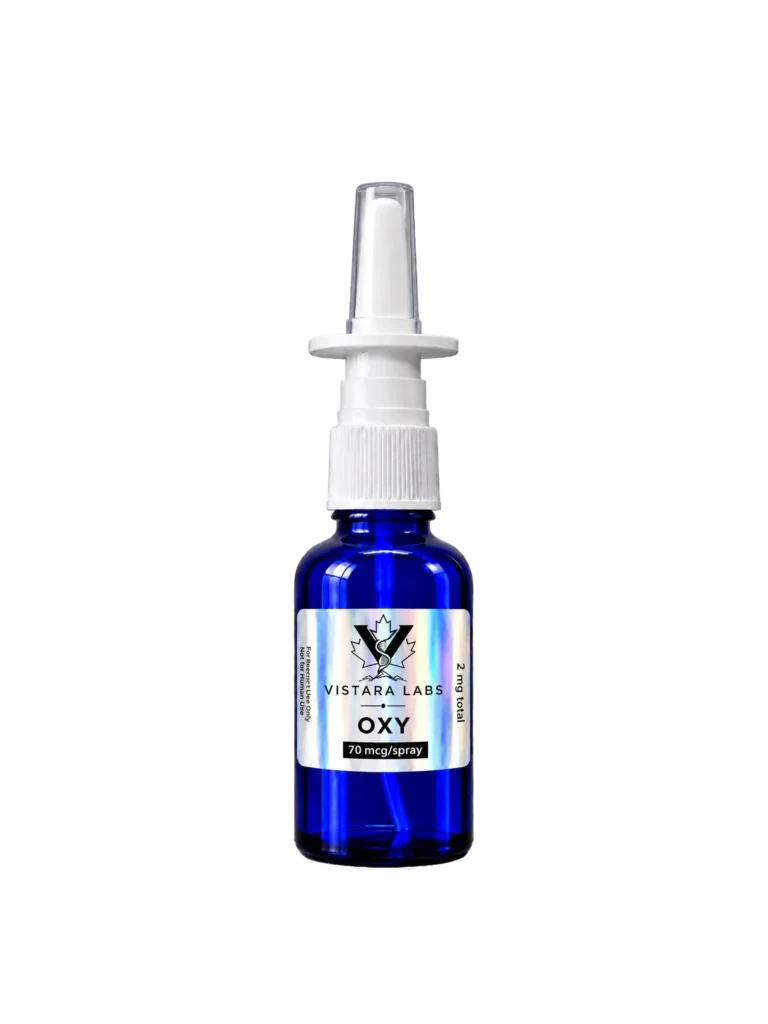
Kisspeptin comes as a 10 mg lyophilised vial and a 10 mg nasal spray. Oxytocin comes as 2 mg and 10 mg vials and as a nasal spray in three sizes. The sprays arrive ready-mixed in a sealed metered pump, 0.175 mL per press. Much of the human oxytocin research used intranasal administration; the human kisspeptin studies used intravenous or subcutaneous administration. The routes are compared in Oxytocin nasal spray vs injection. Vials are reconstituted with bacteriostatic water (see the oxytocin reconstitution guide). Buying details are in Buy Kisspeptin in Canada and Buy Oxytocin in Canada, and every order ships from within Canada.
Kisspeptin and oxytocin are supplied for laboratory research use only. The studies above were clinical research using pharmaceutical preparations.
Frequently asked questions
What is the difference between kisspeptin and oxytocin?
Kisspeptin drives GnRH and with it LH, FSH and testosterone, and changes how the brain processes sexual cues. Oxytocin is a nine-amino-acid peptide released during arousal and orgasm, studied for bonding, trust and the experience after sex. They act at different receptors.
Does kisspeptin release oxytocin?
In rats, intravenous kisspeptin-10 transiently increased the firing of oxytocin neurons, and central kisspeptin excited them in late pregnancy and lactation. A direct effect on oxytocin release has not been established in humans.
Which is better for libido research, kisspeptin or oxytocin?
They cover different parts of the sexual response. Kisspeptin trials measured brain responses to sexual cues, tumescence and desire in people with low desire. Oxytocin studies measured orgasm intensity, contentment and partner interaction in couples.
Can kisspeptin and oxytocin be studied together?
Yes. They act through separate receptors and different phases of the response, so each stays a distinguishable variable. The Libido Trifecta Spray Stack combines the kisspeptin, oxytocin and PT-141 nasal sprays.
Where can I buy kisspeptin and oxytocin in Canada?
Vistara Labs supplies both as lyophilised vials and ready-mixed nasal sprays, plus the Libido Trifecta Spray Stack, shipped from within Canada by Canada Post Xpresspost.
Product details from vistaralabs.ca, October 2026. Sources: Ohtaki T et al. Metastasis suppressor gene KiSS-1 encodes peptide ligand of a G-protein-coupled receptor. Nature. 2001. PMID 11385580. Seminara SB et al. The GPR54 gene as a regulator of puberty. N Engl J Med. 2003. PMID 14573733. Skorupskaite K et al. The kisspeptin-GnRH pathway in human reproductive health and disease. Hum Reprod Update. 2014. PMID 24615662. Dhillo WS et al. Kisspeptin-54 stimulates the hypothalamic-pituitary gonadal axis in human males. J Clin Endocrinol Metab. 2005. PMID 16174713. Jayasena CN et al. The effects of kisspeptin-10 on reproductive hormone release show sexual dimorphism in humans. J Clin Endocrinol Metab. 2011. PMID 21976724. Comninos AN et al. Kisspeptin modulates sexual and emotional brain processing in humans. J Clin Invest. 2017. PMID 28112678. Thurston L et al. Effects of kisspeptin administration in women with hypoactive sexual desire disorder: a randomized clinical trial. JAMA Netw Open. 2022. PMID 36287566. Mills EG et al. Effects of kisspeptin on sexual brain processing and penile tumescence in men with hypoactive sexual desire disorder: a randomized clinical trial. JAMA Netw Open. 2023. PMID 36735255. Lee HJ et al. Oxytocin: the great facilitator of life. Prog Neurobiol. 2009. PMID 19482229. Kosfeld M et al. Oxytocin increases trust in humans. Nature. 2005. PMID 15931222. Carmichael MS et al. Plasma oxytocin increases in the human sexual response. J Clin Endocrinol Metab. 1987. PMID 3782434. Behnia B et al. Differential effects of intranasal oxytocin on sexual experiences and partner interactions in couples. Horm Behav. 2014. PMID 24503174. Muin DA et al. Effect of long-term intranasal oxytocin on sexual dysfunction in premenopausal and postmenopausal women: a randomized trial. Fertil Steril. 2015. PMID 26151620. Scott V, Brown CH. Beyond the GnRH axis: kisspeptin regulation of the oxytocin system in pregnancy and lactation. Adv Exp Med Biol. 2013. PMID 23550008.
More on this: Oxytocin Nasal Spray: What the Human Research Shows.
All products supplied by Vistara Labs are intended for laboratory research use only. They are not drugs, are not approved for human or veterinary use, and are not intended to diagnose, treat, cure or prevent any condition. Nothing on this page constitutes medical advice or guidance for use in humans.