CJC-1295 + Ipamorelin Side Effects: What Research Reports
Hormonal, Growth Hormone & Body Composition Research
No published human trial has tested CJC-1295 and ipamorelin together, so the side-effect picture comes from each compound’s own studies. In two 2006 trials of CJC-1295 in 66 healthy adults, the most common effects were injection-site reactions, headache, loose stools and flushing, with no serious adverse reactions; in a 2014 trial of 114 surgical patients, adverse events were recorded in 87.5% on ipamorelin and 94.8% on placebo. This guide sets out what each study measured and recorded, how the published CJC-1295 differs from the version in CJC-1295 + Ipamorelin (No DAC) and the ready-mixed CJC-1295 + Ipamorelin Nasal Spray, and what remains unstudied.
Findings
- In the CJC-1295 trials, no serious adverse reactions were reported, and every event in the single-dose study was mild to moderate, with none needing medical treatment (Teichman et al., 2006).
- Injection-site reactions were the most frequent effect, seen in about 70% of single-dose participants and lasting up to several hours.
- The trials found no consistent changes in blood or urine tests, glucose, liver function or ECGs, and no significant antibody formation.
- Ipamorelin, given for up to seven days after bowel surgery, was well tolerated, with an adverse-event rate similar to placebo (Beck et al., 2014).
 View product →
What are CJC-1295 and ipamorelin?
Both act on the pituitary gland’s growth hormone (GH) output, through different doors. CJC-1295 is a synthetic analogue of growth hormone-releasing hormone (GHRH), the hypothalamic signal that tells the pituitary to release GH. Ipamorelin is a five-amino-acid peptide that activates the ghrelin receptor, the second main GH-release pathway; it was described in 1998 as the first GH secretagogue with a selectivity for GH release similar to GHRH itself (Raun et al., Eur J Endocrinol, 1998). How the two compare is covered in CJC-1295 vs Ipamorelin.
DAC and no DAC
The human CJC-1295 trials used the version with a drug affinity complex (DAC), a chemical linker that lets the peptide bind albumin in the blood. That gave it an estimated half-life of 5.8-8.1 days and raised GH for six days or more after one injection (Teichman et al., J Clin Endocrinol Metab, 2006). The CJC-1295 in our blend is the no-DAC form, which does not carry that albumin linker and has no published human trial of its own. The difference is explained in CJC-1295 With or Without DAC and CJC-1295 Half-Life.
What did the CJC-1295 trials report?
Two randomised, double-blind, placebo-controlled trials enrolled healthy adults aged 21-61: a single-dose study of 42 people and a repeat-dose study of 24, lasting 28 and 49 days. CJC-1295 raised GH 2- to 10-fold for six days or more and IGF-1 (the growth factor GH drives) 1.5- to 3-fold for 9-11 days. The authors concluded it was safe and relatively well tolerated, particularly at the lower amounts tested (Teichman et al., 2006).
Common effects
- Injection-site reactions: irritation, redness, firmness, pain or itching in about 70% of single-dose participants, usually lasting up to several hours. They were stronger at higher amounts, with residual firmness up to five days, and all resolved on their own. Small hive-like rashes at the site occurred in almost 30% and were not dose related.
- Headache: 63% of active single-dose participants, against 14% on placebo.
- Loose stools or diarrhoea: 43% in the single-dose study, mainly at the higher amounts.
- Flushing: warmth and flushing, sometimes with a brief drop in blood pressure, in 30%. In the repeat-dose study flushing began within 30 minutes of injection and cleared within 1-2 hours.
Severity and withdrawals
In the single-dose study, events were reported by 33 of 35 people on CJC-1295 and 2 of 7 on placebo; all were mild to moderate and none required medical intervention. Three participants withdrew early: two because of mild injection-site reactions and one after several mild effects. One person in the repeat-dose study reported mild involuntary leg-muscle contractions and some loss of coordination that resolved fully within 24 hours. The authors noted that none of the participants developed the fluid retention, joint pain or glucose intolerance associated with GH therapy (Teichman et al., 2006).
The halted 2006 trial
A phase 2 trial of CJC-1295 in people with HIV-associated abdominal fat was stopped in 2006 and posted no results (ClinicalTrials.gov NCT00267527).
What did the ipamorelin trials report?
The largest published ipamorelin study was a phase 2, double-blind, placebo-controlled trial in adults recovering from small or large bowel resection. Participants received intravenous ipamorelin or placebo twice daily from the first day after surgery for up to seven days. Of 117 enrolled, 114 formed the safety population. Treatment-emergent adverse events were recorded in 87.5% of the ipamorelin group and 94.8% of the placebo group, and the authors concluded ipamorelin was well tolerated (Beck et al., Int J Colorectal Dis, 2014). Earlier, a dose-escalation study in 40 healthy men showed each infusion produced a single GH pulse peaking at about 40 minutes, with an ipamorelin half-life of about 2 hours (Gobburu et al., Pharm Res, 1999); see Ipamorelin Half-Life.
What does research show about the combination and longer-term use?
The pairing rests on mechanism: a GHRH analogue and a ghrelin-receptor agonist act on GH release by separate routes. That rationale is covered in CJC-1295 + Ipamorelin: The Research, but no trial has reported side effects for the two given together. The longest CJC-1295 trial ran 49 days and the ipamorelin trial seven days. A 2018 review of GH secretagogues found them generally well tolerated, with some concern about rises in blood glucose through lower insulin sensitivity, and noted that few long-term controlled studies exist (Sigalos and Pastuszak, Sex Med Rev, 2018).
Why research-grade quality and storage matter
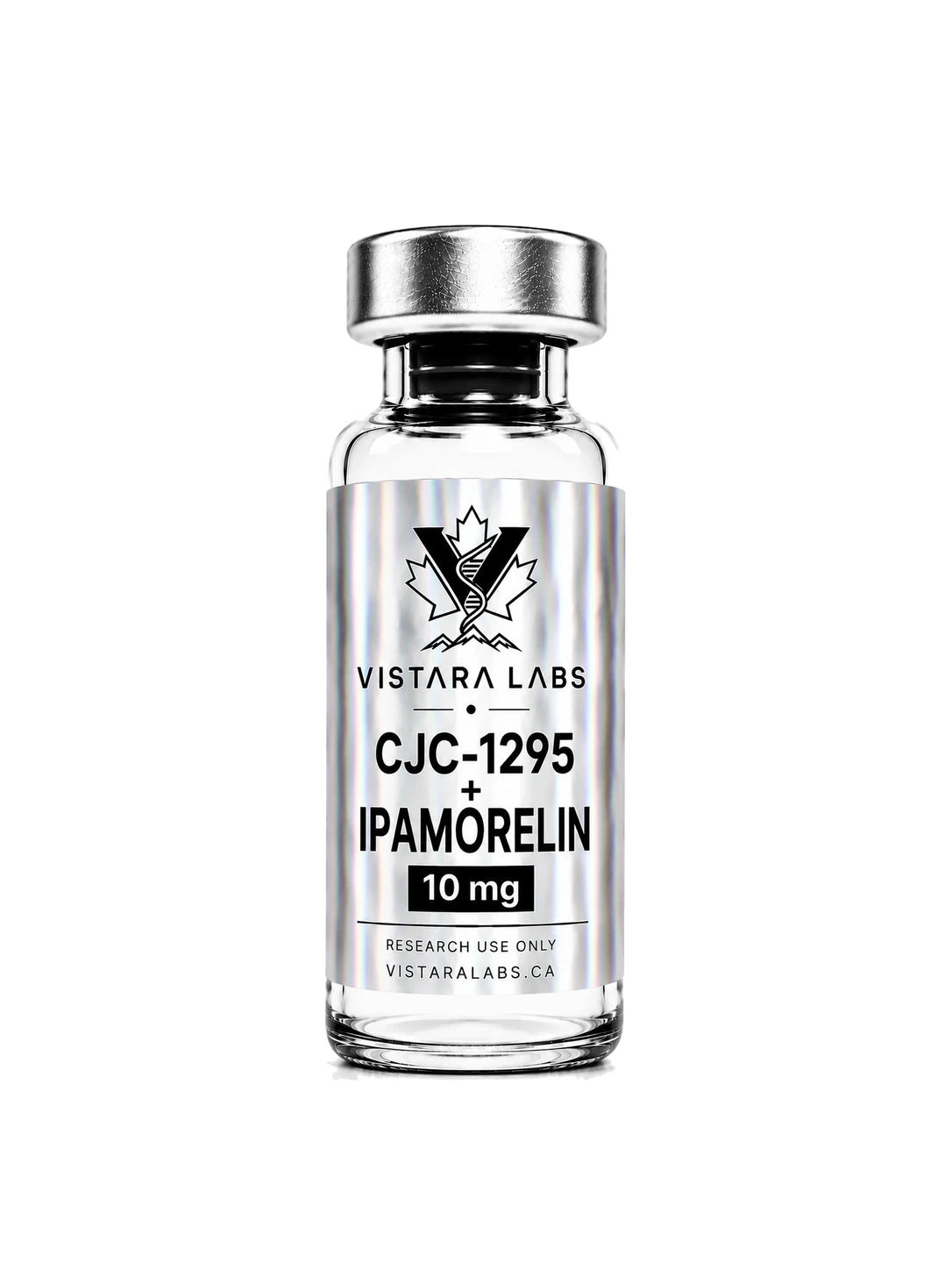
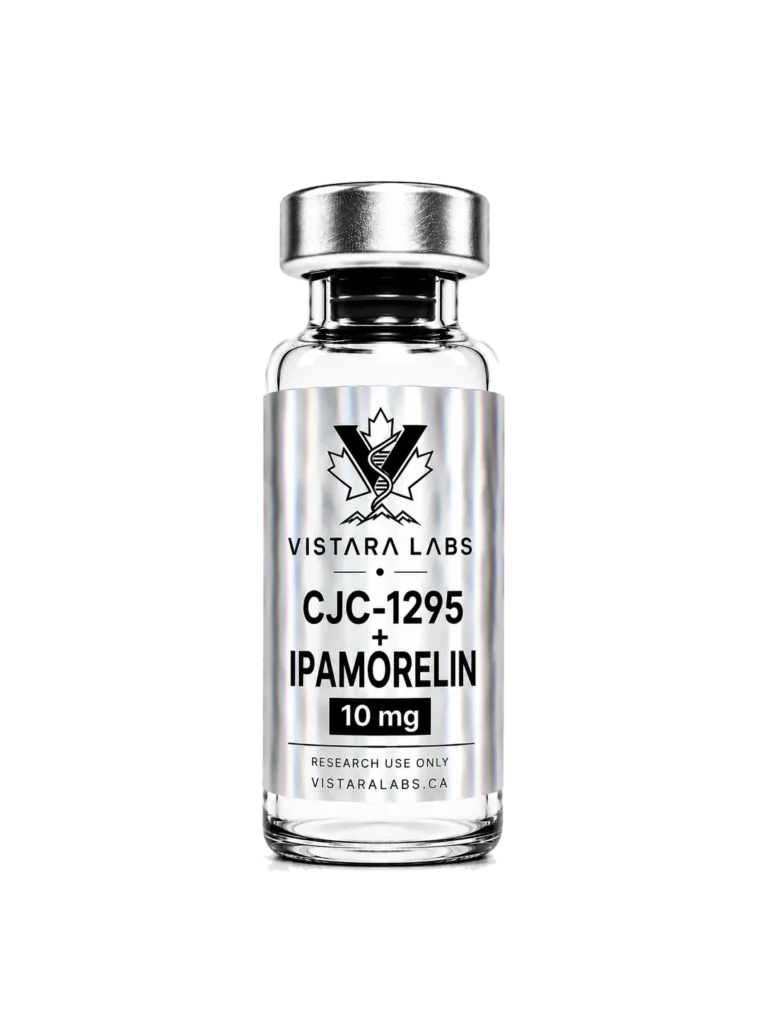
Because the published data come from pharmaceutical-grade material, verified identity and purity are what let laboratory results be read against that literature. Vistara Labs supplies CJC-1295 + Ipamorelin as a lyophilised vial and as a ready-mixed metered nasal spray. Every product is third-party tested, with certificates on the lab reports page. Mixing is covered in the reconstitution guide and stability in How Long Does CJC-1295 + Ipamorelin Last?
CJC-1295 + Ipamorelin is supplied by Vistara Labs for laboratory research use only. The human studies above were clinical research carried out under medical supervision.
Frequently asked questions
What side effects did the CJC-1295 trials report?
In two 2006 trials in 66 healthy adults, the most common effects were injection-site reactions (about 70% after a single dose), headache, loose stools and flushing. All single-dose events were mild to moderate and no serious adverse reactions were reported.
What did the ipamorelin trial show about side effects?
In a 2014 trial of 114 patients after bowel surgery, adverse events were recorded in 87.5% on ipamorelin and 94.8% on placebo, and ipamorelin was well tolerated for up to seven days.
Has CJC-1295 + ipamorelin been studied together in humans?
No published human trial has tested the combination. Its safety data come from separate studies of CJC-1295 with DAC and of ipamorelin.
Is the CJC-1295 in the trials the same as CJC-1295 no DAC?
No. The trials used CJC-1295 with DAC, which binds albumin and had a half-life of 5.8-8.1 days. The no-DAC form lacks that linker and has no published human trial of its own.
Where can I buy CJC-1295 + Ipamorelin in Canada?
Vistara Labs supplies CJC-1295 + Ipamorelin as a lyophilised vial and a ready-mixed nasal spray, third-party tested and shipped from within Canada by Canada Post Xpresspost.
Product details from vistaralabs.ca, October 2026. Sources: Teichman SL et al. Prolonged stimulation of growth hormone (GH) and insulin-like growth factor I secretion by CJC-1295, a long-acting analog of GH-releasing hormone, in healthy adults. J Clin Endocrinol Metab. 2006. PMID 16352683. Beck DE et al. Prospective, randomized, controlled, proof-of-concept study of the ghrelin mimetic ipamorelin for the management of postoperative ileus in bowel resection patients. Int J Colorectal Dis. 2014. PMID 25331030. Gobburu JV et al. Pharmacokinetic-pharmacodynamic modeling of ipamorelin in human volunteers. Pharm Res. 1999. PMID 10496658. Raun K et al. Ipamorelin, the first selective growth hormone secretagogue. Eur J Endocrinol. 1998. PMID 9849822. Sigalos JT, Pastuszak AW. The safety and efficacy of growth hormone secretagogues. Sex Med Rev. 2018. PMID 28400207. ClinicalTrials.gov. A study to evaluate CJC 1295 in HIV patients with visceral obesity. NCT00267527.
More on this: Buy CJC-1295 + Ipamorelin in Canada.
All products supplied by Vistara Labs are intended for laboratory research use only. They are not drugs, are not approved for human or veterinary use, and are not intended to diagnose, treat, cure or prevent any condition. Nothing on this page constitutes medical advice or guidance for use in humans.
References
The published human CJC-1295 trial used the long-acting DAC analogue, not the no-DAC form. Ipamorelin has its own human pharmacokinetic study. No trial of the two combined was identified.
- Prolonged stimulation of growth hormone (GH) and insulin-like growth factor I secretion by CJC-1295, a long-acting analog of GH-releasing hormone, in healthy adultsRandomised placebo-controlled trial in healthy adults — of the LONG-ACTING (DAC) CJC-1295 analogue, not the no-DAC form.
- Pharmacokinetic-pharmacodynamic modeling of ipamorelin, a growth hormone releasing peptide, in human volunteersHuman pharmacokinetic/pharmacodynamic study; five escalating infusion levels, eight healthy male subjects per level.
Links open the study record on PubMed so the source can be checked directly. Listing a study is not a claim that its findings apply to any other use, product or route of administration. Research use only.