TB-500 Half-Life: How Long It Stays Active
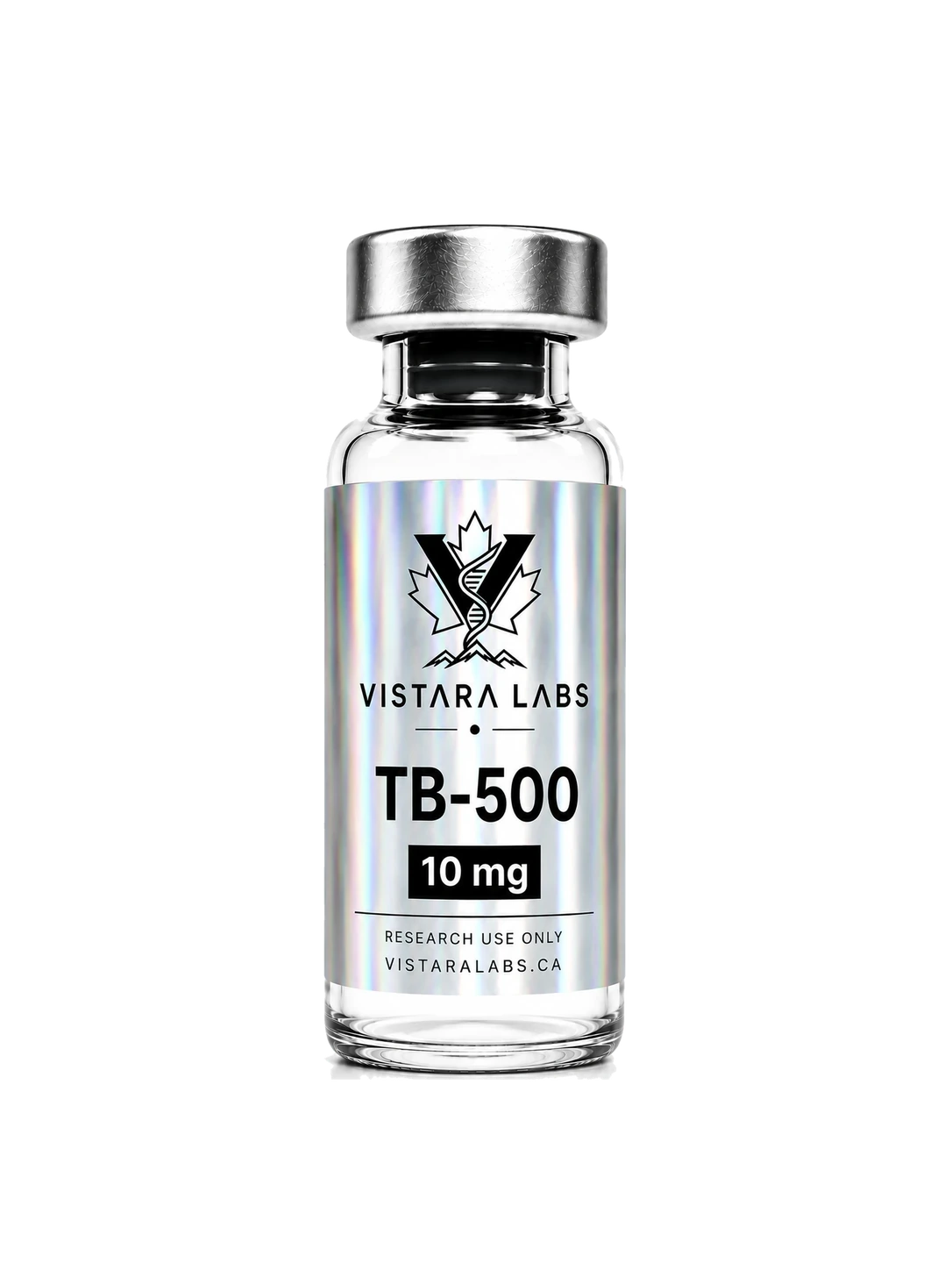
The published human half-life figures for TB-500 come from its parent protein, thymosin beta-4: given intravenously to healthy volunteers, it had a terminal half-life of 0.5 to 2.1 hours (Wang et al., J Cell Mol Med, 2021). TB-500 itself, the acetylated seven-amino-acid fragment of thymosin beta-4, has only animal data: anti-doping studies in horses tracked it and its breakdown products in plasma and urine, but no study has published a half-life figure for the fragment. This page sets out what each study measured, why these peptides clear quickly, and how body half-life differs from how long a vial or spray keeps. Vistara Labs supplies TB-500 as a 10 mg lyophilised vial, as a ready-mixed TB-500 Nasal Spray and in the BPC-157 + TB-500 blend.
Findings
- In a phase I trial of 54 healthy volunteers, intravenous thymosin beta-4 peaked within 3 to 15 minutes and had a terminal half-life of 0.5 to 2.1 hours, with no build-up over 10 days of daily administration (Wang et al., 2021).
- An earlier trial in 40 healthy volunteers found dose-proportional exposure and a half-life that lengthened at higher doses (Ruff et al., Ann N Y Acad Sci, 2010).
- In mice, synthetic thymosin beta-4 appeared in serum within 2 minutes of injection, stayed raised for about 40 minutes, and was removed rapidly by the kidneys (Mora et al., 1997).
- TB-500 (N-acetyl-LKKTETQ) and its metabolites, including N-acetylated Leu-Lys, were identified in horse plasma and urine after a single administration (Ho et al., 2012; Kwok et al., 2013).
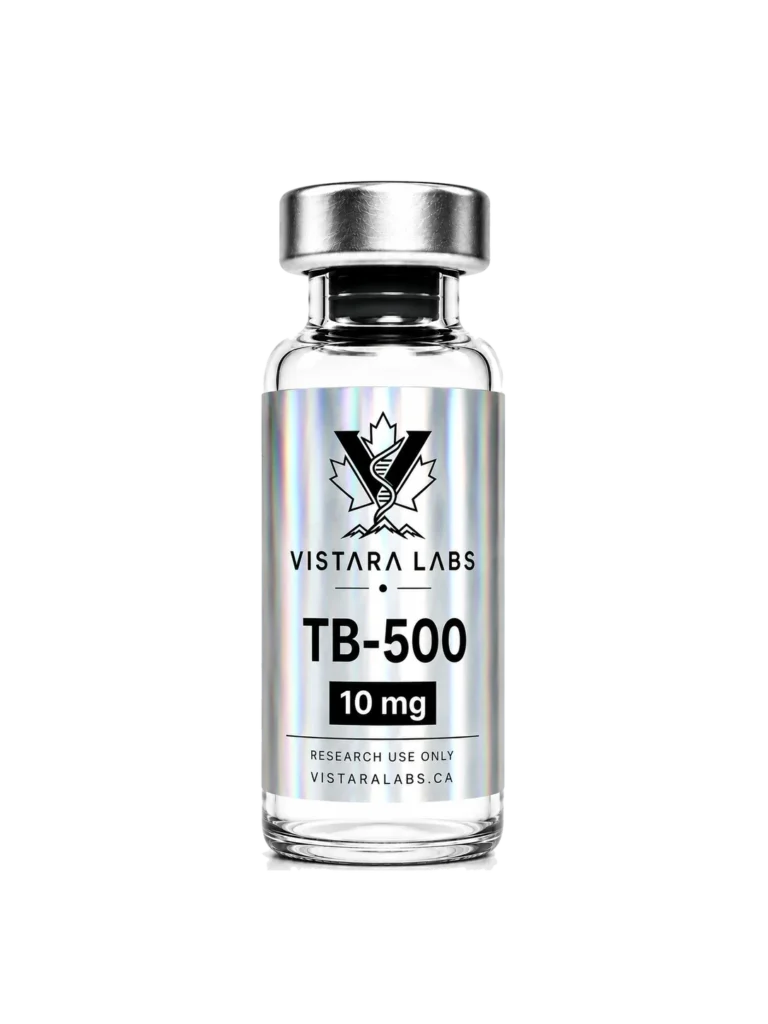 View product →
What does half-life mean?
Elimination half-life is the time it takes for the concentration of a compound in the blood to fall by half. After one half-life half remains, after two a quarter, after four about one-sixteenth. It measures how fast the body clears the molecule, not how long its effects last and not how long a product stays stable in storage. Repair research on thymosin beta-4 and TB-500 reads outcomes over days and weeks, a different timescale from plasma levels; that work is covered in TB-500 and Thymosin Beta-4: The Repair Research.
TB-500 and thymosin beta-4: two different molecules
Thymosin beta-4 is a 43-amino-acid protein found in almost every cell, where its main job is to hold actin, a structural protein, in its unassembled form (Mora et al., Int J Immunopharmacol, 1997). The stretch from amino acids 17 to 23, LKKTETQ, is the active site linked to actin binding, cell migration and wound healing. TB-500 is a synthetic copy of that seven-amino-acid segment with an acetyl group added to its starting end (Ho et al., J Chromatogr A, 2012). The full comparison is in TB-500 vs Thymosin Beta-4: Fragment or Full Protein? and the background in What Is TB-500?
Because the fragment is about one-sixth the size of the full protein, the human figures below describe the parent, not TB-500 itself. They are still the best published guide to the timescale involved.
What did the human thymosin beta-4 studies measure?
Phase I trial, 2021
A randomised, double-blind trial gave recombinant human thymosin beta-4 intravenously to healthy adults: 54 volunteers in single-dose cohorts across a wide range of amounts, and 30 in multiple-dose cohorts given it once a day for 10 days. Peak levels came 3 to 15 minutes after administration, and the terminal half-life ran from 0.5 hours at the lowest amount to 2.08 hours at the highest. Peak concentration and total exposure rose with dose, clearance was consistent across groups, and there was no obvious build-up with daily administration. Adverse events were mild to moderate, with no dose-limiting or serious events (Wang et al., J Cell Mol Med, 2021).
Synthetic thymosin beta-4, 2010
An earlier randomised, placebo-controlled trial gave synthetic thymosin beta-4 intravenously to four cohorts of 10 healthy volunteers, as single doses and then daily for 14 days. Exposure rose in proportion to dose and the half-life increased at higher doses; the peptide was well tolerated with no dose-limiting toxicity (Ruff et al., Ann N Y Acad Sci, 2010).
What do the animal studies show?
In mice given synthetic thymosin beta-4 into the abdominal cavity, serum levels rose from 2 minutes and stayed raised for about 40 minutes. Of the amount given, 83% was recovered by the end of the study: 44.6% in urine, 1.4% in serum and 37.5% in organs, with increases in the heart, brain, kidneys and liver. The authors concluded that the kidneys remove the peptide from circulation rapidly (Mora et al., 1997).
For the TB-500 fragment, the data come from equine anti-doping laboratories. A Hong Kong group developed a method that detected N-acetyl-LKKTETQ at 0.02 ng/mL in horse plasma and 0.01 ng/mL in urine, and confirmed the parent peptide and its metabolites in samples from horses given a single administration (Ho et al., 2012). A follow-up method identified N-acetylated Leu-Lys, a two-amino-acid breakdown product, in plasma after subcutaneous administration to two thoroughbreds (Kwok et al., Anal Bioanal Chem, 2013). These studies were built to prove prior use, so they report detection rather than a half-life.
Why do these peptides clear quickly?
Small peptides without a carrier-binding group are filtered by the kidneys and cut by enzymes called peptidases, and both routes show up in the data: urinary recovery dominated in mice, and the horse work found TB-500 being trimmed down to a two-amino-acid fragment. Nothing in either molecule is designed to bind albumin, the blood protein some modified peptides use to stay in circulation for days. A second factor affects measurement: thymosin beta-4 is naturally present in blood and tissues, so studies of the full protein measure a rise above a natural background.
How does TB-500 compare with related compounds?
| Compound | Published half-life | Species and route |
|---|---|---|
| Thymosin beta-4 | 0.5 to 2.1 h | Healthy humans (IV) |
| TB-500 fragment | None published | Horses (detection only) |
| BPC-157 | 15.2 min; 5.3 min | Rats; dogs (IV) |
BPC-157, the peptide most often studied alongside TB-500, is covered in BPC-157 Half-Life (He et al., Front Pharmacol, 2022). The rationale for pairing the two is set out in The Wolverine Stack: BPC-157 + TB-500.
What does this mean for study design?
- Early sampling. With peak levels at 3 to 15 minutes in humans and serum elevation lasting about 40 minutes in mice, most of the concentration curve sits in the first two hours.
- Sensitive, specific methods. Fragment work relies on liquid chromatography with mass spectrometry able to see sub-nanogram levels, and on tracking metabolites as well as the parent peptide.
- Background correction. For full-length thymosin beta-4, a pre-dose sample sets the natural baseline against which any rise is measured.
- Separate clocks. Repair endpoints are read over days and weeks, independently of plasma half-life.
The tolerability side of these studies is summarised in TB-500 Side Effects.
Half-life in the body vs how long a vial or spray keeps
Half-life describes what happens after a peptide enters a living system. How long a vial or spray stays usable is a question of chemical stability, which depends on temperature, light, moisture and whether a lyophilised (freeze-dried) powder has been mixed into solution. Those timelines are covered in How Long Does TB-500 Last? Storage Before and After Mixing. Vials are reconstituted with bacteriostatic water (see the TB-500 reconstitution guide); the nasal spray arrives ready-mixed in a sealed metered pump. Every product is third-party tested, with certificates on the lab reports page, and orders ship from within Canada by Canada Post Xpresspost.
TB-500 is supplied for laboratory research use only. The human figures above come from clinical studies of the full thymosin beta-4 protein.
Frequently asked questions
What is the half-life of TB-500?
No half-life has been published for the TB-500 fragment itself. Its parent protein, thymosin beta-4, had a terminal half-life of 0.5 to 2.1 hours when given intravenously to healthy volunteers in a 2021 phase I trial.
Has TB-500 been studied in humans?
The human pharmacokinetic studies used full-length thymosin beta-4, in trials of 54 and 40 healthy volunteers. The TB-500 fragment has been tracked in horses, where it and its metabolites were detected in plasma and urine.
What did research show about how thymosin beta-4 is cleared?
In mice, synthetic thymosin beta-4 rose in serum within 2 minutes, stayed raised for about 40 minutes, and was removed rapidly by the kidneys, with 44.6% of the amount given recovered in urine.
What does TB-500 break down into?
Equine studies identified the parent peptide, N-acetyl-LKKTETQ, together with shorter metabolites, including N-acetylated Leu-Lys, in plasma and urine.
Is TB-500’s half-life the same as how long a vial lasts?
No. Half-life describes clearance from the body. How long a vial or nasal spray keeps depends on storage and whether the powder has been mixed, which is covered in the TB-500 storage guide.
Product details from vistaralabs.ca, October 2026. Sources: Wang X et al. A first-in-human, randomized, double-blind, single- and multiple-dose, phase I study of recombinant human thymosin beta4 in healthy Chinese volunteers. J Cell Mol Med. 2021. PMID 34346165. Ruff D et al. A randomized, placebo-controlled, single and multiple dose study of intravenous thymosin beta4 in healthy volunteers. Ann N Y Acad Sci. 2010. PMID 20536472. Mora CA et al. Biodistribution of synthetic thymosin beta 4 in the serum, urine, and major organs of mice. Int J Immunopharmacol. 1997. PMID 9226473. Ho EN et al. Doping control analysis of TB-500, a synthetic version of an active region of thymosin beta4, in equine urine and plasma by liquid chromatography-mass spectrometry. J Chromatogr A. 2012. PMID 23084823. Kwok WH et al. Doping control analysis of seven bioactive peptides in horse plasma by liquid chromatography-mass spectrometry. Anal Bioanal Chem. 2013. PMID 23318763. He L et al. Pharmacokinetics, distribution, metabolism, and excretion of body-protective compound 157 in rats and dogs. Front Pharmacol. 2022. PMID 36588717.
More on this: BPC-157 vs TB-500: How They Differ.
All products supplied by Vistara Labs are intended for laboratory research use only. They are not drugs, are not approved for human or veterinary use, and are not intended to diagnose, treat, cure or prevent any condition. Nothing on this page constitutes medical advice or guidance for use in humans.
References
TB-500 and thymosin β4 are not the same molecule. TB-500 is a thymosin β4-derived fragment (Ac-LKKTETQ); the human trials below studied full-length thymosin β4 and are related research rather than trials of TB-500 itself.
- Synthesis and characterization of the N-terminal acetylated 17-23 fragment of thymosin beta 4 identified in TB-500, a product suspected to possess doping potentialAnalytical chemistry: characterises TB-500 as the N-terminally acetylated 17-23 fragment of thymosin β4 (Ac-LKKTETQ), not the intact 43-amino-acid protein.
- A first-in-human, randomized, double-blind, single- and multiple-dose, phase I study of recombinant human thymosin β4 in healthy Chinese volunteersFirst-in-human randomised, double-blind phase 1; 54 single-dose and 30 multiple-dose subjects; recombinant human thymosin β4.
- The effect of thymosin treatment of venous ulcersRandomised, double-blind, placebo-controlled phase 2 trial; 73 patients, eight European centres; topical full-length thymosin β4.
- Thymosin beta 4 ophthalmic solution for dry eye: a randomized, placebo-controlled, Phase II clinical trial conducted using the controlled adverse environment (CAE™) modelRandomised, double-masked, placebo-controlled phase 2 trial; 72 subjects; thymosin β4 ophthalmic solution.
- Thymosin β4 significantly improves signs and symptoms of severe dry eye in a phase 2 randomized trialRandomised phase 2 trial in severe dry eye; 9 patients.
Links open the study record on PubMed so the source can be checked directly. Listing a study is not a claim that its findings apply to any other use, product or route of administration. Research use only.