BPC-157 Half-Life: How Long It Stays Active
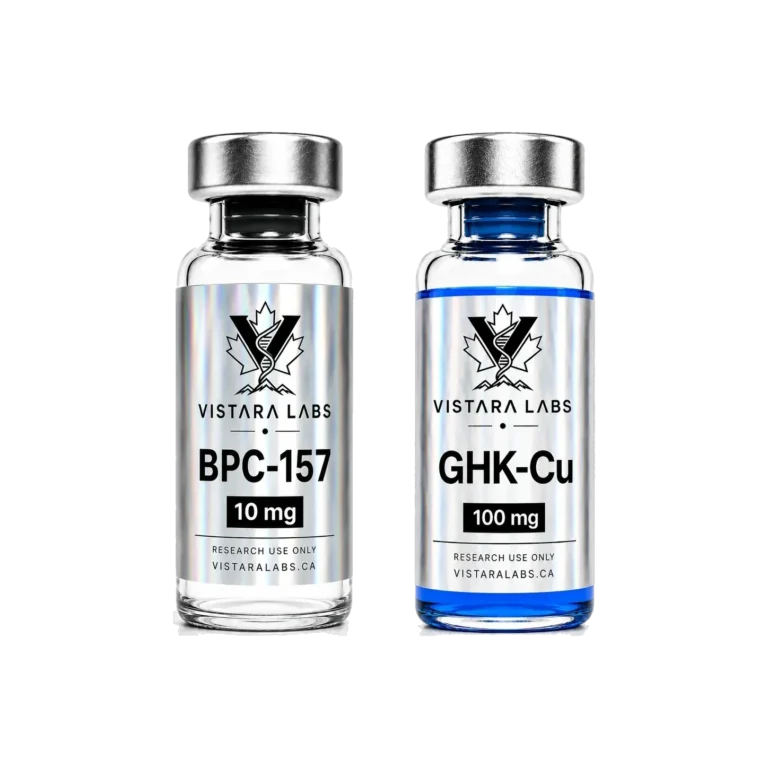
BPC-157 clears from the blood with a half-life of under 30 minutes: a two-person intravenous pilot in adults, summarised in a 2026 review, reported a plasma half-life under 30 minutes, and the formal pharmacokinetic study in animals measured 15.2 minutes in rats and 5.3 minutes in beagle dogs after intravenous injection (He et al., Front Pharmacol, 2022). No exact human figure has been published, so the detailed numbers come from animals, and this page says so where it matters. It sets out the published figures, why the peptide clears so quickly, and how body half-life differs from how long a vial or spray keeps. Vistara Labs supplies BPC-157 as a 10 mg lyophilised vial, as a ready-mixed BPC-157 Nasal Spray and in the BPC-157 + TB-500 blend.
Findings
- After intravenous injection, BPC-157’s elimination half-life was 15.2 minutes in rats and 5.3 minutes in beagle dogs (He et al., 2022).
- After intramuscular injection it peaked within minutes and had a half-life of 7.9 to 29.7 minutes in rats and 20.0 to 29.3 minutes in dogs, with exposure rising in proportion to the amount given.
- The intact peptide was no longer detectable in plasma 4 hours after administration in either species.
- Radio-labelled BPC-157 was broken down into small peptide fragments and then single amino acids that joined normal amino acid metabolism, with urine and bile the main exit routes.
- The only human data, a two-person intravenous pilot, showed a plasma half-life under 30 minutes and levels back to baseline within 24 hours, consistent with the animal work (Mateescu et al., 2026).
- The same 2026 review notes that BPC-157’s biological effects in preclinical work last hours to days, well beyond its plasma half-life (Mateescu et al., Pharmaceutics).
 View product →
What does half-life mean?
A compound’s elimination half-life is the time it takes for its concentration in the blood to fall by half. After one half-life, half remains; after two, a quarter; after four, about one-sixteenth. It describes how fast the body clears the molecule itself, not how long its effects last and not how long a product stays stable on the shelf.
For BPC-157 the distinction matters more than usual, because the peptide clears in minutes while the tissue changes researchers measure, such as tendon, gut lining or blood-vessel repair, unfold over days and weeks. The research behind those outcomes is covered in BPC-157 Research and the Knee-Pain Data.
What did the pharmacokinetic study measure?
He and colleagues ran the first full ADME study of BPC-157 (absorption, distribution, metabolism and excretion) to support a clinical programme. They gave the peptide intravenously once, intramuscularly at three increasing amounts, and intramuscularly once a day for seven days, in both rats and beagle dogs (He et al., Front Pharmacol, 2022).
- Intravenous: half-life 15.2 minutes in rats and 5.3 minutes in dogs.
- Intramuscular, single: peak concentration at 3 minutes in rats and 6 to 9 minutes in dogs; half-life 7.9, 17.1 and 29.7 minutes in rats and 20.0, 25.5 and 29.3 minutes in dogs across the three amounts tested.
- Intramuscular, repeated for seven days: half-life 18.5 minutes in rats and 19.6 minutes in dogs, with no meaningful build-up.
- Linearity: exposure rose in step with the amount given in both species, which means the clearance pathways were not saturated across the range tested.
Why one figure reads 102 hours
The same study also tracked tritium-labelled BPC-157. Measured by total radioactivity, the half-life in rat plasma was 102 hours. That figure does not describe the peptide. At one hour, most of the plasma radioactivity was free labelled proline, a single amino acid released as BPC-157 was dismantled, and that proline was then used by the body like any other. The authors read the long radioactivity half-life as evidence of extensive metabolism, not of the intact peptide lingering (He et al., 2022).
Why is BPC-157’s half-life so short?
BPC-157 is a fifteen-amino-acid peptide (a pentadecapeptide) derived from a protein fragment found in gastric juice. Small, unmodified peptides like this are cleared quickly for three reasons: enzymes called peptidases cut them into shorter pieces, the kidneys filter small molecules efficiently, and nothing in the structure is built to bind a carrier protein such as albumin that would hold it in circulation. The labelled study showed exactly that path, with six breakdown products identified in rat plasma alongside the parent peptide, and excretion mainly through urine, with bile second (He et al., 2022).
The peptide is notable in one respect: reviewers describe it as unusually stable in gastric juice and active by several routes, including by mouth, injection and topically, in preclinical work (Mateescu et al., Pharmaceutics, 2026). Stability in the stomach and fast clearance from blood are separate properties, and BPC-157 shows both. The same review describes the human data as a single two-person intravenous pilot (Lee and Burgess, Altern Ther Health Med, 2025), which it reports showed a plasma half-life under 30 minutes, levels back to baseline within 24 hours and clearance mainly through the kidneys. No exact human value has been published, and no human study has yet covered injection under the skin or nasal delivery, which is why the detailed figures on this page come from animals.
How does BPC-157 compare with related compounds?
| Compound | Published half-life | Species and route |
|---|---|---|
| BPC-157 | 15.2 min; 5.3 min | Rats; dogs (IV) |
| BPC-157 | 7.9 to 29.7 min | Rats (IM) |
| Thymosin beta-4 | 0.5 to 2.1 h | Healthy humans (IV) |
Thymosin beta-4 is the parent protein of TB-500, the peptide most often studied with BPC-157; its figures come from a 2021 phase I trial in healthy volunteers (Wang et al., J Cell Mol Med). The fragment itself is covered in TB-500 Half-Life, and the two peptides are compared in BPC-157 vs TB-500: How They Differ.
What does a short half-life mean for study design?
Three practical points follow from the published data:
- Sampling has to be early and dense. Peak levels arrived at 3 minutes in rats and within 9 minutes in dogs, and the parent peptide was gone from plasma by 4 hours, so blood draws clustered in the first hour capture most of the curve.
- Metabolites tell part of the story. Because BPC-157 is dismantled into fragments and amino acids, measuring only the intact peptide undercounts what the body handled, which is why the labelled study tracked total radioactivity as well.
- Outcomes run on a different clock. Tissue endpoints in the BPC-157 literature are read over days and weeks, and reviewers point to this gap between plasma half-life and effect duration as a central question for the field (Mateescu et al., 2026).
The safety side of the same studies is summarised in BPC-157 Side Effects: What the Research Reports.
Half-life in the body vs how long a vial or spray keeps
Half-life describes what happens after a molecule enters a living system. How long a vial or spray stays usable is a separate question about chemical stability, which depends on temperature, light, moisture and whether the powder has been mixed. A lyophilised (freeze-dried) vial and a reconstituted solution keep for very different lengths of time, and neither has anything to do with the 15-minute plasma figure. Both are covered in How Long Does BPC-157 Last? Storage Before and After Mixing, and the chemistry behind them is in BPC-157 Stability: How It Degrades and How to Slow It.
Vials are reconstituted with bacteriostatic water (see the BPC-157 reconstitution guide), while the nasal spray arrives ready-mixed in a sealed metered pump; its handling is covered in How to Store a Peptide Nasal Spray. Every product is third-party tested, with certificates on the lab reports page, and orders ship from within Canada by Canada Post Xpresspost.
BPC-157 is supplied for laboratory research use only. The detailed pharmacokinetic figures above come from animal studies.
Frequently asked questions
What is the half-life of BPC-157?
In the only formal pharmacokinetic study, BPC-157’s elimination half-life was 15.2 minutes in rats and 5.3 minutes in beagle dogs after intravenous injection, and under 30 minutes after intramuscular injection in both species (He et al., 2022).
Has BPC-157’s half-life been measured in humans?
Only in a small pilot. A 2026 review reports that a two-person intravenous pilot found a plasma half-life under 30 minutes, matching the animal data, but no exact human figure has been published. The detailed figures come from rats and dogs.
Why does one study report a BPC-157 half-life of 102 hours?
That figure is the half-life of total radioactivity after labelled BPC-157 was given to rats. Most of that radioactivity was free proline released as the peptide was broken down, so it reflects metabolism, not the intact peptide.
What happens to BPC-157 after it is broken down?
Labelled studies showed BPC-157 is cut into small peptide fragments and then single amino acids, which enter normal amino acid metabolism. Urine was the main excretion route, followed by bile.
Is BPC-157’s half-life the same as how long a vial lasts?
No. Half-life describes clearance from the body. How long a vial or nasal spray keeps depends on storage conditions and whether the powder has been mixed, which is covered in the BPC-157 storage guide.
Product details from vistaralabs.ca, October 2026. Sources: He L et al. Pharmacokinetics, distribution, metabolism, and excretion of body-protective compound 157, a potential drug for treating various wounds, in rats and dogs. Front Pharmacol. 2022. PMID 36588717. Mateescu DM et al. BPC-157 as an investigational peptide therapeutic: biopharmaceutical challenges, formulation strategies, and translational development barriers. Pharmaceutics. 2026. PMID 42198317. Wang X et al. A first-in-human, randomized, double-blind, single- and multiple-dose, phase I study of recombinant human thymosin beta4 in healthy Chinese volunteers. J Cell Mol Med. 2021. PMID 34346165. Lee E, Burgess K. Safety of intravenous infusion of BPC157 in humans: a pilot study. Altern Ther Health Med. 2025. PMID 40131143.
More on this: BPC-157: Research Reference.
All products supplied by Vistara Labs are intended for laboratory research use only. They are not drugs, are not approved for human or veterinary use, and are not intended to diagnose, treat, cure or prevent any condition. Nothing on this page constitutes medical advice or guidance for use in humans.
References
Most published BPC-157 work is preclinical. A 2025 systematic review screened 544 records and included 36 studies — 35 preclinical and one clinical. The human reports below are small and uncontrolled, and all three appear in the same journal.
- Emerging Use of BPC-157 in Orthopaedic Sports Medicine: A Systematic ReviewSystematic review; 544 records screened, 36 studies included — 35 preclinical and 1 clinical.
- Intra-Articular Injection of BPC 157 for Multiple Types of Knee PainRetrospective chart review, 17 patients (16 followed up by telephone); no control group, no blinding, no validated outcome instrument.
- Effect of BPC-157 on Symptoms in Patients with Interstitial Cystitis: A Pilot StudyUncontrolled pilot, 12 women with interstitial cystitis; no placebo group or blinding.
- Safety of Intravenous Infusion of BPC157 in Humans: A Pilot StudySafety pilot, 2 adults given intravenous BPC-157; preliminary tolerability observations only.
Links open the study record on PubMed so the source can be checked directly. Listing a study is not a claim that its findings apply to any other use, product or route of administration. Research use only.