BPC-157 vs TB-500: How They Differ
BPC-157 is a 15-amino-acid peptide taken from a protein in human gastric juice, studied for gut lining, tendon and blood vessel repair. TB-500 is a synthetic peptide built on the actin-binding region of thymosin beta-4, studied for cell migration and wound closure. Both are repair peptides, but BPC-157 works through blood vessel growth and nitric oxide signalling, TB-500 through actin, the protein that lets cells move. Here is how they compare, what the one head-to-head study found, and why the BPC-157 + TB-500 blend pairs them.
Findings
- BPC-157 is GEPPPGKPADDAGLV, a 15-residue partial sequence of a gastric protein, described as stable in human gastric juice (2012).
- TB-500’s key ingredient is Ac-LKKTETQ, residues 17 to 23 of the 43-amino-acid protein thymosin beta-4 with an acetyl group added, as identified by two doping-control laboratories (2012).
- In the only head-to-head study, a 2026 rat Achilles tendon model, both peptides improved tendon structure and TB-500 reached a significant gain in load to failure.
- Human data differ in kind: BPC-157 has three small pilot studies totalling 30 people; the human trials in the TB-500 family used full-length thymosin beta-4, including a 73-patient phase 2 wound study.
What is BPC-157?
BPC-157 is a pentadecapeptide, a chain of 15 amino acids, that is a partial sequence of body protection compound, a protein isolated from human gastric juice (Chang et al., J Appl Physiol, 2011). Its sequence is GEPPPGKPADDAGLV; the Zagreb group that developed it describes it as stable in gastric juice and reports phase II testing in inflammatory bowel disease under the code PL 14736 (Sikiric et al., Curr Med Chem, 2012).
How BPC-157 is thought to work
Two mechanisms are best documented. In tendon explants, BPC-157 accelerated fibroblast outgrowth, survival under oxidative stress and migration, with rising activation of the FAK and paxillin signalling proteins (Chang et al., 2011). In vessel work, it sped blood-flow recovery in ischaemic rat hind limbs and raised expression of VEGFR2, the main receptor for vascular growth factor, activating the VEGFR2, Akt and eNOS pathway (Hsieh et al., J Mol Med, 2017).
The human studies
Three small clinical reports exist. In a retrospective review of 16 knee-pain patients, 11 of the 12 who received BPC-157 alone reported significant improvement (Lee and Padgett, Altern Ther Health Med, 2021). In 12 women with interstitial cystitis, 10 reported complete resolution of symptoms after a single procedure (Lee et al., Altern Ther Health Med, 2024). A two-person intravenous pilot found no measurable change in organ or glucose markers (Lee and Burgess, Altern Ther Health Med, 2025). A 2026 systematic review counted these three studies, 30 participants in all, and noted symptom improvement in most participants without treatment-related adverse events, while rating the certainty of evidence very low (Poolton et al., Acta Orthop Belg, 2026). More detail is in BPC-157 research and the knee-pain data.
What is TB-500?
TB-500 descends from thymosin beta-4, a 43-amino-acid protein first sequenced from calf thymus in 1981 (Low et al., PNAS, 1981). Thymosin beta-4 binds single actin molecules one to one and holds them out of the filaments that give cells their shape and movement (Safer et al., J Biol Chem, 1991). In 2012 a Ghent doping-control laboratory analysed a product sold as TB-500 and identified its active content as Ac-LKKTETQ, the acetylated 17 to 23 fragment of thymosin beta-4 (Esposito et al., Drug Test Anal, 2012). The Hong Kong Jockey Club laboratory agreed: LKKTETQ with an artificial acetyl group, the protein’s site for actin binding, cell migration and wound healing (Ho et al., J Chromatogr A, 2012). The name is not used consistently, so the fragment and the full protein are compared in TB-500 vs thymosin beta-4.
How the TB-500 sequence is thought to work
An NIH team found the seven-amino-acid actin-binding motif essential for thymosin beta-4’s effect on blood vessels: in endothelial migration and sprouting assays the full protein and the motif showed near-identical activity at about 50 nM (Philp et al., FASEB J, 2003). The parent protein, applied to rat full-thickness wounds, increased re-epithelialisation by 42% over saline at day 4 and by up to 61% at day 7 (Malinda et al., J Invest Dermatol, 1999).
The human studies
The clinical trials used full-length synthetic thymosin beta-4, not the seven-residue fragment. Forty healthy volunteers in four dose cohorts received it intravenously, once and then daily for 14 days, and it was well tolerated with no dose-limiting toxicity (Ruff et al., Ann N Y Acad Sci, 2010). A double-blind, placebo-controlled phase 2 study at eight European sites randomised 73 patients with venous leg ulcers to topical thymosin beta-4 and reported a safety profile comparable to placebo (Guarnera et al., Ann N Y Acad Sci, 2010); across that trial and a pressure-ulcer trial, patients who healed did so almost a month faster (Treadwell et al., Ann N Y Acad Sci, 2012). Those trials are covered in TB-500 and thymosin beta-4: the repair research.
What happened when they were compared directly?
A 2026 study is the first to test both in the same model. Thirty-two rats with cut and repaired Achilles tendons were split into four groups: control, BPC-157, TB-500 (described by the authors as synthetic thymosin beta-4) and both, for four weeks. Both peptides raised maximum load to failure over controls, with the TB-500 group reaching statistical significance. TB-500 also significantly lowered the Bonar and Movin tendon-damage scores, the combination significantly lowered the Movin score, and the BPC-157 group’s scores were numerically lower. The combination did not add to either alone (Biçer et al., Jt Dis Relat Surg, 2026).
How do BPC-157 and TB-500 compare side by side?
| Question | BPC-157 | TB-500 |
|---|---|---|
| What is it? | Partial sequence of a gastric juice protein | Synthetic peptide from thymosin beta-4’s actin-binding region |
| Size | 15 amino acids | 7 amino acids, acetylated (parent protein: 43) |
| Main research areas | Gut lining, tendon, ligament, blood vessels | Wound closure, cell migration, new vessels |
| Mechanism focus | VEGFR2, Akt and eNOS; FAK and paxillin | Actin binding and endothelial cell migration |
| Human evidence | Three small pilot studies, 30 people | Phase 1 and 2 trials of full-length thymosin beta-4 |
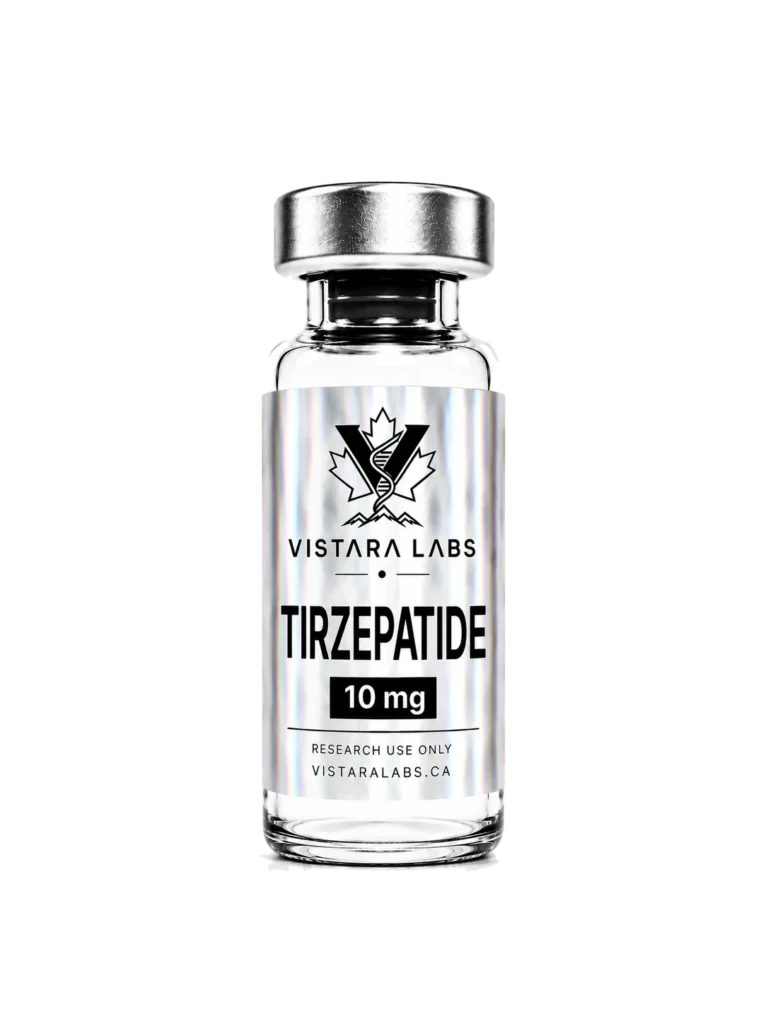
| Forms we supply | 10 mg vial, nasal spray, blends | 10 mg vial, nasal spray, blends |
Which one fits which research question?
- Gut lining and ulcer healing: BPC-157, which began as an anti-ulcer peptide.
- Tendon and ligament repair with a vascular angle: BPC-157, for its VEGFR2 and tendon fibroblast work; TB-500 where load to failure is the endpoint, given the 2026 Achilles result.
- Skin wound closure, keratinocyte and endothelial migration: TB-500, whose parent protein has the dermal wound and venous ulcer data.
Can BPC-157 and TB-500 be studied together?
Yes, and they often are. The rationale is two routes to repair: vessel signalling for BPC-157, actin-driven cell movement for TB-500. The knee-pain review included four patients who received BPC-157 with thymosin beta-4, three of whom improved (Lee and Padgett, 2021), and the 2026 rat study found both combined matched, rather than exceeded, either alone.
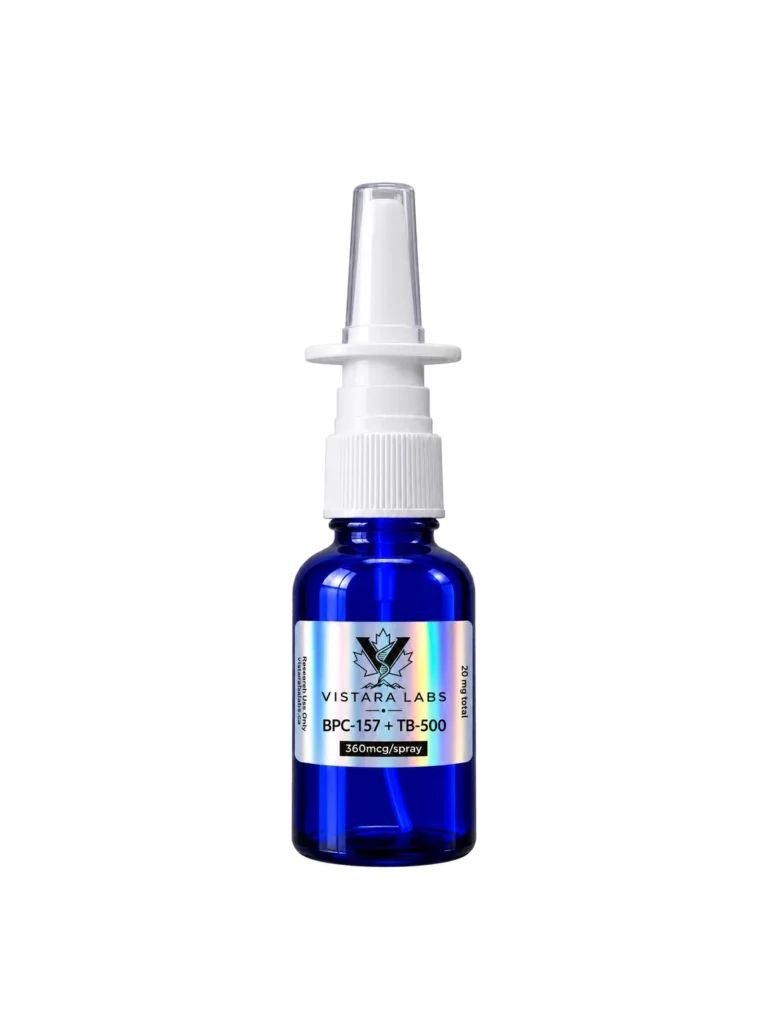
The pairing is known as the Wolverine stack, explained in The Wolverine Stack: BPC-157 + TB-500. Whether to use the pre-mixed blend or two vials is covered in BPC-157 + TB-500: blend or separate vials?. Both peptides also sit in GLOW and KLOW, and other combinations are on the stacks page.
How are BPC-157 and TB-500 supplied?
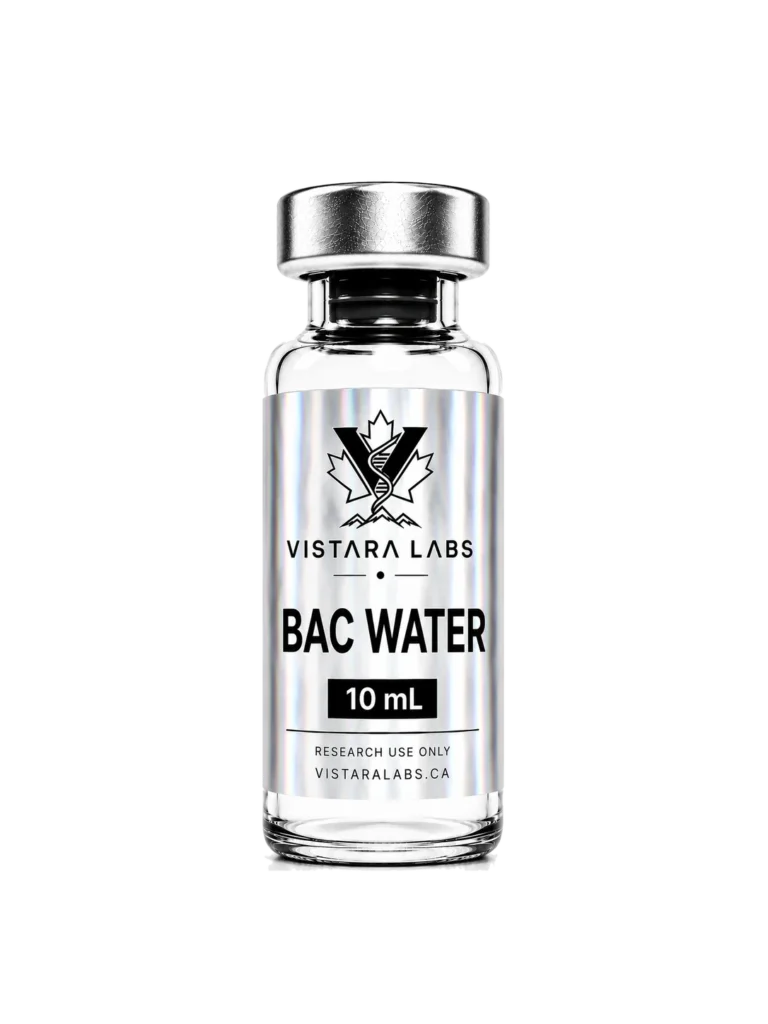
Each comes as a 10 mg lyophilised vial and as a ready-mixed nasal spray, the BPC-157 Nasal Spray and the TB-500 Nasal Spray, with a metered 0.175 mL per press. The pairing comes as the blend vial and the BPC-157 + TB-500 Nasal Spray. Vials are reconstituted with bacteriostatic water (see the BPC-157 reconstitution guide); storage windows are in how long BPC-157 lasts and how long TB-500 lasts. Certificates of analysis are on the lab reports page, and every order ships from within Canada.
BPC-157 and TB-500 are supplied for laboratory research use only. The human studies above used clinical or pharmaceutical preparations under medical supervision.
Frequently asked questions
What is the difference between BPC-157 and TB-500?
BPC-157 is a 15-amino-acid partial sequence of a protein from human gastric juice, studied for gut, tendon and blood vessel repair through VEGFR2 and nitric oxide signalling. TB-500 is a synthetic seven-amino-acid peptide copying the actin-binding region of thymosin beta-4, studied for cell migration and wound closure.
Is TB-500 stronger than BPC-157?
No study has measured potency on a common scale. In the one head-to-head study, a 2026 rat Achilles model, both improved tendon structure, and only the TB-500 group reached a statistically significant gain in load to failure at four weeks.
Can BPC-157 and TB-500 be studied together?
Yes. They work through different pathways, which is the rationale for the Wolverine stack. In the 2026 rat study the combination improved tendon scores but did not add to either peptide alone. Vistara Labs supplies a BPC-157 + TB-500 blend as a vial and as a nasal spray.
Is TB-500 the same as thymosin beta-4?
Not exactly. Thymosin beta-4 is a natural 43-amino-acid protein. Doping-control laboratories identified the key ingredient of TB-500 as Ac-LKKTETQ, the acetylated 17 to 23 fragment of that protein. Some papers use the name TB-500 for synthetic full-length thymosin beta-4.
Where can I buy BPC-157 and TB-500 in Canada?
Vistara Labs supplies both as 10 mg lyophilised vials, ready-mixed nasal sprays and a combined blend, with certificates of analysis on the lab reports page, shipped from within Canada by Canada Post Xpresspost.
Product details from vistaralabs.ca, October 2026. Sources: Chang CH et al. The promoting effect of pentadecapeptide BPC 157 on tendon healing involves tendon outgrowth, cell survival, and cell migration. J Appl Physiol. 2011. PMID 21030672. Sikiric P et al. Focus on ulcerative colitis: stable gastric pentadecapeptide BPC 157. Curr Med Chem. 2012. PMID 22300085. Hsieh MJ et al. Therapeutic potential of pro-angiogenic BPC157 is associated with VEGFR2 activation and up-regulation. J Mol Med. 2017. PMID 27847966. Lee E, Padgett B. Intra-articular injection of BPC 157 for multiple types of knee pain. Altern Ther Health Med. 2021. PMID 34324435. Lee E et al. Effect of BPC-157 on symptoms in patients with interstitial cystitis: a pilot study. Altern Ther Health Med. 2024. PMID 39325560. Lee E, Burgess K. Safety of intravenous infusion of BPC157 in humans: a pilot study. Altern Ther Health Med. 2025. PMID 40131143. Poolton JT et al. Human evidence for BPC-157 in orthopaedic and regenerative medicine: a systematic review of efficacy and safety. Acta Orthop Belg. 2026. PMID 42885452. Low TL et al. Complete amino acid sequence of bovine thymosin beta 4. Proc Natl Acad Sci U S A. 1981. PMID 6940133. Safer D et al. Thymosin beta 4 and Fx, an actin-sequestering peptide, are indistinguishable. J Biol Chem. 1991. PMID 1999398. Esposito S et al. Synthesis and characterization of the N-terminal acetylated 17-23 fragment of thymosin beta 4 identified in TB-500. Drug Test Anal. 2012. PMID 22962027. Ho EN et al. Doping control analysis of TB-500, a synthetic version of an active region of thymosin beta 4, in equine urine and plasma. J Chromatogr A. 2012. PMID 23084823. Philp D et al. The actin binding site on thymosin beta4 promotes angiogenesis. FASEB J. 2003. PMID 14500546. Malinda KM et al. Thymosin beta4 accelerates wound healing. J Invest Dermatol. 1999. PMID 10469335. Ruff D et al. A randomized, placebo-controlled, single and multiple dose study of intravenous thymosin beta4 in healthy volunteers. Ann N Y Acad Sci. 2010. PMID 20536472. Guarnera G et al. The effect of thymosin treatment of venous ulcers. Ann N Y Acad Sci. 2010. PMID 20536470. Treadwell T et al. The regenerative peptide thymosin beta4 accelerates the rate of dermal healing in preclinical animal models and in patients. Ann N Y Acad Sci. 2012. PMID 23050815. Biçer O et al. Effects of BPC-157 and TB-500 on Achilles tendon healing in rats: a histopathological and biomechanical study. Jt Dis Relat Surg. 2026. PMID 42542926.
More on this: Peptides for Injury Recovery: What the Research Shows.
All products supplied by Vistara Labs are intended for laboratory research use only. They are not drugs, are not approved for human or veterinary use, and are not intended to diagnose, treat, cure or prevent any condition. Nothing on this page constitutes medical advice or guidance for use in humans.