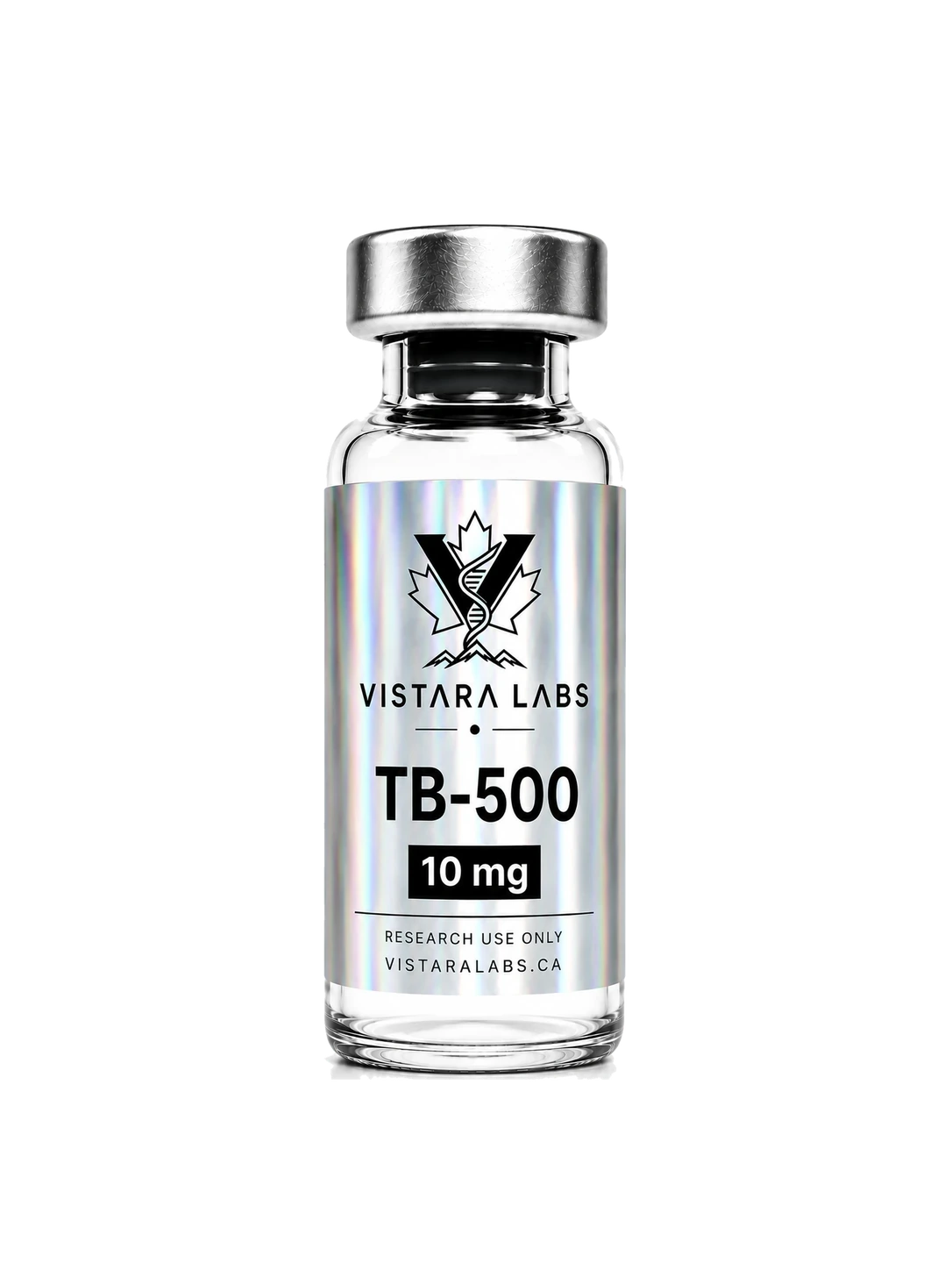
TB-500 Side Effects: What the Research Reports
The human safety data behind TB-500 come from clinical trials of thymosin beta-4, the natural protein it is derived from, and across those trials adverse events were infrequent, mild to moderate, and similar to placebo, with no dose-limiting toxicity. In a 2010 study, 40 healthy volunteers received intravenous thymosin beta-4 daily for 14 days with no serious adverse events. TB-500 itself has not been tested in a published human trial. This guide sets out what the thymosin beta-4 studies recorded, how TB-500 relates to them, and how TB-500 and the ready-mixed TB-500 Nasal Spray fit a laboratory research setting.
Findings
- In a placebo-controlled phase 1 study in 40 healthy adults, intravenous thymosin beta-4 given once and then daily for 14 days was well tolerated, with no dose-limiting toxicities or serious adverse events (Ruff et al., 2010).
- A 2021 phase 1 study of recombinant thymosin beta-4 in 84 healthy adults found all events mild to moderate, at rates similar to or lower than placebo.
- In a phase 2 trial of eye drops in 72 people with dry eye, no adverse events were reported by any participant (Sosne and Ousler, 2015).
- In 73 patients with venous leg ulcers, topical thymosin beta-4 had a safety profile comparable to placebo (Guarnera et al., 2010).
 View product →
What is TB-500, and why are the human data from thymosin beta-4?
Thymosin beta-4 is a naturally occurring 43-amino-acid protein released by platelets at sites of injury, where it supports cell migration, new blood-vessel growth and tissue repair (Treadwell et al., Ann N Y Acad Sci, 2012). TB-500 is the name used for a synthetic peptide based on it: a 2012 analysis of a product sold as TB-500 identified the acetylated 17-23 fragment of thymosin beta-4, a seven-amino-acid stretch of the full protein (Esposito et al., Drug Test Anal, 2012). Clinical development has used full-length thymosin beta-4, so those trials are the closest human evidence. The relationship is explained in What Is TB-500? and TB-500 vs Thymosin Beta-4.
What did the human studies report?
Intravenous safety in healthy volunteers, 2010
The first systemic safety study gave synthetic thymosin beta-4 or placebo to four cohorts of 10 healthy adults, at four ascending dose levels, first as a single infusion and then daily for 14 days. Adverse events were infrequent and mild or moderate, there were no dose-limiting toxicities or serious adverse events, and the authors concluded it was well tolerated across the full range tested (Ruff et al., Ann N Y Acad Sci, 2010).
Recombinant thymosin beta-4, 2021
A first-in-human study in China tested a recombinant version in 54 healthy adults as single infusions and in 30 adults as daily infusions for 10 days. In the single-dose part, 56.8% of active participants and 70% of placebo participants had an adverse event; in the repeat-dose part, 66.7% and 83.3%. Most events were laboratory findings such as blood chemistry, urine or ECG variations, all were mild to moderate, most resolved on their own, and there were no serious adverse events. A mild, temporary rise in one tumour marker (SCC antigen) was seen in both active and placebo groups, and one participant in each of the active and placebo arms withdrew because of an abnormal ECG (Wang et al., J Cell Mol Med, 2021).
Wound and skin trials
In a double-blind, placebo-controlled phase 2 trial at eight European sites, 73 patients with venous leg ulcers had thymosin beta-4 applied topically to the wound. The safety profile at all doses was acceptable and comparable to placebo, and the data suggested faster healing in some patients (Guarnera et al., Ann N Y Acad Sci, 2010). Across two phase 2 trials in venous and pressure ulcers, it shortened healing time by almost a month in patients who healed (Treadwell et al., 2012).
Eye trials
Thymosin beta-4 eye drops (RGN-259) have been tested in several controlled trials. In a phase 2 trial of 72 people with moderate to severe dry eye, no adverse events were reported by any participant over 28 days (Sosne and Ousler, Clin Ophthalmol, 2015). A smaller trial in severe dry eye found the drops safe and well tolerated, with less discomfort and better corneal staining scores (Sosne et al., Cornea, 2015). In a phase 3 trial in neurotrophic keratopathy, a slow-healing corneal condition, 6 of 10 treated participants healed fully at four weeks against 1 of 8 on placebo, and no significant adverse effects were observed (Sosne et al., Int J Mol Sci, 2022).
Combined use with BPC-157
In a 2021 chart review of 16 knee-pain patients, four received BPC-157 together with thymosin beta-4, and reviewers summarising the human BPC-157 studies noted that no adverse effects were reported (McGuire et al., Curr Rev Musculoskelet Med, 2025). That study is analysed in BPC-157 and TB-500 for Knee Pain, and the two compounds’ safety records sit side by side in BPC-157 Side Effects.
What does research show about longer-term use?
The longest systemic human exposure published is 14 days of daily infusions; the topical and eye-drop trials ran for weeks to a few months. Within those windows no serious safety signal emerged. The question researchers raise is biological rather than clinical: because thymosin beta-4 promotes cell migration and blood-vessel growth, which is central to its repair research, laboratory and animal studies have also examined its role in tumour cell migration (Sribenja et al., Cancer Invest, 2013). None of the human studies above reported such an effect. Elimination is quick: in the 2021 study, the half-life after an intravenous dose was about 0.5-2 hours, with no accumulation after repeated dosing; see TB-500 Half-Life.
Why research-grade quality and storage matter
Products sold as TB-500 can differ in which sequence they contain, which is why verified identity and purity matter when comparing laboratory results with the thymosin beta-4 literature. Vistara Labs supplies TB-500 as a lyophilised vial and as a ready-mixed metered nasal spray. Every product is third-party tested, with certificates on the lab reports page. Mixing is covered in the TB-500 reconstitution guide and stability in How Long Does TB-500 Last?
TB-500 is supplied by Vistara Labs for laboratory research use only. The human studies above tested thymosin beta-4 in clinical research carried out under medical supervision.
Frequently asked questions
What side effects has TB-500 research reported?
The human data come from trials of thymosin beta-4. Intravenous, topical and eye-drop studies reported infrequent, mild to moderate events at rates similar to placebo, with no dose-limiting toxicities or serious adverse events in the healthy-volunteer studies.
Has TB-500 been tested in humans?
TB-500 itself has not been tested in a published human trial. The clinical research used full-length thymosin beta-4, the 43-amino-acid protein that TB-500 is derived from.
What did the thymosin beta-4 safety study in healthy volunteers show?
In a 2010 placebo-controlled study, 40 healthy adults received intravenous thymosin beta-4 once and then daily for 14 days. Adverse events were infrequent and mild or moderate, with no dose-limiting toxicities or serious adverse events.
What did the thymosin beta-4 eye-drop trials show?
In a phase 2 trial of 72 people with dry eye, no adverse events were reported. In a phase 3 trial in neurotrophic keratopathy, 6 of 10 treated participants healed fully at four weeks, with no significant adverse effects.
Where can I buy TB-500 in Canada?
Vistara Labs supplies TB-500 as a lyophilised vial and a ready-mixed nasal spray, third-party tested and shipped from within Canada by Canada Post Xpresspost.
Product details from vistaralabs.ca, October 2026. Sources: Ruff D et al. A randomized, placebo-controlled, single and multiple dose study of intravenous thymosin beta4 in healthy volunteers. Ann N Y Acad Sci. 2010. PMID 20536472. Wang X et al. A first-in-human, randomized, double-blind, single- and multiple-dose, phase I study of recombinant human thymosin beta4 in healthy Chinese volunteers. J Cell Mol Med. 2021. PMID 34346165. Guarnera G et al. The effect of thymosin treatment of venous ulcers. Ann N Y Acad Sci. 2010. PMID 20536470. Treadwell T et al. The regenerative peptide thymosin beta4 accelerates the rate of dermal healing in preclinical animal models and in patients. Ann N Y Acad Sci. 2012. PMID 23050815. Sosne G, Ousler GW. Thymosin beta 4 ophthalmic solution for dry eye: a randomized, placebo-controlled, phase II clinical trial. Clin Ophthalmol. 2015. PMID 26056426. Sosne G et al. Thymosin beta4 significantly improves signs and symptoms of severe dry eye in a phase 2 randomized trial. Cornea. 2015. PMID 25826322. Sosne G et al. 0.1% RGN-259 (thymosin beta4) ophthalmic solution promotes healing and improves comfort in neurotrophic keratopathy patients. Int J Mol Sci. 2022. PMID 36613994. Esposito S et al. Synthesis and characterization of the N-terminal acetylated 17-23 fragment of thymosin beta 4 identified in TB-500. Drug Test Anal. 2012. PMID 22962027. McGuire FP et al. Regeneration or risk? A narrative review of BPC-157 for musculoskeletal healing. Curr Rev Musculoskelet Med. 2025. PMID 40789979. Sribenja S et al. Roles and mechanisms of beta-thymosins in cell migration and cancer metastasis: an update. Cancer Invest. 2013. PMID 23320791.
More on this: TB-500 and Thymosin Beta-4: The Repair Research.
All products supplied by Vistara Labs are intended for laboratory research use only. They are not drugs, are not approved for human or veterinary use, and are not intended to diagnose, treat, cure or prevent any condition. Nothing on this page constitutes medical advice or guidance for use in humans.
References
TB-500 and thymosin β4 are not the same molecule. TB-500 is a thymosin β4-derived fragment (Ac-LKKTETQ); the human trials below studied full-length thymosin β4 and are related research rather than trials of TB-500 itself.
- Synthesis and characterization of the N-terminal acetylated 17-23 fragment of thymosin beta 4 identified in TB-500, a product suspected to possess doping potentialAnalytical chemistry: characterises TB-500 as the N-terminally acetylated 17-23 fragment of thymosin β4 (Ac-LKKTETQ), not the intact 43-amino-acid protein.
- A first-in-human, randomized, double-blind, single- and multiple-dose, phase I study of recombinant human thymosin β4 in healthy Chinese volunteersFirst-in-human randomised, double-blind phase 1; 54 single-dose and 30 multiple-dose subjects; recombinant human thymosin β4.
- The effect of thymosin treatment of venous ulcersRandomised, double-blind, placebo-controlled phase 2 trial; 73 patients, eight European centres; topical full-length thymosin β4.
- Thymosin beta 4 ophthalmic solution for dry eye: a randomized, placebo-controlled, Phase II clinical trial conducted using the controlled adverse environment (CAE™) modelRandomised, double-masked, placebo-controlled phase 2 trial; 72 subjects; thymosin β4 ophthalmic solution.
- Thymosin β4 significantly improves signs and symptoms of severe dry eye in a phase 2 randomized trialRandomised phase 2 trial in severe dry eye; 9 patients.
Links open the study record on PubMed so the source can be checked directly. Listing a study is not a claim that its findings apply to any other use, product or route of administration. Research use only.