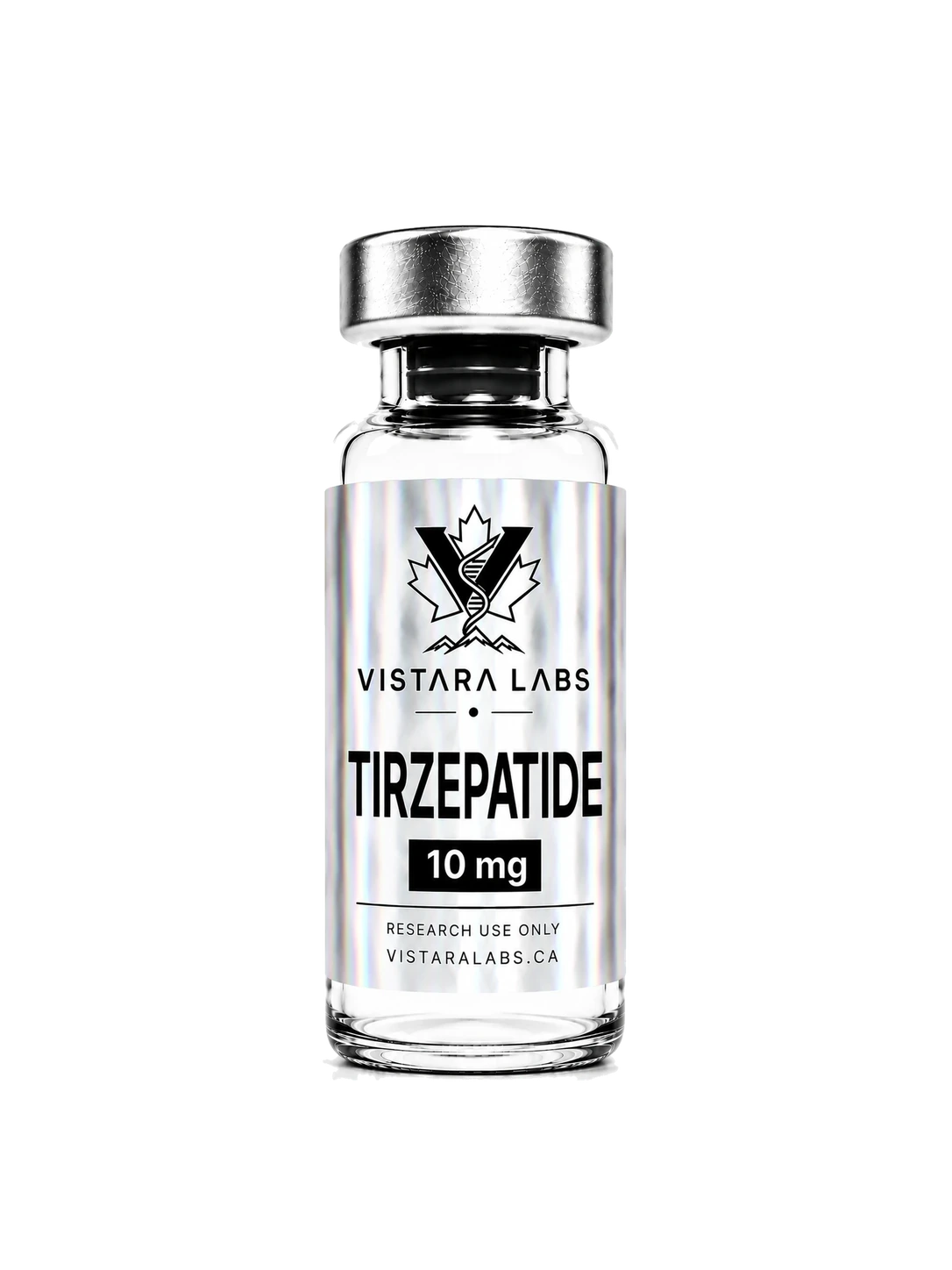
Tirzepatide Half-Life: How Long It Stays Active
Weight Loss & Metabolism Research
Tirzepatide has an elimination half-life of approximately 5 days in humans after subcutaneous injection, according to its 2022 FDA prescribing information, and a mean of 116.7 hours in healthy volunteers in its first published human study (Coskun et al., Mol Metab, 2018). That is roughly a thousand times longer than the 7.3-minute half-life of intact native GIP, the hormone it is built on. The reason is a C20 fatty acid chain that binds albumin, the main protein in blood. This guide explains the numbers, how tirzepatide compares with native hormones and semaglutide, and how half-life differs from how long a vial keeps.
Findings
- The FDA label gives an elimination half-life of approximately 5 days, a clearance of 0.061 L per hour and a volume of distribution of about 10.3 L after subcutaneous injection (2022).
- In a single-dose study in 56 healthy volunteers, mean half-life was 116.7 hours, with peak levels 24-48 hours after injection (Mol Metab, 2018).
- Tirzepatide is 99% bound to plasma albumin, through a C20 fatty diacid attached at lysine 20; the label states this binding prolongs the half-life.
- Absolute bioavailability after subcutaneous injection is 80%, with similar exposure from abdomen, thigh and upper arm.
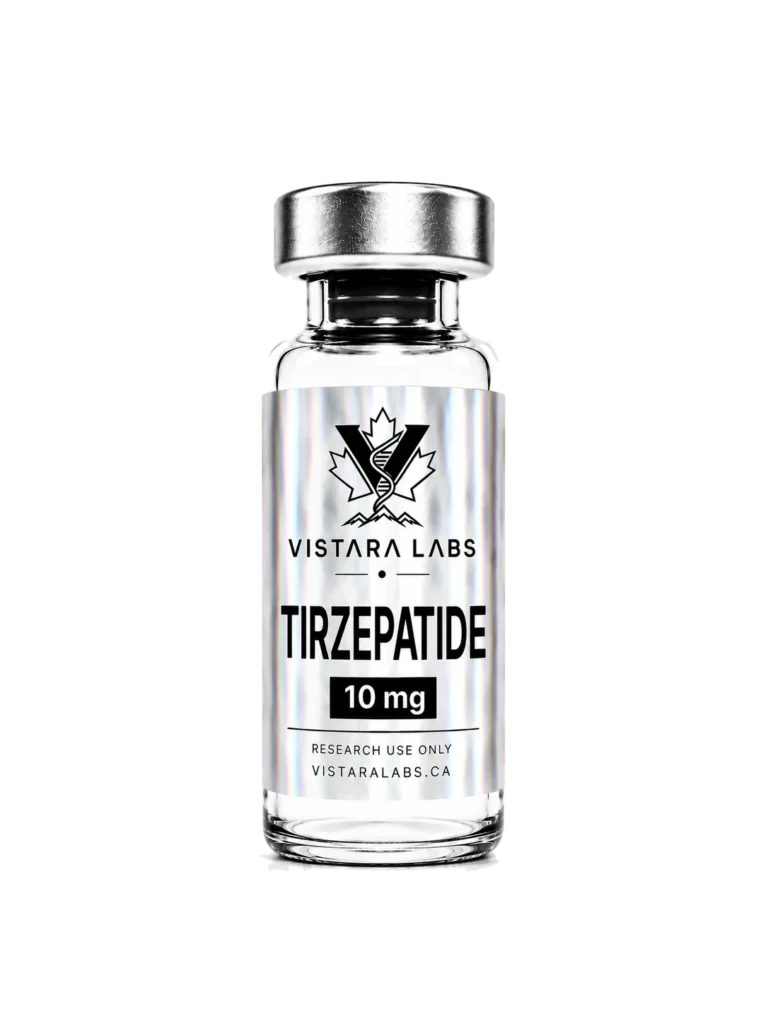 View product →
What is tirzepatide?
Tirzepatide is a 39-amino-acid modified peptide based on the sequence of GIP (glucose-dependent insulinotropic polypeptide), one of the two main incretin hormones the gut releases after a meal. It activates both the GIP and GLP-1 receptors. Its structure includes two non-coded amino acids (aminoisobutyric acid, Aib) at positions 2 and 13, a C-terminal amide, and a lysine at position 20 attached through a linker to 1,20-eicosanedioic acid, a 20-carbon fatty diacid. Its molecular weight is 4813.53 Da (FDA label, 2022). The human trials are summarised in Tirzepatide trials: weight and diabetes.
What does half-life mean?
Half-life is the time it takes for the concentration of a compound in the blood to fall by half. With a half-life of about 5 days, roughly half of a peak remains after 5 days and a quarter after 10. By simple arithmetic, five half-lives (about 25 days) take levels to around 3% of the starting point. Half-life is specific to a route and species, and the figures here are for subcutaneous injection in humans.
The full pharmacokinetic picture
The 2022 FDA prescribing information gives this human profile for subcutaneous tirzepatide:
- Absorption: time to peak concentration 8-72 hours; mean absolute bioavailability 80%; similar exposure from abdomen, thigh or upper arm.
- Distribution: apparent volume of distribution about 10.3 L; 99% bound to plasma albumin.
- Elimination: clearance 0.061 L per hour; elimination half-life approximately 5 days.
- Metabolism: proteolytic cleavage of the peptide backbone, beta-oxidation of the C20 fatty diacid, and amide hydrolysis.
- Excretion: metabolites leave through urine and faeces; intact tirzepatide is not found in either.
The label also reports that pharmacokinetics are similar in healthy people and people with type 2 diabetes, that exposure rises in proportion to the amount given, that steady-state concentrations were reached after four weeks of repeated administration, and that age, sex, race, ethnicity and body weight had no clinically relevant effect.
The first published human data agree. In single-dose studies in 56 healthy volunteers, maximum concentrations occurred 24-48 hours after dosing, mean half-life was approximately 5 days (116.7 hours), steady-state clearance and volume of distribution were 0.056 L per hour and 9.5 L, pharmacokinetics were proportional to dose, and variability between people was 30% or less (Coskun et al., Mol Metab, 2018).
Why is tirzepatide’s half-life so long?
Native incretins are short-lived. Intact GIP had a plasma half-life of 7.3 minutes in healthy people after intravenous infusion, and 5.2 minutes in people with type 2 diabetes, because the enzyme dipeptidyl peptidase IV (DPP-4) cuts it at the N-terminal end (Deacon et al., J Clin Endocrinol Metab, 2000). Native GLP-1 is similarly degraded from its N-terminus after both subcutaneous and intravenous administration (Deacon et al., Diabetes, 1995).
Tirzepatide’s fatty diacid changes that. The label states that the C20 moiety enables albumin binding and prolongs the half-life. In general terms, peptide bound to albumin, a large protein, is protected from quick clearance and released gradually, which keeps the molecule in circulation for days. The study authors describe the same acylation technology as the basis of its long duration in humans (Coskun et al., 2018).
How does tirzepatide compare with related compounds?
| Compound | Route and species | Published half-life |
|---|---|---|
| Native GIP (intact) | Intravenous, healthy humans | 7.3 minutes |
| Tirzepatide | Subcutaneous, humans | About 5 days |
| Semaglutide | Subcutaneous, humans | About 1 week |
Semaglutide also relies on albumin binding, through a modified lysine at position 26; its FDA label reports more than 99% albumin binding, 89% bioavailability and peak levels 1-3 days after injection (FDA label, 2017). The two are compared in Tirzepatide vs Semaglutide, and tirzepatide’s pairing with an amylin analogue in Cagrilintide vs Tirzepatide.
What does this mean for study design?
A half-life measured in days shapes research in several ways. Sampling needs to run over days and weeks, not hours, with peak concentrations expected between 8 and 72 hours. Because steady state took four weeks of repeated administration in the label’s studies, short studies capture a rising, not a stable, exposure. Washout periods between study phases need to cover several half-lives. And tirzepatide delays gastric emptying, most after the first exposure and less over time: in the label’s interaction study, the peak level of oral acetaminophen fell by 50% after the first exposure, with no meaningful effect by week 4. Designs that pair tirzepatide with oral compounds need to account for that.
Half-life in the body vs how long a vial keeps
A 5-day half-life describes the peptide in circulation. It says nothing about shelf life, which depends on temperature, light and handling. How long a lyophilised (freeze-dried) tirzepatide vial keeps before and after mixing is covered in How long does tirzepatide last? and How to store research peptides. Vials are reconstituted with bacteriostatic water (see the tirzepatide reconstitution guide), and certificates for every product are on the lab reports page.
Tirzepatide is supplied for laboratory research use only. The figures above come from clinical research using pharmaceutical preparations.
Frequently asked questions
What is the half-life of tirzepatide?
Its 2022 FDA prescribing information gives an elimination half-life of approximately 5 days after subcutaneous injection in humans. The first published human study reported a mean of 116.7 hours in healthy volunteers.
Why does tirzepatide last so much longer than natural GIP?
Tirzepatide carries a C20 fatty diacid that binds albumin, and 99% of it is albumin-bound in plasma. Intact native GIP, which DPP-4 cleaves, had a half-life of 7.3 minutes in healthy people.
How long does tirzepatide take to reach peak levels?
The FDA label gives a time to peak concentration of 8 to 72 hours after subcutaneous injection, and the first human study found peaks 24 to 48 hours after dosing.
How does tirzepatide’s half-life compare with semaglutide’s?
Tirzepatide’s is approximately 5 days and semaglutide’s approximately 1 week, according to their FDA labels. Both rely on albumin binding through a fatty acid chain.
Is half-life the same as how long tirzepatide lasts in the vial?
No. Half-life describes the peptide in the body. How long a vial keeps before and after mixing depends on storage temperature, light and handling, covered in the tirzepatide storage guide.
Sources: Tirzepatide injection, full prescribing information. US Food and Drug Administration, 2022. FDA label. Coskun T et al. A novel dual GIP and GLP-1 receptor agonist for the treatment of type 2 diabetes mellitus: from discovery to clinical proof of concept. Mol Metab. 2018. PMID 30473097. Deacon CF et al. Degradation of endogenous and exogenous gastric inhibitory polypeptide in healthy and in type 2 diabetic subjects as revealed using a new assay for the intact peptide. J Clin Endocrinol Metab. 2000. PMID 11061504. Deacon CF et al. Both subcutaneously and intravenously administered glucagon-like peptide I are rapidly degraded from the NH2-terminus in type II diabetic patients and in healthy subjects. Diabetes. 1995. PMID 7657039. Semaglutide injection, full prescribing information. US Food and Drug Administration, 2017. FDA label.
More on this: Tirzepatide in Canada: A Researcher’s Buying Guide and Tirzepatide Side Effects.
All products supplied by Vistara Labs are intended for laboratory research use only. They are not drugs, are not approved for human or veterinary use, and are not intended to diagnose, treat, cure or prevent any condition. Nothing on this page constitutes medical advice or guidance for use in humans.
References
Tirzepatide has one of the largest human trial programmes of any compound in this catalogue, including multiple phase 3 trials.
- Tirzepatide Once Weekly for the Treatment of ObesityRandomised phase 3 trial; 2,539 adults with overweight or obesity without diabetes, 72 weeks.
- Continued Treatment With Tirzepatide for Maintenance of Weight Reduction in Adults With ObesityRandomised phase 3 withdrawal trial; 670 participants randomised after a 36-week open-label phase.
- Tirzepatide for the Treatment of Obstructive Sleep Apnea and ObesityRandomised phase 3 trials in adults with obesity and moderate-to-severe obstructive sleep apnoea.
- Tirzepatide for Heart Failure with Preserved Ejection Fraction and ObesityRandomised phase 3 trial (SUMMIT); 731 patients with obesity-related heart failure with preserved ejection fraction.
- Tirzepatide, cardiovascular outcomes and mortality in obesity and diabetes: a systematic review and meta-analysisSystematic review and meta-analysis; 22 trials, 29,023 participants.
Links open the study record on PubMed so the source can be checked directly. Listing a study is not a claim that its findings apply to any other use, product or route of administration. Research use only.