What Is Melanotan II? The Melanocortin Peptide Explained
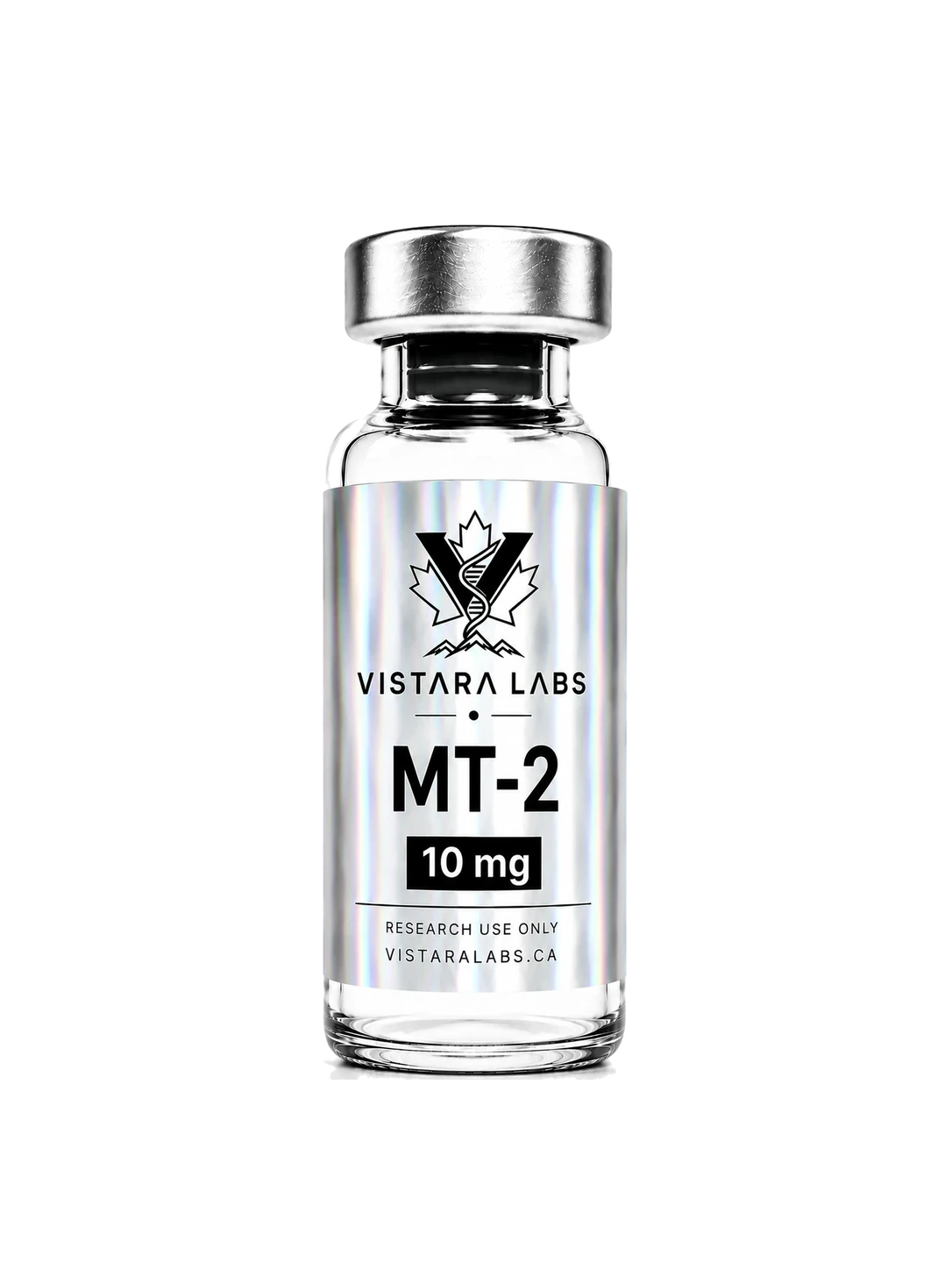
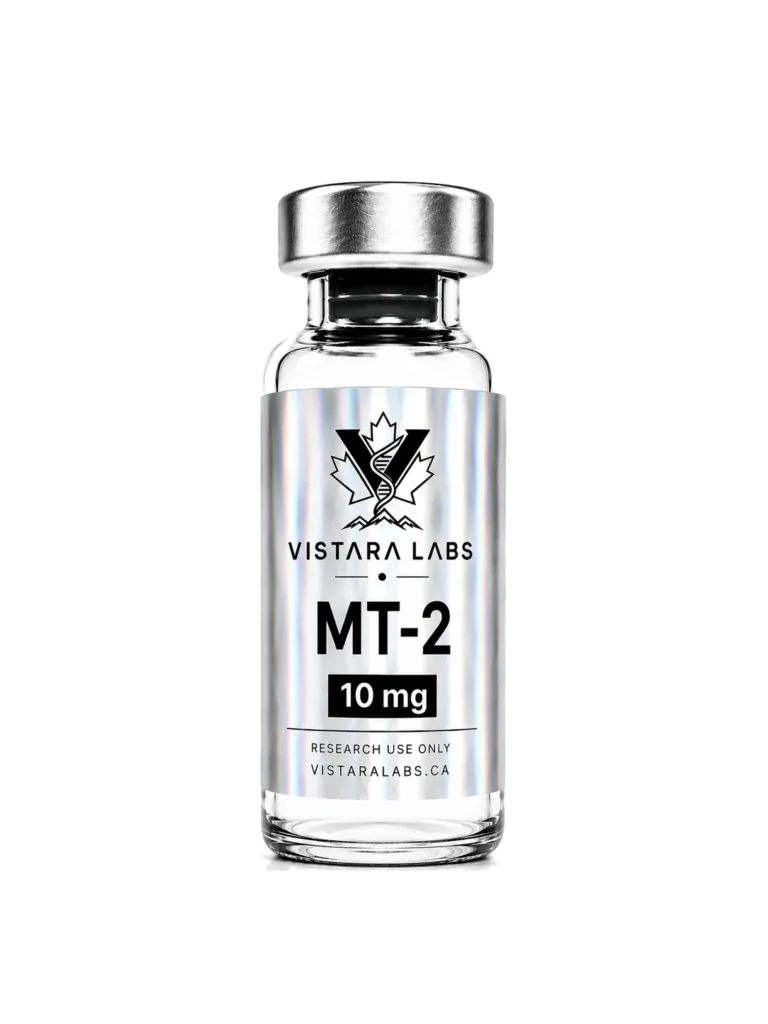
Melanotan II (MT-II) is a synthetic, ring-shaped peptide built from alpha-melanocyte-stimulating hormone (alpha-MSH), the body’s own signal for skin pigmentation, and it acts on the melanocortin receptor system that links pigment, appetite and sexual function. It was designed at the University of Arizona and tested in small human studies in the 1990s, which recorded both increased skin pigmentation and spontaneous erections, findings that later led to the approved drug bremelanotide (PT-141). Vistara Labs supplies it as a Melanotan II 10 mg lyophilised vial and a ready-mixed Melanotan II nasal spray.
Findings
- MT-II is a cyclic heptapeptide (seven amino acids closed into a ring by a lactam bridge) based on alpha-MSH, with the formula C50H69N15O9.
- In a 1996 pilot phase I study, two of three men showed increased pigmentation of the face, upper body and buttocks, measured by reflectance, after only five doses (1996).
- In a placebo-controlled crossover trial in 10 men with psychogenic erectile dysfunction, 8 of 10 developed erections, with a mean of 38.0 minutes of strong rigidity against 3.0 with placebo (1998).
- Across 20 men, sexual desire rose after 68% of MT-II doses against 19% of placebo doses (2000).
- Its close relative PT-141 (bremelanotide) went on to approval in the United States in 2019.
 View product →
What is Melanotan II?
Melanotan II is a laboratory-made analogue of alpha-MSH, a hormone cut from a larger precursor protein and best known for telling pigment cells (melanocytes) to make melanin. Its sequence is Ac-Nle-Asp-His-D-Phe-Arg-Trp-Lys-NH2, with the aspartic acid and lysine joined into a ring. The University of Arizona team that made it described it as a superpotent melanotropic peptide, meaning it is far more active at pigment-cell receptors than the natural hormone (Dorr et al., Life Sci, 1996).
Where it came from
The Arizona group, including Mac Hadley, Victor Hruby and Robert Dorr, set out to build melanocortin analogues that were more potent, longer acting and more resistant to enzymes than alpha-MSH. Two reached clinical testing: a linear peptide, melanotan I, studied for skin tanning, and the cyclic, shortened melanotan II, studied for male erectile dysfunction (Hadley and Dorr, Peptides, 2006). Melanotan I, under the name afamelanotide, later went through two randomised, placebo-controlled trials in erythropoietic protoporphyria, a rare light-sensitivity disorder (Langendonk et al., N Engl J Med, 2015), and is now an approved treatment for that condition (Wensink et al., Expert Rev Clin Pharmacol, 2021).
MT-II itself was never approved as a medicine. Among the alpha-MSH analogues, afamelanotide is the one approved for a skin condition, and dermatology reviews have collected case reports of changes in existing moles among people using unregulated melanotan products (Habbema et al., Int J Dermatol, 2017).
How Melanotan II works
The melanocortin system is a family of five receptors, numbered MC1R to MC5R, that respond to alpha-MSH and related hormones. MT-II is a non-selective agonist, which means it switches on several of these receptors rather than one (Wessells et al., Int J Impot Res, 2000). Three of them explain most of what the research recorded:
- MC1R, in the skin. On melanocytes, MC1R activation drives production of eumelanin, the brown-black pigment. The approved analogue afamelanotide works through this receptor and can activate eumelanin production without ultraviolet exposure (Wensink et al., 2021).
- MC3R and MC4R, in the brain. These receptors sit in the hypothalamus and are involved in feeding and sexual behaviour. In a landmark 1997 study, MT-II given into the brain reduced feeding in four different models of overeating in mice, and a melanocortin blocker cancelled the effect (Fan et al., Nature, 1997).
Because MT-II reaches all of these receptors, a single compound produces pigment, appetite and sexual-function signals at once. That breadth is what made it a useful research tool, and it is also why later drug development moved toward more targeted relatives.
What the research has shown
The human record for MT-II comes from a small number of University of Arizona studies in the 1990s, all controlled against saline placebo.
Skin pigmentation in humans
The first human study was a single-blind, placebo-controlled pilot phase I trial in three healthy men, with MT-II and saline given on alternating days for two weeks. One week after the last dose, two of the three had increased pigmentation in the face, upper body and buttocks, confirmed both by quantitative reflectance measurement and by eye. The authors concluded that MT-II has tanning activity in humans after only five low doses. The same study recorded mild nausea at most dose levels, a stretching and yawning response, and intermittent spontaneous erections lasting 1-5 hours (Dorr et al., 1996).
Erections and sexual desire
The erections seen in the pilot study led directly to a urology programme. In a double-blind, placebo-controlled crossover trial in 10 men with erectile dysfunction of no known physical cause, 8 of 10 developed clinically apparent erections with MT-II, monitored in real time over six hours. Strong rigidity (tip rigidity above 80%) lasted a mean of 38.0 minutes with MT-II and 3.0 minutes with placebo (Wessells et al., J Urol, 1998).
A second crossover trial enrolled 10 men whose erectile dysfunction had physical risk factors. MT-II initiated erections after 12 of 19 injections against 1 of 21 placebo doses, with 45.3 minutes of strong rigidity against 1.9 minutes, and sexual desire was significantly higher after MT-II (Wessells et al., Urology, 2000). Pooling both groups, the investigators reported erections in 17 of 20 men without any sexual stimulation, and increased desire after 68% of MT-II doses compared with 19% of placebo doses (Wessells et al., 2000).
Across these trials the recorded side effects were nausea, stretching and yawning, and reduced appetite, reported more often with MT-II than with placebo. In the 1998 trial none required treatment (Wessells et al., 1998).
From MT-II to PT-141
The finding that a melanocortin agonist acts in the brain to initiate erection and raise desire opened a new line of drug development. PT-141, or bremelanotide, was developed as an MT-II analogue (Hadley and Dorr, 2006). The two are almost identical: PubChem lists MT-II as C50H69N15O9 and bremelanotide as C50H68N14O10, the difference being a carboxylic acid at one end of bremelanotide where MT-II carries an amide. Bremelanotide was approved in the United States in 2019 for low sexual desire in premenopausal women (Dhillon and Keam, Drugs, 2019). The full story is on Melanotan II: The Clinical History and the PT-141 Connection and PT-141 vs Melanotan II.
Melanotan II at a glance
| Question | Answer |
|---|---|
| Type | Cyclic heptapeptide, alpha-MSH analogue |
| Origin | University of Arizona, 1990s |
| Receptors | Melanocortin receptors incl. MC1R, MC3R, MC4R |
| Human studies | Pigmentation (1996); erection and desire (1998, 2000) |
| Descendant | PT-141 (bremelanotide), approved 2019 |
Forms Vistara Labs stocks
Melanotan II comes in two formats. The 10 mg lyophilised vial is a freeze-dried powder for reconstitution; the concentration arithmetic is in how much bacteriostatic water for a Melanotan II 10 mg vial. The Melanotan II nasal spray is a ready-mixed metered spray, which suits research designs built around the intranasal route; it sits alongside the skin-research sprays in Skin Peptide Nasal Sprays in Canada. Both are third-party tested, with certificates on the lab reports page, and ordering details are in Buy Melanotan II in Canada.
Melanotan II is supplied by Vistara Labs for laboratory research use only. The human studies above are described as published facts, not as guidance.
Frequently asked questions
What is Melanotan II?
Melanotan II is a synthetic cyclic peptide of seven amino acids based on alpha-melanocyte-stimulating hormone. It was developed at the University of Arizona and acts on several melanocortin receptors, which are involved in skin pigmentation, appetite and sexual function.
What did the human research on Melanotan II show?
A 1996 pilot study found increased pigmentation of the face, upper body and buttocks in two of three men. Trials in 1998 and 2000 found erections in 17 of 20 men with erectile dysfunction and increased sexual desire after 68% of doses against 19% with placebo.
How does Melanotan II work?
It is a non-selective melanocortin receptor agonist. Activation of MC1R on pigment cells drives eumelanin production, while MC3R and MC4R in the brain are involved in feeding and sexual behaviour.
How is Melanotan II related to PT-141?
PT-141 (bremelanotide) was developed as an analogue of Melanotan II and differs from it at one end of the molecule, where it carries a carboxylic acid instead of an amide. Bremelanotide was approved in the United States in 2019.
What is the difference between Melanotan I and Melanotan II?
Melanotan I is a linear peptide that was studied for skin tanning and became the approved drug afamelanotide. Melanotan II is a shorter, ring-shaped peptide that was studied mainly for erectile dysfunction and sexual desire.
Product details from vistaralabs.ca, October 2026. Compound data from PubChem (CID 92432; bremelanotide CID 9941379). Sources: Dorr RT et al. Evaluation of melanotan-II, a superpotent cyclic melanotropic peptide in a pilot phase-I clinical study. Life Sci. 1996. PMID 8637402. Wessells H et al. Synthetic melanotropic peptide initiates erections in men with psychogenic erectile dysfunction. J Urol. 1998. PMID 9679884. Wessells H et al. Effect of an alpha-melanocyte stimulating hormone analog on penile erection and sexual desire in men with organic erectile dysfunction. Urology. 2000. PMID 11018622. Wessells H et al. Melanocortin receptor agonists, penile erection, and sexual motivation: human studies with Melanotan II. Int J Impot Res. 2000. PMID 11035391. Hadley ME, Dorr RT. Melanocortin peptide therapeutics: historical milestones, clinical studies and commercialization. Peptides. 2006. PMID 16412534. Fan W et al. Role of melanocortinergic neurons in feeding and the agouti obesity syndrome. Nature. 1997. PMID 8990120. Langendonk JG et al. Afamelanotide for erythropoietic protoporphyria. N Engl J Med. 2015. PMID 26132941. Wensink D et al. Afamelanotide for prevention of phototoxicity in erythropoietic protoporphyria. Expert Rev Clin Pharmacol. 2021. PMID 33507118. Habbema L et al. Risks of unregulated use of alpha-melanocyte-stimulating hormone analogues: a review. Int J Dermatol. 2017. PMID 28266027. Dhillon S, Keam SJ. Bremelanotide: first approval. Drugs. 2019. PMID 31429064.
More on this: What Is PT-141? Bremelanotide Explained.
All products supplied by Vistara Labs are intended for laboratory research use only. They are not drugs, are not approved for human or veterinary use, and are not intended to diagnose, treat, cure or prevent any condition. Nothing on this page constitutes medical advice or guidance for use in humans.
References
Melanotan II has direct human research from small controlled studies, centred on pigmentation and erectile function. Adverse effects including nausea were commonly reported.
- Evaluation of melanotan-II, a superpotent cyclic melanotropic peptide in a pilot phase-I clinical studyPlacebo-controlled pilot phase 1 study; measurable pigmentation after repeated low-dose exposure. Nausea, fatigue, yawning and spontaneous erections observed.
- Effect of an alpha-melanocyte stimulating hormone analog on penile erection and sexual desire in men with organic erectile dysfunctionRandomised, double-blind, placebo-controlled crossover trial; 10 men with organic erectile dysfunction. Nausea common and sometimes severe.
Links open the study record on PubMed so the source can be checked directly. Listing a study is not a claim that its findings apply to any other use, product or route of administration. Research use only.