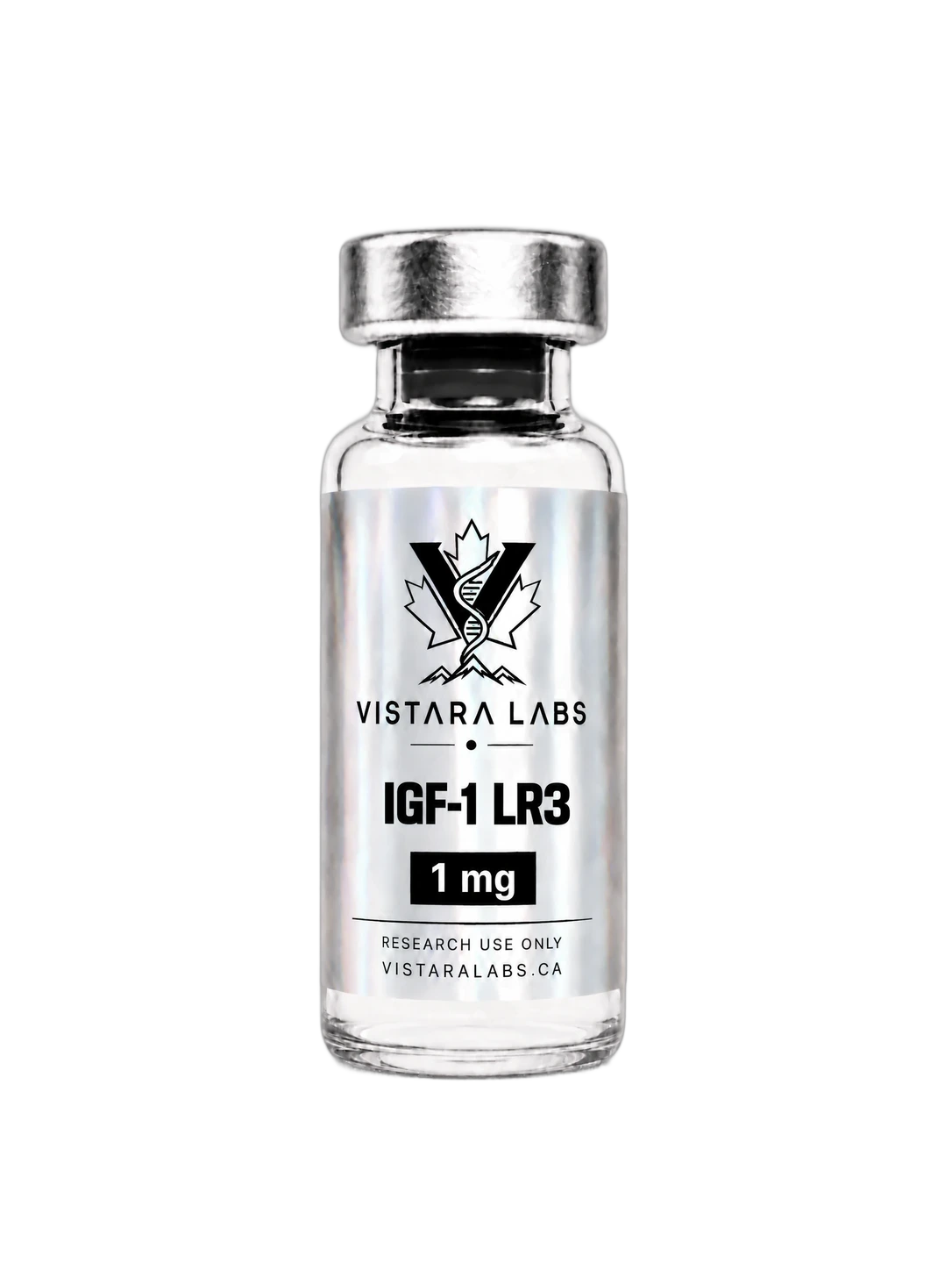
Buy IGF-1 LR3 in Canada: The 1 mg Long R3 IGF-1 Vial
Hormonal, Growth Hormone & Body Composition Research
You can buy IGF-1 LR3 in Canada from Vistara Labs as a 1 mg lyophilised vial, shipped from within Canada by Canada Post Xpresspost. IGF-1 LR3 (Long R3 IGF-1) is an 83-amino-acid analogue of insulin-like growth factor 1 with arginine in place of glutamic acid at position 3 and a 13-amino-acid extension on its N-terminal end, changes that sharply cut its binding to the IGF-binding proteins that normally hold IGF-1 in check. It was built in Adelaide, Australia, in the early 1990s and is still widely used as a growth factor in cell culture. This guide covers the vial, what the research found and how ordering works.
At a glance: Vistara Labs stocks IGF-1 LR3 as a 1 mg lyophilised vial. It is third-party tested, with certificates on our Lab Reports page, and ships from within Canada by Canada Post Xpresspost.
 View product →
Findings
- Binding proteins, 1993: native IGF-I bound IGF-binding proteins about 1,000-fold more strongly than LR3 IGF-I, which made LR3 5-10 times more potent in cultured muscle cells (Growth Regulation).
- Growth, 1993: over 14 days in growing rats, LR3 IGF-I was about 6-fold more potent than IGF-I for gains in body weight, nitrogen retention and food conversion efficiency.
- Muscle protein, 1993: in a diabetic model, IGF-I and its analogues raised muscle protein synthesis rates and RNA levels by up to 50% and restored growth (Biochemical Journal).
- Gut, 1995: three days of LR3 IGF-I increased small and large intestine weight by about 20% and lengthened ileal crypts by 22% (Gut).
- Cell culture, 2000: in serum-free Chinese hamster ovary cell lines making recombinant proteins, LR3 sustained viability better than insulin (Biotechnology Progress).
What is in the IGF-1 LR3 vial?
| Property | IGF-1 LR3 |
|---|---|
| Product | IGF-1 LR3, 1 mg lyophilised vial |
| Length | 83 amino acids |
| Changes from IGF-1 | Arg at position 3, 13-residue N-terminal extension |
| Other names | Long R3 IGF-1, LR3 IGF-I, LongR3 |
The vial holds freeze-dried powder that is reconstituted before laboratory use. The arithmetic for the 1 mg vial is on IGF-1 LR3 reconstitution, the general method is in how to reconstitute peptides, and the peptide calculator handles any other volume.
What is IGF-1 LR3?
Natural IGF-1 is a 70-amino-acid hormone made mainly in the liver in response to growth hormone. In blood, more than 80% of it travels in a large complex with IGF-binding protein 3 and a partner protein called the acid-labile subunit, which keeps it in circulation but limits how much reaches cells (FDA, Increlex prescribing information).
A team at the CSIRO and the University of Adelaide set out to make IGF-1 analogues that escape those binding proteins. They first showed that swapping the glutamic acid at position 3 for arginine (R3) left receptor activity largely intact while binding to IGF-binding protein 2 became very weak (King et al., J Mol Endocrinol, 1992). They then added an extension made of the first 11 amino acids of porcine growth hormone plus a Val-Asn linker. The extension helped the protein fold correctly during production, and the resulting “Long [Arg3]-IGF-I” was the most potent of the analogues tested in cells that secrete binding proteins (Francis et al., J Mol Endocrinol, 1992). That molecule is what is sold today as IGF-1 LR3.
The full story of how it works, including what the research showed about its clearance from blood, is in What Is IGF-1 LR3?
What has IGF-1 LR3 research shown?
The published work on IGF-1 LR3 to date is laboratory research: cell studies and animal models, much of it from the Adelaide group that designed it.
Potency in cells
In rat L6 myoblasts (muscle precursor cells), LR3 IGF-I was more potent than IGF-I at stimulating protein and DNA synthesis and at slowing protein breakdown (Francis et al., 1992). The reason is binding, not receptor strength: LR3 binds the IGF-1 receptor about 3-fold less well than IGF-I, yet comes out ahead because far less of it is captured by binding proteins (Tomas et al., Biochem J, 1992).
Growth and protein balance
- Catabolic model, 1992. In rats losing weight on the steroid dexamethasone, LR3 IGF-I was about 2.5-fold more potent than IGF-I at reversing weight loss, and the IGF peptides increased gut weight by up to 45% (Tomas et al., Biochem J, 1992).
- Normal growth, 1993. In growing female rats, LR3 IGF-I raised weight gain, nitrogen retention and food conversion efficiency while keeping body proportions at their starting balance (Tomas et al., J Endocrinol, 1993).
- Diabetic model, 1993. LR3 IGF-I was 2.5-3 times more potent than IGF-I at restoring growth, and the added weight was protein rather than fat (Tomas et al., Biochem J, 1993).
- Injection, 1996. LR3 kept its potency advantage for several effects when given by once-daily injection rather than continuous infusion (Tomas et al., J Endocrinol, 1996).
Gut and muscle
- Gut resection, 1994. After removal of 70% of the small bowel, IGF-I peptides significantly reduced malabsorption of fat and nitrogen, and LR3 was the more potent for weight gain (Lemmey et al., Growth Factors, 1994).
- Muscle injury, 2008. Four weeks of LR3 IGF-I made the limb and diaphragm muscles of a muscular dystrophy model less susceptible to contraction-induced damage (Gehrig et al., Exp Physiol, 2008).
Our growth hormone and body composition research notes cover the wider field.
Why cell-culture labs use it
Serum-free cell culture needs a growth factor to keep cells alive and productive, and insulin is the traditional choice. In a 2000 study at Immunex, two Chinese hamster ovary cell lines producing recombinant receptor proteins were run with insulin or LongR3; LongR3 sustained the viability of both lines better under production conditions, and the authors named it the preferred growth factor for those lines (Morris and Schmid, Biotechnol Prog, 2000).
Which compounds are studied alongside IGF-1 LR3?
IGF-1 sits at the bottom of the growth hormone axis: growth hormone from the pituitary drives IGF-1 production. Compounds we stock that work further up the same axis include Tesamorelin, a growth-hormone-releasing hormone analogue, and the CJC-1295 + Ipamorelin blend. How those secretagogues differ from growth hormone itself is set out in CJC-1295 + Ipamorelin vs HGH and Tesamorelin vs HGH. IGF-1 LR3 differs from all of them: it acts directly at the IGF-1 receptor rather than through the pituitary.
How should IGF-1 LR3 be stored?
The lyophilised powder is the stable form: keep unopened vials cold, dry and away from light. Once reconstituted, keep the vial in the fridge at 2 to 8 °C and label it with the date and concentration. Our guide to storing research peptides covers the detail.
Where to buy IGF-1 LR3 in Canada
- Ships from Canada. Every order ships from within Canada by Canada Post Xpresspost.
- Certificates. IGF-1 LR3 is third-party tested, with certificates published on our Lab Reports page.
- The full catalogue. See buying peptides in Canada.
Frequently asked questions
What is IGF-1 LR3?
IGF-1 LR3 (Long R3 IGF-1) is an 83-amino-acid analogue of insulin-like growth factor 1 with arginine at position 3 and a 13-amino-acid N-terminal extension. These changes greatly reduce its binding to IGF-binding proteins.
What did IGF-1 LR3 research show?
In laboratory studies, LR3 IGF-I was 5-10 times more potent than IGF-I in cultured muscle cells and about 6-fold more potent for growth in rats. It restored growth in diabetic and steroid-treated models and increased intestinal growth.
Why is IGF-1 LR3 more potent than IGF-1?
Native IGF-I binds IGF-binding proteins about 1,000-fold more strongly than LR3 IGF-I. With far less of it captured by those proteins, more LR3 is free to act at the IGF-1 receptor, even though it binds that receptor about 3-fold less strongly.
What is IGF-1 LR3 used for in cell culture?
It is used as a growth factor in serum-free cell culture. In a 2000 study of two Chinese hamster ovary cell lines making recombinant proteins, LongR3 sustained cell viability better than insulin.
Where can I buy IGF-1 LR3 in Canada?
Vistara Labs supplies IGF-1 LR3 as a 1 mg lyophilised vial, third-party tested and shipped from within Canada by Canada Post Xpresspost.
Product details from vistaralabs.ca, October 2026. Sources: King R, et al. J Mol Endocrinol. 1992. PMID 1311930. Francis GL, et al. J Mol Endocrinol. 1992. PMID 1378742. Tomas FM, et al. Biochem J. 1992. PMID 1371669. Ballard FJ, et al. Growth Regul. 1993. PMID 7683526. Tomas FM, et al. J Endocrinol. 1993. PMID 8371075. Tomas FM, et al. Biochem J. 1993. PMID 7683875. Lemmey AB, et al. Growth Factors. 1994. PMID 7803042. Steeb CB, et al. Gut. 1995. PMID 8549937. Tomas FM, et al. J Endocrinol. 1996. PMID 8708565. Morris AE, Schmid J. Biotechnol Prog. 2000. PMID 11027158. Gehrig SM, et al. Exp Physiol. 2008. PMID 18567600. Increlex (mecasermin) prescribing information. DailyMed.
More on this: What Is IGF-1 LR3? How the IGF-1 Analogue Works.
All products supplied by Vistara Labs are intended for laboratory research use only. They are not drugs, are not approved for human or veterinary use, and are not intended to diagnose, treat, cure or prevent any condition. Nothing on this page constitutes medical advice or guidance for use in humans.