Buy GLOW Blend in Canada
“GLOW” is a product name, not a compound. No standards body defines it and no monograph governs it, so the name on its own does not fix a formula. What matters is what is in the vial, and for the Vistara Labs GLOW Blend the full composition is listed on the product page, constituent by constituent.
 View product →
At a glance: Vistara Labs stocks the GLOW blend (GHK-Cu, BPC-157 and TB-500) in 70 mg vials and as a ready-mixed nasal spray, independently tested, with a certificate of analysis on our Lab Reports page, shipped from within Canada by Canada Post Xpresspost, with same-business-day dispatch on orders before 3 pm Pacific. We deliver to every province, including Ontario, Quebec, British Columbia and Alberta.
What GLOW normally contains
In its common form, GLOW is a lyophilised blend of three peptides that sit in overlapping areas of the repair and tissue literature:
- GHK-Cu: the copper tripeptide, studied around collagen and elastin, skin renewal and tissue remodelling. It is the reason the blend has the name it has.
- BPC-157: studied around inflammatory response and soft tissue repair across muscle, tendon, ligament and gut research.
- TB-500: associated with tissue regeneration, cell migration and new blood vessel formation.
The logic of the blend is that the three cover related pathways rather than the same one. That is also why it is bought as a blend instead of three separate vials.
The number that actually matters
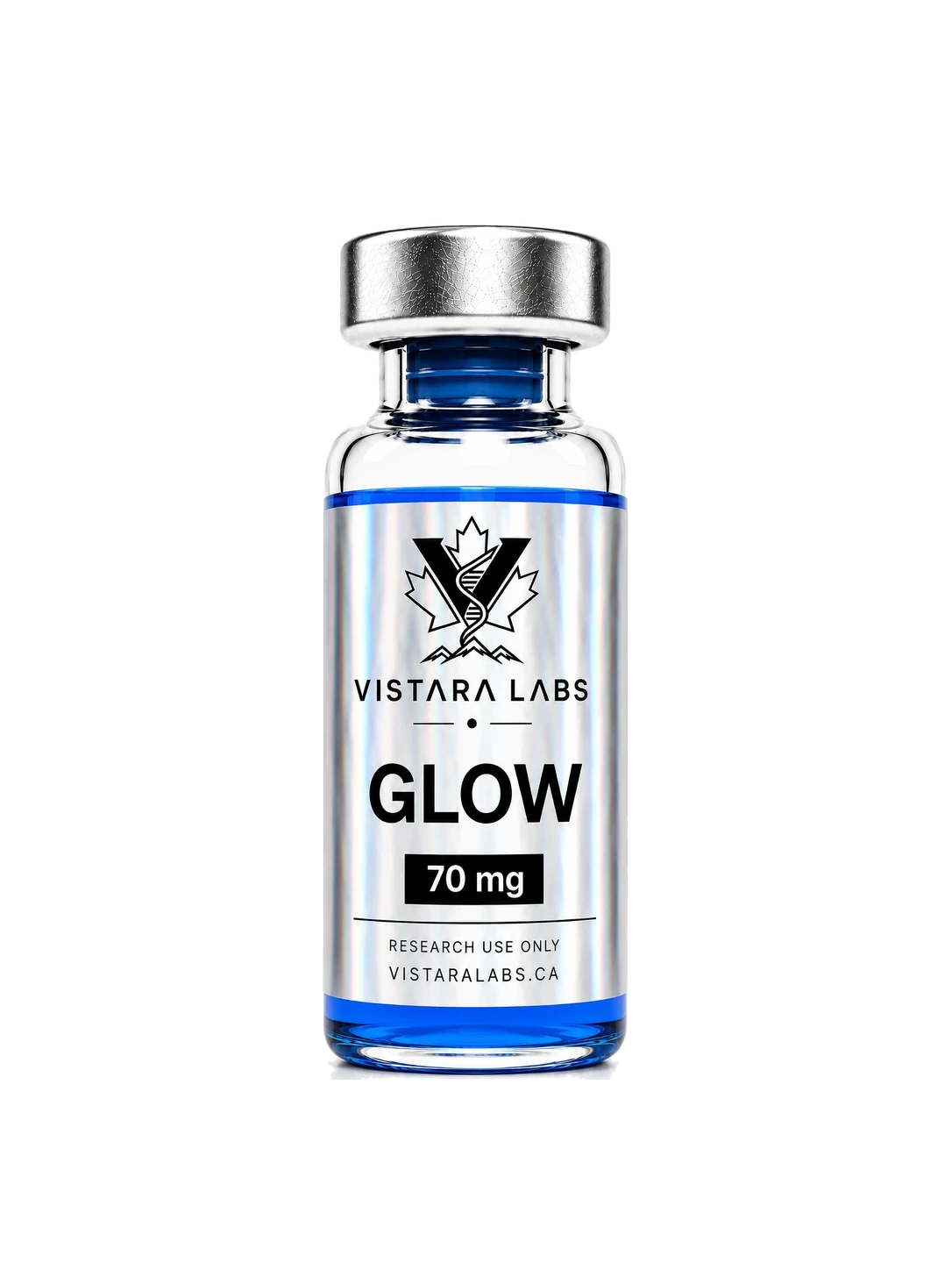
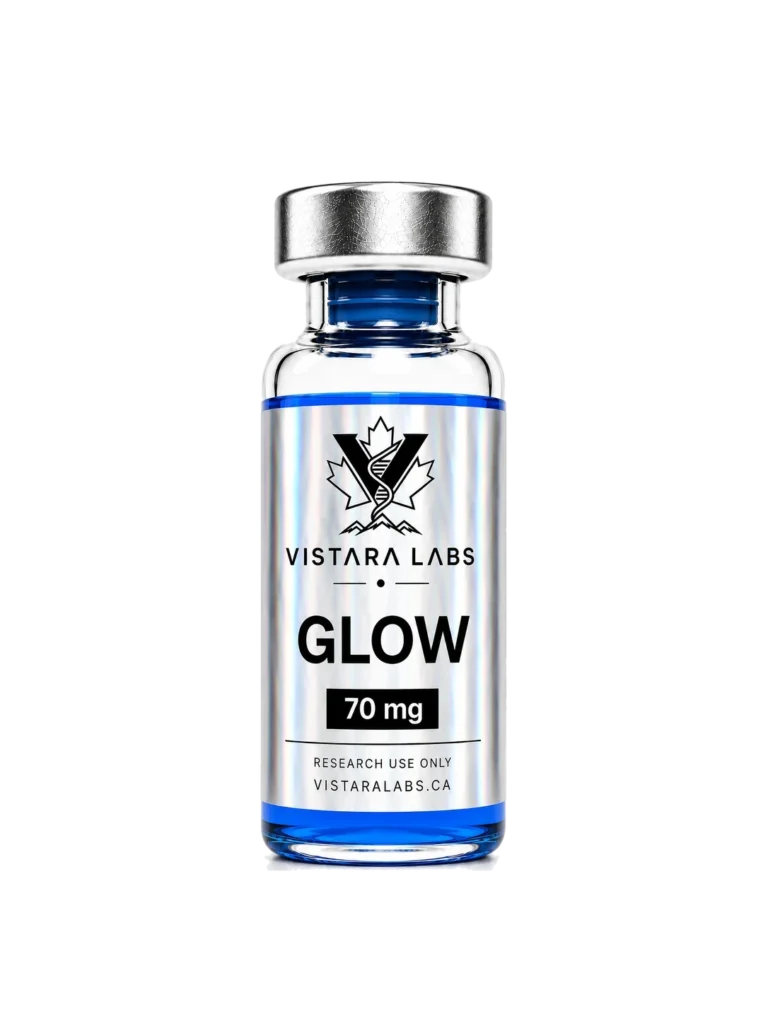
A blend is sold by its total mass. Vistara Labs’ GLOW Blend is a 70 mg vial: that is 70 mg of peptide across the three constituents, not 70 mg of each.
Inside those 70 mg the split is 50 mg GHK-Cu, 10 mg BPC-157 and 10 mg TB-500, so the copper peptide makes up most of the vial by mass. The product page lists each constituent with its own milligram figure alongside the total, so the composition is clear at a glance.
Buying it in Canada
None of these three peptides is approved for human use in Canada. They are supplied as research materials for laboratory use.
Lab reports. Certificates of analysis from independent laboratories are published for each compound on our lab reports page, with purity above 99 percent. GLOW Blend arrives as a single lyophilised vial and keeps well stored cold and dry until it is reconstituted.
Questions are welcome. If you would like more detail on the blend, its constituents or its storage, the team is glad to help through our contact page.
Ordering GLOW Blend from Vistara Labs
- GHK-Cu, BPC-157 and TB-500. All three peptides are named on the product page, with the milligrams of each.
- 70 mg per vial. The total is stated on the product page, and the blend is also offered as a pack of ten vials.
- A blue tint from the copper. GHK-Cu is a copper complex and copper peptides are blue, so the blend carries a blue tint rather than a bone-white cake. The colour comes from the copper itself, not from a dye.
- Tracked delivery to every province. Shipped orders travel with tracking, so you can follow the parcel to the door.
- Supplied for laboratory research. GLOW Blend is supplied strictly for laboratory use and is described here by its constituents.
GLOW or KLOW?
The other blend you will see alongside it is KLOW, which is the same three peptides with KPV added as a fourth. KPV is studied around inflammatory signalling, so KLOW is generally the one people look at when inflammation is the part of the picture they care about most. We have set the two side by side in KLOW vs GLOW.
Vistara Labs stocks GLOW Blend, as a lyophilised blend of GHK-Cu, BPC-157 and TB-500, shipped from within Canada to every province. If you would rather read up on the copper peptide on its own first, our GHK-Cu buying guide covers it.
Frequently asked questions
What is in GLOW peptide blend?
Ordinarily three peptides (GHK-Cu, BPC-157 and TB-500) supplied together as a single lyophilised vial. GLOW is a product name rather than a defined formulation, so we list the exact constituents on our product page.
Can you buy GLOW in Canada?
Yes, as a research material from Canadian research suppliers. It is not sold as a medicine in Canada and holds no approval for human use.
What does 70 mg mean on a GLOW vial?
It is the total peptide mass in the vial across all three constituents, not 70 mg of each. In our GLOW Blend the split is 50 mg GHK-Cu, 10 mg BPC-157 and 10 mg TB-500.
What is the difference between GLOW and KLOW?
KLOW is the same three peptides with KPV added as a fourth, giving it an additional inflammatory-signalling component.
Will a GLOW order be stopped at customs?
Every order ships from within Canada, so there is no customs step. Your GLOW Blend travels as an ordinary domestic parcel.
All products supplied by Vistara Labs are intended for laboratory research use only. They are not drugs, are not approved for human or veterinary use, and are not intended to diagnose, treat, cure or prevent any condition. Nothing on this page constitutes medical advice or guidance for use in humans.
References
No study of the GLOW blend as a complete formulation was identified. The references below cover its individual components.
- Enhanced healing of ulcers in patients with diabetes by topical treatment with glycyl-l-histidyl-l-lysine copperMulticentre randomised, evaluator-blinded, placebo-controlled trial; topical GHK-Cu in diabetic neuropathic ulcers.
- Intra-Articular Injection of BPC 157 for Multiple Types of Knee PainRetrospective chart review, 17 patients (16 followed up by telephone); no control group, no blinding, no validated outcome instrument.
- Synthesis and characterization of the N-terminal acetylated 17-23 fragment of thymosin beta 4 identified in TB-500, a product suspected to possess doping potentialAnalytical chemistry: characterises TB-500 as the N-terminally acetylated 17-23 fragment of thymosin β4 (Ac-LKKTETQ), not the intact 43-amino-acid protein.
- Emerging Use of BPC-157 in Orthopaedic Sports Medicine: A Systematic ReviewSystematic review; 544 records screened, 36 studies included — 35 preclinical and 1 clinical.
Links open the study record on PubMed so the source can be checked directly. Listing a study is not a claim that its findings apply to any other use, product or route of administration. Research use only.